In unit profile schedule it reads that the Residential school is 14-15 September however it should read it is on the 16-17 September.
In assessment tasks: Assessment 2 PART B has been changed to a Reflection. Details and marking rubric are found in the moodle site under Assessment 2.
Overview
Nutrition is vital for the care and husbandry of animals. With livestock, it is important to know how to feed animals adequately so that they grow and reproduce at rates which are economically sound so that an enterprise functions in a sustainable manner. This unit is designed to equip you with the practical application of nutritional principles in ruminant and monogastric production systems. Animal nutrition focuses on digestion, absorption, and metabolism of feed and how the different dietary nutrients are used to maintain life or assimilated into products. In order for a feed to be consumed and utilised by an animal, it has to be palatable, digestible, absorbable and metabolisable to be utilised into energy and structural components. You will develop an understanding of this series of events while covering a range of animals (ruminants and simple-stomached). This unit also covers the constituents of feed and the capacity of the different classes of feeds to supply the animal with nutrients to meet its requirements for maintenance, growth, and production, as well as various processing of feed so that it is safer, more palatable and more nutritious.
Details
Pre-requisites or Co-requisites
Completion of 48 credit points.
Important note: Students enrolled in a subsequent unit who failed their pre-requisite unit, should drop the subsequent unit before the census date or within 10 working days of Fail grade notification. Students who do not drop the unit in this timeframe cannot later drop the unit without academic and financial liability. See details in the Assessment Policy and Procedure (Higher Education Coursework).
Offerings For Term 2 - 2026
Attendance Requirements
All on-campus students are expected to attend scheduled classes - in some units, these classes are identified as a mandatory (pass/fail) component and attendance is compulsory. International students, on a student visa, must maintain a full time study load and meet both attendance and academic progress requirements in each study period (satisfactory attendance for International students is defined as maintaining at least an 80% attendance record).
Recommended Student Time Commitment
Each 6-credit Undergraduate unit at CQUniversity requires an overall time commitment of an average of 12.5 hours of study per week, making a total of 150 hours for the unit.
Class Timetable
Assessment Overview
Assessment Grading
This is a graded unit: your overall grade will be calculated from the marks or grades for each assessment task, based on the relative weightings shown in the table above. You must obtain an overall mark for the unit of at least 50%, or an overall grade of 'pass' in order to pass the unit. If any 'pass/fail' tasks are shown in the table above they must also be completed successfully ('pass' grade). You must also meet any minimum mark requirements specified for a particular assessment task, as detailed in the 'assessment task' section (note that in some instances, the minimum mark for a task may be greater than 50%). Consult the University's Grades and Results Policy for more details of interim results and final grades.
All University policies are available on the CQUniversity Policy site.
You may wish to view these policies:
- Grades and Results Policy
- Assessment Policy and Procedure (Higher Education Coursework)
- Review of Grade Procedure
- Student Academic Integrity Policy and Procedure
- Academic Progression Policy and Procedure
- Student Refund and Credit Balance Policy and Procedure
- Complaints Policy and Procedure
- Information and Communications Technology Acceptable Use Policy and Procedure
This list is not an exhaustive list of all University policies. The full list of University policies are available on the CQUniversity Policy site.
- Define the form and function of anatomical features of the digestive systems of different species of domestic animals
- Identify the general features of the different classes of feeds and the constituents of feeds
- Design, formulate and analyse diets from first principal using feed and animal requirement tables
- Communicate nutritional principles in the feeding of various animal species and articulate potential solutions to common nutritional problems.
Alignment of Assessment Tasks to Learning Outcomes
| Assessment Tasks | Learning Outcomes | |||
|---|---|---|---|---|
| 1 | 2 | 3 | 4 | |
| 1 - Online Quiz(zes) - 40% | ||||
| 2 - Written Assessment - 30% | ||||
| 3 - Written Assessment - 30% | ||||
Alignment of Graduate Attributes to Learning Outcomes
| Graduate Attributes | Learning Outcomes | |||
|---|---|---|---|---|
| 1 | 2 | 3 | 4 | |
| 1 - Communication | ||||
| 2 - Problem Solving | ||||
| 3 - Critical Thinking | ||||
| 4 - Information Literacy | ||||
| 5 - Team Work | ||||
| 6 - Information Technology Competence | ||||
| 7 - Cross Cultural Competence | ||||
| 8 - Ethical practice | ||||
| 9 - Social Innovation | ||||
| 10 - First Nations Knowledges | ||||
| 11 - Aboriginal and Torres Strait Islander Cultures | ||||
Textbooks
There are no required textbooks.
IT Resources
- CQUniversity Student Email
- Internet
- Unit Website (Moodle)
All submissions for this unit must use the referencing style: Harvard (author-date)
For further information, see the Assessment Tasks.
k.harper@cqu.edu.au
Week 1
Begin Date: 13 Jul 2026Module/Topic
Introduction to nutrition - digestive function
Chapter
Events and Submissions/Topic
Week 2
Begin Date: 20 Jul 2026Module/Topic
Water requirements and water sources
Chapter
Events and Submissions/Topic
Week 3
Begin Date: 27 Jul 2026Module/Topic
Limiting nutrients -energy
Chapter
Events and Submissions/Topic
Week 4
Begin Date: 03 Aug 2026Module/Topic
Limiting nutrients - protein
Chapter
Events and Submissions/Topic
Week 5
Begin Date: 10 Aug 2026Module/Topic
Limiting nutrients - minerals and vitamins
Chapter
Events and Submissions/Topic
Week 6
Begin Date: 17 Aug 2026Module/Topic
Food intake
Chapter
Events and Submissions/Topic
Assessment1 Quiz A (20%) Due date: Quiz closes Week 6 Friday 21 August, 2026 5.00 pm AEST.
Vacation Week
Begin Date: 24 Aug 2026Module/Topic
Chapter
Events and Submissions/Topic
Week 7
Begin Date: 31 Aug 2026Module/Topic
Applied nutrition - monogastrics 1
Chapter
Events and Submissions/Topic
Week 8
Begin Date: 07 Sep 2026Module/Topic
Applied nutrition - monogastrics 2
Chapter
Events and Submissions/Topic
Week 9
Begin Date: 14 Sep 2026Module/Topic
Applied nutrition - extensive grazers
Chapter
Events and Submissions/Topic
Residential school 14-15 September, 2026
Assessment 3 Practical Portfolio Due: Week 9 Friday (18 Sept 2026) 5:00 pm AEST
Week 10
Begin Date: 21 Sep 2026Module/Topic
Applied nutrition - dairy
Chapter
Events and Submissions/Topic
Week 11
Begin Date: 28 Sep 2026Module/Topic
Applied nutrition - feedlots
Chapter
Events and Submissions/Topic
Assessment1 Quiz B (20%) Due date: Week 11 Friday 2 October, 2026 5.00 pm AEST
Week 12
Begin Date: 05 Oct 2026Module/Topic
Forage conservation
Chapter
Events and Submissions/Topic
ASSESSMENT 2 PART A due Week 12 Tuesday 6 October 2026 by 5 pm AEST; PART B due Week 12 Friday 9 October 2026 by 5 pm AEST.
Exam Week
Begin Date: 12 Oct 2026Module/Topic
Chapter
Events and Submissions/Topic
Vacation/Exam Week
Begin Date: 19 Oct 2026Module/Topic
Chapter
Events and Submissions/Topic
1 Online Quiz(zes)
There are two (2) quizzes:
QUIZ A (20%) Assessment of content delivered during lectures and tutorials from Week 1 through to and including Week 5. Due date: Quiz closes Week 6, Friday 21 August, 2026 5.00 pm AEST.
QUIZ B (20%) Assessment of content delivered during lectures and tutorials up to and including Week 11. Quiz closes Week 11, Friday 2 October, 2026 5.00 pm AEST.
Quizzes will be undertaken on Moodle, consists of multiple choice, true/false, match type questions and will open on Monday of the corresponding week at 7 am. You will have 1 hour to complete each quiz once started. Only one attempt is allowed.
Level of GenAI use allowed.
Level 1: You must not use AI at any point during the assessment. You must demonstrate your core skills and knowledge. The 72-hour grace period does not apply to this assessment.
QUIZ A (20%) Due date: Quiz closes Week 6 Friday 21 August, 2026 5.00 pm AEST. QUIZ B (20%) Due date: Week 11 Friday 2 October, 2026 5.00 pm AEST.
Grades will be returned within 10 working days of submission.
Marks will be awarded based on correct responses to quiz questions.
- Define the form and function of anatomical features of the digestive systems of different species of domestic animals
- Identify the general features of the different classes of feeds and the constituents of feeds
2 Written Assessment
This assessment comprises of two (2) parts and accounts for 30% of your final mark.
PART A Report (20%)
Choose one (1) of the four (4) case studies provided. Develop a supplementation strategy based on sound scientific background and economic returns in the form of a written report. In this report include:
Introduction - Outline the scenario and the production objectives in the chosen case study.
Evaluation of deficiency - Describe and discuss the assessment of the nutrient deficiency
Supplementation strategy - Describe and discuss the supplementation strategy to be implemented.
Evaluation of strategy - outline how you will monitor and evaluate the success of the supplementation strategy in relation to the production system and economic returns.
This assessment will be in the format of an essay (1500 words) and must include the above focus headings, conclusion and references. References are not included in the word limit. Figures are encouraged.
PART B - Presentation (10%)
You are required to pre-record a 10 minute presentation to describe supplementation delivery methods of the deficient nutrient within your case study. For the presentation you should include the following aspects:
Introduce the nutrient and the symptoms of a deficiency
Outline the different delivery methods and benefit and any potential issues of each delivery method.
Outline any issues with over supplementation.
The marking rubrics will be available on Moodle
PART A due Week 12 Tuesday 6 October 2026 by 5 pm AEST; PART B due Week 12 Friday 9 October 2026 by 5 pm AEST.
Grades will be returned within 14 working days of submission.
Marks are awarded for:
Communication and presentation skills
introduction and addressing the topic
Knowledge, content and structure
Analysis of information
Discussion of how the supplementation strategy will be implemented
Evaluation of the sucess of the supplementation strategy
Clarity of English expression, spelling and grammar
Use of references and accuracy of referencing
Appropriate length (Part A) and timeframe (Part B).
Detailed marking rubrics will be available on Moodle.
- Define the form and function of anatomical features of the digestive systems of different species of domestic animals
- Identify the general features of the different classes of feeds and the constituents of feeds
- Design, formulate and analyse diets from first principal using feed and animal requirement tables
- Communicate nutritional principles in the feeding of various animal species and articulate potential solutions to common nutritional problems.
3 Written Assessment
The practical portfolio relates to the residential school, where you will be required to complete a series of activities and short response questions. A copy of the practical portfolio will be available on Moodle including specific details for each activity.
Level of Gen AI use allowed.
Level 1: You must not use AI at any point during the assessment. You must demonstrate your core skills and knowledge.
Week 9 Friday (18 Sept 2026) 5:00 pm AEST
Grades will be returned within 14 days of submission.
Marking are awarded for attendance, participation, completion, correct responses to questions and submission of required practical activities at the residential school.
- Design, formulate and analyse diets from first principal using feed and animal requirement tables
- Communicate nutritional principles in the feeding of various animal species and articulate potential solutions to common nutritional problems.
As a CQUniversity student you are expected to act honestly in all aspects of your academic work.
Any assessable work undertaken or submitted for review or assessment must be your own work. Assessable work is any type of work you do to meet the assessment requirements in the unit, including draft work submitted for review and feedback and final work to be assessed.
When you use the ideas, words or data of others in your assessment, you must thoroughly and clearly acknowledge the source of this information by using the correct referencing style for your unit. Using others’ work without proper acknowledgement may be considered a form of intellectual dishonesty.
Participating honestly, respectfully, responsibly, and fairly in your university study ensures the CQUniversity qualification you earn will be valued as a true indication of your individual academic achievement and will continue to receive the respect and recognition it deserves.
As a student, you are responsible for reading and following CQUniversity’s policies, including the Student Academic Integrity Policy and Procedure. This policy sets out CQUniversity’s expectations of you to act with integrity, examples of academic integrity breaches to avoid, the processes used to address alleged breaches of academic integrity, and potential penalties.
What is a breach of academic integrity?
A breach of academic integrity includes but is not limited to plagiarism, self-plagiarism, collusion, cheating, contract cheating, and academic misconduct. The Student Academic Integrity Policy and Procedure defines what these terms mean and gives examples.
Why is academic integrity important?
A breach of academic integrity may result in one or more penalties, including suspension or even expulsion from the University. It can also have negative implications for student visas and future enrolment at CQUniversity or elsewhere. Students who engage in contract cheating also risk being blackmailed by contract cheating services.
Where can I get assistance?
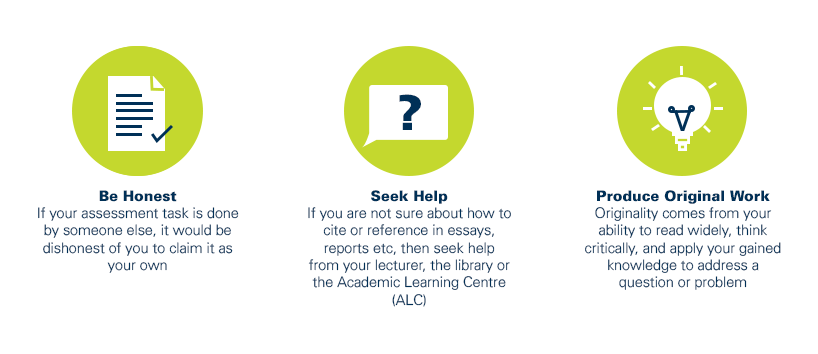
For academic advice and guidance, the Academic Learning Centre (ALC) can support you in becoming confident in completing assessments with integrity and of high standard.
What can you do to act with integrity?