Overview
Understanding the evolution, anatomy and identification of plants and animals is critical in tackling the scientific study or management of organisms, ecosystems and animal or plant production. In Life Science Laboratory, you will study evolution and phylogeny, and the anatomy of the most common vertebrate and invertebrate animals, plants, algae and fungi, to support the development of your practical skills, which include specimen collection, preparation and curation; microscopic and macroscopic identification; and animal and plant dissection. This unit includes field work where you will use the knowledge and skills developed to study organisms in both terrestrial and marine ecosystems. On conclusion of this unit, you will understand the important role that biology plays in research and innovation in the fields of science, environmental science and agriculture.
Details
Pre-requisites or Co-requisites
Anti-requisite BIOL11099 Living Systems
Important note: Students enrolled in a subsequent unit who failed their pre-requisite unit, should drop the subsequent unit before the census date or within 10 working days of Fail grade notification. Students who do not drop the unit in this timeframe cannot later drop the unit without academic and financial liability. See details in the Assessment Policy and Procedure (Higher Education Coursework).
Offerings For Term 1 - 2021
Attendance Requirements
All on-campus students are expected to attend scheduled classes - in some units, these classes are identified as a mandatory (pass/fail) component and attendance is compulsory. International students, on a student visa, must maintain a full time study load and meet both attendance and academic progress requirements in each study period (satisfactory attendance for International students is defined as maintaining at least an 80% attendance record).
Recommended Student Time Commitment
Each 6-credit Undergraduate unit at CQUniversity requires an overall time commitment of an average of 12.5 hours of study per week, making a total of 150 hours for the unit.
Class Timetable
Assessment Overview
Assessment Grading
This is a graded unit: your overall grade will be calculated from the marks or grades for each assessment task, based on the relative weightings shown in the table above. You must obtain an overall mark for the unit of at least 50%, or an overall grade of 'pass' in order to pass the unit. If any 'pass/fail' tasks are shown in the table above they must also be completed successfully ('pass' grade). You must also meet any minimum mark requirements specified for a particular assessment task, as detailed in the 'assessment task' section (note that in some instances, the minimum mark for a task may be greater than 50%). Consult the University's Grades and Results Policy for more details of interim results and final grades.
All University policies are available on the CQUniversity Policy site.
You may wish to view these policies:
- Grades and Results Policy
- Assessment Policy and Procedure (Higher Education Coursework)
- Review of Grade Procedure
- Student Academic Integrity Policy and Procedure
- Monitoring Academic Progress (MAP) Policy and Procedure - Domestic Students
- Monitoring Academic Progress (MAP) Policy and Procedure - International Students
- Student Refund and Credit Balance Policy and Procedure
- Student Feedback - Compliments and Complaints Policy and Procedure
- Information and Communications Technology Acceptable Use Policy and Procedure
This list is not an exhaustive list of all University policies. The full list of University policies are available on the CQUniversity Policy site.
Feedback, Recommendations and Responses
Every unit is reviewed for enhancement each year. At the most recent review, the following staff and student feedback items were identified and recommendations were made.
Feedback from SUTE
Students enjoy the hands on aspects of this unit.
Practicals and field trips will continue.
Feedback from SUTE
Students appreciated the change to online laboratories required during Covid-19.
Online laboratories will be provided as required in future.
Feedback from SUTE
Some students would like to see a clear distinction between core and supplementary knowledge.
Information will be designated as core or supplementary where appropriate.
Feedback from SUTE
Students liked the level of detail provided in lectures, and the order in which the information was provided.
Lecture format and level of detail will continue.
- Distinguish between major taxa of plants and animals using morphological features
- Discuss evolution and the Hierarchy of Classification in relation to the diversity of living organisms
- Safely perform laboratory activities, including the use of microscopes and aseptic techniques, and the dissection of plants and animals
- Collect and curate plant specimens
- Use dichotomous keys to identify flowering plants and insects.
Alignment of Assessment Tasks to Learning Outcomes
| Assessment Tasks | Learning Outcomes | ||||
|---|---|---|---|---|---|
| 1 | 2 | 3 | 4 | 5 | |
| 1 - Written Assessment - 20% | |||||
| 2 - Practical Assessment - 30% | |||||
| 3 - Laboratory/Practical - 0% | |||||
| 4 - Online Quiz(zes) - 50% | |||||
Alignment of Graduate Attributes to Learning Outcomes
| Graduate Attributes | Learning Outcomes | ||||
|---|---|---|---|---|---|
| 1 | 2 | 3 | 4 | 5 | |
| 1 - Communication | |||||
| 2 - Problem Solving | |||||
| 3 - Critical Thinking | |||||
| 4 - Information Literacy | |||||
| 5 - Team Work | |||||
| 6 - Information Technology Competence | |||||
| 7 - Cross Cultural Competence | |||||
| 8 - Ethical practice | |||||
| 9 - Social Innovation | |||||
| 10 - First Nations Knowledges | |||||
| 11 - Aboriginal and Torres Strait Islander Cultures | |||||
Alignment of Assessment Tasks to Graduate Attributes
| Assessment Tasks | Graduate Attributes | ||||||||||
|---|---|---|---|---|---|---|---|---|---|---|---|
| 1 | 2 | 3 | 4 | 5 | 6 | 7 | 8 | 9 | 10 | 11 | |
| 1 - Written Assessment - 20% | |||||||||||
| 2 - Practical Assessment - 30% | |||||||||||
| 3 - Laboratory/Practical - 0% | |||||||||||
| 4 - Online Quiz(zes) - 50% | |||||||||||
Textbooks
Campbell Biology: Australian and New Zealand Version
- 11th Edition (2018)
- Authors: Urry, LA, Meyers, N, Cain, ML, Wasserman, SA, Minorsky, PV, Reece, JB
- Pearson Australia
- Melbourne Melbourne , Victoria , Australia
- ISBN: 9781488613715
- Binding: Hardcover
IT Resources
- CQUniversity Student Email
- Internet
- Unit Website (Moodle)
All submissions for this unit must use the referencing style: Harvard (author-date)
For further information, see the Assessment Tasks.
a.carton@cqu.edu.au
Week 1
Begin Date: 08 Mar 2021Module/Topic
Understanding biological diversity
Evolution by natural selection
Hierarchy of classification
Chapter
Study Guide Module 1
Study Guide Module 2
Study Guide Module 3
Events and Submissions/Topic
Laboratory Skill Sets Practical 1 Assessment (ROK students only)
Week 2
Begin Date: 15 Mar 2021Module/Topic
Taxonomy
Cell theory
Prokaryotes
Chapter
Study Guide Module 3
Study Guide Module 4
Study Guide Module 5
Events and Submissions/Topic
Week 3
Begin Date: 22 Mar 2021Module/Topic
Endosymbiosis
Protists
Algae
Chapter
Study Guide Module 6
Study Guide Module 7
Study Guide Module 7
Events and Submissions/Topic
Laboratory Skill Sets Practical 3 Assessment (ROK students only).
Week 4
Begin Date: 29 Mar 2021Module/Topic
Bryophytes
Monilophytes and Lycophytes
Gymnosperms
Chapter
Study Guide Module 8
Study Guide Module 9
Study Guide Module 10
Events and Submissions/Topic
Week 5
Begin Date: 05 Apr 2021Module/Topic
Angiosperms (flowering plants)
Review of plant morphology
Chapter
Study Guide Module 11
Study Guide Module 12
Events and Submissions/Topic
Media article on an organism recently discovered in Australia due.
Due: Week 5 Friday (9 Apr 2021) 11:30 pm AEST.
Media article on an organism recently discovered in Australia Due: Week 5 Friday (9 Apr 2021) 11:30 pm AEST
Vacation Week
Begin Date: 12 Apr 2021Module/Topic
Chapter
Events and Submissions/Topic
Week 6
Begin Date: 19 Apr 2021Module/Topic
Fungi
Porifera
Cnidarians
Chapter
Study Guide Module 13
Study Guide Module 14
Study Guide Module 15
Events and Submissions/Topic
Week 7
Begin Date: 26 Apr 2021Module/Topic
Platyhelminths
Annelids
Chapter
Study Guide Module 16
Study Guide Module 17
Events and Submissions/Topic
Laboratory Skill Sets Practical 6 Assessment (ROK students only).
Week 8
Begin Date: 03 May 2021Module/Topic
Molluscs
Nematodes
Chapter
Study Guide Module 18
Study Guide Module 19
Events and Submissions/Topic
Week 9
Begin Date: 10 May 2021Module/Topic
Arthropods
Focus on insects
Chapter
Study Guide Module 20
Study Guide Module 20
Events and Submissions/Topic
Residential School (including North Keppel Island field trip) for Mixed-mode Students.
North Keppel Island field trip for Rockhampton Students (Group A).
Laboratory Skill Sets Practical 1, 3 and 6 Assessments (Res Sch A students only).
Week 10
Begin Date: 17 May 2021Module/Topic
No lectures
Chapter
Events and Submissions/Topic
Residential school (including North Keppel Island field trip) for Mixed-mode Students.
North Keppel Island field trip for Rockhampton Students (Group B).
Laboratory Skill Sets Practical 1, 3 and 6 Assessments (Res Sch B students only).
Week 11
Begin Date: 24 May 2021Module/Topic
Echinoderms
Chordates
Humans and other vertebrates
Chapter
Study Guide Module 21
Study Guide Module 22
Study Guide Module 22
Events and Submissions/Topic
Week 12
Begin Date: 31 May 2021Module/Topic
Review of animal morphology
Origin of life
Unit review
Chapter
Study Guide Module 23
Study Guide Module 24
Events and Submissions/Topic
Field Trip Online Quiz, Practical's 1-4 Online Quiz, Practical's 5-8 Online Quiz due.
Online tests on Practical work Due: Week 12 Friday (4 Jun 2021) 11:30 pm AEST
Practical Assessment Due: Week 12 Friday (4 June 2021) 11:30 pm AEST
End of Unit Online Quiz Due: Week 12 Monday (31 May 2021) 11:45 pm AEST
Review/Exam Week
Begin Date: 07 Jun 2021Module/Topic
Chapter
Events and Submissions/Topic
Exam Week
Begin Date: 14 Jun 2021Module/Topic
Chapter
Events and Submissions/Topic
End of Unit Online Quiz: Exam week Monday 14th June.
1 Written Assessment
This assessment requires you to research an organism that has been discovered in Australia (including surrounding waters) within the last ten years and write a 500 word article for a popular science magazine.
Your article should include a description of the scientific classification (kingdom, phylum etc) and the characteristics associated with organisms in that group (approximately 200 words). In the remaining words (approximately 300), you should describe what is interesting about the organism, what makes it different from other similar organisms, the significance of the discovery, or other relevant information that will attract and keep the audience's attention. At the end of the article, you must provide a list of the references you have used, but do not use any in-text referencing except to refer to the scientific paper that describes the species that has been discovered. As well as uploading your assignment as a Word document, you must upload a pdf of the original paper where the species is described. Exemplar articles will be available on the units Moodle page at the commencement of the term.
Week 5 Friday (9 Apr 2021) 11:30 pm AEST
Week 8 Monday (3 May 2021)
The complete assessment rubric will be available on the units Moodle site at the commencement of the term.
The assessment criteria primarily focuses on the following:
- Accuracy of the information about the newly discovered species and its classification.
- Relevance of the material.
- Accuracy of referencing.
- Correct English grammar.
- Clarity of expression and ability to engage an audience.
- Distinguish between major taxa of plants and animals using morphological features
- Discuss evolution and the Hierarchy of Classification in relation to the diversity of living organisms
- Communication
- Problem Solving
- Critical Thinking
- Information Literacy
2 Practical Assessment
You will complete three (3) short tests (10% each) based on the practical material covered during your practical laboratory/field sessions.
The timing of these assessments will vary according to your enrolment mode (On-campus or Mixed-mode). You must complete the relevant practical work before attempting the tests. A full schedule of practical work and associated tests will be available on the unit Moodle site for each enrolment mode and all practical tests will close at the end of Week 12.
These on-line tests will be based on the material covered in:
- Field trip (untimed; short answer).
- Laboratory Practicals 1 - 4 (30 minutes; multiple choice questions; one attempt only).
- Laboratory Practicals 5 - 8 (30 minutes; multiple choice questions; one attempt only).
Week 12 Friday (4 June 2021) 11:30 pm AEST
Results will available a short time after online submission of the quiz.
Answers to on-line tests will be assessed on the correctness, comprehensiveness and relevance of the answers.
- Safely perform laboratory activities, including the use of microscopes and aseptic techniques, and the dissection of plants and animals
- Collect and curate plant specimens
- Use dichotomous keys to identify flowering plants and insects.
- Communication
- Problem Solving
- Critical Thinking
- Information Technology Competence
3 Laboratory/Practical
Three tests will be conducted during practical laboratory classes. These tests will be based on a combination of practical skills and relevant theoretical knowledge in:
- Practical 1 (Bacteria and protists). Correctly set up a microscope, prepare a wet mount of a protist and draw the specimen on the microscope slide.
- Practical 3 (Flowering plants), Collect a plant specimen, complete an appropriate plant label and identify the specimen to Family.
- Practical 6 (Identifying insects). Identify an insect to Order and draw the specimen, labelling the morphological features used in the identification.
Students will be assessed as Pass/Fail during the practical session.
Students will be assessed during the relevant practical laboratory session.
Students will be assessed as Pass/Fail during the practical session.
Ability to perform the laboratory exercises to the required standard.
- Safely perform laboratory activities, including the use of microscopes and aseptic techniques, and the dissection of plants and animals
- Collect and curate plant specimens
- Use dichotomous keys to identify flowering plants and insects.
- Problem Solving
- Critical Thinking
- Information Literacy
- Team Work
4 Online Quiz(zes)
This end of unit quiz is based on lecture and study material covered during Weeks 1-12 (students are asked to revise the lecture and reading material associated with each week).
The end of unit online quiz is limited to 120 minutes for completion and must be submitted after completion. Answers will be automatically submitted after 120mins.
Quiz questions will be a combination ten (10) short and eight (8) long answer questions. Short answer questions will form 20% and long answer questions 80% of total available marks.
1
Other
Week 12 Monday (31 May 2021) 11:45 pm AEST
During the University examination period
Answers will assessed on there completeness, relevance and correct application of biological knowledge.
- Distinguish between major taxa of plants and animals using morphological features
- Discuss evolution and the Hierarchy of Classification in relation to the diversity of living organisms
- Communication
- Problem Solving
- Critical Thinking
- Information Literacy
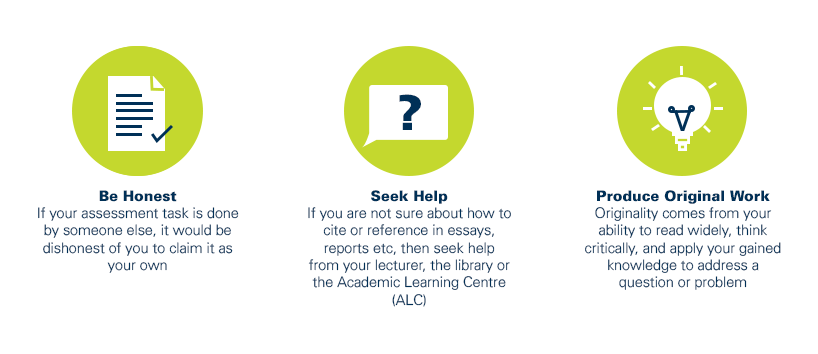
As a CQUniversity student you are expected to act honestly in all aspects of your academic work.
Any assessable work undertaken or submitted for review or assessment must be your own work. Assessable work is any type of work you do to meet the assessment requirements in the unit, including draft work submitted for review and feedback and final work to be assessed.
When you use the ideas, words or data of others in your assessment, you must thoroughly and clearly acknowledge the source of this information by using the correct referencing style for your unit. Using others’ work without proper acknowledgement may be considered a form of intellectual dishonesty.
Participating honestly, respectfully, responsibly, and fairly in your university study ensures the CQUniversity qualification you earn will be valued as a true indication of your individual academic achievement and will continue to receive the respect and recognition it deserves.
As a student, you are responsible for reading and following CQUniversity’s policies, including the Student Academic Integrity Policy and Procedure. This policy sets out CQUniversity’s expectations of you to act with integrity, examples of academic integrity breaches to avoid, the processes used to address alleged breaches of academic integrity, and potential penalties.
What is a breach of academic integrity?
A breach of academic integrity includes but is not limited to plagiarism, self-plagiarism, collusion, cheating, contract cheating, and academic misconduct. The Student Academic Integrity Policy and Procedure defines what these terms mean and gives examples.
Why is academic integrity important?
A breach of academic integrity may result in one or more penalties, including suspension or even expulsion from the University. It can also have negative implications for student visas and future enrolment at CQUniversity or elsewhere. Students who engage in contract cheating also risk being blackmailed by contract cheating services.
Where can I get assistance?
For academic advice and guidance, the Academic Learning Centre (ALC) can support you in becoming confident in completing assessments with integrity and of high standard.
What can you do to act with integrity?