Overview
In Professional Placement or Project you will either complete a placement in a workplace relevant to your degree and major, or if your GPA is 5.0 or greater, you may have the option of undertaking a short, independent research project approved by the unit coordinator. Alternatively, options for you to complete an international placement or study tour may also be available. This unit will provide you with an opportunity to apply the theoretical knowledge and practical skills you have attained in your course to the professional work environment. You will complete 15 days (approximately 120 hours) relevant industry experience with an emphasis on the interaction of your university learning with the practical environment. You are required to find your own placement or project and details of the placement or project must be provided to the unit coordinator prior to commencing the placement or project. You will be provided with further information and assistance via email prior to the beginning of term.
Details
Pre-requisites or Co-requisites
Prerequisite: 72 credit points
Important note: Students enrolled in a subsequent unit who failed their pre-requisite unit, should drop the subsequent unit before the census date or within 10 working days of Fail grade notification. Students who do not drop the unit in this timeframe cannot later drop the unit without academic and financial liability. See details in the Assessment Policy and Procedure (Higher Education Coursework).
Offerings For Term 3 - 2026
Attendance Requirements
All on-campus students are expected to attend scheduled classes - in some units, these classes are identified as a mandatory (pass/fail) component and attendance is compulsory. International students, on a student visa, must maintain a full time study load and meet both attendance and academic progress requirements in each study period (satisfactory attendance for International students is defined as maintaining at least an 80% attendance record).
Recommended Student Time Commitment
Each 6-credit Undergraduate unit at CQUniversity requires an overall time commitment of an average of 12.5 hours of study per week, making a total of 150 hours for the unit.
Class Timetable
Assessment Overview
| Assessment Task | Part Weighting (% of assessment) |
Assessment Security Level | Gen AI Guidance Levels |
|---|---|---|---|
| 1. Placement attendance and completion (50% of unit ) | |||
| Placement attendance and completion (Professional Practice Placement) | 100% of 50% | Medium | AI Integration (Authentic Professional Use) |
| 2. Reflective Practice Assessment (50% of unit ) | |||
| Daily Reflective Diary and CV (Reflective Practice Assignment) | 100% of 50% | Low | AI Integration (Authentic Professional Use) |
Assessment Grading
This is a pass/fail (non-graded) unit. To pass the unit, you must pass all of the individual assessment tasks shown in the table above.
All University policies are available on the CQUniversity Policy site.
You may wish to view these policies:
- Grades and Results Policy
- Assessment Policy and Procedure (Higher Education Coursework)
- Review of Grade Procedure
- Student Academic Integrity Policy and Procedure
- Academic Progression Policy and Procedure
- Student Refund and Credit Balance Policy and Procedure
- Complaints Policy and Procedure
- Information and Communications Technology Acceptable Use Policy and Procedure
This list is not an exhaustive list of all University policies. The full list of University policies are available on the CQUniversity Policy site.
Feedback, Recommendations and Responses
Every unit is reviewed for enhancement each year. At the most recent review, the following staff and student feedback items were identified and recommendations were made.
Feedback from Direct Student Feedback
Students enjoy their placement/project opportunity and consistently report a positive experience.
Continue to provide placement/project opportunities to students.
- Apply knowledge and skills in a professional role or to a practical research project relevant to your degree course
- Demonstrate the ability to work independently and as a member of a team
- Demonstrate communication and problem-solving skills within a professional or project context, including the appropriate and ethical use of digital technologies
- Reflect on the relevance of the project or placement to your degree course and document how your skills and knowledge have been extended by the project or placement
- Maintain a work or research diary documenting activities, learning and reflections during the placement or project.
Alignment of Assessment Tasks to Learning Outcomes
| Assessment Tasks | Learning Outcomes | ||||
|---|---|---|---|---|---|
| 1 | 2 | 3 | 4 | 5 | |
|
1.
Assessment 1
(50% of unit )
Professional Practice Placement
|
|||||
|
2.
Assessment 2
(50% of unit )
Reflective Practice Assignment
|
|||||
Alignment of Graduate Attributes to Learning Outcomes
| Graduate Attributes | Learning Outcomes | ||||
|---|---|---|---|---|---|
| 1 | 2 | 3 | 4 | 5 | |
| 1 - Communication | |||||
| 2 - Problem Solving | |||||
| 3 - Critical Thinking | |||||
| 4 - Information Literacy | |||||
| 5 - Team Work | |||||
| 6 - Information Technology Competence | |||||
| 7 - Cross Cultural Competence | |||||
| 8 - Ethical practice | |||||
| 9 - Social Innovation | |||||
| 10 - First Nations Knowledges | |||||
Textbooks
There are no required textbooks.
IT Resources
- CQUniversity Student Email
- Internet
- Unit Website (Moodle)
All submissions for this unit must use the referencing style: Harvard (author-date)
For further information, see the Assessment Tasks.
a.anastasi@cqu.edu.au
Preparation for Placement or Project
Begin Date: 09 Nov 2026Module/Topic
Placement or Project Preparation
Chapter
Events and Submissions/Topic
Things to do in preparation for starting placement:
- Ensure your CV is up to date to provide to your placement site.
- If you are completing a project, ensure you have planned your research in conjunction with your academic project supervisor.
- Access SONIA to enter the details of your placement/project, and complete required paperwork and checks.
The Work Integrated Learning Team will let you know when your agreement is finalised, you must wait for confirmation before beginning your placement or project.
Mid term check
Begin Date: 23 Nov 2026Module/Topic
Mid term check
Chapter
Events and Submissions/Topic
Census date is coming up. If you have not organised a placement or project yet, make sure you remain enrolled in this unit, and contact the unit coordinator.
Completion of Placement or Project
Begin Date: 08 Feb 2027Module/Topic
Placement or Project Completion
Chapter
Events and Submissions/Topic
You must submit your portfolio to Moodle within four (4) weeks of completing the placement or project.
Timing of your placement/project is flexible. Please contact the Unit Coordinator for more information.
Your placement or project must be completed, and your portfolio submitted, no later than Week 12 of Term 2, 2027, with permission from the Unit Coordinator.
1. Placement attendance and completion ( 50% of unit )
Professional Practice Placement
You will successfully complete a placement, project or approved study tour of approximately 15 days (approximately 120 hours) in duration. This can be undertaken full time, part time, in blocks, or a mixture of these, in agreement with your placement or project site supervisor.
You will complete all required forms in Sonia and await approval from the Work Integrated Learning Team prior to beginning your placement.
The workplace or research supervisor is required to complete a short feedback form that includes an assessment of your progress and work ethic during the placement or research project. The feedback form will be sent directly to your supervisor via Sonia. You will be able to see the form in Sonia after it is finalised. You must print/save a copy from Sonia for submission to Moodle.
Four weeks from completion of Placement or Project.
Two weeks after submission of assessment
Pass non Graded (PN): Supervisor feedback form submitted on time.
Fail (F): Non submission of supervisor feedback form.
- Apply knowledge and skills in a professional role or to a practical research project relevant to your degree course
- Demonstrate the ability to work independently and as a member of a team
- Demonstrate communication and problem-solving skills within a professional or project context, including the appropriate and ethical use of digital technologies
- Maintain a work or research diary documenting activities, learning and reflections during the placement or project.
2. Reflective Practice Assessment ( 50% of unit )
Reflective Practice Assignment
A portfolio must be submitted that includes:
1. Current CV
Upload a current CV into Moodle. This should be the CV you may submit to the workplace when organising your placement.
2. Daily Reflective Diary
Upload a copy of a diary detailing daily activities and responsibilities.
Each entry needs to include a reflection on:
(i) the knowledge you gained and the skills learned during your industry placement or research project;
(ii) how the knowledge and skills relate to your program of study and may be useful in your future career and
(iii) identification of knowledge and skills that would have been useful to have before going on your industry placement or research project.
There is no minimum or maximum word limit for these pieces but they should be succinct and clearly written.
Four weeks from completion of Placement or Project
Two weeks after submission of assessment
Pass non Graded (PN): Daily reflective diary and CV submitted on time and of an acceptable standard.
Fail (F): Elements missing from the portfolio or portfolio not submitted on time or not of an acceptable standard.
| General Criteria | Satisfactory | Unsatisfactory |
| Title and task | Descriptive title and task provided in full. | Title absent or inappropriate. |
| Grammar | Appropriately structured sentences. Well organized paragraphs. | Poorly structured sentences. Paragraphs poorly organised. |
| Spelling | No, or minor, errors only. | Many errors. |
| Presentation | Appropriate for style of writing presented. | Poorly presented. |
| Flow of text | Fluent expression, well organised with no problems or only minor problems. | Text is poorly organised and/or disjointed. |
- Demonstrate communication and problem-solving skills within a professional or project context, including the appropriate and ethical use of digital technologies
- Reflect on the relevance of the project or placement to your degree course and document how your skills and knowledge have been extended by the project or placement
- Maintain a work or research diary documenting activities, learning and reflections during the placement or project.
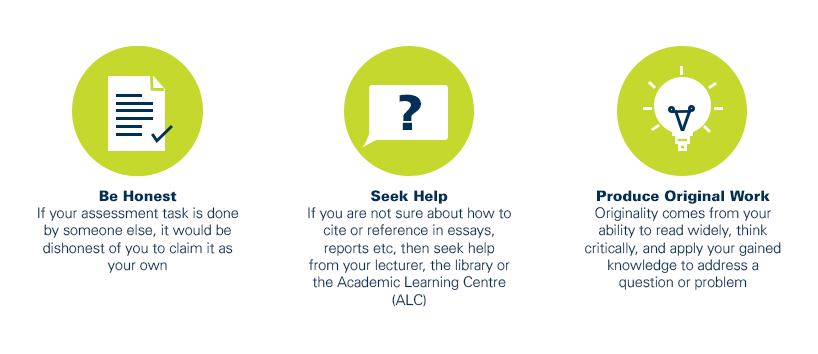
As a CQUniversity student you are expected to act honestly in all aspects of your academic work.
Any assessable work undertaken or submitted for review or assessment must be your own work. Assessable work is any type of work you do to meet the assessment requirements in the unit, including draft work submitted for review and feedback and final work to be assessed.
When you use the ideas, words or data of others in your assessment, you must thoroughly and clearly acknowledge the source of this information by using the correct referencing style for your unit. Using others’ work without proper acknowledgement may be considered a form of intellectual dishonesty.
Participating honestly, respectfully, responsibly, and fairly in your university study ensures the CQUniversity qualification you earn will be valued as a true indication of your individual academic achievement and will continue to receive the respect and recognition it deserves.
As a student, you are responsible for reading and following CQUniversity’s policies, including the Student Academic Integrity Policy and Procedure. This policy sets out CQUniversity’s expectations of you to act with integrity, examples of academic integrity breaches to avoid, the processes used to address alleged breaches of academic integrity, and potential penalties.
What is a breach of academic integrity?
A breach of academic integrity includes but is not limited to plagiarism, self-plagiarism, collusion, cheating, contract cheating, and academic misconduct. The Student Academic Integrity Policy and Procedure defines what these terms mean and gives examples.
Why is academic integrity important?
A breach of academic integrity may result in one or more penalties, including suspension or even expulsion from the University. It can also have negative implications for student visas and future enrolment at CQUniversity or elsewhere. Students who engage in contract cheating also risk being blackmailed by contract cheating services.
Where can I get assistance?
For academic advice and guidance, the Academic Learning Centre (ALC) can support you in becoming confident in completing assessments with integrity and of high standard.
What can you do to act with integrity?