Overview
Upon successful completion of this unit, you will be able to describe the structural levels of organisation within the body, use anatomical terminology to describe the relative location of structures in the body, and explain the role and general features of homeostasis in the body. You will also gain an understanding of the anatomy and physiology of the integumentary, skeletal, muscular, nervous, endocrine, cardiovascular, lymphatic and immune, respiratory, digestive, urinary, and reproductive human body systems. Your knowledge and skills will be developed through a series of coursework exercises.
Details
Pre-requisites or Co-requisites
There are no requisites for this unit.
Important note: Students enrolled in a subsequent unit who failed their pre-requisite unit, should drop the subsequent unit before the census date or within 10 working days of Fail grade notification. Students who do not drop the unit in this timeframe cannot later drop the unit without academic and financial liability. See details in the Assessment Policy and Procedure (Higher Education Coursework).
Offerings For Term 1 - 2026
Attendance Requirements
All on-campus students are expected to attend scheduled classes - in some units, these classes are identified as a mandatory (pass/fail) component and attendance is compulsory. International students, on a student visa, must maintain a full time study load and meet both attendance and academic progress requirements in each study period (satisfactory attendance for International students is defined as maintaining at least an 80% attendance record).
Recommended Student Time Commitment
Each 6-credit Undergraduate unit at CQUniversity requires an overall time commitment of an average of 12.5 hours of study per week, making a total of 150 hours for the unit.
Class Timetable
Assessment Overview
Assessment Grading
This is a graded unit: your overall grade will be calculated from the marks or grades for each assessment task, based on the relative weightings shown in the table above. You must obtain an overall mark for the unit of at least 50%, or an overall grade of 'pass' in order to pass the unit. If any 'pass/fail' tasks are shown in the table above they must also be completed successfully ('pass' grade). You must also meet any minimum mark requirements specified for a particular assessment task, as detailed in the 'assessment task' section (note that in some instances, the minimum mark for a task may be greater than 50%). Consult the University's Grades and Results Policy for more details of interim results and final grades.
All University policies are available on the CQUniversity Policy site.
You may wish to view these policies:
- Grades and Results Policy
- Assessment Policy and Procedure (Higher Education Coursework)
- Review of Grade Procedure
- Student Academic Integrity Policy and Procedure
- Academic Progression Policy and Procedure
- Student Refund and Credit Balance Policy and Procedure
- Complaints Policy and Procedure
- Information and Communications Technology Acceptable Use Policy and Procedure
This list is not an exhaustive list of all University policies. The full list of University policies are available on the CQUniversity Policy site.
Feedback, Recommendations and Responses
Every unit is reviewed for enhancement each year. At the most recent review, the following staff and student feedback items were identified and recommendations were made.
Feedback from SUTE
Students enjoyed the real-world examples provided in the tutorials.
Continue providing real-world examples of anatomy and physiology in the tutorials.
Feedback from SUTE
The lecturer covers important topics. Students' questions during the tutorials were also accommodated and answered logically.
Continue delivery style with focus on key concepts in tutorials.
Feedback from SUTE
The lecturer clearly loves this subject and delivers it well. There is a lot of in-depth content to remember in a short amount of time, and this can be difficult.
Provide more 'how to learn science' tutorials and link with the Academic Learning Centre for student support.
- Identify the structural levels of organisation and anatomical structures using medical terminology
- Define homeostatic mechanisms and their essential role in physiological responses in the human body
- Identify the human anatomical structures of the integumentary, skeletal, muscular, nervous, endocrine, cardiovascular, lymphatic and immune, respiratory, digestive, urinary and reproductive systems
- Apply knowledge of human anatomy and physiology of the integumentary, skeletal, muscular, nervous, endocrine, cardiovascular, lymphatic and immune, respiratory, digestive, urinary and reproductive systems
- Recognise the interactions between structure and function in each of the human body systems
- Recognise the application of human anatomy and physiology relevant to your discipline.
In courses that are externally accredited, the learning outcomes are linked to the national standards of the respective professional organisation/s.
Alignment of Assessment Tasks to Learning Outcomes
| Assessment Tasks | Learning Outcomes | |||||
|---|---|---|---|---|---|---|
| 1 | 2 | 3 | 4 | 5 | 6 | |
| 1 - Online Quiz(zes) - 40% | ||||||
| 2 - Online Test - 60% | ||||||
Alignment of Graduate Attributes to Learning Outcomes
| Graduate Attributes | Learning Outcomes | |||||
|---|---|---|---|---|---|---|
| 1 | 2 | 3 | 4 | 5 | 6 | |
| 1 - Communication | ||||||
| 2 - Problem Solving | ||||||
| 3 - Critical Thinking | ||||||
| 4 - Information Literacy | ||||||
| 5 - Team Work | ||||||
| 6 - Information Technology Competence | ||||||
| 7 - Cross Cultural Competence | ||||||
| 8 - Ethical practice | ||||||
| 9 - Social Innovation | ||||||
| 10 - First Nations Knowledges | ||||||
| 11 - Aboriginal and Torres Strait Islander Cultures | ||||||
Textbooks
Anatomy and Physiology
- (2022)
- Authors: J. Gordon Betts, Kelly A. Young, James A. Wise, Eddie Johnson, Brandon Poe, Dean H. Kruse, Oksana Korol, Jody E. Johnson, Mark Womble, Peter DeSaix
- OpenStax
- ISBN: https://openstax.org/details/books/anatomy-and-physiology
This free online textbook (https://openstax.org/details/books/anatomy-and-physiology) is the only textbook students need for this unit. It will be listed as “prescribed” and is the compulsory text for this unit.
Whereas the Patton textbook (Anatomy and Physiology: Adapted International Edition 9th (2018) Authors: Kevin T. Patton, Gary A. Thibodeau, Andrew Hutton) will be listed as “supplementary”. A supplementary textbook is not compulsory for the unit but adds more information as some students may want to read further.
Students will have free access to Complete Anatomy (https://3d4medical.com/). More details about accessing Complete Anatomy will be provided on Moodle.
Anatomy and Physiology: Adapted International Edition S
- Edition: 9th (2019)
- Authors: Kevin T. Patton, Gary A. Thibodeau, Andrew Hutton
- Elsevier Health Sciences
- Great Britain
- ISBN: 9780702077166
IT Resources
- CQUniversity Student Email
- Internet
- Unit Website (Moodle)
- Zoom access: microphone and webcam required
All submissions for this unit must use the referencing style: American Psychological Association 7th Edition (APA 7th edition)
For further information, see the Assessment Tasks.
i.wise@cqu.edu.au
Week 1
Begin Date: 09 Mar 2026Module/Topic
Introduction to Anatomy and Physiology
Chapter
Chapters 1, 2 and 3
Events and Submissions/Topic
Week 2
Begin Date: 16 Mar 2026Week 3
Begin Date: 23 Mar 2026Week 4
Begin Date: 30 Mar 2026Week 5
Begin Date: 06 Apr 2026Module/Topic
Cardiovascular System
Chapter
Chapters 18, 19 and 20
Events and Submissions/Topic
Week 6
Begin Date: 13 Apr 2026Module/Topic
Respiratory System
Chapter
Chapter 22
Events and Submissions/Topic
Online Quiz 1
Due: Week 6 Tuesday (14 April 2026) 5:00 pm AEST
Online Quiz 1 Due: Week 6 Tuesday (14 Apr 2026) 5:00 pm AEST
Vacation Week
Begin Date: 20 Apr 2026Module/Topic
Vacation Week
Chapter
Events and Submissions/Topic
Week 7
Begin Date: 27 Apr 2026Week 8
Begin Date: 04 May 2026Week 9
Begin Date: 11 May 2026Week 10
Begin Date: 18 May 2026Week 11
Begin Date: 25 May 2026Week 12
Begin Date: 01 Jun 2026Exam Week
Begin Date: 08 Jun 2026Module/Topic
Chapter
Events and Submissions/Topic
Online Quiz 2
Due: Exam Week Tuesday (9 June 2026) 5:00 pm AEST
End of Term Online Quiz 2 Due: Exam Week Tuesday (9 June 2026) 5:00 pm AEST
Vacation/Exam Week
Begin Date: 15 Jun 2026Module/Topic
Chapter
Events and Submissions/Topic
The unit coordinator this term is Dr Ingrid Wise. The best way to contact the unit coordinator is
Email: bmsc11010@cqu.edu.au
Telephone: 07 4037 5931
Via the Q&A forum on the Moodle site
The only textbook students need for this unit is a free online textbook (https://openstax.org/details/books/anatomy-and-physiology). It will be listed as “prescribed” and is the compulsory text for this unit.
The Patton textbook (Anatomy and Physiology: Adapted International Edition 9th (2018) Authors: Kevin T. Patton, Gary A. Thibodeau, Andrew Hutton) adds more information for students who may want to read further. This textbook will be listed as “supplementary” and is not compulsory for the unit.
Students will have free access to Complete Anatomy (https://3d4medical.com/). More details about accessing Complete Anatomy will be provided on Moodle.
As per Australian educational standards, you are expected to commit 150 hours of engagement to your study of this unit. A recommended breakdown of weekly study hours is given below:
- 2 - 3 hours per week watching pre-recorded lectures and revising the content through study notes.
- 2 - 3 hours per week completing the weekly study questions and weekly revision quizzes on the unit's Moodle site.
- 2 - 3 hours per week attending the weekly tutorials and reflecting on your answers to the weekly revision worksheets.
- 3 - 4 hours per week preparing for your assessable online quiz 1 and end of term online quiz 2.
No assessment reattempts are allowed in this unit. In order to be eligible for a supplementary assessment, all assessment tasks must be reasonably attempted in this unit. Supplementary assessments will be provided in alignment with the CQU Assessment Policy and Procedure (HED).
1 Online Quiz(zes)
Online Quiz (40% weighting)
The 72-hour grace period does not apply to this assessment.
The online quiz assesses content from weeks 1–5.
- Week 1 – Introduction to Anatomy and Physiology
- Week 2 – Integumentary System
- Week 3 – Muscular System
- Week 4 – Skeletal System
- Week 5 – Cardiovascular System
Opens: Week 6 Monday 13 April 2026 at 09:00 am AEST (QLD time).
Closes: Week 6 Tuesday 14 April 2026 at 5:00 pm AEST (QLD time).
Attempts allowed: One (1).
- Students will have one attempt to complete the online quiz on Moodle
- There is a minimum requirement in the assessment task: 50% of the available marks for this assessment item.
- In the absence of an approved extension, there will be no opportunity to complete the task after the assigned date.
Level of generative artificial intelligence (GenAI) use allowed: Level 1: You must not use artificial intelligence (AI) at any point during the assessment. You must demonstrate your core skills and knowledge.
Week 6 Tuesday (14 Apr 2026) 5:00 pm AEST
The online test will be open for the period of time between Monday 13 April 2026 at 09:00 am AEST and will close on Tuesday 14 April 2026 at 5:00 pm AEST.
Students will be able to review the quiz results once all students have completed the online quiz.
Assessment 1 - Online Quiz (40% weighting)
- Assessing content from weeks 1-5.
- Some questions in this assessment are weighted more heavily than others, meaning they contribute a greater proportion to your overall grade. As a result, performance across all questions is important, not just the number of questions answered correctly.
- The minimum passing mark is 50%.
- Practice assessment questions are provided on Moodle.
- Identify the structural levels of organisation and anatomical structures using medical terminology
- Define homeostatic mechanisms and their essential role in physiological responses in the human body
- Identify the human anatomical structures of the integumentary, skeletal, muscular, nervous, endocrine, cardiovascular, lymphatic and immune, respiratory, digestive, urinary and reproductive systems
- Apply knowledge of human anatomy and physiology of the integumentary, skeletal, muscular, nervous, endocrine, cardiovascular, lymphatic and immune, respiratory, digestive, urinary and reproductive systems
- Recognise the interactions between structure and function in each of the human body systems
- Recognise the application of human anatomy and physiology relevant to your discipline.
2 Online Test
End of Term Online Quiz 2 (60% weighting)
The 72-hour grace period does not apply to this assessment.
The end of term online test assesses content covered during weeks 6-12.
- Week 6 – Respiratory System
- Week 7 – Lymphatic System and Immunity
- Week 8 – Endocrine System
- Week 9 – Nervous System
- Week 10 – Digestive System
- Week 11 – Urinary System
- Week 12 – Reproductive System
Opens: Exam Week 1 Monday 8 June 2026 at 09:00 am AEST (QLD time).
Closes: Exam Week 1 Tuesday 9 June 2026 at 5:00 pm AEST (QLD time).
Attempts allowed: One (1).
- Students will have one attempt to complete the end of term online test on Moodle.
- There is a minimum requirement in the assessment task: 50% of the available marks for this assessment item.
- In the absence of an approved extension, there will be no opportunity to complete the task after the assigned date.
Level of generative artificial intelligence (GenAI) use allowed: Level 1: You must not use artificial intelligence (AI) at any point during the assessment. You must demonstrate your core skills and knowledge.
Exam Week Tuesday (9 June 2026) 5:00 pm AEST
The online test will be open for the period of time between Monday 8 June 2026 at 09:00 am AEST and will close on Tuesday 9 June 2026 at 5:00 pm AEST
Students will be able to review the quiz once all students have completed the online quiz.
Assessment 2 - End of Term Online Test (60% weighting)
- Assessing content from weeks 6-12.
- Some questions in this assessment are weighted more heavily than others, meaning they contribute a greater proportion to your overall grade. As a result, performance across all questions is important, not just the number of questions answered correctly.
- The minimum passing mark is 50%.
- Practice assessment questions are provided on Moodle.
- Identify the structural levels of organisation and anatomical structures using medical terminology
- Define homeostatic mechanisms and their essential role in physiological responses in the human body
- Identify the human anatomical structures of the integumentary, skeletal, muscular, nervous, endocrine, cardiovascular, lymphatic and immune, respiratory, digestive, urinary and reproductive systems
- Apply knowledge of human anatomy and physiology of the integumentary, skeletal, muscular, nervous, endocrine, cardiovascular, lymphatic and immune, respiratory, digestive, urinary and reproductive systems
- Recognise the interactions between structure and function in each of the human body systems
- Recognise the application of human anatomy and physiology relevant to your discipline.
As a CQUniversity student you are expected to act honestly in all aspects of your academic work.
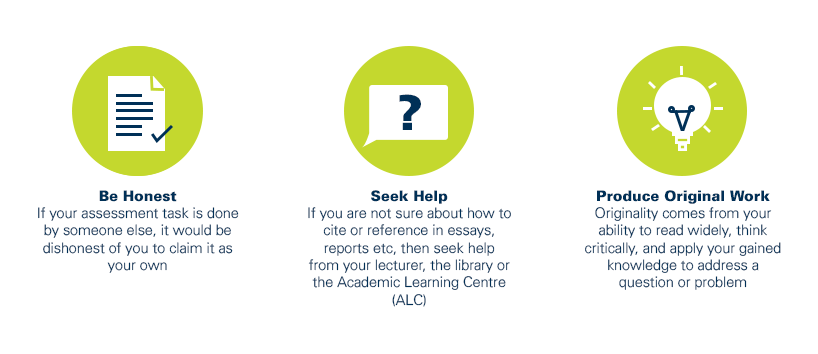
Any assessable work undertaken or submitted for review or assessment must be your own work. Assessable work is any type of work you do to meet the assessment requirements in the unit, including draft work submitted for review and feedback and final work to be assessed.
When you use the ideas, words or data of others in your assessment, you must thoroughly and clearly acknowledge the source of this information by using the correct referencing style for your unit. Using others’ work without proper acknowledgement may be considered a form of intellectual dishonesty.
Participating honestly, respectfully, responsibly, and fairly in your university study ensures the CQUniversity qualification you earn will be valued as a true indication of your individual academic achievement and will continue to receive the respect and recognition it deserves.
As a student, you are responsible for reading and following CQUniversity’s policies, including the Student Academic Integrity Policy and Procedure. This policy sets out CQUniversity’s expectations of you to act with integrity, examples of academic integrity breaches to avoid, the processes used to address alleged breaches of academic integrity, and potential penalties.
What is a breach of academic integrity?
A breach of academic integrity includes but is not limited to plagiarism, self-plagiarism, collusion, cheating, contract cheating, and academic misconduct. The Student Academic Integrity Policy and Procedure defines what these terms mean and gives examples.
Why is academic integrity important?
A breach of academic integrity may result in one or more penalties, including suspension or even expulsion from the University. It can also have negative implications for student visas and future enrolment at CQUniversity or elsewhere. Students who engage in contract cheating also risk being blackmailed by contract cheating services.
Where can I get assistance?
For academic advice and guidance, the Academic Learning Centre (ALC) can support you in becoming confident in completing assessments with integrity and of high standard.
What can you do to act with integrity?