Overview
A professional internship or work placement provides you with experience in a professional environment relevant to your chosen discipline. The process of combining theoretical knowledge with practical experience will assist you in understanding the relevance of material presented during discipline studies and further expand your professional knowledge and work-readiness with practical experience. Following a detailed application and selection process in the term prior to your BUSN20020 enrolment term, once you are placed with a host organisation, you will be engaged in work-integrated learning (WIL) while being supported by the School of Business and Law. You will undertake applied organisational research with a focus on your host organisation's approach to systems, processes and strategies related to your discipline, i.e. human resource management, marketing, management or accounting, with a view to improving organisational effectiveness. You will also be required to document and reflect on your work placement experiences to assess professional growth, recognise and evaluate your strengths and weaknesses, and develop an action plan for future professional development. This unit involves a company placement, either self-sourced by students, or organised and coordinated by a number of internship providers (external companies contracted by CQU to manage this aspect of the internship unit for Postgraduate business students). This unit involves some on-campus classes and assessments, as well as an intensive placement in a host organisation. Because of the involvement of these external host organisations and internship providers, this unit is only available to full-time on-campus international students normally based on the Melbourne, Sydney and Brisbane campuses.
Details
Pre-requisites or Co-requisites
Pre-requisites: Must be on track to complete all units (other than BUSN20020) of their course prior to final term of enrolment. BUSN20020 must be the only unit undertaken in the final term of enrolment. Students must follow the internship course planner of their Masters course. For Master of Professional Accounting (MPA) students, successful completion of ACCT20074 Contemporary Accounting Theory, ACCT20075 Auditing and Ethics, and ACCT20080 Ethics and Governance; OR For non-MPA students, successful completion of BUSN20017 Effective Business Communications and BUSN20016 Research in Business; and No Failures on the student’s Academic Record. Enrolment in this unit is subject to your successful application through the SONIA internship system early in the term prior to your final term of enrolment. This process will involve lodging a formal application through SONIA, an examination of your academic record, then interviews with external organisations including possible host organisations. Students may choose to self-source an internship, but all self-sourced placements must be approved and vetted, and students must nonetheless apply through the SONIA system, following the same timeframes as all other students. Placements through an internship provider are not guaranteed, but unsuccessful students will be notified in time for the School to facilitate enrolment in alternative electives. Once accepted for placement in a host organisation, students will follow normal office hours for four days per week over 10 consecutive weeks for the work placement component of BUSN20020. Students cannot self-enrol in this unit; only students who have been successful in securing an approved internship in a host organisation, and who meet the other requirements of this unit, will be enrolled into BUSN20020 by the WIL team. The Postgraduate Business Internships Moodle site outlines all application processes in detail.
Important note: Students enrolled in a subsequent unit who failed their pre-requisite unit, should drop the subsequent unit before the census date or within 10 working days of Fail grade notification. Students who do not drop the unit in this timeframe cannot later drop the unit without academic and financial liability. See details in the Assessment Policy and Procedure (Higher Education Coursework).
Offerings For Term 1 - 2026
Attendance Requirements
All on-campus students are expected to attend scheduled classes - in some units, these classes are identified as a mandatory (pass/fail) component and attendance is compulsory. International students, on a student visa, must maintain a full time study load and meet both attendance and academic progress requirements in each study period (satisfactory attendance for International students is defined as maintaining at least an 80% attendance record).
Recommended Student Time Commitment
Each 12-credit Postgraduate unit at CQUniversity requires an overall time commitment of an average of 25 hours of study per week, making a total of 300 hours for the unit.
Class Timetable
Assessment Overview
Assessment Grading
This is a graded unit: your overall grade will be calculated from the marks or grades for each assessment task, based on the relative weightings shown in the table above. You must obtain an overall mark for the unit of at least 50%, or an overall grade of 'pass' in order to pass the unit. If any 'pass/fail' tasks are shown in the table above they must also be completed successfully ('pass' grade). You must also meet any minimum mark requirements specified for a particular assessment task, as detailed in the 'assessment task' section (note that in some instances, the minimum mark for a task may be greater than 50%). Consult the University's Grades and Results Policy for more details of interim results and final grades.
All University policies are available on the CQUniversity Policy site.
You may wish to view these policies:
- Grades and Results Policy
- Assessment Policy and Procedure (Higher Education Coursework)
- Review of Grade Procedure
- Student Academic Integrity Policy and Procedure
- Academic Progression Policy and Procedure
- Student Refund and Credit Balance Policy and Procedure
- Complaints Policy and Procedure
- Information and Communications Technology Acceptable Use Policy and Procedure
This list is not an exhaustive list of all University policies. The full list of University policies are available on the CQUniversity Policy site.
Feedback, Recommendations and Responses
Every unit is reviewed for enhancement each year. At the most recent review, the following staff and student feedback items were identified and recommendations were made.
Feedback from Benchmarking; tutor reflections; student feedback.
Include more Career Development Learning and reflective content into the unit content and assessment.
Incorporate more Career Development Learning and reflections into the unit, throughout multiple assessment regime of the unit.
Feedback from Benchmarking; tutor reflections; student feedback, grades and engagement.
Early assessment item.
Include an assessment very early in the term, before students are overly busy with their internship, to help transition them into the internship and spread the assessment load across the term.
- Apply conceptual and discipline-based knowledge and skills in an authentic work environment
- Apply research skills to analyse and generate solutions to workplace problems relevant to specific cognate or discipline areas
- Demonstrate communication and interpersonal skills in workplace and academic settings
- Critically reflect on the personal, professional and academic learning from the internship experience and its relevance to future professional practice
- Demonstrate the ability to work professionally and ethically with colleagues, clients and other stakeholders in the host organisation.
N/A
Alignment of Assessment Tasks to Learning Outcomes
| Assessment Tasks | Learning Outcomes | ||||
|---|---|---|---|---|---|
| 1 | 2 | 3 | 4 | 5 | |
| 1 - Presentation - 20% | |||||
| 2 - Poster Sessions - 30% | |||||
| 3 - Portfolio - 50% | |||||
Alignment of Graduate Attributes to Learning Outcomes
| Graduate Attributes | Learning Outcomes | ||||
|---|---|---|---|---|---|
| 1 | 2 | 3 | 4 | 5 | |
| 1 - Knowledge | |||||
| 2 - Communication | |||||
| 3 - Cognitive, technical and creative skills | |||||
| 4 - Research | |||||
| 5 - Self-management | |||||
| 6 - Ethical and Professional Responsibility | |||||
| 7 - Leadership | |||||
| 8 - First Nations Knowledges | |||||
| 9 - Aboriginal and Torres Strait Islander Cultures | |||||
Textbooks
There are no required textbooks.
IT Resources
- CQUniversity Student Email
- Internet
- Unit Website (Moodle)
All submissions for this unit must use the referencing style: American Psychological Association 7th Edition (APA 7th edition)
For further information, see the Assessment Tasks.
s.macht@cqu.edu.au
q.nisar@cqu.edu.au
Week 1 - Campus Workshop: Overview of Unit, Assessments, and Frameworks
Begin Date: 09 Mar 2026Module/Topic
Overview of Unit, Assessments, and Frameworks
Please note: Prior to this week, an compulsory Internship Orientation has taken place. A recording is made available to students and students should review this before attending class.
Chapter
Please see e-Reading List in Moodle.
Events and Submissions/Topic
Before Week 1: Attend the Internship Orientation and make sure you have reviewed all introductory material and videos on the BUSN20020 Business Internship Moodle site. Carefully review your internship agreement and start to research publicly available information about your host company.
Friday of Week 1: Compulsory on-campus timetabled workshop 9.30am - 12.30pm. This workshop is very important as it describes the assessment requirements for the unit and how you need to integrate your assessments into your workplace activities in your host company.
This session also addresses the key literature and models necessary for your assessments. The first assessment is due in Week 2, so it is important you hit the ground running!
Week 2 - Campus Workshop: Assessed Presentations and Clarifications
Begin Date: 16 Mar 2026Module/Topic
Assessed Presentations (Assessment 1) take place on campus during the workshop this week.
The remainder of the workshop time will be an opportunity to clarify other aspects of the unit and assessment.
Chapter
Please see e-Reading List in Moodle.
Events and Submissions/Topic
Friday of Week 2: Compulsory on-campus timetabled workshop 9.30am - 12.30pm. The Assessed Presentations take place in class this week.
Monday to Thursday: The company placement of most students has started on Monday of Week 2. Start keeping a log/diary of your activities and learning in the host company as that will help you with the reflective components of your assessments.
Internship Readiness Presentation Due: Week 2 Friday (20 Mar 2026) 11:59 pm AEST
Week 3 - Internship (No Classes)
Begin Date: 23 Mar 2026Module/Topic
There is NO class this week. Please start working on your assessments 2 and 3.
Chapter
Please see e-Reading List in Moodle.
Events and Submissions/Topic
Monday to Thursday: At your host company. Remember to keep a log/diary of your activities and learning in the host company as that will help you with the reflective components of your assessments.
Week 4 - Internship (No Classes)
Begin Date: 30 Mar 2026Module/Topic
There is NO class this week. Please start working on your assessments 2 and 3.
Chapter
Please see e-Reading List in Moodle.
Events and Submissions/Topic
Monday to Thursday: At your host company. Remember to keep a log/diary of your activities and learning in the host company as that will help you with the reflective components of your assessments.
Week 5 - Internship & Online Consultation
Begin Date: 06 Apr 2026Module/Topic
Consultation with your campus tutor on zoom.
Please continue working on your assessments 2 and 3.
Chapter
Please see e-Reading List in Moodle.
Events and Submissions/Topic
Friday: Compulsory timetabled consultation taking place on zoom. Please check your timetable to see the time, and Moodle site to see the zoom link.
Meet with your campus tutor regarding your internship progress and assessments 2 and 3.
Monday to Thursday: At your host company. Remember to keep a log/diary of your activities and learning in the host company as that will help you with the reflective components of your assessments.
Week 6 - Internship (No Classes)
Begin Date: 13 Apr 2026Module/Topic
There is NO class this week. Please continue working on your assessments 2 and 3.
Chapter
Please see e-Reading List in Moodle.
Events and Submissions/Topic
Monday to Thursday: At your host company. Remember to keep a log/diary of your activities and learning in the host company as that will help you with the reflective components of your assessments.
Internship Professional Development Portfolio Part A Due: Week 6 Friday (17 April 2026) 11:59 pm AEST
Vacation Week - Internship (No Classes)
Begin Date: 20 Apr 2026Module/Topic
There is NO class this week but your internship continues despite it being university vacation week. Please continue to work on your assessments 2 and 3.
Chapter
Events and Submissions/Topic
Monday to Thursday: At your host company. Remember to keep a log/diary of your activities and learning in the host company as that will help you with the reflective components of your assessments.
Week 7 - Internship (No Classes)
Begin Date: 27 Apr 2026Module/Topic
There is NO class this week. Please continue working on your assessments 2 and 3.
Chapter
Please see e-Reading List in Moodle.
Events and Submissions/Topic
Monday to Thursday: At your host company. Remember to keep a log/diary of your activities and learning in the host company as that will help you with the reflective components of your assessments.
Week 8 - Online Workshop: Assessments 2 and 3
Begin Date: 04 May 2026Module/Topic
Online workshop with your tutor. Please check Moodle for the zoom link and make sure you are available for the full three hours, with working microphone and camera.
Chapter
Please see e-Reading List in Moodle.
Events and Submissions/Topic
Friday of Week 8: Compulsory online timetabled workshop 9.30am - 12.30pm. This is an important workshop as we will go through the assessment 2 and 3 (Part B) components and prepare for the Poster Symposium.
Monday to Thursday: At your host company. Remember to keep a log/diary of your activities and learning in the host company as that will help you with the reflective components of your assessments. Please remember the requirements of assessment 2 (e.g. a photo at your workplace).
Week 9 - Internship (No Classes)
Begin Date: 11 May 2026Module/Topic
There is NO class this week. Please continue working on your assessments 2 and 3.
Chapter
Please see e-Reading List in Moodle.
Events and Submissions/Topic
Monday to Thursday: At your host company. Remember to keep a log/diary of your activities and learning in the host company as that will help you with the reflective components of your assessments.
Week 10 - Internship (No Classes)
Begin Date: 18 May 2026Module/Topic
There is NO class this week. Please continue working on your assessments 2 and 3.
Chapter
Please see e-Reading List in Moodle.
Events and Submissions/Topic
Monday to Thursday: This will be the last internship week for students who have started their internship in Week 2. If you have started late, or you have days to make up, please continue to attend your host company until your internship period is completed.
Week 11 - Poster Symposium On-Campus (Assessment 2)
Begin Date: 25 May 2026Module/Topic
The Poster Symposium (Assessment 2) takes place on campus during the workshop this week.
Chapter
Please see e-Reading List in Moodle.
Events and Submissions/Topic
Friday of Week 2: Compulsory on-campus timetabled workshop 9.30am - 12.30pm. The Assessed Poster Symposium takes place in class this week.
Monday to Thursday: Students who have started their internship in Week 2, will have finished by now. Students who have started after Week 2, or who need to make up days, please continue to attend your host company Monday to Thursday until your internship period is completed.
Internship Poster Symposium Due: Week 11 Monday (25 May 2026) 11:59 pm AEST
Week 12 - Internship & Online Consultation
Begin Date: 01 Jun 2026Module/Topic
Consultation with your campus tutor on zoom.
Final chance for discussion of and feedback on assessment 3 Part B.
Chapter
Please see e-Reading List in Moodle.
Events and Submissions/Topic
Friday: Compulsory timetabled consultation taking place on zoom. Please check your timetable to see the time, and Moodle site to see the zoom link.
Meet with your campus tutor regarding your portfolio progress and other assessments.
Monday to Thursday: Students who have started their internship in Week 2, will have finished by now. Students who have started after Week 2, or who need to make up days, please continue to attend your host company Monday to Thursday until your internship period is completed.
Internship Professional Development Portfolio Part B Due: Week 12 Friday (05 June 2026) 11:59 pm AEST
1 Presentation
This is an individual, oral presentation, with supporting PowerPoint slides, followed by a viva voce-style question and answer sessions led by your campus tutor. This presentation takes place early in the term for two main reasons: first, it requires you to actively engage with available materials about your host company and internship role early on, which allows you to hit the ground running and make the most of your time during the internship. Second, it facilitates early engagement with the basics you need for the assessable, for-credit components of BUSN20020.
To prepare for this presentation, you are required to:
- Research publicly available information about your host company (including, but not limited to: its history, size and structure; mission and vision; products/services on offer; the industry/industries and market(s) it operates in; contemporary challenges and opportunities arising from its environment);
- Reflect on your personal thoughts about starting and completing the first few of weeks of your internship (including, but not limited to: reflections on your interview experience in relation to your expectations for the internship; thoughts about your internship readiness; your personal learning goals; anticipated challenges and concerns; if you have started your internship already, any differences between your anticipation and reality); and
- Review all information you have already received about the host and your internship (including, but not limited to: your internship agreement; the internship orientation materials from the pre-term orientation session).
You are required to present the main results of your research, reflection, and review of the above three elements in the form of a formal and professional in-class presentation. Unless there are evidenced extenuating circumstances, the presentations will take place face-to-face on campus, during the timetabled workshop of week 2.
Please note: most students start their internship on Monday of week 2, although some students may have started in week 1 or week 3. Irrespective of the start date, the presentation will take place as scheduled and the content will be assessed based on students’ start date and publicly available information (e.g. students who present before they have started their internship will not be expected to reflect on the reality of being in the host company; the level of detail required about the host company will depend on amount of publicly available information about individual hosts).
The length of the presentation will be 10-15 minutes. You should use a maximum of 10-15 content slides (title slide, references, and other optional non-content slides may be added to these 10-15 content slides). The slides must be provided via USB stick to your tutor on the day of the presentation, and submitted to Moodle following the presentation. Slides must be submitted as presented – post-presentation changes to slides are not permitted. Please note that the 3-day grace period does not apply to this assessment item.
Following the presentation, your tutor will lead a viva voce-style question and answer session. The questions can focus on any aspect of your presentation, as well as any aspect of the pre-term orientation materials provided to you.
All publicly available material about the host company must be referenced on the respective slide and in an APA-formatted reference list at the end of the slides. If you make reference to specific documents (e.g. your internship agreement), please also clearly outline and/or reference this if appropriate. Please note: journal article references should not be used in this assignment!
Artificial Intelligence (AI) Statement: This assessment requires students to adhere to the guidelines on the use of artificial intelligence tools as specified in the Artificial Intelligence Assessment Scale (AIAS). Any misuse or lack of disclosure regarding the use of AI tools will be considered a breach of academic integrity. For this assessment, you may use AI for planning, idea development, and research. Your final submission should show how you have developed and refined these ideas.
Week 2 Friday (20 Mar 2026) 11:59 pm AEST
Submit your PowerPoint slides, exactly as you have presented them in class, to Moodle.
Presentation feedback will be provided live in-class; marks for this assignment will be available in Moodle within two weeks.
Your assignment will be marked on the following criteria; detailed marking rubrics are available in Moodle:
- Overview of host company and environment (30%)
- Overview of and reflections on internship role (20%)
- Reflections on/personal thoughts about internship readiness and early internship week(s) (20%)
- Professional presentation delivery (10%)
- Depth of understanding demonstrated during viva voce (20%)
Late submission and academic misconduct penalties will be applied in accordance with the university policies.
- Apply research skills to analyse and generate solutions to workplace problems relevant to specific cognate or discipline areas
- Demonstrate communication and interpersonal skills in workplace and academic settings
2 Poster Sessions
At the beginning of Week 11, you will be required to submit two visually appealing posters; the preferred format is PowerPoint (PPT) printable in A3 (A3 PPT slides in landscape and portrait will be available in Moodle, on which you can create your posters).
One poster will detail your three most prominent learnings about your cognate field of study* that you have achieved during your internship WITH links to specific units and contents/theories studied in your cognate field (if you make reference to specific concepts or theories, these require a reference). This may refer to the most surprising learnings, your biggest cognate projects/achievements, some learnings that contradict your theoretical knowledge, etc. The second poster will detail your three most prominent learnings about yourself from completing the internship. This may refer to learnings about your career, learnings about your personality or work preferences, learnings about your skills, etc. (this poster does not require referencing). One of the posters must include a photograph of yourself at the workplace. The posters should be self-explanatory but visually appealing, i.e. limited text but use of appropriate visualisations, colours, imagery, and layout.
During the timetabled workshop on Friday of week 11, you will attend an on-campus poster symposium. The campus team will ensure your posters are displayed in the classroom. You will be asked to present your poster contents to the attendees in a short presentation (approximately 6-12 minutes, depending on student numbers). Following that, you will stand/sit next to your poster for the remainder of the class time, while attendees will circulate and engage with students about their internships. The symposium will be open to all staff and students, as well as external parties (which may include your host supervisors). It is aimed to be a celebration of your internship and an opportunity for you to self-promote, similar to a job interview in which you would have to talk about your tasks, achievements, learnings, reflections, and so on. All attendees can ask you questions and you should answer those ethically and professionally. Marks will be allocated to your posters, short presentation AND your responses to your tutor’s questions during the remainder of the symposium time.
Please note: while the poster contents, presentations, and poster symposium discussions with attendees are opportunities for reflection, they are not an opportunity for complaints or feedback on the internship or host company; other avenues exist for this. Once the posters have been submitted, your tutor will moderate the content and – if required – may ask you to make some adjustments should it be deemed unsuitable for the purpose of this event.
*The cognate field of study is accounting/finance for MPA students, and marketing, HRM, or management for MME, MBM, and MBA (Global) students.
Due to the nature of this assessment item, the 3-day grace period for submission of posters does not apply to this assessment. The poster symposium will take place on campus. Only during exceptional, evidenced circumstances, can students request their posters to be presented and discussed online. Please note that it is your responsibility to be available for this workshop – it is during term time, and the timetable is available well ahead of the start of term. Participation at the symposium is a pass-fail activity, i.e. non-attendance without appropriate evidence will result in a mark of zero, which may well result in a fail grade for the unit.
Artificial Intelligence (AI) Statement: This assessment requires students to adhere to the guidelines on the use of artificial intelligence tools as specified in the Artificial Intelligence Assessment Scale (AIAS). Any misuse or lack of disclosure regarding the use of AI tools will be considered a breach of academic integrity. For this assessment, you may use AI for planning, idea development, and research. Your final submission should show how you have developed and refined these ideas.
Week 11 Monday (25 May 2026) 11:59 pm AEST
Submit your two PPT posters via Moodle by the above deadline. The symposium itself takes place on Friday of Week 11, as per the timetable.
Verbal feedback from your tutor (and other attendees) will be available on the day; the marks and potential other feedback will be available within 2 weeks after the symposium.
Your assignment will be marked on the following criteria; detailed marking rubrics are available in Moodle:
- Depth of Discipline Learning & Linkage to Curriculum evidenced in presentation and discussion (30%)
- Personal & Professional Reflection (Self-Learnings) evidenced in presentation and discussion (30%)
- Poster Design (15%)
- Oral Presentation skills (15%)
- Professionalism & Ethics in Content and Conduct (10%)
Late submission and academic misconduct penalties will be applied in accordance with the university policies.
No submission method provided.
- Apply conceptual and discipline-based knowledge and skills in an authentic work environment
- Demonstrate communication and interpersonal skills in workplace and academic settings
- Critically reflect on the personal, professional and academic learning from the internship experience and its relevance to future professional practice
- Demonstrate the ability to work professionally and ethically with colleagues, clients and other stakeholders in the host organisation.
3 Portfolio
This is an individual assessment, which takes the form of a portfolio. There are two submission points during the term: Part A of the portfolio is due at the end of Week 6, while Part B is due at the end of Week 12. Part A accounts for 40% of assessment 3 and it purely contains artefacts you must curate yourself. Part B accounts for 60% of assessment 3 and it contains artefacts you must curate (40% of assessment 3) and the final evaluation from your host company (20% of assessment 3). The host evaluation is provided to CQUniversity through the SONIA internship system – you need to fill in SONIA forms as and when required throughout the term, but you do not have to submit the final evaluation yourself.
The purpose of the portfolio is threefold:
- To deepen your understanding of the operations of your host company in general;
- To apply the cognate knowledge and skills from your Masters to your host company’s activities; and
- To reflect upon yourself and your career development resulting from the internship.
Both parts of the portfolio require you to compile a range of individual artefacts (e.g. updated resume with internship information; updated LinkedIn provide with internship information; brief analysis of the host company’s approach to a cognate issue etc.) into two separate Word-document portfolio templates (available in Moodle). A list of acceptable artefacts is available in Moodle and you must ensure that the required artefacts are included in your portfolio - please note that some of the artefacts on the list are compulsory for all students, while the remaining artefacts are to be considered a pool, from which you need to choose artefacts relevant to you, your career aspirations, and/or your host company.
The portfolio can contain multimedia artefacts (e.g. screenshots of LinkedIn page) but any text-based documents you create yourself (e.g. reflective statements, resume) need to be provided in Word format within the portfolio – screenshots of these documents are not permissible. Please also note that access to any hyperlinks required for artefacts is your responsibility – any broken links or inaccessible artefacts will not be able to attract marks. Some artefacts require referencing (this information is in the list of artefacts) - if that is the case, you should provide in-text referencing in the artefact and a reference list after the relevant artefact (this may mean your portfolio contains multiple small reference lists, each following the artefact it refers to). Most artefacts will have their own word count (also provided in the list of artefacts); there is, however, no word or page limit for the portfolio itself.
Artificial Intelligence (AI) Statement: This assessment requires students to adhere to the guidelines on the use of artificial intelligence tools as specified in the Artificial Intelligence Assessment Scale (AIAS). Any misuse or lack of disclosure regarding the use of AI tools will be considered a breach of academic integrity. For this assessment, you may use AI for planning, idea development, and research. Your final submission should show how you have developed and refined these ideas.
Part A: Due Friday Week 6 (17/04/26), 11.59PM AEST. Part B: Due Friday Week 12 (05/06/26), 11.59PM AEST.
Part A: Feedback and marks will be available in Moodle within 2 weeks of submission. Part B: Feedback and marks will be available in Moodle no later than certification date.
Your assignment will be marked on the following criteria; detailed marking rubrics are available in Moodle:
Part A - Curated Artefacts (40%)
- Understanding of Host Company Structure (7%)
- Application of Cognate Knowledge (7%)
- Critical Reflection on Incident (7%)
- Career Development Artefact (7%)
- Elective Artefact (7%)
- Professional Presentation and Accuracy of Referencing (5%)
Part B: Curated Artefacts + Host Evaluation
- Understanding of Host Company Culture (7%)
- Advanced Application of Cognate Knowledge (7%)
- Advanced Reflection on an Incident (7%)
- Career Development Artefact (7%)
- Elective Artefact (7%)
- Professional Presentation and Accuracy of Referencing (5%)
- Host Evaluation (20%)
Late submission and academic misconduct penalties will be applied in accordance with the university policies.
No submission method provided.
- Apply conceptual and discipline-based knowledge and skills in an authentic work environment
- Apply research skills to analyse and generate solutions to workplace problems relevant to specific cognate or discipline areas
- Critically reflect on the personal, professional and academic learning from the internship experience and its relevance to future professional practice
- Demonstrate the ability to work professionally and ethically with colleagues, clients and other stakeholders in the host organisation.
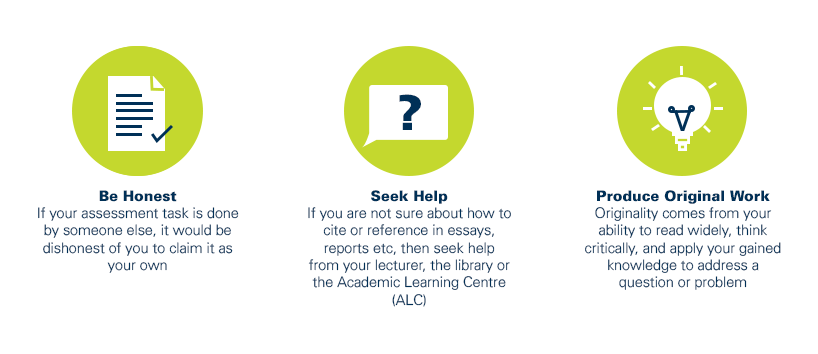
As a CQUniversity student you are expected to act honestly in all aspects of your academic work.
Any assessable work undertaken or submitted for review or assessment must be your own work. Assessable work is any type of work you do to meet the assessment requirements in the unit, including draft work submitted for review and feedback and final work to be assessed.
When you use the ideas, words or data of others in your assessment, you must thoroughly and clearly acknowledge the source of this information by using the correct referencing style for your unit. Using others’ work without proper acknowledgement may be considered a form of intellectual dishonesty.
Participating honestly, respectfully, responsibly, and fairly in your university study ensures the CQUniversity qualification you earn will be valued as a true indication of your individual academic achievement and will continue to receive the respect and recognition it deserves.
As a student, you are responsible for reading and following CQUniversity’s policies, including the Student Academic Integrity Policy and Procedure. This policy sets out CQUniversity’s expectations of you to act with integrity, examples of academic integrity breaches to avoid, the processes used to address alleged breaches of academic integrity, and potential penalties.
What is a breach of academic integrity?
A breach of academic integrity includes but is not limited to plagiarism, self-plagiarism, collusion, cheating, contract cheating, and academic misconduct. The Student Academic Integrity Policy and Procedure defines what these terms mean and gives examples.
Why is academic integrity important?
A breach of academic integrity may result in one or more penalties, including suspension or even expulsion from the University. It can also have negative implications for student visas and future enrolment at CQUniversity or elsewhere. Students who engage in contract cheating also risk being blackmailed by contract cheating services.
Where can I get assistance?
For academic advice and guidance, the Academic Learning Centre (ALC) can support you in becoming confident in completing assessments with integrity and of high standard.
What can you do to act with integrity?