Overview
The creative industries is one of the fastest-growing and most dynamic sectors; and yet it is only in the last couple of decades that the arts has been seen as an industry at all. In this unit, you will explore how the creative arts industries sit on the international stage and within the broader Australian context. You will consider how the combination of ideas, talent, hands-on skills and the entrepreneurial spirit can be effectively applied within creative industry. You will investigate the history of the creative arts from medieval craftsmen, to renaissance and later artists, to modern day creative practitioners.
Details
Pre-requisites or Co-requisites
There are no requisites for this unit.
Important note: Students enrolled in a subsequent unit who failed their pre-requisite unit, should drop the subsequent unit before the census date or within 10 working days of Fail grade notification. Students who do not drop the unit in this timeframe cannot later drop the unit without academic and financial liability. See details in the Assessment Policy and Procedure (Higher Education Coursework).
Offerings For Term 1 - 2020
Attendance Requirements
All on-campus students are expected to attend scheduled classes - in some units, these classes are identified as a mandatory (pass/fail) component and attendance is compulsory. International students, on a student visa, must maintain a full time study load and meet both attendance and academic progress requirements in each study period (satisfactory attendance for International students is defined as maintaining at least an 80% attendance record).
Recommended Student Time Commitment
Each 6-credit Undergraduate unit at CQUniversity requires an overall time commitment of an average of 12.5 hours of study per week, making a total of 150 hours for the unit.
Class Timetable
Assessment Overview
Assessment Grading
This is a graded unit: your overall grade will be calculated from the marks or grades for each assessment task, based on the relative weightings shown in the table above. You must obtain an overall mark for the unit of at least 50%, or an overall grade of 'pass' in order to pass the unit. If any 'pass/fail' tasks are shown in the table above they must also be completed successfully ('pass' grade). You must also meet any minimum mark requirements specified for a particular assessment task, as detailed in the 'assessment task' section (note that in some instances, the minimum mark for a task may be greater than 50%). Consult the University's Grades and Results Policy for more details of interim results and final grades.
All University policies are available on the CQUniversity Policy site.
You may wish to view these policies:
- Grades and Results Policy
- Assessment Policy and Procedure (Higher Education Coursework)
- Review of Grade Procedure
- Student Academic Integrity Policy and Procedure
- Monitoring Academic Progress (MAP) Policy and Procedure - Domestic Students
- Monitoring Academic Progress (MAP) Policy and Procedure - International Students
- Student Refund and Credit Balance Policy and Procedure
- Student Feedback - Compliments and Complaints Policy and Procedure
- Information and Communications Technology Acceptable Use Policy and Procedure
This list is not an exhaustive list of all University policies. The full list of University policies are available on the CQUniversity Policy site.
Feedback, Recommendations and Responses
Every unit is reviewed for enhancement each year. At the most recent review, the following staff and student feedback items were identified and recommendations were made.
Feedback from Self-reflection
In the 2019 offering students were assessed with two assessments rather than three. Students responded well to this system, and unlike last year, no one failed the course outright.
Continue the double assessment system next year.
Feedback from Self-reflection
With two public holidays to contend with, scheduling was again an issue. One lecture had to take place in the semester break. Unfortunately not one student attended, on campus or via zoom.
That CQU institute a policy for dealing with rescheduling of classes that fall on public holidays.
- Describe the concept of creativity as it applies to the creative industries and the role it plays in Australian society
- Compare and contrast the creative industries in Australia with creative industries internationally
- Discuss the role of the creative arts at the local, national and international level.
Alignment of Assessment Tasks to Learning Outcomes
| Assessment Tasks | Learning Outcomes | ||
|---|---|---|---|
| 1 | 2 | 3 | |
| 1 - Essay - 40% | |||
| 2 - In-class Test(s) - 60% | |||
Alignment of Graduate Attributes to Learning Outcomes
| Graduate Attributes | Learning Outcomes | ||
|---|---|---|---|
| 1 | 2 | 3 | |
| 1 - Communication | |||
| 2 - Problem Solving | |||
| 3 - Critical Thinking | |||
| 4 - Information Literacy | |||
| 5 - Team Work | |||
| 6 - Information Technology Competence | |||
| 7 - Cross Cultural Competence | |||
| 8 - Ethical practice | |||
| 9 - Social Innovation | |||
| 10 - First Nations Knowledges | |||
| 11 - Aboriginal and Torres Strait Islander Cultures | |||
Alignment of Assessment Tasks to Graduate Attributes
| Assessment Tasks | Graduate Attributes | ||||||||||
|---|---|---|---|---|---|---|---|---|---|---|---|
| 1 | 2 | 3 | 4 | 5 | 6 | 7 | 8 | 9 | 10 | 11 | |
| 1 - Essay - 40% | |||||||||||
| 2 - In-class Test(s) - 60% | |||||||||||
Textbooks
There are no required textbooks.
IT Resources
- CQUniversity Student Email
- Internet
- Unit Website (Moodle)
All submissions for this unit must use the referencing style: American Psychological Association 6th Edition (APA 6th edition)
For further information, see the Assessment Tasks.
m.p.price@cqu.edu.au
Week 1
Begin Date: 09 Mar 2020Module/Topic
Lecture 1
Introduction to Creative Industries, Cultural Industries and the Creative Economy.
Chapter
Events and Submissions/Topic
Week 2
Begin Date: 16 Mar 2020Module/Topic
Lecture 2
Intellectual Property.
Chapter
Events and Submissions/Topic
Week 3
Begin Date: 23 Mar 2020Module/Topic
Lecture 3
Intellectual Property continued.
The History of Arts Funding.
Chapter
Events and Submissions/Topic
Week 4
Begin Date: 30 Mar 2020Module/Topic
Lecture 4
Audiences and Marketing.
Chapter
Events and Submissions/Topic
Week 5
Begin Date: 06 Apr 2020Module/Topic
Lecture 5
Creative Places.
Chapter
Events and Submissions/Topic
Mid Semester Break
Begin Date: 13 Apr 2020Module/Topic
No lecture this week.
Chapter
Events and Submissions/Topic
Week 6
Begin Date: 20 Apr 2020Module/Topic
Lecture 6
Creative Places continued.
YouTube.
Chapter
Events and Submissions/Topic
Week 7
Begin Date: 27 Apr 2020Module/Topic
Lecture 7
Life as a Freelancer
Chapter
Events and Submissions/Topic
Research Essay Due:
Deadline for submission is 11.55pm, Friday May 1st, 2020 (AEST).
Research Essay Due: Week 7 Friday (1 May 2020) 11:45 pm AEST
Week 8
Begin Date: 04 May 2020Module/Topic
Lecture 8
Alternate Realities
Chapter
Events and Submissions/Topic
Week 9
Begin Date: 11 May 2020Module/Topic
Lecture 9
The Artist as Commodity
Chapter
Events and Submissions/Topic
Week 10
Begin Date: 18 May 2020Module/Topic
Lecture 10
Superbowl!
Big, Better, Best
Chapter
Events and Submissions/Topic
Week 11
Begin Date: 25 May 2020Module/Topic
Lecture 11
Review week.
Chapter
Events and Submissions/Topic
Week 12
Begin Date: 01 Jun 2020Module/Topic
Lecture 12
In-Class Test
Chapter
Events and Submissions/Topic
The quiz will be open between 2.00 to 3.30 pm Tuesday June 2nd (AEST)
In-Class Test Due: Week 12 Friday (5 June 2020) 11:45 pm AEST
Review/Exam Week
Begin Date: 08 Jun 2020Module/Topic
Chapter
Events and Submissions/Topic
Exam Week
Begin Date: 15 Jun 2020Module/Topic
Chapter
Events and Submissions/Topic
1 Essay
Provide an overview of a town or city with a strong reputation as an important cultural centre.
What defining factors have cemented its place as an important destination? Discuss the role of marketing, as well as the events and cultural institutions that have contributed to this reputation. Ensure your essay includes a geographical and sociological context.
- The word limit for the essay is 1000-1500 words. Include a word count at the end of the essay. The word count is considered from the first word of the introduction to the last word of the conclusion. It excludes the cover page, abstract, contents page, reference page and appendices. It includes in-text references and direct quotations
- Your essay must contain a comprehensive Reference List
- Your Reference List should contain at least four different sources
- To adequately complete this assessment it is recommended that students consult a large variety of sources
- Essays are to be uploaded to the Research Essay link on the CART11001 Moodle site
- Essays must be in Word format
- Ensure you cite your sources and list them in the Reference List.
- When answering the question ensure you back up your assertions with evidence such as quotes and statistics
- Your essay must be formatted in accordance with the CQU APA Style Guide
- For assistance with essay writing please refer to the CQU Guide to Essay Writing
- Late submissions and extension deadlines will be governed by the Assessment Policy and Procedure Policy
Week 7 Friday (1 May 2020) 11:45 pm AEST
Week 10 Friday (22 May 2020)
- Evidence (25%)
- Conforms to APA Style Guide (20%)
- Spelling, Grammar, Overall Presentation (15%)
- Essay Structure (15%)
- Describe the concept of creativity as it applies to the creative industries and the role it plays in Australian society
- Compare and contrast the creative industries in Australia with creative industries internationally
- Discuss the role of the creative arts at the local, national and international level.
- Communication
- Critical Thinking
- Information Literacy
2 In-class Test(s)
- The quiz will consist of thirty questions from Weeks 1-11 of the 2020 CART11001 Creative Industries Course.
- This is an ‘open book’ test. Students are allowed to directly refer to the PowerPoint slides uploaded to Moodle
- This assessment will take place in regular class time during week 12 2020 and will ONLY be open 2.00 to 3.30pm (AEST)
- The quiz can be accessed through the CART11001 Moodle page
- Students may only attempt the quiz ONCE
- Students are strongly urged to complete the quiz at a CQU campus. Students who choose to complete the quiz off campus are responsible for internet connection and any technical issues which may arise
- N.B. it is not possible to re-sit the quiz because of issues with off-campus technical issues or internet connectivity
- Extension deadlines will be governed by the Assessment Policy and Procedure Policy
Week 12 Friday (5 June 2020) 11:45 pm AEST
This assessment to be completed in regular class time during week 12 2020. The quiz will ONLY be open between 9.30-11.00am (AEST).
Exam Week Friday (19 June 2020)
- Questions will be randomly generated from a larger question bank
- Individual questions will be worth between 1-4 marks
- Questions will be in short answer format
- Describe the concept of creativity as it applies to the creative industries and the role it plays in Australian society
- Compare and contrast the creative industries in Australia with creative industries internationally
- Discuss the role of the creative arts at the local, national and international level.
- Communication
- Critical Thinking
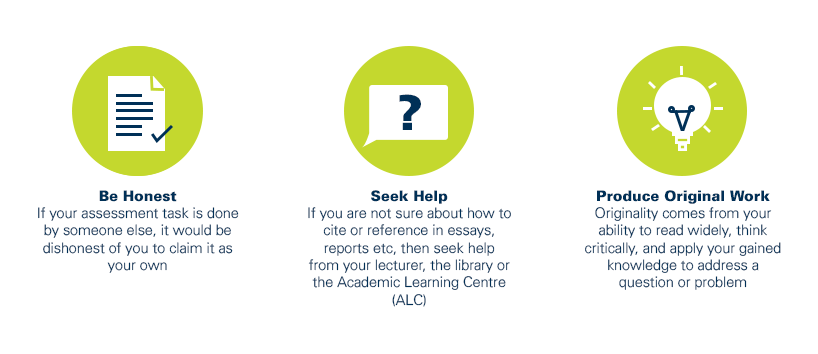
As a CQUniversity student you are expected to act honestly in all aspects of your academic work.
Any assessable work undertaken or submitted for review or assessment must be your own work. Assessable work is any type of work you do to meet the assessment requirements in the unit, including draft work submitted for review and feedback and final work to be assessed.
When you use the ideas, words or data of others in your assessment, you must thoroughly and clearly acknowledge the source of this information by using the correct referencing style for your unit. Using others’ work without proper acknowledgement may be considered a form of intellectual dishonesty.
Participating honestly, respectfully, responsibly, and fairly in your university study ensures the CQUniversity qualification you earn will be valued as a true indication of your individual academic achievement and will continue to receive the respect and recognition it deserves.
As a student, you are responsible for reading and following CQUniversity’s policies, including the Student Academic Integrity Policy and Procedure. This policy sets out CQUniversity’s expectations of you to act with integrity, examples of academic integrity breaches to avoid, the processes used to address alleged breaches of academic integrity, and potential penalties.
What is a breach of academic integrity?
A breach of academic integrity includes but is not limited to plagiarism, self-plagiarism, collusion, cheating, contract cheating, and academic misconduct. The Student Academic Integrity Policy and Procedure defines what these terms mean and gives examples.
Why is academic integrity important?
A breach of academic integrity may result in one or more penalties, including suspension or even expulsion from the University. It can also have negative implications for student visas and future enrolment at CQUniversity or elsewhere. Students who engage in contract cheating also risk being blackmailed by contract cheating services.
Where can I get assistance?
For academic advice and guidance, the Academic Learning Centre (ALC) can support you in becoming confident in completing assessments with integrity and of high standard.
What can you do to act with integrity?