Overview
Industry Work Placement provides you with an opportunity to reflect on the Information and Communications Technology course through a paid, supervised Work Integrated Learning (WIL) experience. You will apply the knowledge and skills that you have gained in your academic units to this work environment. You will practise your soft skills such as teamwork and communication skills in an authentic work environment. You will reflect on your strength and weaknesses in knowledge and skills, related both to your discipline and workplace experience for future improvement. You will evaluate how your university studies prepared you for the industry. Your industry supervisors will also provide you with feedback to assist this reflective process.
Details
Pre-requisites or Co-requisites
Pre-requisites: You must have completed all units in your course except this unit (COIT13238).
Important note: Students enrolled in a subsequent unit who failed their pre-requisite unit, should drop the subsequent unit before the census date or within 10 working days of Fail grade notification. Students who do not drop the unit in this timeframe cannot later drop the unit without academic and financial liability. See details in the Assessment Policy and Procedure (Higher Education Coursework).
Offerings For Term 1 - 2026
Attendance Requirements
All on-campus students are expected to attend scheduled classes - in some units, these classes are identified as a mandatory (pass/fail) component and attendance is compulsory. International students, on a student visa, must maintain a full time study load and meet both attendance and academic progress requirements in each study period (satisfactory attendance for International students is defined as maintaining at least an 80% attendance record).
Recommended Student Time Commitment
Each 12-credit Undergraduate unit at CQUniversity requires an overall time commitment of an average of 25 hours of study per week, making a total of 300 hours for the unit.
Class Timetable
Assessment Overview
Assessment Grading
This is a pass/fail (non-graded) unit. To pass the unit, you must pass all of the individual assessment tasks shown in the table above.
All University policies are available on the CQUniversity Policy site.
You may wish to view these policies:
- Grades and Results Policy
- Assessment Policy and Procedure (Higher Education Coursework)
- Review of Grade Procedure
- Student Academic Integrity Policy and Procedure
- Academic Progression Policy and Procedure
- Student Refund and Credit Balance Policy and Procedure
- Complaints Policy and Procedure
- Information and Communications Technology Acceptable Use Policy and Procedure
This list is not an exhaustive list of all University policies. The full list of University policies are available on the CQUniversity Policy site.
Feedback, Recommendations and Responses
Every unit is reviewed for enhancement each year. At the most recent review, the following staff and student feedback items were identified and recommendations were made.
Feedback from Student Feedback during term
More engagement with the Unit Coordinator
Regular updates to students regarding workplace issues by sharing latest new/media articles related to workplace issues and increase awareness.
- Apply ICT knowledge and skills in an authentic work environment
- Practise soft skills such as teamwork and communication skills in an authentic work environment
- Evaluate how your university studies prepared you for a job in the industry
- Critically reflect on strengths and weaknesses in knowledge and skills, related both to your discipline and workplace experience.
The Australian Computer Society (ACS) recognises the Skills Framework for the Information Age (SFIA). SFIA is adopted by organisations, governments and individuals in many countries and provides a widely used and consistent definition of ICT skills. SFIA is increasingly being used when developing job descriptions and role profiles. ACS members can use the tool MySFIA to build a skills profile.
This unit contributes to the following workplace skills as defined by SFIA 9 (the SFIA code is included):
- Technology service management (ITMG)
- Methods and tools (METL)
- Application support (ASUP)
- Problem management (PBMG)
This unit will also contribute to skills related to the major, depending on the job role.
Alignment of Assessment Tasks to Learning Outcomes
| Assessment Tasks | Learning Outcomes | |||
|---|---|---|---|---|
| 1 | 2 | 3 | 4 | |
| 1 - Written Assessment - 100% | ||||
Alignment of Graduate Attributes to Learning Outcomes
| Graduate Attributes | Learning Outcomes | |||
|---|---|---|---|---|
| 1 | 2 | 3 | 4 | |
| 1 - Communication | ||||
| 2 - Problem Solving | ||||
| 3 - Critical Thinking | ||||
| 4 - Information Literacy | ||||
| 5 - Team Work | ||||
| 6 - Information Technology Competence | ||||
| 7 - Cross Cultural Competence | ||||
| 8 - Ethical practice | ||||
| 9 - Social Innovation | ||||
| 10 - First Nations Knowledges | ||||
| 11 - Aboriginal and Torres Strait Islander Cultures | ||||
Textbooks
There are no required textbooks.
IT Resources
- CQUniversity Student Email
- Internet
- Unit Website (Moodle)
- Microsoft Teams
- Zoom (both microphone and webcam capability)
- Access to Microsoft software such as Word, PowerPoint, MS Project and Visio
All submissions for this unit must use the referencing style: Harvard (author-date)
For further information, see the Assessment Tasks.
r.sarin@cqu.edu.au
Week 1
Begin Date: 09 Mar 2026Module/Topic
Meeting 1 - Assessment Overview
Chapter
Events and Submissions/Topic
Attend host organisation as per placement/training agreement.
Zoom meeting with Unit Coordinator: Friday, 4pm AEST. Attendance is mandatory. Topic: overview of assessment requirements, Moodle site and internship/placement expectations.
Week 2
Begin Date: 16 Mar 2026Module/Topic
(no meeting)
Chapter
Events and Submissions/Topic
Attend host organisation as per training agreement.
Week 3
Begin Date: 23 Mar 2026Module/Topic
(no meeting)
Chapter
Events and Submissions/Topic
Attend host organisation as per training agreement.
Week 4
Begin Date: 30 Mar 2026Module/Topic
(no meeting)
Chapter
Events and Submissions/Topic
Attend host organisation as per training agreement.
Plan: Submit a written report outlining an overview of the host organisation, your role within the placement, the roles of your collaborators, and the tasks you intend to undertake.
Deadline: 6:00 PM AEST, Friday of Week 4
Week 5
Begin Date: 06 Apr 2026Module/Topic
Meeting 2 - Career Planning
Chapter
Events and Submissions/Topic
Attend host organisation as per training agreement.
Zoom meeting with Unit Coordinator: Friday, 4pm AEST. Attendance is mandatory. Topic: self-assessing skills with ICT frameworks (e.g., SFIA)
Week 6
Begin Date: 13 Apr 2026Module/Topic
(no meeting)
Chapter
Events and Submissions/Topic
Attend host organisation as per training agreement.
Vacation Week
Begin Date: 20 Apr 2026Module/Topic
(no meeting)
Chapter
Events and Submissions/Topic
Attend host organisation as per training agreement.
You do not have a Vacation Week as you attend the host organisation for 12 consecutive weeks.
Week 7
Begin Date: 27 Apr 2026Module/Topic
Meeting 3 - Report Update
Chapter
Events and Submissions/Topic
Attend host organisation as per training agreement.
Zoom meeting with Unit Coordinator: Friday, 4pm AEST. Attendance is mandatory. Topic: check-in on diary of weekly tasks and discuss finalising the report.
Week 8
Begin Date: 04 May 2026Module/Topic
(no meeting)
Chapter
Events and Submissions/Topic
Attend host organisation as per training agreement.
Week 9
Begin Date: 11 May 2026Module/Topic
(no meeting)
Chapter
Events and Submissions/Topic
Attend host organisation as per training agreement.
Week 10
Begin Date: 18 May 2026Module/Topic
Meeting 4 - Presentation Planning
Chapter
Events and Submissions/Topic
Attend host organisation as per training agreement.
Zoom meeting with Unit Coordinator: Friday, 4pm AEST. Attendance is mandatory. Topic: discuss expectations of presentations.
Week 11
Begin Date: 25 May 2026Module/Topic
Presentations
Chapter
Events and Submissions/Topic
Attend host organisation as per training agreement.
Deliver your presentation at designated slots throughout the week.
Deadline: 6pm AEST Friday, Week 11 - Presentation Slides
Week 12
Begin Date: 01 Jun 2026Module/Topic
(no meeting)
Chapter
Events and Submissions/Topic
Deadline: 6pm AEST Friday, Week 12 - Career Planning
Exam Week
Begin Date: 08 Jun 2026Module/Topic
Chapter
Events and Submissions/Topic
Vacation/Exam Week
Begin Date: 15 Jun 2026Module/Topic
Chapter
Events and Submissions/Topic
Unit Coordinator
Associate Professor Rajesh Sarin
School of Engineering & Technology
CQUniversity Brisbane, 160 Ann Street, Brisbane, Qld 4000
P +61 07 3295 1141 | E r.sarin@cqu.edu.au
1 Written Assessment
Assessment Components
This is a pass/fail unit. There are multiple components of the assessment, and you must achieve a pass for every component in order to pass this unit. The components are:
- Plan: a written report that provides an overview of the host organisation, your role and that of the people you are working with, and your planned tasks.
- Presentation: an oral presentation, with slides, where you summarise your tasks and learnings. The presentation is between 15-20 minutes, including questions and answers.
- Report: a written report that expands on the Plan, where you describe the actual tasks completed and reflect on your learnings. This must include a diary of tasks completed each week (which you update each week).
- Career Planning: assess your own skills against ICT frameworks (e.g., SFIA) and against currently available jobs (e.g., on SEEK), and update your CV in preparation for those jobs.
- Host Organisation Feedback: you will complete evaluation forms during the term and submit them to your host organisation. Your host will evaluate you and return the forms to CQU.
Further details of each component, including templates, are provided on Moodle.
Deadlines
The deadline for each component is included in the schedule. This assessment is exempted from the 72-hour submission grace period and must be completed by the stated submission date/time.
The oral presentations will be scheduled across multiple time slots in Week 11. You will be given a choice of time slots prior to Week 11.
Gen AI usage instructions:
AI ASSESSMENT SCALE - FULL AI
You may use Al extensively throughout your work, either as you wish or as specifically directed in your assessment. Focus on directing Al to achieve your goals while demonstrating your critical thinking.
You may use AI to complete any elements of the assessment task and then critique and reflect on the AI-generated content, proposing further improvements as appropriate. You must cite (refer to AI citation guidelines by ALC) any AI-generated content. You can use AI tools in multiple ways to achieve the assessment outcomes, as long as you clearly state when and where AI is used in the assessment.
See schedule for deadlines of each component
Plan and Presentation returned 2 weeks after submission; others returned on Certification of Grades day.
Submission
The Plan, Presentation slides, Report and Career Planning must be submitted on Moodle. The Career Planning outputs must also be submitted on Moodle. The Presentation must be delivered live in a scheduled presentation slot.
The Host Organisation Feedback is not submitted on Moodle, but via an external system. Instructions for use will be provided during the term.
All written reports must be submitted as Microsoft Word files, and presentation slides as Microsoft PowerPoint format. Other formats, including zip, will not be accepted.
Marking Criteria
All assessments must be prepared to the professional level expected of an ICT graduate. This includes professional formatting, writing styles, referencing in written reports, and professional appearance, formatting and speaking in the presentation. There are no word or page limits on reports. Your reports and presentation must demonstrate your in-depth knowledge of the technologies and processes used in the host organisation, and demonstrate your ability to evaluate issues and identify approaches to solving them. You must provide sufficient detail to allow teaching staff, including the Unit Coordinator, to understand what you have done and learnt at the host organisation.
Failure to submit components in the required format may result in a fail mark. Failure to attend your presentation in your designated time slot may result in a fail mark.
- Apply ICT knowledge and skills in an authentic work environment
- Practise soft skills such as teamwork and communication skills in an authentic work environment
- Evaluate how your university studies prepared you for a job in the industry
- Critically reflect on strengths and weaknesses in knowledge and skills, related both to your discipline and workplace experience.
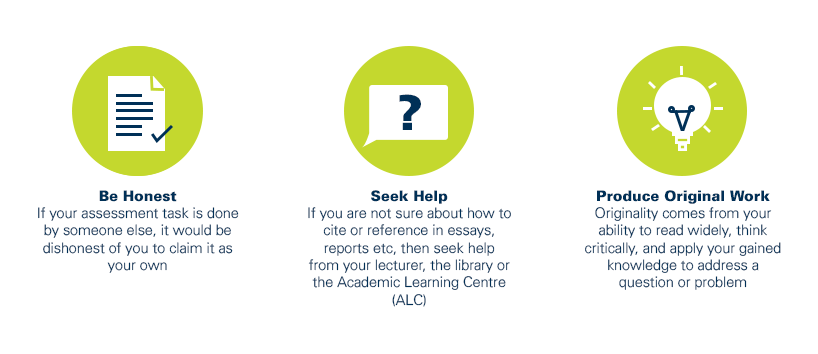
As a CQUniversity student you are expected to act honestly in all aspects of your academic work.
Any assessable work undertaken or submitted for review or assessment must be your own work. Assessable work is any type of work you do to meet the assessment requirements in the unit, including draft work submitted for review and feedback and final work to be assessed.
When you use the ideas, words or data of others in your assessment, you must thoroughly and clearly acknowledge the source of this information by using the correct referencing style for your unit. Using others’ work without proper acknowledgement may be considered a form of intellectual dishonesty.
Participating honestly, respectfully, responsibly, and fairly in your university study ensures the CQUniversity qualification you earn will be valued as a true indication of your individual academic achievement and will continue to receive the respect and recognition it deserves.
As a student, you are responsible for reading and following CQUniversity’s policies, including the Student Academic Integrity Policy and Procedure. This policy sets out CQUniversity’s expectations of you to act with integrity, examples of academic integrity breaches to avoid, the processes used to address alleged breaches of academic integrity, and potential penalties.
What is a breach of academic integrity?
A breach of academic integrity includes but is not limited to plagiarism, self-plagiarism, collusion, cheating, contract cheating, and academic misconduct. The Student Academic Integrity Policy and Procedure defines what these terms mean and gives examples.
Why is academic integrity important?
A breach of academic integrity may result in one or more penalties, including suspension or even expulsion from the University. It can also have negative implications for student visas and future enrolment at CQUniversity or elsewhere. Students who engage in contract cheating also risk being blackmailed by contract cheating services.
Where can I get assistance?
For academic advice and guidance, the Academic Learning Centre (ALC) can support you in becoming confident in completing assessments with integrity and of high standard.
What can you do to act with integrity?