Overview
Information systems analysis and design is a complex, challenging, and stimulating organisational process, that a team of business and systems professionals use to develop and maintain computer-based information systems. In this unit, you will learn the importance of responding to and anticipating problems through the innovative use of systems development process. You will learn how understanding user-centered design and task-centered design are fundamental to good systems design. In order to understand these concepts, you will study how to determine user-requirements and convert user requirements to system design. You will demonstrate this understanding by designing web-interfaces of given case studies and practical examples. You will study different phases of the systems development life cycle, which includes developing a system proposal, determining user requirements, designing a system, and applying key principles to the implementation of a system. You will also explore the organisational context and the iterative nature of systems analysis and design.
Details
Pre-requisites or Co-requisites
Anti-requisites: COIS20025 Systems Development Overview. Students who have studied COIS20025 in the past cannot take COIT20248.
Important note: Students enrolled in a subsequent unit who failed their pre-requisite unit, should drop the subsequent unit before the census date or within 10 working days of Fail grade notification. Students who do not drop the unit in this timeframe cannot later drop the unit without academic and financial liability. See details in the Assessment Policy and Procedure (Higher Education Coursework).
Offerings For Term 2 - 2026
Attendance Requirements
All on-campus students are expected to attend scheduled classes - in some units, these classes are identified as a mandatory (pass/fail) component and attendance is compulsory. International students, on a student visa, must maintain a full time study load and meet both attendance and academic progress requirements in each study period (satisfactory attendance for International students is defined as maintaining at least an 80% attendance record).
Recommended Student Time Commitment
Each 6-credit Postgraduate unit at CQUniversity requires an overall time commitment of an average of 12.5 hours of study per week, making a total of 150 hours for the unit.
Class Timetable
Assessment Overview
Assessment Grading
This is a graded unit: your overall grade will be calculated from the marks or grades for each assessment task, based on the relative weightings shown in the table above. You must obtain an overall mark for the unit of at least 50%, or an overall grade of 'pass' in order to pass the unit. If any 'pass/fail' tasks are shown in the table above they must also be completed successfully ('pass' grade). You must also meet any minimum mark requirements specified for a particular assessment task, as detailed in the 'assessment task' section (note that in some instances, the minimum mark for a task may be greater than 50%). Consult the University's Grades and Results Policy for more details of interim results and final grades.
All University policies are available on the CQUniversity Policy site.
You may wish to view these policies:
- Grades and Results Policy
- Assessment Policy and Procedure (Higher Education Coursework)
- Review of Grade Procedure
- Student Academic Integrity Policy and Procedure
- Academic Progression Policy and Procedure
- Student Refund and Credit Balance Policy and Procedure
- Complaints Policy and Procedure
- Information and Communications Technology Acceptable Use Policy and Procedure
This list is not an exhaustive list of all University policies. The full list of University policies are available on the CQUniversity Policy site.
Feedback, Recommendations and Responses
Every unit is reviewed for enhancement each year. At the most recent review, the following staff and student feedback items were identified and recommendations were made.
Feedback from Student Unit and Teaching Evaluations
The clear and knowledgeable explanation of systems analysis techniques (e.g., data flow diagrams, requirement gathering) was helpful to students in grasping complex ideas.
Should continue providing clear and knowledgeable explanations.
Feedback from Student Unit and Teaching Evaluations
Effectively connected unit content to real-world applications, enhancing student understanding and relevance of the subject matter.
The practice of linking content to real-world applications has proven effective and should be sustained in future offerings to enhance student engagement and relevance.
- Develop requirements, specifications and provide academic and practical arguments to defend the solutions by employing core principles of information system analysis and design
- Develop prototypes for computer-based information systems demonstrating initiative and problem-solving judgement to meet client briefs
- Employ effective interpersonal and professional skills to collaborate with and influence team members to achieve a negotiated team outcome while maintaining responsibility and accountability for their own learning and work
- Analyse and evaluate to critically reflect on the alternative methodologies used in developing business information systems
- Critically analyse and evaluate different modelling techniques for developing business information systems.
The Australian Computer Society (ACS) recognises the Skills Framework for the Information Age (SFIA). SFIA is adopted by organisations, governments and individuals in many countries and provides a widely used and consistent definition of ICT skills. SFIA is increasingly being used when developing job descriptions and role profiles. ACS members can use the tool MySFIA to build a skills profile.
This unit contributes to the following workplace skills as defined by SFIA 9 (the SFIA code is included):
- Strategy Planning (ITSP)
- Business Situation Analysis (BUSA)
- Requirements Definition and Management (REQM)
- Business Modelling (BSMO)
- Systems Design (DESN)
- User Experience Design (HCEV)
Alignment of Assessment Tasks to Learning Outcomes
| Assessment Tasks | Learning Outcomes | ||||
|---|---|---|---|---|---|
| 1 | 2 | 3 | 4 | 5 | |
| 1 - Project (applied) - 30% | |||||
| 2 - Project (applied) - 30% | |||||
| 3 - Project (applied) - 40% | |||||
Alignment of Graduate Attributes to Learning Outcomes
| Graduate Attributes | Learning Outcomes | ||||
|---|---|---|---|---|---|
| 1 | 2 | 3 | 4 | 5 | |
| 1 - Knowledge | |||||
| 2 - Communication | |||||
| 3 - Cognitive, technical and creative skills | |||||
| 4 - Research | |||||
| 5 - Self-management | |||||
| 6 - Ethical and Professional Responsibility | |||||
| 7 - Leadership | |||||
| 8 - First Nations Knowledges | |||||
| 9 - Aboriginal and Torres Strait Islander Cultures | |||||
Textbooks
Essentials of Systems Analysis and Design (Global Edition)
- Edition: 6th (2015)
- Authors: J.S. Valacich, J.F. George, J.A. Hoffer
- Pearson
- Boston Boston , USA
- ISBN: 1-292-07661-5
No
IT Resources
- CQUniversity Student Email
- Internet
- Unit Website (Moodle)
- MS Office
- MS Project
- MS Visio
All submissions for this unit must use the referencing style: Harvard (author-date)
For further information, see the Assessment Tasks.
u.venugopal@cqu.edu.au
Week 1
Begin Date: 13 Jul 2026Module/Topic
Systems Development Environment & the sources of software
Chapter
Chapter 1 & 2 (Prescribed Textbook)
Events and Submissions/Topic
Week 2
Begin Date: 20 Jul 2026Module/Topic
Managing the Information Systems Project; Systems Planning & Selection
Chapter
Chapters 3 & 4 (Prescribed Textbook)
Events and Submissions/Topic
Week 3
Begin Date: 27 Jul 2026Module/Topic
Agile Methodologies
Chapter
Appendix B (Prescribed Textbook)
Events and Submissions/Topic
Week 4
Begin Date: 03 Aug 2026Module/Topic
Determining System Requirements; Use Case Modeling
Chapter
Chapter 5 (Prescribed Textbook)
Events and Submissions/Topic
Week 5
Begin Date: 10 Aug 2026Module/Topic
Structuring System Requirements: Process Modeling
Chapter
Chapter 6 (Prescribed Textbook)
Events and Submissions/Topic
Week 6
Begin Date: 17 Aug 2026Module/Topic
Designing the Human Interface
Chapter
Chapter 8 (Prescribed Textbook)
Events and Submissions/Topic
Vacation Week
Begin Date: 24 Aug 2026Module/Topic
Chapter
Events and Submissions/Topic
Week 7
Begin Date: 31 Aug 2026Module/Topic
Structuring Systems Requirements Conceptual Data Modelling
Chapter
Chapter 7 (Prescribed Textbook)
Events and Submissions/Topic
Week 8
Begin Date: 07 Sep 2026Module/Topic
Object-Oriented Analysis & Design
Chapter
Appendix A (Prescribed Textbook)
Events and Submissions/Topic
Week 9
Begin Date: 14 Sep 2026Module/Topic
Systems Implementation & Operations
Chapter
Chapter 10 (Prescribed Textbook)
Events and Submissions/Topic
Week 10
Begin Date: 21 Sep 2026Module/Topic
Software Testing
Chapter
Ian Sommerville, (2011), Software Engineering, Chapter 8: Software Testing, Ninth Edition, Addison-Wesley.
Pooja Kaplesh, Severin K. Y. Pang (2020), Software Engineering for Agile Application Development, IGI Global, DOI: 10.4018/978-1-7998-2531-9.ch008
Events and Submissions/Topic
Week 11
Begin Date: 28 Sep 2026Module/Topic
Software Quality Management
Chapter
Ian Sommerville, (2011), Software Engineering, Chapters 24: Quality Management and Configuration Management, Ninth Edition, Addison-Wesley.
Events and Submissions/Topic
Week 12
Begin Date: 05 Oct 2026Module/Topic
Software Evolution
Chapter
Chapter 9: Software evolution from Ian Sommerville (2011), Software Engineering, Ninth Edition, Addison-Wesley.
Events and Submissions/Topic
Exam Week
Begin Date: 12 Oct 2026Module/Topic
Chapter
Events and Submissions/Topic
Vacation/Exam Week
Begin Date: 19 Oct 2026Module/Topic
Chapter
Events and Submissions/Topic
Unit coordinator: Umapathy Venugopal
Email: u.venugopal@cqu.edu.au
Ph: (02) 9324 5789
1 Project (applied)
Assessment 1 is an individual assessment. You will plan and manage a project as well as analyse and select the most appropriate systems development methodology based on the project on hand. You will produce a report that discusses the project based on your understanding and analysis. The case study will be provided to you via Moodle in Week 1 or 2. This assessment will assess the unit knowledge gained between Weeks 1-4 about the different facets of systems development.
AI ASSESSMENT SCALE: AI PLANNING
You may use AI for planning, idea development, and research. Your final submission should show how you have developed and refined these ideas.
For this assessment, three days of default extension is permitted.
Week 5 Friday (14 Aug 2026) 11:59 am AEST
Late submissions are subject to the university's late submission penalty policies
Week 7 Friday (4 Sept 2026)
Marking and feedback will be returned to you via Moodle
The assessment criteria will cover the contents and the presentation/format of the submission. You will be assessed based on your knowledge and understanding about how to perform the following:
- analyse the business and project environment
- analyse and choose the most appropriate systems development methodology
- perform project planning and management.
The following criteria will be used for assessing your submission:
- Selection and Justification of Methodology
- GenAI Prompt, Response, and Critique
- Stakeholder Identification and Concerns
- Requirements Gathering
- Functional Requirements
- Use Case Diagram
- GenAI Use Case Support and Critique
- Team Structure and Justification
- Risks and Mitigation Strategies
- Future AI Integration Planning
- GenAI Reflection
In addition, all the different parts of the assessment should be written in a professional and coherent manner. A detailed marking template will be made available later with the assignment specification on the Moodle unit webpage.
- Develop requirements, specifications and provide academic and practical arguments to defend the solutions by employing core principles of information system analysis and design
- Critically analyse and evaluate different modelling techniques for developing business information systems.
2 Project (applied)
Assessment 2 is a group assessment. You are required to form a team of 3 to 4 members. Your knowledge gained about how to model the systems requirements in both the object-oriented and traditional approaches will be assessed in this assessment. Your group needs to submit a design of a web-based system. Your design should include various elements such as critical use cases and data flow diagrams. Your submission should also include a prototype of the website design. The assessment details will be released later via Moodle.
AI ASSESSMENT SCALE: AI PLANNING
You may use AI for planning, idea development, and research. Your final submission should show how you have developed and refined these ideas.
For this assessment, three days of default extension is permitted.
Week 8 Friday (11 Sept 2026) 11:59 pm AEST
This is a group assessment to be submitted online via Moodle. Only one group member will submit the report. Late submissions are subject to the university's late submission penalty policies
Week 11 Friday (2 Oct 2026)
Marking and feedback will be returned to you via Moodle
For the group report, the assessment criteria will cover the contents and the presentation/format of the submission. In addition, all the different parts of the assessment should be written in a professional and coherent manner.
For the task of agile requirements, the following criteria will be mainly used for assessment:
- Individual initiative
- AI use and synthesis
- Group collaboration
For the task of process modelling the following criteria will be used for assessment:
- Context diagram
- Process Description
- DFD Quality
- Error Correction
For the task of Interface Design, the following criteria will be used for assessment:
- Design Quality
- AI Feedback Evaluation
- Contextual Understanding
A detailed marking template will be made available on the Moodle unit webpage later along with assessment specification.
- Develop prototypes for computer-based information systems demonstrating initiative and problem-solving judgement to meet client briefs
- Employ effective interpersonal and professional skills to collaborate with and influence team members to achieve a negotiated team outcome while maintaining responsibility and accountability for their own learning and work
- Analyse and evaluate to critically reflect on the alternative methodologies used in developing business information systems
3 Project (applied)
Assessment 3 is an individual assessment. You will design how to test a software system and plan for a systematic system installation process. Overall, this assessment tests your knowledge and understanding on how to deliver an effective and high-quality system to end users. In this assessment, you will be assessed on your understanding of the relevant concepts and ability to apply these concepts to a commercial-like development project.
AI ASSESSMENT SCALE: AI PLANNING
You may use AI for planning, idea development, and research. Your final submission should show how you have developed and refined these ideas.
For this assessment, three days of default extension is permitted.
Week 12 Friday (9 Oct 2026) 11:59 am AEST
Late submissions are subject to the university's late submission penalty policies
Vacation/Exam Week Friday (23 Oct 2026)
Marks of Assessment 3 will be released to you on the certificate date as this is the final assessment (in line with CQU policy).
The assessment criteria will cover the concepts and the presentation/format of the submission. In addition, all the different parts of the assessment should be written in a professional and coherent manner. The following criteria will be used mainly to assess your submission:
- Applicability of Unit, System and other tests
- Module Testing Approach and Test Cases
- Infeasibility of Complete Testing
- User Training Methods
- Selected Installation Option and Justification
- Adequate Use of CQU Harvard References
A detailed marking template will be made available on the Moodle unit webpage later along with assessment specification.
- Develop requirements, specifications and provide academic and practical arguments to defend the solutions by employing core principles of information system analysis and design
- Analyse and evaluate to critically reflect on the alternative methodologies used in developing business information systems
As a CQUniversity student you are expected to act honestly in all aspects of your academic work.
Any assessable work undertaken or submitted for review or assessment must be your own work. Assessable work is any type of work you do to meet the assessment requirements in the unit, including draft work submitted for review and feedback and final work to be assessed.
When you use the ideas, words or data of others in your assessment, you must thoroughly and clearly acknowledge the source of this information by using the correct referencing style for your unit. Using others’ work without proper acknowledgement may be considered a form of intellectual dishonesty.
Participating honestly, respectfully, responsibly, and fairly in your university study ensures the CQUniversity qualification you earn will be valued as a true indication of your individual academic achievement and will continue to receive the respect and recognition it deserves.
As a student, you are responsible for reading and following CQUniversity’s policies, including the Student Academic Integrity Policy and Procedure. This policy sets out CQUniversity’s expectations of you to act with integrity, examples of academic integrity breaches to avoid, the processes used to address alleged breaches of academic integrity, and potential penalties.
What is a breach of academic integrity?
A breach of academic integrity includes but is not limited to plagiarism, self-plagiarism, collusion, cheating, contract cheating, and academic misconduct. The Student Academic Integrity Policy and Procedure defines what these terms mean and gives examples.
Why is academic integrity important?
A breach of academic integrity may result in one or more penalties, including suspension or even expulsion from the University. It can also have negative implications for student visas and future enrolment at CQUniversity or elsewhere. Students who engage in contract cheating also risk being blackmailed by contract cheating services.
Where can I get assistance?
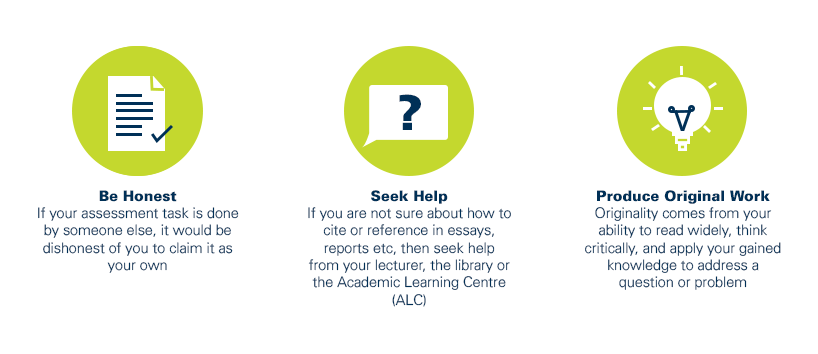
For academic advice and guidance, the Academic Learning Centre (ALC) can support you in becoming confident in completing assessments with integrity and of high standard.
What can you do to act with integrity?