Overview
This unit offers the foundational communication skills, expectations, and ethical considerations that shape the role of Information and Communications Technology (ICT) professionals, also called digital professionals. Through hands-on activities, you will learn to communicate professionally, both in written and verbal forms, fostering clear and persuasive communication. The unit delves into strategies for effective interpersonal communication within team settings, promoting collaborative teamwork and conflict resolution. It equips you to develop and deliver effective oral presentations underpinned by critical thinking. In addition, this unit strongly emphasises ethics and codes of conduct in the ICT profession. You will apply ethical principles to real-world ICT scenarios, demonstrating ethical, legal, and societal decision-making competencies. Through a blend of theory and practical in-class activities, you will be well-prepared to navigate the multifaceted landscape of ICT professionalism.
Details
Pre-requisites or Co-requisites
Anti-requisite: COIT20233 Professional Skills for Information and Communication Technology.
Important note: Students enrolled in a subsequent unit who failed their pre-requisite unit, should drop the subsequent unit before the census date or within 10 working days of Fail grade notification. Students who do not drop the unit in this timeframe cannot later drop the unit without academic and financial liability. See details in the Assessment Policy and Procedure (Higher Education Coursework).
Offerings For Term 2 - 2026
Attendance Requirements
All on-campus students are expected to attend scheduled classes - in some units, these classes are identified as a mandatory (pass/fail) component and attendance is compulsory. International students, on a student visa, must maintain a full time study load and meet both attendance and academic progress requirements in each study period (satisfactory attendance for International students is defined as maintaining at least an 80% attendance record).
Recommended Student Time Commitment
Each 6-credit Postgraduate unit at CQUniversity requires an overall time commitment of an average of 12.5 hours of study per week, making a total of 150 hours for the unit.
Class Timetable
Assessment Overview
Assessment Grading
This is a graded unit: your overall grade will be calculated from the marks or grades for each assessment task, based on the relative weightings shown in the table above. You must obtain an overall mark for the unit of at least 50%, or an overall grade of 'pass' in order to pass the unit. If any 'pass/fail' tasks are shown in the table above they must also be completed successfully ('pass' grade). You must also meet any minimum mark requirements specified for a particular assessment task, as detailed in the 'assessment task' section (note that in some instances, the minimum mark for a task may be greater than 50%). Consult the University's Grades and Results Policy for more details of interim results and final grades.
All University policies are available on the CQUniversity Policy site.
You may wish to view these policies:
- Grades and Results Policy
- Assessment Policy and Procedure (Higher Education Coursework)
- Review of Grade Procedure
- Student Academic Integrity Policy and Procedure
- Academic Progression Policy and Procedure
- Student Refund and Credit Balance Policy and Procedure
- Complaints Policy and Procedure
- Information and Communications Technology Acceptable Use Policy and Procedure
This list is not an exhaustive list of all University policies. The full list of University policies are available on the CQUniversity Policy site.
Feedback, Recommendations and Responses
Every unit is reviewed for enhancement each year. At the most recent review, the following staff and student feedback items were identified and recommendations were made.
Feedback from Unit Coordinator's Reflection
Students often face uncertainty regarding the appropriate and ethical use of generative artificial intelligence (GenAI) in assessments, particularly in understanding acceptable levels of GenAI assistance, maintaining academic integrity, and ensuring that submitted work reflects their own knowledge, skills and critical thinking.
Introduce an in-class activity or assessment component that encourages students to critically reflect on the responsible use of GenAI in assessments, including acceptable AI assistance, academic integrity and independent thinking.
Feedback from Unit Coordinator's Reflection
More opportunities to apply ethical theories to practical scenarios, particularly when navigating complex ethical dilemmas, would enhance understanding and ethical decision-making skills.
Introduce more scenario-based tutorial activities involving contemporary ethical dilemmas, encouraging students to apply relevant theories, consider alternative perspectives and justify their decisions.
Feedback from Student Evaluation Feedback
Students appreciated the clear explanations, supportive teaching approach and practical examples that helped them understand unit concepts and their relevance to professional practice.
Continue using clear explanations, practical examples and interactive teaching approaches to maintain student engagement and support effective learning.
- Describe the skills and expectations that define ICT professionals, including attributes, communication skills, and ethical considerations
- Illustrate the ability to communicate professionally, facilitating clear and persuasive communication in both written and verbal forms
- Apply effective strategies for interpersonal communication within team settings to foster collaborative teamwork
- Develop and deliver compelling oral presentations supported by critical thinking, ensuring convincing and impactful communication of complex concepts
- Demonstrate the application of ethical principles and codes of conduct to real-world ICT scenarios, showcasing ethical, legal and societal decision-making competencies.
The Australian Computer Society (ACS), the professional association for Australia's ICT sector, recognises the Skills Framework for the Information Age (SFIA). SFIA is adopted by organisations, governments, and individuals in many countries and provides a widely used and consistent definition of ICT skills. SFIA is increasingly being used when developing job descriptions and role profiles. ACS members can use the tool MySFIA to build a skills profile. This unit contributes to the following workplace skills as defined by SFIA 8 (the SFIA code is included):
- Business situation analysis (BUSA)
- Business administration (ADMN)
- Competency assessment (LEDA)
- Consultancy (CNSL)
- Emerging technology monitoring (EMRG)
- Learning delivery (ETDL)
- Requirements definition and management (REQM)
- Research (RSCH)
- Risk management (BURM)
Alignment of Assessment Tasks to Learning Outcomes
| Assessment Tasks | Learning Outcomes | ||||
|---|---|---|---|---|---|
| 1 | 2 | 3 | 4 | 5 | |
| 1 - Presentation - 20% | |||||
| 2 - Portfolio - 45% | |||||
| 3 - Report - 35% | |||||
Alignment of Graduate Attributes to Learning Outcomes
| Graduate Attributes | Learning Outcomes | ||||
|---|---|---|---|---|---|
| 1 | 2 | 3 | 4 | 5 | |
| 1 - Knowledge | |||||
| 2 - Communication | |||||
| 3 - Cognitive, technical and creative skills | |||||
| 4 - Research | |||||
| 5 - Self-management | |||||
| 6 - Ethical and Professional Responsibility | |||||
| 7 - Leadership | |||||
| 8 - First Nations Knowledges | |||||
| 9 - Aboriginal and Torres Strait Islander Cultures | |||||
Textbooks
There are no required textbooks.
IT Resources
- CQUniversity Student Email
- Internet
- Unit Website (Moodle)
- Webcam, microphone and speakers (or headset)
All submissions for this unit must use the referencing style: Harvard (author-date)
For further information, see the Assessment Tasks.
g.galea@cqu.edu.au
Week 1
Begin Date: 13 Jul 2026Module/Topic
Skills and Expectations of ICT Professionals
Chapter
Refer to the unit's Moodle website for assigned readings.
Events and Submissions/Topic
Week 2
Begin Date: 20 Jul 2026Module/Topic
Professional ICT Ethics and Codes of Conduct
Chapter
Refer to the unit's Moodle website for assigned readings.
Events and Submissions/Topic
Week 3
Begin Date: 27 Jul 2026Module/Topic
Professional Communication
Chapter
Refer to the unit's Moodle website for assigned readings.
Events and Submissions/Topic
Discuss Assessment 1 (Presentation) group formation with your tutor. Obtain approval for the Presentation, Company/Organisation and Presentation date for all students by the end of Week 3.
Assessment 1 is a compulsory assignment with a minimum mark requirement that all students must achieve to pass the unit.
Read specifications for Assessment 2 (Parts A, B and C).
Week 4
Begin Date: 03 Aug 2026Module/Topic
Working Individually, Teamwork & Conflict Management
Chapter
Refer to the unit's Moodle website for assigned readings.
Events and Submissions/Topic
Read specifications for Assessment 1 (Presentation).
Week 5
Begin Date: 10 Aug 2026Module/Topic
Developing and Delivering Presentations
Chapter
Refer to the unit's Moodle website for assigned readings.
Events and Submissions/Topic
Assessment 2 (Part A) - submission by Friday, Week 5 (11:45 pm).
Week 6
Begin Date: 17 Aug 2026Module/Topic
Interpersonal Communication
Chapter
Refer to the unit's Moodle website for assigned readings.
Events and Submissions/Topic
Assessment 1 (Presentations) commences during tutorial classes for all students.
Break Week
Begin Date: 24 Aug 2026Module/Topic
There are no scheduled classes this week, but your local lecturer may advise of any rescheduled classes or activities.
Chapter
Events and Submissions/Topic
Enjoy the break.
Week 7
Begin Date: 31 Aug 2026Module/Topic
Critical Thinking, Logical Arguments, and Problem-Solving
Chapter
Refer to the unit's Moodle website for assigned readings.
Events and Submissions/Topic
Assessment 2 (Part B) - submission by Friday, Week 7 (11:45 pm).
Read specifications for Assessment 3.
Week 8
Begin Date: 07 Sep 2026Module/Topic
Writing Professional Documents (Part 1)
Chapter
Refer to the unit's Moodle website for assigned readings.
Events and Submissions/Topic
Presentations during tutorial classes to continue.
Week 9
Begin Date: 14 Sep 2026Module/Topic
Writing Professional Documents (Part 2) and Skills for the Information Age (SFIA) Framework
Chapter
Refer to the unit's Moodle website for assigned readings.
Events and Submissions/Topic
Presentations during tutorial classes to continue.
Week 10
Begin Date: 21 Sep 2026Module/Topic
Ethical Concepts and Theories
Chapter
Refer to the unit's Moodle website for assigned readings.
Events and Submissions/Topic
Final week of Assessment 1 (Presentations) during tutorials.
Assessment 3 (Part A) - submission by Friday, Week 10 (11:45 pm)
Week 11
Begin Date: 28 Sep 2026Module/Topic
Ethical, Legal, and Societal ICT Issues
Chapter
Refer to the unit's Moodle website for assigned readings.
Events and Submissions/Topic
Assessment 3 (Part B) - Viva Voce/Oral Interview during tutorials.
Complete the unit and teaching evaluation.
Week 12
Begin Date: 05 Oct 2026Module/Topic
Improving and Developing as an ICT Professional
Chapter
Refer to the unit's Moodle website for assigned readings.
Events and Submissions/Topic
Assessment 3 (Part B) - Viva Voce/Oral Interview during tutorials.
Complete the unit and teaching evaluation.
Unit Coordinator: Dr Gitte Galea
Office: Cairns Campus
Email: g.galea@cqu.edu.au
1 Presentation
For this assessment, you will collaborate in small groups of 3-4 people from your tutorial class. The task involves researching the assigned topic and developing a presentation to deliver to your peers during the tutorial. Your tutor will finalise presentation schedules, and all group members must belong to the same tutorial.
You must achieve at least 5 out of 20 marks (25%) in this assessment to pass the unit.
You are encouraged to select current, useful and interesting examples that are aligned with the topic, demonstrate your presentation skills and address the assessment requirements in line with the marking criteria and rubric.
The presentation date must be approved by your campus tutor by the end of Week 3. You must attend your scheduled tutorial and complete the approval process.
Presentations are expected to take place on the designated day. In the event that a group member is absent, the remaining students are required to proceed with the presentation, and this circumstance will be considered during the evaluation process. If, for any reason, you are unable to present on the assigned day, it is imperative to promptly apply for an extension accompanied by appropriate evidence. This assessment is exempt from the standard 72-hour grace period and must be completed by the stated submission date/time.
An application for an extension should be completed before the allocated date of the presentation, wherever possible. If an individual student in a group is granted an extension, the rest of the group will still have to present on the allocated day (unless otherwise agreed). The individual with an extension may have to present on a different topic as an individual presenter at a later date.
Please refer to the unit's Moodle website for the detailed assessment specification document.
Use of Generative AI
AI ASSESSMENT SCALE - AI PLANNING: You may use AI for planning, idea development, and research. Your final submission should show how you have developed and refined these ideas.
Week 6, 8, 9 or 10 of the term - All group members must upload presentation materials into Moodle before delivering the presentation.
Within two weeks of the presentation. The presentations will be marked by the tutor in the tutorial and moderated by the Unit Coordinator (or nominee).
Assessments provide the opportunity for you to demonstrate your knowledge and skills to achieve the required standards. Your assessment responses must be clear and easy to understand for effective evaluation. Failure to do so hinders the University's ability to ascertain your demonstrated knowledge and skills. Assessments will be graded accordingly, with the possibility of receiving zero (0) marks if clarity is lacking. In addition, all your assignments must correctly focus on the tasks specified in the assessment specification documents, or you may be given zero (0) marks with little to no feedback.
All presentations must be based on the topic and use valid sources of reference material. You must deliver the presentation on the allocated day to have your assessment marked. Submitting the file(s) alone is unacceptable as having completed the assessment requirements. You must present your presentation and submit all materials used in the presentation to receive marks.
IMPORTANT NOTE: To pass this unit, you must present and score at least five marks in this assessment. Failure to present and score the minimum marks could result in an overall Fail grade.
The marking criteria are based on the following:
• speaker/presenter’s appearance and other impressions, including behaviour during presentations;
• presentation structure and content to meet the presentation needs;
• referencing, including the use of valid references, citations and referencing style/formatting;
• coping with questions and facilitating discussion during and at the end of the presentation;
• delivery, including time management;
• visual aids, activities and handouts;
• target and audience; and
• behaviour as audience members.
Please refer to the unit's Moodle website for the detailed assessment specification document, including the marking criteria and rubric.
Academic misconduct undermines learning and growth. If your work is found to be copied or done by someone else, plagiarism penalties will be applied according to the University's policy. It is crucial to do your own work to uphold academic integrity and ensure your personal and academic well-being.
- Apply effective strategies for interpersonal communication within team settings to foster collaborative teamwork
- Develop and deliver compelling oral presentations supported by critical thinking, ensuring convincing and impactful communication of complex concepts
- Demonstrate the application of ethical principles and codes of conduct to real-world ICT scenarios, showcasing ethical, legal and societal decision-making competencies.
2 Portfolio
In this assessment (completed individually), you are required to develop a portfolio of written submissions with varying tasks. The compilation and submission of the written items are progressive throughout the term.
This assessment is subject to the standard 72-hour grace period.
This assessment uses multiple AI Assessment Scale levels across tasks. Refer to individual task instructions for permitted AI use.
This assessment consists of the following three portfolio activities with various tasks.
Assessment 2 - Part A - Written submission (20 marks) - Due by Friday, Week 5 (11:45 pm)
Assessment 2 - Part B - Written submission (20 marks) - Due by Friday, Week 7 (11:45 pm)
Assessment 2 - Part C - Engagement evaluation (5 marks) - Ongoing
IMPORTANT NOTE: Part C will specifically focus on your attendance, active participation in tutorials, and contributions to the online discussion forum throughout the term.
Please refer to the unit's Moodle website for the detailed assessment specification document.
Use of Generative AI
Assessment 2 - Part A:
Task 1: AI ASSESSMENT SCALE - AI PLANNING: You may use AI for planning, idea development, and research. Your final submission should show how you have developed and refined these ideas.
Task 2: AI ASSESSMENT SCALE - NO AI: You must not use AI at any point during the assessment. You must demonstrate your core skills and knowledge.
Assessment 2 - Part B (Tasks 1, 2 and 3): AI ASSESSMENT SCALE - AI PLANNING: You may use AI for planning, idea development, and research. Your final submission should show how you have developed and refined these ideas.
Part A - Due by Friday, Week 5 (11:45 pm), Part B - Due by Friday, Week 7 (11:45 pm), and Part C - Ongoing. Please see the unit’s Moodle website for the exact dates.
Marked assignments will typically be returned within 2 weeks of submission, after marking has been moderated and finalised.
Assessments provide the opportunity for you to demonstrate your knowledge and skills to achieve the required standards. Your assessment responses must be clear and easy to understand for effective evaluation. Failure to do so hinders the University's ability to ascertain your demonstrated knowledge and skills. Assessments will be graded accordingly, with the possibility of receiving zero (0) marks if clarity is lacking. In addition, all your assignments must correctly focus on the tasks specified in the assessment specification documents, or you may be given zero (0) marks with little to no feedback.
Please refer to the unit's Moodle website for the detailed assessment specification documents of these activities, including the marking criteria and rubric.
Academic misconduct undermines learning and growth. If your work is found to be copied or done by someone else, plagiarism penalties will be applied according to the University's policy. It is crucial to do your own work to uphold academic integrity and ensure your personal and academic well-being.
- Describe the skills and expectations that define ICT professionals, including attributes, communication skills, and ethical considerations
- Illustrate the ability to communicate professionally, facilitating clear and persuasive communication in both written and verbal forms
- Apply effective strategies for interpersonal communication within team settings to foster collaborative teamwork
3 Report
This assessment (completed individually) will assess your skills in critical thinking, researching information, forming opinions, academic writing, logical ordering of ideas, supporting your arguments with quotes from literature, and ability to articulate knowledge orally. This assessment has two parts. Part A is writing a report on a given scenario. Part B is viva voce (oral interview) based on the given scenario and ethical concepts and theories.
Part A: Report (25 marks) - submission by Friday, Week 10 (11:45 pm)
In this part, you are required to complete an investigation based on a given scenario and write a structured report in accordance with professional writing principles. The scenario will be made available on the Moodle unit website.
This assessment is subject to the standard 72-hour grace period.
Specifically, your report should include the following:
1. Title page: unit code and name, assessment number, report title, assessment due date, word count (actual), student name, student number, CQUniversity email address, local lecturer and unit coordinator’s names.
2. Executive summary: should include the purpose of the report, the problem, including key issues considered and how they were investigated, your findings, and an overview of your recommendations.
3. Table of Contents (ToC): should list the report topics using decimal notation. You need to include the main headings and subheadings with corresponding page numbers, using a format that makes the hierarchy of topics clear.
4. Introduction: provide a brief background description about the given scenario, including any assumptions, a concise overview of the problem you have been asked to research, the main aims/purpose of the report, the objectives to be achieved by writing the report, and how you investigated the problem. Provide an outline of the sections of the report.
5. Body of the report (use appropriate headings in the body of the report): define key terms you will use in your report that are directly related to the problem considered. Then, present your ideas on the topic and discuss the information you found in your research that was relevant to the report’s objectives. Provide an analysis of the information that you gathered. Ensure that you explore the tasks listed in the scenario.
6. Conclusion: restate the report’s purpose and summarise the key issues investigated and the related findings based on your research and analysis. Explain the significance of your findings for addressing the problem stated in the scenario and outline any limitations. State how your report has achieved its objectives and any future work to be considered.
7. Recommendations: 3 to 5 recommendations are required.
8. Reference list: a correctly cited list of references ordered alphabetically by surname of the first author, in accordance with the Harvard referencing style. You must have between 10-15 current references (2020 onwards) in your reference list. Your report must provide in-text referencing for all the references cited in the reference list.
9. Appendices if necessary.
Format the report according to the report writing guidelines discussed in the unit. Reports that do not focus on the provided scenario will be given zero (0) marks and will not be provided with any additional feedback.
Part B: Viva Voce/Oral Interview (10 marks) – In tutorial class in Weeks 11 and 12
In this part of the assessment, your comprehension of the given scenario and the ethical concepts and theories will be assessed orally. Your tutor will ask questions related to these topics, evaluating your ability to explain, apply, and draw connections.
The viva/interview sessions will occur in the tutorial class during Weeks 11 and 12. Evaluation will be conducted individually, and responses should be concise and focused. If you do not attend the viva, you will receive zero marks for this part of the assessment. So, it is your responsibility to attend the viva during the time of your scheduled tutorial. The unit coordinator will coordinate a mutually convenient time with online distance students. This part of the assessment is exempt from the standard 72-hour grace period and must be completed by the stated submission date/time.
Please refer to the unit's Moodle website for the detailed assessment specification documents of these activities.
Use of Generative AI
Assessment 3 - Part A: AI ASSESSMENT SCALE - AI PLANNING: You may use AI for planning, idea development, and research. Your final submission should show how you have developed and refined these ideas.
Assessment 3 - Part B: AI ASSESSMENT SCALE - AI PLANNING: You may use AI for planning, idea development, and research. Your final submission should show how you have developed and refined these ideas.
Please note this is an individual submission. All students need to upload their report on Moodle. Part A – Due by Friday, Week 10 (11:45 pm); and Part B – In tutorial class in Weeks 11 and 12. Please see the unit’s Moodle website for the exact dates.
Report and viva marks will be returned on Certification of Grades day. As this report is in place of an exam, the marks or feedback will not be returned before the day of Certification of Grades.
Assessments provide the opportunity for you to demonstrate your knowledge and skills to achieve the required standards. Your assessment responses must be clear and easy to understand for effective evaluation. Failure to do so hinders the University's ability to ascertain your demonstrated knowledge and skills. Assessments will be graded accordingly, with the possibility of receiving zero (0) marks if clarity is lacking. In addition, all your assignments must correctly focus on the tasks specified in the assessment specification documents, or you may be given zero (0) marks with little to no feedback.
For Part A, the marking criteria are based on:
• correct topic as provided in the assessment specifications;
• correct style and content of executive summary;
• appropriate table of contents;
• linkage of introduction,
• discussion (body of report), conclusion and recommendations;
• addressing the problem described in the scenario;
• organisation of ideas and paragraph structure;
• using the appropriate referencing style (Harvard), including citations and formatting;
• use of valid references to support arguments and ideas;
• presentation of the report, including correct grammar, spelling and punctuation;
• keeping within the word count, and
For Part B, you will be assessed on demonstrating an understanding of the given scenario/topic, ethical concepts and theories and verbal communication skills in articulating clear responses.
For more information, including a detailed marking rubric, refer to the assessment specification document, which can be found on the Moodle unit website.
You may be required to demonstrate authorship of your report. It is advisable to retain evidence such as early drafts, annotated copies of references, and other notes you used to substantiate that you have independently written the report.
Academic misconduct undermines learning and growth. If your work is found to be copied or done by someone else, plagiarism penalties will be applied according to the University's policy. It is crucial to do your own work to uphold academic integrity and ensure your personal and academic well-being.
- Describe the skills and expectations that define ICT professionals, including attributes, communication skills, and ethical considerations
- Illustrate the ability to communicate professionally, facilitating clear and persuasive communication in both written and verbal forms
- Demonstrate the application of ethical principles and codes of conduct to real-world ICT scenarios, showcasing ethical, legal and societal decision-making competencies.
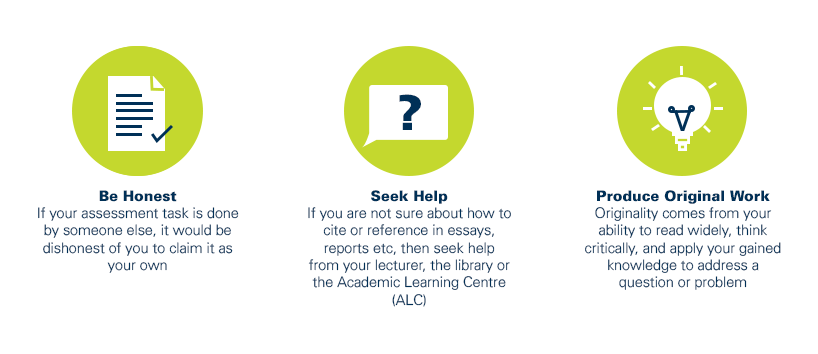
As a CQUniversity student you are expected to act honestly in all aspects of your academic work.
Any assessable work undertaken or submitted for review or assessment must be your own work. Assessable work is any type of work you do to meet the assessment requirements in the unit, including draft work submitted for review and feedback and final work to be assessed.
When you use the ideas, words or data of others in your assessment, you must thoroughly and clearly acknowledge the source of this information by using the correct referencing style for your unit. Using others’ work without proper acknowledgement may be considered a form of intellectual dishonesty.
Participating honestly, respectfully, responsibly, and fairly in your university study ensures the CQUniversity qualification you earn will be valued as a true indication of your individual academic achievement and will continue to receive the respect and recognition it deserves.
As a student, you are responsible for reading and following CQUniversity’s policies, including the Student Academic Integrity Policy and Procedure. This policy sets out CQUniversity’s expectations of you to act with integrity, examples of academic integrity breaches to avoid, the processes used to address alleged breaches of academic integrity, and potential penalties.
What is a breach of academic integrity?
A breach of academic integrity includes but is not limited to plagiarism, self-plagiarism, collusion, cheating, contract cheating, and academic misconduct. The Student Academic Integrity Policy and Procedure defines what these terms mean and gives examples.
Why is academic integrity important?
A breach of academic integrity may result in one or more penalties, including suspension or even expulsion from the University. It can also have negative implications for student visas and future enrolment at CQUniversity or elsewhere. Students who engage in contract cheating also risk being blackmailed by contract cheating services.
Where can I get assistance?
For academic advice and guidance, the Academic Learning Centre (ALC) can support you in becoming confident in completing assessments with integrity and of high standard.
What can you do to act with integrity?