Overview
Big data is a popular term used to describe the exponential growth and availability of structured and unstructured data and business intelligence involves collecting, processing, analysing, and visualising data to help organisations make informed business decisions. In this unit, you will learn concepts of business intelligence, the alignment of big data with business intelligence, and how big data technologies can be leveraged to build organisational business intelligence. You will also explore contemporary tools in business intelligence and gain an understanding of data ethics, ensuring that data-driven solutions are developed and implemented responsibly and transparently. You will learn how to use big data for decision-making and impacting change in organisations. To understand these, you will be introduced to big data analytical tools and technologies to help solve authentic business problems and make effective business decisions. This unit provides a comprehensive foundation in big data and business intelligence with a strong business focus, equipping you with the skills needed for a successful career in data analytics along with expertise in big data strategy, architecture, and data ethics.
Details
Pre-requisites or Co-requisites
Prerequisites: COIT20250 Technologies in Information Systems Practice, and COIT20245 Introduction to Programming, and COIT20247 Database Design and Development. Anti-Requisites: COIT20236 Business Intelligence Management
Important note: Students enrolled in a subsequent unit who failed their pre-requisite unit, should drop the subsequent unit before the census date or within 10 working days of Fail grade notification. Students who do not drop the unit in this timeframe cannot later drop the unit without academic and financial liability. See details in the Assessment Policy and Procedure (Higher Education Coursework).
Offerings For Term 2 - 2026
Attendance Requirements
All on-campus students are expected to attend scheduled classes - in some units, these classes are identified as a mandatory (pass/fail) component and attendance is compulsory. International students, on a student visa, must maintain a full time study load and meet both attendance and academic progress requirements in each study period (satisfactory attendance for International students is defined as maintaining at least an 80% attendance record).
Recommended Student Time Commitment
Each 6-credit Postgraduate unit at CQUniversity requires an overall time commitment of an average of 12.5 hours of study per week, making a total of 150 hours for the unit.
Class Timetable
Assessment Overview
Assessment Grading
This is a graded unit: your overall grade will be calculated from the marks or grades for each assessment task, based on the relative weightings shown in the table above. You must obtain an overall mark for the unit of at least 50%, or an overall grade of 'pass' in order to pass the unit. If any 'pass/fail' tasks are shown in the table above they must also be completed successfully ('pass' grade). You must also meet any minimum mark requirements specified for a particular assessment task, as detailed in the 'assessment task' section (note that in some instances, the minimum mark for a task may be greater than 50%). Consult the University's Grades and Results Policy for more details of interim results and final grades.
All University policies are available on the CQUniversity Policy site.
You may wish to view these policies:
- Grades and Results Policy
- Assessment Policy and Procedure (Higher Education Coursework)
- Review of Grade Procedure
- Student Academic Integrity Policy and Procedure
- Academic Progression Policy and Procedure
- Student Refund and Credit Balance Policy and Procedure
- Complaints Policy and Procedure
- Information and Communications Technology Acceptable Use Policy and Procedure
This list is not an exhaustive list of all University policies. The full list of University policies are available on the CQUniversity Policy site.
Feedback, Recommendations and Responses
Every unit is reviewed for enhancement each year. At the most recent review, the following staff and student feedback items were identified and recommendations were made.
Feedback from Student Feedback
Give students clearer, more immediate feedback.
Introduce oral examinations for Assessments 1 and 3 to strengthen individual verification of learning and provide timely feedback.
- Apply concepts and principles of big data to evaluate and explain how large volume of structured and unstructured data are managed in an organisation
- Analyse critically and reflect on how organisations are utilising non-traditional unstructured data with the traditional structured enterprise data to perform business intelligence analysis
- Evaluate and appraise different big data technologies used for decision making in an organisation
- Design a big data strategy for data-centric organisations that meets client requirements while addressing data ethics, ensuring responsible and transparent data usage throughout the process
- Explore big data architecture, tools, and technologies for decision making and problem solving in the organisational context.
The Australian Computer Society (ACS) recognises the Skills Framework for the Information Age (SFIA). SFIA is adopted by organisations, governments and individuals in many countries and provides a widely used and consistent definition of ICT skills. SFIA is increasingly being used when developing job descriptions and role profiles. ACS members can use the tool MySFIA to build a skills profile.
This unit contributes to the following workplace skills as defined by SFIA 9 (the SFIA code is included):
- Enterprise and Business architecture (STPL)
- Data Management (DATM)
- Business Intelligence (BINT)
- Data Analytics (DAAN)
- Artificial intelligence (AI) and data ethics (AIDE)
Alignment of Assessment Tasks to Learning Outcomes
| Assessment Tasks | Learning Outcomes | ||||
|---|---|---|---|---|---|
| 1 | 2 | 3 | 4 | 5 | |
| 1 - Written Assessment - 35% | |||||
| 2 - Presentation - 25% | |||||
| 3 - Project (applied) - 40% | |||||
Alignment of Graduate Attributes to Learning Outcomes
| Graduate Attributes | Learning Outcomes | ||||
|---|---|---|---|---|---|
| 1 | 2 | 3 | 4 | 5 | |
| 1 - Knowledge | |||||
| 2 - Communication | |||||
| 3 - Cognitive, technical and creative skills | |||||
| 4 - Research | |||||
| 5 - Self-management | |||||
| 6 - Ethical and Professional Responsibility | |||||
| 7 - Leadership | |||||
| 8 - First Nations Knowledges | |||||
| 9 - Aboriginal and Torres Strait Islander Cultures | |||||
Textbooks
Big Data Application Architecture Q&A A Problem - Solution Approach
- 1st edition (2013)
- Authors: Nitin Sawant, Himanshu Shah
- Apress
- ISBN: 9781430262930
Big Data Technologies for Business
- (2020)
- Authors: Arben Asllani
- Prospect Press
- ISBN: 978-1-943153-75-6
IT Resources
- CQUniversity Student Email
- Internet
- Unit Website (Moodle)
- Anaconda Data Science Platform (Individual - Free Distribution)
- Google Colab
All submissions for this unit must use the referencing style: Harvard (author-date)
For further information, see the Assessment Tasks.
m.jha@cqu.edu.au
g.galea@cqu.edu.au
Week 1
Begin Date: 13 Jul 2026Module/Topic
Introduction To Big Data
Chapter
Sawant, N., & Shah, H. (2014). Big data application architecture Q&A: A problem-solution approach. Apress.
Chapter 1
Events and Submissions/Topic
Tutorial 1
Week 2
Begin Date: 20 Jul 2026Module/Topic
Big data - application and architecture
Chapter
Sawant, N., & Shah, H. (2014). Big data application architecture Q&A: A problem-solution approach. Apress.
Chapter 2
Events and Submissions/Topic
Tutorial 2
Week 3
Begin Date: 27 Jul 2026Module/Topic
Big Data Ingestion and Streaming Patterns
Chapter
Sawant, N., & Shah, H. (2014). Big data application architecture Q&A: A problem-solution approach. Apress.
Chapter 3
Events and Submissions/Topic
Tutorial 3
Week 4
Begin Date: 03 Aug 2026Module/Topic
Big Data Storage Patterns
Chapter
Sawant, N., & Shah, H. (2014). Big data application architecture Q&A: A problem-solution approach. Apress.
Chapter 4
Events and Submissions/Topic
Tutorial 4
Week 5
Begin Date: 10 Aug 2026Module/Topic
Modern Big Data Storage Trend
Chapter
Sawant, N., & Shah, H. (2014). Big data application architecture Q&A: A problem-solution approach. Apress
Chapter 5
Events and Submissions/Topic
Tutorial 5
Week 6
Begin Date: 17 Aug 2026Module/Topic
Big Data-Driven Decision Making & Strategy
Chapter
Sharda, R., Delen, D. and Turban, E. (March 13, 2024). Business Intelligence, Analytics, Data Science, and AI, Global Edition, 5th edition. Pearson.
Chapters 1 and 2
Events and Submissions/Topic
Tutorial 6
Assignment 1 (Written Assessment and Programming 35%) Due: Week 6 Monday (17 Aug 2026) 11:45 pm AEST
Vacation Week
Begin Date: 24 Aug 2026Module/Topic
Chapter
Events and Submissions/Topic
Week 7
Begin Date: 31 Aug 2026Module/Topic
Predictive & Prescriptive Analytics for Business Intelligence
Chapter
Sharda, R., Delen, D. and Turban, E. (March 13, 2024). Business Intelligence, Analytics, Data Science, and AI, Global Edition, 5th edition. Pearson.
Chapters 5 and 8
Events and Submissions/Topic
Tutorial 7
Week 8
Begin Date: 07 Sep 2026Module/Topic
Big Data Visualisation & Dashboarding
Chapter
Sawant, N., & Shah, H. (2014). Big data application architecture Q&A: A problem-solution approach. Apress.
Chapter 7
Events and Submissions/Topic
Tutorial 8
Assignment 2 (Written Assessment and Presentation 25%) Due: Week 8 Monday (7 Sept 2026) 11:45 pm AEST
Week 9
Begin Date: 14 Sep 2026Module/Topic
Machine Learning for Business Intelligence
Chapter
Sharda, R., Delen, D. and Turban, E. (March 13, 2024). Business Intelligence, Analytics, Data Science, and AI, Global Edition, 5th edition. Pearson.
Chapters 6-7
Events and Submissions/Topic
Tutorial 9
Week 10
Begin Date: 21 Sep 2026Module/Topic
Big Data & AI-Driven Business Intelligence Trends
Chapter
Sharda, R., Delen, D. and Turban, E. (March 13, 2024). Business Intelligence, Analytics, Data Science, and AI, Global Edition, 5th edition. Pearson.
Chapters 9-10
Events and Submissions/Topic
Tutorial 10
Week 11
Begin Date: 28 Sep 2026Module/Topic
Ethical, Privacy, and Managerial Considerations in BI
Chapter
Sharda, R., Delen, D. and Turban, E. (March 13, 2024). Business Intelligence, Analytics, Data Science, and AI, Global Edition, 5th edition. Pearson.
Chapter 11
Events and Submissions/Topic
Tutorial 11
Week 12
Begin Date: 05 Oct 2026Module/Topic
Business Intelligence Project (Assignment 3) Presentation
Chapter
Events and Submissions/Topic
Tutorial 12
Assignment 3 (Written Assessment, Programming, and Presentation 40%) Due: Week 12 Monday (5 Oct 2026) 11:45 pm AEST
Exam Week
Begin Date: 12 Oct 2026Module/Topic
Chapter
Events and Submissions/Topic
Vacation/Exam Week
Begin Date: 19 Oct 2026Module/Topic
Chapter
Events and Submissions/Topic
Unit Coordinator: Associate Professor Dr Meena Jha
Room 2.09, Level 2; 400 Kent Street; Sydney NSW 2000
P +61 2 9324 5776 | X 55776 |
Email: m.jha@cqu.edu.au
1 Written Assessment
This individual assignment focuses on real-time data ingestion and storage in a Big Data environment. Building on concepts of big data patterns covered in the first half of the course, you will design and implement a scalable data storage solution that supports efficient data ingestion while handling continuous data streams. Through completing this assignment, you will demonstrate your understanding by implementing a real-time data ingestion process, storing data in a structured format, and ensuring the system can handle continuous data streams effectively. The submission includes a self-contained Python implementation in a Google Colab or Jupyter Notebook (.ipynb) and a written report (max. 1,500 words) detailing the design, implementation, challenges, and key insights. This assignment provides practical experience in handling real-time data, designing scalable storage architectures, and applying business intelligence principles in a data-driven environment.
GenAI usage instructions:
AI COLLABORATION
You may use Al to assist with specific tasks such as drafting text, refining and evaluating your work. You must critically evaluate and modify any Al-generated content you use.
Al may be used to help complete the task, including idea generation, drafting, feedback, and refinement. You should critically evaluate and modify the Al-suggested outputs, demonstrating your achievement of Learning Outcomes. You may use AI tools to rewrite/edit to clarify or refine your ideas or edit text captured with automatic speech recognition (e.g., verbally recorded drafts). In a multimodal context (for example, presentation video or slides), AI-assisted editing tools could be used alongside documentation of the process. If AI is used to edit/refine your final submission, you must acknowledge the use of AI tools, and the original work must be provided for comparison. While you can use AI to improve the clarity or quality of the work, no new content can be created using AI unless specifically allowed in the assessment.
You may be asked to use specific AI tool(s) to complete a particular task of the assessment. You must cite the AI content (refer to AI citation guidelines by ALC), including the prompts used to generate the content.
Please note: Re-attempts of this assignment are not allowed. This assessment is exempt from the 72-hour submission grace period and must be completed by the stated submission date/time. All assessments should be submitted via Moodle.
Week 6 Monday (17 Aug 2026) 11:45 pm AEST
Late submissions are subject to the university's late submission penalty policies.
Week 8 Monday (7 Sept 2026)
The feedback will be returned two weeks after the submission date.
The assignment will be assessed based on several key criteria. Database Setup & Configuration (10%) evaluates the selection, setup, and schema design of a suitable storage system. Implementation of Real-Time Data Ingestion (30%) focuses on successfully connecting to a real-time data source, ensuring continuous and efficient ingestion while maintaining data integrity. Storage Solution Effectiveness (30%) assesses the system’s ability to handle continuous data streams, its scalability, reliability, and how it improves upon previous limitations. Written Report (20%) requires a well-structured explanation of the solution, justification of design choices, and reflection on challenges, limitations, and improvements. Finally, Code Documentation & Organization (10%) considers the clarity, structure, and readability of the Python code.
- Apply concepts and principles of big data to evaluate and explain how large volume of structured and unstructured data are managed in an organisation
- Analyse critically and reflect on how organisations are utilising non-traditional unstructured data with the traditional structured enterprise data to perform business intelligence analysis
2 Presentation
This group assignment (2-3 students per team) is the first part of a two-part assessment, leading into Assignment 3. In this phase, your group will develop a Business Intelligence (BI) strategy for a chosen industry scenario and present it as a pitch to stakeholders through a recorded presentation (8-12 minutes) and a written executive summary (max. 1,000 words). The focus is on outlining how Big Data can be leveraged for decision-making, covering data ingestion, storage, analytics, and visualisation while aligning the strategy with key business objectives and performance indicators. This assignment emphasises strategic thinking, BI planning, and effective communication. In Assignment 3, you will move from strategy to execution by implementing their BI solution, creating a functional artefact in Python that demonstrates the proposed approach. The artefact, along with a final report and presentation, will be submitted to showcase the practical application of the BI strategy developed in this assessment.
This assessment is exempted from the 72-hour submission grace period and must be completed by the stated submission date/time.
GenAI usage instructions:
AI PLANNING
You may use Al for planning, idea development, and research. Your final submission should show how you have developed and refined these ideas.
Al may be used for pre-task activities such as brainstorming, outlining and initial research. You may use AI-assisted automatic speech recognition to transcribe notes, AI tools to convert notes into outlines, and AI tools to brainstorm or suggest improvements to already created work. Image generation technologies might be used to generate starting points for designs or tools used to explore possibilities for producing software. You must then use the AI-generated ideas as the starting point and apply your skills and knowledge to refine and improve the initial ideas to the final submission. No GenAI-created content without changes should be included in the final submissions.
You do not need to cite the AI-generated content, as it has been substantially changed in the final submission. However, you need to briefly describe how AI tools were used during the planning, research and initial idea-generation stage of the assessment.
Week 8 Monday (7 Sept 2026) 11:45 pm AEST
Week 10 Monday (21 Sept 2026)
The assessment for Assignment 2 evaluates the depth and clarity of the proposed Business Intelligence (BI) strategy, the quality of analysis, and the effectiveness of communication in both the written executive summary and recorded presentation. Industry & Business Problem Analysis (25%) assesses how well the chosen scenario and business challenges are articulated. BI Strategy (40%) focuses on the design of the BI architecture, covering data ingestion, storage, analytics, and visualisation, along with the selection of relevant tools and technologies. Presentation Quality & Communication (25%) considers the clarity, professionalism, and engagement of the recorded presentation, ensuring all team members contribute meaningfully. Finally, Report Structure & Clarity (10%) ensures the executive summary is well-organised, concise, and professional.
- Evaluate and appraise different big data technologies used for decision making in an organisation
- Design a big data strategy for data-centric organisations that meets client requirements while addressing data ethics, ensuring responsible and transparent data usage throughout the process
- Explore big data architecture, tools, and technologies for decision making and problem solving in the organisational context.
3 Project (applied)
This group assignment (same teams as Assignment 2) is the second part of a larger assessment, focusing on implementing the BI strategy developed in Assignment 2. You will develop a working prototype that demonstrates Big Data ingestion, processing, analytics, and visualisation to support decision-making. The assessment includes a Python-based implementation, a written report (max. 1,500 words), and a final presentation delivered in Week 12 in front of the class. The implementation must effectively showcase how data is utilised to generate business insights using appropriate Big Data tools and techniques. The report should document the design, implementation process, challenges, and evaluation of the solution’s effectiveness. The presentation will communicate how the system works, key insights derived, and its impact on business decision-making.
This assessment is exempted from the 72-hour submission grace period and must be completed by the stated submission date/time.
GenAI usage instructions:
AI COLLABORATION
You may use Al to assist with specific tasks such as drafting text, refining and evaluating your work. You must critically evaluate and modify any Al-generated content you use.
Al may be used to help complete the task, including idea generation, drafting, feedback, and refinement. You should critically evaluate and modify the Al-suggested outputs, demonstrating your achievement of Learning Outcomes. You may use AI tools to rewrite/edit to clarify or refine your ideas or edit text captured with automatic speech recognition (e.g., verbally recorded drafts). In a multimodal context (for example, presentation video or slides), AI-assisted editing tools could be used alongside documentation of the process. If AI is used to edit/refine your final submission, you must acknowledge the use of AI tools, and the original work must be provided for comparison. While you can use AI to improve the clarity or quality of the work, no new content can be created using AI unless specifically allowed in the assessment.
You may be asked to use specific AI tool(s) to complete a particular task of the assessment. You must cite the AI content (refer to AI citation guidelines by ALC), including the prompts used to generate the content.
Week 12 Monday (5 Oct 2026) 11:45 pm AEST
On the certification date
This assignment is assessed on BI solution implementation (40%), evaluating how well the Python-based system handles data ingestion, processing, analytics, and visualisation using appropriate Big Data tools. The written report (30%) will be assessed on clarity, documentation, challenges addressed, and effectiveness of the solution. The final presentation (20%), delivered in Week 12, will be assessed on how clearly the team communicates the system’s functionality, insights, and business impact using visuals and demonstrations. Finally, code documentation and organisation (10%) will be evaluated for clarity, structure, and adequate commenting.
- Apply concepts and principles of big data to evaluate and explain how large volume of structured and unstructured data are managed in an organisation
- Analyse critically and reflect on how organisations are utilising non-traditional unstructured data with the traditional structured enterprise data to perform business intelligence analysis
- Evaluate and appraise different big data technologies used for decision making in an organisation
- Design a big data strategy for data-centric organisations that meets client requirements while addressing data ethics, ensuring responsible and transparent data usage throughout the process
- Explore big data architecture, tools, and technologies for decision making and problem solving in the organisational context.
As a CQUniversity student you are expected to act honestly in all aspects of your academic work.
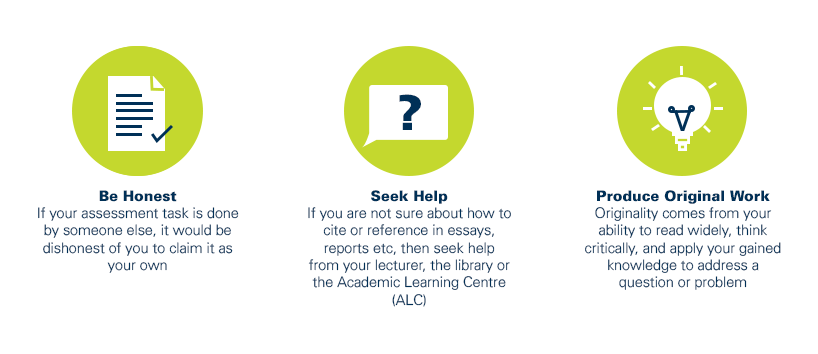
Any assessable work undertaken or submitted for review or assessment must be your own work. Assessable work is any type of work you do to meet the assessment requirements in the unit, including draft work submitted for review and feedback and final work to be assessed.
When you use the ideas, words or data of others in your assessment, you must thoroughly and clearly acknowledge the source of this information by using the correct referencing style for your unit. Using others’ work without proper acknowledgement may be considered a form of intellectual dishonesty.
Participating honestly, respectfully, responsibly, and fairly in your university study ensures the CQUniversity qualification you earn will be valued as a true indication of your individual academic achievement and will continue to receive the respect and recognition it deserves.
As a student, you are responsible for reading and following CQUniversity’s policies, including the Student Academic Integrity Policy and Procedure. This policy sets out CQUniversity’s expectations of you to act with integrity, examples of academic integrity breaches to avoid, the processes used to address alleged breaches of academic integrity, and potential penalties.
What is a breach of academic integrity?
A breach of academic integrity includes but is not limited to plagiarism, self-plagiarism, collusion, cheating, contract cheating, and academic misconduct. The Student Academic Integrity Policy and Procedure defines what these terms mean and gives examples.
Why is academic integrity important?
A breach of academic integrity may result in one or more penalties, including suspension or even expulsion from the University. It can also have negative implications for student visas and future enrolment at CQUniversity or elsewhere. Students who engage in contract cheating also risk being blackmailed by contract cheating services.
Where can I get assistance?
For academic advice and guidance, the Academic Learning Centre (ALC) can support you in becoming confident in completing assessments with integrity and of high standard.
What can you do to act with integrity?