Overview
This unit is devoted to the design and implementation of Android and iOS mobile applications. Native mobile programming languages will form the basis upon which programming techniques and design patterns will be developed for creating standalone applications. Commonly used mobile tools and frameworks for mobile application development are used. All stages of software development from the initial idea, through to development and testing will be covered. Consideration will be given to the business case from the developers' point of view. Some examination of how to market mobile apps is also undertaken. Research skills will be introduced as a means of keeping up to date with the changing mobile development landscape.
Details
Pre-requisites or Co-requisites
Pre-Req: COIT20268 Responsive Web Design
Important note: Students enrolled in a subsequent unit who failed their pre-requisite unit, should drop the subsequent unit before the census date or within 10 working days of Fail grade notification. Students who do not drop the unit in this timeframe cannot later drop the unit without academic and financial liability. See details in the Assessment Policy and Procedure (Higher Education Coursework).
Offerings For Term 2 - 2026
Attendance Requirements
All on-campus students are expected to attend scheduled classes - in some units, these classes are identified as a mandatory (pass/fail) component and attendance is compulsory. International students, on a student visa, must maintain a full time study load and meet both attendance and academic progress requirements in each study period (satisfactory attendance for International students is defined as maintaining at least an 80% attendance record).
Recommended Student Time Commitment
Each 6-credit Postgraduate unit at CQUniversity requires an overall time commitment of an average of 12.5 hours of study per week, making a total of 150 hours for the unit.
Class Timetable
Assessment Overview
Assessment Grading
This is a graded unit: your overall grade will be calculated from the marks or grades for each assessment task, based on the relative weightings shown in the table above. You must obtain an overall mark for the unit of at least 50%, or an overall grade of 'pass' in order to pass the unit. If any 'pass/fail' tasks are shown in the table above they must also be completed successfully ('pass' grade). You must also meet any minimum mark requirements specified for a particular assessment task, as detailed in the 'assessment task' section (note that in some instances, the minimum mark for a task may be greater than 50%). Consult the University's Grades and Results Policy for more details of interim results and final grades.
All University policies are available on the CQUniversity Policy site.
You may wish to view these policies:
- Grades and Results Policy
- Assessment Policy and Procedure (Higher Education Coursework)
- Review of Grade Procedure
- Student Academic Integrity Policy and Procedure
- Academic Progression Policy and Procedure
- Student Refund and Credit Balance Policy and Procedure
- Complaints Policy and Procedure
- Information and Communications Technology Acceptable Use Policy and Procedure
This list is not an exhaustive list of all University policies. The full list of University policies are available on the CQUniversity Policy site.
Feedback, Recommendations and Responses
Every unit is reviewed for enhancement each year. At the most recent review, the following staff and student feedback items were identified and recommendations were made.
Feedback from Student Feedback in class
Students requested additional walkthrough video recordings for setting up the development environment prior to Week 1 practical labs.
Short, pre-recorded video guides on software installation and initial project setup will be made available to students on Moodle.
- Design and implement native mobile applications
- Describe and be able to develop critical parts of a native mobile system programming interface
- Use an integrated IDE to build, debug and test native mobile applications
- Determine the business impact of a given mobile solution and critically assess the implementation of an app and its likely marketability and profitability
- Critically analyse a research issue in mobile computing.
The Australian Computer Society (ACS) recognises the Skills Framework for the Information Age (SFIA). SFIA is adopted by organisations, governments and individuals in many countries and provides a widely used and consistent definition of ICT skills. SFIA is increasingly being used when developing job descriptions and role profiles.
ACS members can use the tool MySFIA to build a skills profile at https://www.acs.org.au/professionalrecognition/mysfia-b2c.html
This unit contributes to the following workplace skills as defined by SFIA 7 (the SFIA code is included):
- Systems Design (DESN)
- System Integration (SINT)
- Program ming/Software Development (PROG)
- Data Analysis (DTAN)
- Database/Repository Design (DBDS)
- Testing (TEST)
- Network Support (NTAS)
- Release and Deployment (RELM)
- Applications Support (ASUP)
Alignment of Assessment Tasks to Learning Outcomes
| Assessment Tasks | Learning Outcomes | ||||
|---|---|---|---|---|---|
| 1 | 2 | 3 | 4 | 5 | |
| 1 - Portfolio - 20% | |||||
| 2 - Practical Assessment - 30% | |||||
| 3 - Practical Assessment - 30% | |||||
| 4 - Written Assessment - 20% | |||||
Alignment of Graduate Attributes to Learning Outcomes
| Graduate Attributes | Learning Outcomes | ||||
|---|---|---|---|---|---|
| 1 | 2 | 3 | 4 | 5 | |
| 1 - Knowledge | |||||
| 2 - Communication | |||||
| 3 - Cognitive, technical and creative skills | |||||
| 4 - Research | |||||
| 5 - Self-management | |||||
| 6 - Ethical and Professional Responsibility | |||||
| 7 - Leadership | |||||
| 8 - First Nations Knowledges | |||||
| 9 - Aboriginal and Torres Strait Islander Cultures | |||||
Alignment of Assessment Tasks to Graduate Attributes
| Assessment Tasks | Graduate Attributes | ||||||||
|---|---|---|---|---|---|---|---|---|---|
| 1 | 2 | 3 | 4 | 5 | 6 | 7 | 8 | 9 | |
| 1 - Portfolio - 20% | |||||||||
| 2 - Practical Assessment - 30% | |||||||||
| 3 - Practical Assessment - 30% | |||||||||
| 4 - Written Assessment - 20% | |||||||||
Textbooks
There are no required textbooks.
IT Resources
- CQUniversity Student Email
- Internet
- Unit Website (Moodle)
- Visual Studio Code (recent e.g. 1.105)
All submissions for this unit must use the referencing style: Harvard (author-date)
For further information, see the Assessment Tasks.
j.shield@cqu.edu.au
Week 1
Begin Date: 13 Jul 2026Module/Topic
1 Introduction
Chapter
- Mobile design challenges
- Mobile UI guidelines
- (Bailey & Biessek 2023, Chp 1)
Events and Submissions/Topic
Week 2
Begin Date: 20 Jul 2026Module/Topic
2 Layout
Chapter
- Toolbar and Menus
- (Bailey & Biessek 2023, Chp 5)
Events and Submissions/Topic
Week 3
Begin Date: 27 Jul 2026Module/Topic
3 Adaptive
Chapter
- Adaptive layouts
- (Windmill 2020, Chp 4)
Events and Submissions/Topic
Week 4
Begin Date: 03 Aug 2026Module/Topic
4 Intro to Navigation and State
Chapter
- (Bailey & Biessek 2023, Chp 8)
Events and Submissions/Topic
Week 5
Begin Date: 10 Aug 2026Module/Topic
5 Advanced Navigation
Chapter
- (Windmill 2020, Chp 8)
Events and Submissions/Topic
Week 6
Begin Date: 17 Aug 2026Module/Topic
6 Shared State
Chapter
- Passing data
- (Tyagi 2021, Chp 18)
Events and Submissions/Topic
Vacation Week
Begin Date: 24 Aug 2026Module/Topic
Chapter
Events and Submissions/Topic
Week 7
Begin Date: 31 Aug 2026Module/Topic
7 Gestures
Chapter
- Swipe
- Drag
- (Bailey & Biessek 2023, Chp 6)
Events and Submissions/Topic
Week 8
Begin Date: 07 Sep 2026Module/Topic
8 Testing
Chapter
Events and Submissions/Topic
Week 9
Begin Date: 14 Sep 2026Module/Topic
9 Forms
Chapter
- (Windmill 2020, Chp 5)
Events and Submissions/Topic
Week 10
Begin Date: 21 Sep 2026Module/Topic
10 Themes
Chapter
- Colours
- Typography
- (Adefioye 2024, Chp 4)
Events and Submissions/Topic
11 Deployment
Begin Date: 28 Sep 2026Module/Topic
Chapter
Events and Submissions/Topic
Unit Coordinator: Jamie Shield, Cairns,
j.shield@cqu.edu.au,
Office: 07 4037 4750
1 Written Assessment
You are to design a mobile application and justify your design decisions using scholarly sources. You will:
- Define the primary problem that your app addresses and the users affected
- Analyse existing solutions and identify gaps or opportunities
- Propose a new design and communicate it through standard HCD/UCD artefacts such as personae, use case and activity diagrams
- Specify at least 5 usability goals for evaluation and
- Discuss the ethics of the app.
Your scholarly sources can only be research papers available full-text online from the Central Queensland University library.
AI Collaboration: You may use AI to assist with specific tasks such as drafting text, refining and evaluating your work. You must critically evaluate and modify any AI-generated content you use. Completion of this assessment assumes that you have read and understood the relevant unit materials so you can appropriately guide the use of AI.
Week 5 Thursday (13 Aug 2026) 11:45 pm AEST
You can submit this assessment 72-hours late without an extension.
Feedback is usually provided within 2 weeks of the due date.
Your submission will be assessed on aspects such as:
- Analysis of existing applications and solutions, their limitations, and your proposed improvements
- Personae: research-informed identification of the intended user groups for the app and how well you justify that your solution aligns with their needs
- Ethics: identification of ethical risks including privacy, data handling, informed consent, dark-pattern risks, persuasive or behavioural influences and accessibility inequities
- Strength of peer-reviewed, scholarly sources including how well these sources justify your personae, task analysis (activity diagrams), ethical analysis and design choices; and quality of your referencing
- Technology-agnostic design: cross-platform applicability, relying on universal design principles rather than, e.g. a specific platform's guidelines
- Usability goals: relevant and measurable.
- Describe and be able to develop critical parts of a native mobile system programming interface
- Critically analyse a research issue in mobile computing.
- Knowledge
- Communication
- Cognitive, technical and creative skills
- Research
- Self-management
2 Practical Assessment
You will develop an Android prototype for the mobile application you designed in Assignment 1, focusing on user interface design and adherence to specified design constraints. You will produce a screen-based prototype that demonstrates the key tasks outlined in the provided activity diagrams. Your interfaces must follow the prescribed UI design guidelines and APIs. Your prototype is intended to showcase layout, structure and interaction patterns rather than full application logic. Accordingly, your screens may be hardcoded, and you are not expected to implement complex transitions, gestures, state management, or advanced navigation.
Repository: Create a private code repository and invite your tutor and the unit coordinator.
AI Collaboration: You may use AI to assist with specific tasks such as drafting text, refining and evaluating your work. You must critically evaluate and modify any AI-generated content you use. Completion of this assessment assumes that you have read and understood the relevant unit materials so you can appropriately guide the use of AI.
Week 6 Thursday (20 Aug 2026) 11:45 pm AEST
You can submit this assessment 72-hours late without an extension.
Feedback is usually provided within 2 weeks of the due date.
Your submission will be assessed on aspects such as:
- Quality of per-screen design: clear visual hierarchy including responsive, adaptable layout, adherence to prescribed UI guidelines and required APIs; appropriate use of usability design patterns such as navigation structures
- Completeness of implementation: are screens implemented for all major steps represented in the activity diagrams from your Assignment 1
- Code quality: correct use of coding conventions, adequate commenting, lack of deprecated code and overall code readability
- Per-screen mobile heuristic evaluation including quick and easy interaction, micro-usage design, and consistency, and
- Management of users’ privacy and ethics, and
- Presentation content and quality.
- Design and implement native mobile applications
- Use an integrated IDE to build, debug and test native mobile applications
- Knowledge
- Cognitive, technical and creative skills
- Self-management
3 Portfolio
In this assignment, you will evaluate your mobile app's usability. You will recruit participants and record videos of each participant attempting tasks. After collecting your data, you will analyse the results, identify patterns in user performance, and develop recommendations for improving your mobile app's design.
AI Collaboration: You may use AI to assist with specific tasks such as drafting text, refining and evaluating your work. You must critically evaluate and modify any AI-generated content you use. Completion of this assessment assumes that you have read and understood the relevant unit materials so you can appropriately guide the use of AI.
Week 9 Thursday (17 Sept 2026) 11:45 pm AEST
You can submit this assessment 72-hours late without an extension.
Feedback is usually provided within 2 weeks of the due date.
Your submission will be assessed on aspects such as:
- Completeness of usability testing: all usability tests have been performed by all participants and there is sufficient evidence to evaluate usability
- Quality of results and recommendations: your recommendations should be actionable and framed at the design-principle or design-pattern level, e.g. navigation or error prevention, rather than low-level cosmetic suggestions, e.g. changing a colour.
- Describe and be able to develop critical parts of a native mobile system programming interface
- Determine the business impact of a given mobile solution and critically assess the implementation of an app and its likely marketability and profitability
- Knowledge
- Communication
- Self-management
4 Practical Assessment
In this assignment, you will deploy the second iteration of your mobile application's development. You will develop and deploy a fully functioning mobile app. Your interface must follow the prescribed UI design guidelines and APIs. All functionality must be implemented and accessible within a single application.
This iteration extends beyond static design: you are expected to incorporate behavioural elements including advanced navigation techniques, gestures, state management, persistence and transitions to create a responsive, adaptive, and predictable user experience.
Repository: Create a private code repository and invite your tutor and the unit coordinator.
AI Collaboration: You may use AI to assist with specific tasks such as drafting text, refining and evaluating your work. You must critically evaluate and modify any AI-generated content you use. Completion of this assessment assumes that you have read and understood the relevant unit materials so you can appropriately guide the use of AI.
Week 11 Thursday (1 Oct 2026) 11:45 pm AEST
You can submit this assessment 72-hours late without an extension.
Feedback will be returned upon the Certification of Grades.
Your submission will be assessed on aspects such as:
- Behavioural interaction quality including the quality of state management, persistence, navigation routing, gestures and transitions
- Quality of screen design: visual hierarchy including layout, spacing, typography and colour usage, adherence to prescribed UI guidelines and required APIs; appropriate use of usability design patterns such as navigation structures
- Completeness: all features implemented
- Code quality: design-level comments in code, coding conventions, lack of deprecated code and overall code readability
- Mobile heuristic evaluation including quick and easy interaction, micro-usage design, and consistency
- Management of users' privacy and ethics
- Demonstration of features and explanation of code, and
- Deployment.
- Design and implement native mobile applications
- Use an integrated IDE to build, debug and test native mobile applications
- Determine the business impact of a given mobile solution and critically assess the implementation of an app and its likely marketability and profitability
- Knowledge
- Cognitive, technical and creative skills
- Self-management
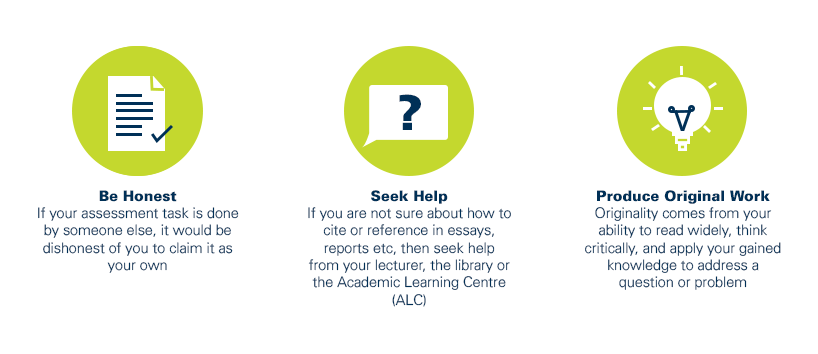
As a CQUniversity student you are expected to act honestly in all aspects of your academic work.
Any assessable work undertaken or submitted for review or assessment must be your own work. Assessable work is any type of work you do to meet the assessment requirements in the unit, including draft work submitted for review and feedback and final work to be assessed.
When you use the ideas, words or data of others in your assessment, you must thoroughly and clearly acknowledge the source of this information by using the correct referencing style for your unit. Using others’ work without proper acknowledgement may be considered a form of intellectual dishonesty.
Participating honestly, respectfully, responsibly, and fairly in your university study ensures the CQUniversity qualification you earn will be valued as a true indication of your individual academic achievement and will continue to receive the respect and recognition it deserves.
As a student, you are responsible for reading and following CQUniversity’s policies, including the Student Academic Integrity Policy and Procedure. This policy sets out CQUniversity’s expectations of you to act with integrity, examples of academic integrity breaches to avoid, the processes used to address alleged breaches of academic integrity, and potential penalties.
What is a breach of academic integrity?
A breach of academic integrity includes but is not limited to plagiarism, self-plagiarism, collusion, cheating, contract cheating, and academic misconduct. The Student Academic Integrity Policy and Procedure defines what these terms mean and gives examples.
Why is academic integrity important?
A breach of academic integrity may result in one or more penalties, including suspension or even expulsion from the University. It can also have negative implications for student visas and future enrolment at CQUniversity or elsewhere. Students who engage in contract cheating also risk being blackmailed by contract cheating services.
Where can I get assistance?
For academic advice and guidance, the Academic Learning Centre (ALC) can support you in becoming confident in completing assessments with integrity and of high standard.
What can you do to act with integrity?