Overview
In this unit, you will extend your thinking about viable sources of curriculum, and through reflection on the work of educators of Reggio Emilia, you will explore the notion of ‘teacher as researcher’, see yourselves as researchers and see children as active participants in the design, construction and enactment of the ‘curriculum’. You will examine the teacher’s role in pedagogical decisions with particular emphasis on mindfulness, reflective practice and intentional teaching, and as (co)creators of aesthetic learning environments that support connectedness, belonging, investigation, discovery, play and wellbeing. Pedagogies of relationships, place, play, possibility and provocation are examined in in-depth ways. You will examine guiding principles and research underpinning curriculum approaches as well as your own developing assumptions and philosophy of education to articulate what you believe should underpin curriculum inquiry in early childhood. You will inspect how early childhood pedagogy reflects the importance of childhood and contributes to the holistic wellbeing, learning and development of children. As part of this process, you consider what being, belonging and becoming can look like in practice for children and for the early childhood educator. You will scrutinise real-world challenges and dilemmas. You will demonstrate your ability to identify and think through complex issues, diverse interpretations and expectations of the teaching and learning process and respond to these in ways that deepen your intellectual, ethical and emotional engagement work. You will complete a 15 day placement in an early childhood service with children birth to 35 months.
Details
Pre-requisites or Co-requisites
Pre-requisite EDFE11038 Professional Practice 1 - Introduction to Teaching.
Important note: Students enrolled in a subsequent unit who failed their pre-requisite unit, should drop the subsequent unit before the census date or within 10 working days of Fail grade notification. Students who do not drop the unit in this timeframe cannot later drop the unit without academic and financial liability. See details in the Assessment Policy and Procedure (Higher Education Coursework).
Offerings For Term 3 - 2026
Attendance Requirements
All on-campus students are expected to attend scheduled classes - in some units, these classes are identified as a mandatory (pass/fail) component and attendance is compulsory. International students, on a student visa, must maintain a full time study load and meet both attendance and academic progress requirements in each study period (satisfactory attendance for International students is defined as maintaining at least an 80% attendance record).
Recommended Student Time Commitment
Each 6-credit Undergraduate unit at CQUniversity requires an overall time commitment of an average of 12.5 hours of study per week, making a total of 150 hours for the unit.
Class Timetable
Assessment Overview
Assessment Grading
This is a graded unit: your overall grade will be calculated from the marks or grades for each assessment task, based on the relative weightings shown in the table above. You must obtain an overall mark for the unit of at least 50%, or an overall grade of 'pass' in order to pass the unit. If any 'pass/fail' tasks are shown in the table above they must also be completed successfully ('pass' grade). You must also meet any minimum mark requirements specified for a particular assessment task, as detailed in the 'assessment task' section (note that in some instances, the minimum mark for a task may be greater than 50%). Consult the University's Grades and Results Policy for more details of interim results and final grades.
All University policies are available on the CQUniversity Policy site.
You may wish to view these policies:
- Grades and Results Policy
- Assessment Policy and Procedure (Higher Education Coursework)
- Review of Grade Procedure
- Student Academic Integrity Policy and Procedure
- Academic Progression Policy and Procedure
- Student Refund and Credit Balance Policy and Procedure
- Complaints Policy and Procedure
- Information and Communications Technology Acceptable Use Policy and Procedure
This list is not an exhaustive list of all University policies. The full list of University policies are available on the CQUniversity Policy site.
Feedback, Recommendations and Responses
Every unit is reviewed for enhancement each year. At the most recent review, the following staff and student feedback items were identified and recommendations were made.
Feedback from Email and Verbal feedback
Timing of units delivered across the term should be changed
Ensure that students are aware of the delivery schedule.
Feedback from Email and Verbal feedback
Knowledge of the practical placement associated with this unit a
Prior to the commencement of this unit, students will be emailed to alert them to the placement requirement.
- Articulate a theorised approach to early childhood pedagogy that recognises the importance of play and builds on relationships with children and connectedness to their worlds
- Evaluate the influence of educators' personal assumptions and biases on understanding and interpreting the contexts and consequences of communities and children's socio-economic backgrounds
- Conduct an inquiry into pedagogies of place and play to identify the influence and significance of contexts on teachers' curriculum decision making
- Defend the role of the early childhood professional in making ethical decisions that respect children
- Critically reflect on prevailing notions of curriculum, curriculum frameworks and schooling to identify opportunities for exercising professional judgement in curriculum decision making and pedagogical practices that value children and childhood in and beyond early years settings.
- Complete a placement with young children birth to 35 months
- Plan and implement learning experiences that promote the engagement and participation of all learners and are responsive to their characteristics, stage of development and social, cultural and linguistic backgrounds and also link to your observations of the child/children.
Successful completion of this unit provides opportunities for students to engage with the Australian Professional Standards for Teachers (Graduate Career Stage) focus areas of:
1.2 Understand how students learn
2.1 Content and teaching strategies of the teaching area
2.2 Content selection and organization
3.6 Evaluate and improve teaching programs
3.7 Engage parents/carers in the educative process
4.1 Support student participation
6.2 Engage in professional learning and improve practice
7.1 Meet professional ethics and responsibilities
7.2 Comply with legislative, administrative and organisational requirements
Guidelines for the registration of an early childhood qualification with the Australian Children Education and Care Quality Authority (ACECQA) specify what the curriculum of an early childhood course must include. This unit contributes unit content related to early childhood pedagogies and education and curriculum studies.
Alignment of Assessment Tasks to Learning Outcomes
| Assessment Tasks | Learning Outcomes | ||||||
|---|---|---|---|---|---|---|---|
| 1 | 2 | 3 | 4 | 5 | 6 | 7 | |
|
1.
Assessment 1
(50% of unit)
Part 1 -
Portfolio
|
|||||||
|
2.
Assessment 2
(50% of unit)
Part 1 -
Written Assessment
|
|||||||
|
3.
Assessment 3
(Pass/Fail)
Part 1 -
Professional Practice Placement
|
|||||||
Alignment of Graduate Attributes to Learning Outcomes
| Graduate Attributes | Learning Outcomes | ||||||
|---|---|---|---|---|---|---|---|
| 1 | 2 | 3 | 4 | 5 | 6 | 7 | |
| 1 - Communication | |||||||
| 2 - Problem Solving | |||||||
| 3 - Critical Thinking | |||||||
| 4 - Information Literacy | |||||||
| 5 - Team Work | |||||||
| 6 - Information Technology Competence | |||||||
| 7 - Cross Cultural Competence | |||||||
| 8 - Ethical practice | |||||||
| 9 - Social Innovation | |||||||
| 10 - First Nations Knowledges | |||||||
| 11 - Aboriginal and Torres Strait Islander Cultures | |||||||
Textbooks
There are no required textbooks.
IT Resources
- CQUniversity Student Email
- Internet
- Unit Website (Moodle)
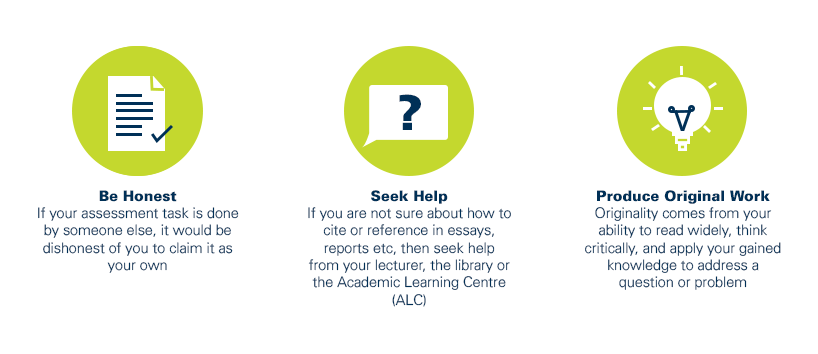
As a CQUniversity student you are expected to act honestly in all aspects of your academic work.
Any assessable work undertaken or submitted for review or assessment must be your own work. Assessable work is any type of work you do to meet the assessment requirements in the unit, including draft work submitted for review and feedback and final work to be assessed.
When you use the ideas, words or data of others in your assessment, you must thoroughly and clearly acknowledge the source of this information by using the correct referencing style for your unit. Using others’ work without proper acknowledgement may be considered a form of intellectual dishonesty.
Participating honestly, respectfully, responsibly, and fairly in your university study ensures the CQUniversity qualification you earn will be valued as a true indication of your individual academic achievement and will continue to receive the respect and recognition it deserves.
As a student, you are responsible for reading and following CQUniversity’s policies, including the Student Academic Integrity Policy and Procedure. This policy sets out CQUniversity’s expectations of you to act with integrity, examples of academic integrity breaches to avoid, the processes used to address alleged breaches of academic integrity, and potential penalties.
What is a breach of academic integrity?
A breach of academic integrity includes but is not limited to plagiarism, self-plagiarism, collusion, cheating, contract cheating, and academic misconduct. The Student Academic Integrity Policy and Procedure defines what these terms mean and gives examples.
Why is academic integrity important?
A breach of academic integrity may result in one or more penalties, including suspension or even expulsion from the University. It can also have negative implications for student visas and future enrolment at CQUniversity or elsewhere. Students who engage in contract cheating also risk being blackmailed by contract cheating services.
Where can I get assistance?
For academic advice and guidance, the Academic Learning Centre (ALC) can support you in becoming confident in completing assessments with integrity and of high standard.
What can you do to act with integrity?