Overview
Quality assessment and reporting in a secondary school context requires professionally informed judgement practice using relevant knowledge, skills and dispositions. In this unit you will be asked to consider your role and the roles of your students in assessment for the purposes of improving student learning. This unit develops your capacity to interpret student assessment data and evidence to make decisions about teaching practices that will best support the needs of your students. In addition, your skills will be developed in the selection application of timely and appropriate types of feedback to improve students’ learning. You will be engaged in authentic assessment tasks that will help you to develop the skills and knowledges that are essential to you as a teacher assessor. This unit requires you to draw upon contemporary literature, theory, policy and good practice in building your assessment identity.
Details
Pre-requisites or Co-requisites
Pre-requisite EDFE13033 Pre-requisite EDSE12021
Important note: Students enrolled in a subsequent unit who failed their pre-requisite unit, should drop the subsequent unit before the census date or within 10 working days of Fail grade notification. Students who do not drop the unit in this timeframe cannot later drop the unit without academic and financial liability. See details in the Assessment Policy and Procedure (Higher Education Coursework).
Offerings For Term 1 - 2026
Attendance Requirements
All on-campus students are expected to attend scheduled classes - in some units, these classes are identified as a mandatory (pass/fail) component and attendance is compulsory. International students, on a student visa, must maintain a full time study load and meet both attendance and academic progress requirements in each study period (satisfactory attendance for International students is defined as maintaining at least an 80% attendance record).
Recommended Student Time Commitment
Each 6-credit Undergraduate unit at CQUniversity requires an overall time commitment of an average of 12.5 hours of study per week, making a total of 150 hours for the unit.
Class Timetable
Assessment Overview
Assessment Grading
This is a graded unit: your overall grade will be calculated from the marks or grades for each assessment task, based on the relative weightings shown in the table above. You must obtain an overall mark for the unit of at least 50%, or an overall grade of 'pass' in order to pass the unit. If any 'pass/fail' tasks are shown in the table above they must also be completed successfully ('pass' grade). You must also meet any minimum mark requirements specified for a particular assessment task, as detailed in the 'assessment task' section (note that in some instances, the minimum mark for a task may be greater than 50%). Consult the University's Grades and Results Policy for more details of interim results and final grades.
All University policies are available on the CQUniversity Policy site.
You may wish to view these policies:
- Grades and Results Policy
- Assessment Policy and Procedure (Higher Education Coursework)
- Review of Grade Procedure
- Student Academic Integrity Policy and Procedure
- Academic Progression Policy and Procedure
- Student Refund and Credit Balance Policy and Procedure
- Complaints Policy and Procedure
- Information and Communications Technology Acceptable Use Policy and Procedure
This list is not an exhaustive list of all University policies. The full list of University policies are available on the CQUniversity Policy site.
Feedback, Recommendations and Responses
Every unit is reviewed for enhancement each year. At the most recent review, the following staff and student feedback items were identified and recommendations were made.
Feedback from SUTE comments
Ensure feedback comments are explicit.
Review feedback approaches.
Feedback from SUTE comments
Review where assessment materials are placed on Moodle site.
Check that assessment materials are located centrally on moodle site.
- Critically evaluate how assessment can contribute to educational success for the diverse range of students in secondary schools
- Apply theory, principles and practice to design and critically evaluate assessment instruments and supports to ensure alignment between curriculum, assessment and learning experiences
- Use quality exemplars, feedback and reporting mechanisms to communicate student achievements, learning progress and future learning needs
- Recognise and respond to the accountability of teachers in assessment and reporting in secondary school contexts including moderation processes
- Demonstrate broad knowledge of planning, teaching and assessment strategies used to evaluate teaching programs to improve student learning.
Successful completion of this unit provides opportunities for students to engage with the Australian Professional Standards for Teachers (Graduate Career Stage) focus areas of:
1.2 Understand how students learn
1.5 Differentiate teaching to meet the specific learning needs of students across the full range of abilities
2.3 Curriculum, assessment and reporting
3.6 Evaluate and improve teaching programs
5.1 Assess student learning
5.2 Provide feedback to students on their learning
5.3 Make consistent and comparable judgements
5.4 Interpret student data
5.5 Report on student achievement
7.2 Comply with legislative, administrative and organisational requirements
Alignment of Assessment Tasks to Learning Outcomes
| Assessment Tasks | Learning Outcomes | ||||
|---|---|---|---|---|---|
| 1 | 2 | 3 | 4 | 5 | |
| 1 - Online discussion forum - 5% | |||||
| 2 - Written Assessment - 45% | |||||
| 3 - Online discussion forum - 5% | |||||
| 4 - Written Assessment - 45% | |||||
Alignment of Graduate Attributes to Learning Outcomes
| Graduate Attributes | Learning Outcomes | ||||
|---|---|---|---|---|---|
| 1 | 2 | 3 | 4 | 5 | |
| 1 - Communication | |||||
| 2 - Problem Solving | |||||
| 3 - Critical Thinking | |||||
| 4 - Information Literacy | |||||
| 5 - Team Work | |||||
| 6 - Information Technology Competence | |||||
| 7 - Cross Cultural Competence | |||||
| 8 - Ethical practice | |||||
| 9 - Social Innovation | |||||
| 10 - First Nations Knowledges | |||||
| 11 - Aboriginal and Torres Strait Islander Cultures | |||||
Textbooks
Assessment and Reporting : Celebrating Student Achievement
- Edition: 5th (2019)
- Authors: Brady, Laurie & Kennedy, Kerry
- Pearson Australia
- Sydney Sydney , NSW , Australia
- ISBN: 9781488615870
- Binding: Paperback
IT Resources
- CQUniversity Student Email
- Internet
- Unit Website (Moodle)
All submissions for this unit must use the referencing style: American Psychological Association 7th Edition (APA 7th edition)
For further information, see the Assessment Tasks.
j.dargusch@cqu.edu.au
Week 1
Begin Date: 09 Mar 2026Module/Topic
Contexts for assessment
Chapter
Chapter 1, Brady and Kennedy
Adie, L., Wyatt-Smith, C., Finch, M., & DeLuca, C. (2024). Evidence of teacher assessment work and its relationship to their assessment identity. Teaching and Teacher Education, 141. https://doi.org/10.1016/j.tate.2024.104518
Brown, T. D., Barnes, M., & Finefter-Rosenbluh. (2024). Teacher perspectives and experiences of assessment literacy in Victorian junior secondary schools. Australian Journal of Education, 68(1). https://doi.org/10.1177/00049441231214022
Stobart, G. (2014). Expert Learner. Maidenhead: McGraw-Hill Education. Retrieved from http://ebookcentral.proquest.com.ezproxy.cqu.edu.au/lib/cqu/detail.action?docID=1630542
Willis, Jill & Cowie, Bronwen (2014) Assessment as a Generative Dance : Connecting Teaching, Learning and Curriculum. In Wyatt-Smith, Claire, Klenowski, Valentina, & Colbert, Peta (Eds.) Designing Assessment for Quality Learning. Springer Netherlands, pp. 23-37.
Wyatt-Smith, C. M., & Gunn, S. (2009). Towards theorising assessment as critical inquiry. In C. Wyatt-Smith & J. Cumming (Eds.), Educational assessment in the 21st century: Connecting theory and practice (pp. 83–102). Dordrecht, The Netherlands: Springer International.
Events and Submissions/Topic
Week 2
Begin Date: 16 Mar 2026Module/Topic
Principles of assessment
Chapter
Chapter 2, Brady and Kennedy
ACSA. (nd). Principles of Student Assessment. Retrieved from: https://www.acsa.edu.au/pages/images/principles.pdf
Australian Education Research Organisation (AERO). (2021). Tried and tested: Formative assessment. https://www.edresearch.edu.au/sites/default/files/2021-03/AERO-Tried-and-tested-guide-Formative-assessment.pdf
Black, P., & Wiliam, D. (1998). Assessment and classroom learning. Assessment in Education: Principles, Policy and Practice, 5(1), 7-74. doi: 10.1080/0969595980050102
Manitoba Education, Citizenship and Youth. (2006). Rethinking classroom assessment with purpose in mind: Assessment for learning, assessment as learning, assessment of learning. Retrieved from http://www.edu.gov.mb.ca/k12/assess/wncp/full_doc.pdf
Masters, G. (2014). Reforming Educational Assessment-The purpose of assessment. Retrieved from https://www.acer.org/cari/videos/the-purpose-of-assessment
Events and Submissions/Topic
Week 3
Begin Date: 23 Mar 2026Module/Topic
Alignment of curriculum, pedagogy and assessment
Chapter
Ball, R., & Fairlamb, A. (2025). The Scaffolding Effect: Supporting All Students to Succeed (1st ed.). Routledge. https://doi.org/10.4324/9781003467069
McTighe, J., & Wiggins, G. (nd.). Understanding by Design. Retrieved from: https://www.edutopia.org/pdfs/resources/wiggins-mctighe-backward-design-why-backward-is-best.pdf
Wiliam, D. (2006). Assessment for learning: why, what and how. Cambridge Assessment Network Conference, University of Cambridge.
Events and Submissions/Topic
Week 4
Begin Date: 30 Mar 2026Module/Topic
Data, accountability and improvement
Chapter
Chapter 8, Brady and Kennedy
Merrett, R. (2015.) How data analysis boosted the performance of Queensland school students. CIO. Retrieved from: http://www.cio.com.au/article/568935/how-data-analysis-boosted-performance-queensland-school-students/
Readman, K. & Allen, B. (2013). Practical Planning and Assessment. Melbourne, Oxford.
Victorian Curriculum and Assessment Authority. (2013). Using NAPLAN data diagnostically-an introductory guide for classroom teachers. Retrieved from http://www.vcaa.vic.edu.au/Documents/naplan/teachersguide-usingnaplandata.pdf
Wyatt-Smith, C., Adie, L., & Harris, L. (2023). Supporting teacher judgement and decision-making: Using focused analysis to help teachers see students, learning and quality in assessment data. British Educational Research Journal, 50, 1420-1448. DOI: 10.1002/berj.3984
Events and Submissions/Topic
Week 5
Begin Date: 06 Apr 2026Module/Topic
Assessment for Learning Part 1
Chapter
Chapter 3, Brady and Kennedy
ACER. (2014). Action Research Episode 1: Peer assessment in Mathematics. Retrieved from: https://soundcloud.com/teacher-acer/action-research-episode-1-peer-assessment-in-mathematics
Education Services Australia. (ND). Assessment for Learning website. http://www.assessmentforlearning.edu.au/default.asp?id=912
Stobart, G. (2006) Validity in formative assessment. In Gardner, J. (ed), Assessment and Learning. London, UK: Sage Publications, Ltd.
Wiggins, G. (2012). 13 Concrete Examples Of Better Feedback For Learning. Teachthought. http://www.teachthought.com/pedagogy/assessment/13-examples-of-better-feedback-for-learning/
Wiliam, D. (2017). Embedded formative assessment : (strategies for classroom assessment that drives student engagement and learning). Solution Tree.
Events and Submissions/Topic
Week 6
Begin Date: 13 Apr 2026Module/Topic
Assessment for Learning Part 2
Chapter
Chapter 5, Brady and Kennedy
Arnold, J. (2022). Prioritising students in Assessment for Learning: A scoping review of research on students' classroom experience. British Educational Research Association, 10, 1-36. https://doi.org/10.1002/rev3.3366
Australian Education Research Organisation (AERO). (2021). Tried and tested: Formative assessment. https://www.edresearch.edu.au/sites/default/files/2021-03/AERO-Tried-and-tested-guide-Formative-assessment.pdf
Brooke, G., & Andrade, H. (2013). Student-centered assessment: Peer assessment. Retrieved from: http://studentsatthecenterhub.org/resource/student-centered-assessment-guide-peer-assessment/
Clarke, S. (2005). Formative Assessment in the Secondary Classroom. Abingdon, Hodder Murray.
Hattie, J. (ND) 3 Hattie's Visible Learning in 7 minutes revised. Retrieved from: http://tmsydney.wikispaces.com/file/view/Hattie%E2%80%99s+visible+learning+in+7+minutes.pptx
Nieves, K. (2017). Compare and contrast exemplar annotations. Retrieved from: https://www.youtube.com/watch?v=IN2fNQQgTTo
Rowland, D. (nd). Exploring the typical features and structure of an argumentative essay with a simple example. Learning Hub, UQ. Retrieved from: http://uq.edu.au/student-services/pdf/learning/annotated-argumentative-essay.pdf
Tognolini, J. (2005) Using online assessment to inform teaching and learning in primary and secondary schools. ACER Research Conference. Retrieved from; http://www.acer.edu.au/workshops/conferences.html
Wiliam, D. (2015). Ten feedback techniques that make students think, Retrieved from: http://www.dylanwiliamcenter.com/practical-ideas-for-classroom-formative-assessment/
Events and Submissions/Topic
Vacation Week
Begin Date: 20 Apr 2026Module/Topic
Chapter
Events and Submissions/Topic
Week 7
Begin Date: 27 Apr 2026Module/Topic
Designing quality assessment tasks
Chapter
Chapter 4, Brady and Kennedy
Graham, L.J., Tancredi, H., Willis, J., & McGraw, K.. (2018). Designing out barriers to student access and participation in secondary school assessment. Australian Educational Researcher, 45, (pp.103–124). https://doi.org/10.1007/s13384-018-0266-y
QCAA. (2014). QCAA Assessment Glossary. Retrieved from: https://www.qcaa.qld.edu.au/k-12-policies/student-assessment/assessment-policy
QCAA (ND). Senior assessment instrument evaluation. Retrieved from: https://www.qcaa.qld.edu.au/downloads/approach2/qual_assur_snr_assess_tool.docx
Events and Submissions/Topic
Week 8
Begin Date: 04 May 2026Module/Topic
Alignment in assessment: from outcomes to rubrics
Chapter
CRO
Dargusch, J. (2014). Teachers as mediators: Formative practices with assessment criteria and standards. Australian Journal of Language and Literacy 37(3), pp. 192-204.
McCurry, D. (2013). Overview of Senior Assessment and Tertiary Entrance in Australia and other countries. Retrieved from: http://research.acer.edu.au/qld_review/5
QCAA. (2018). Australian Curriculum Sample Assessments. Retrieved from: www.qcaa.qld.edu.au/p-10/aciq/frequently-used-resources/sample-assessments
QCAA. (nd). Senior Subjects. https://www.qcaa.qld.edu.au/senior/senior-subjects
Events and Submissions/Topic
Week 9
Begin Date: 11 May 2026Module/Topic
Making judgements and writing good feedback
Chapter
Chapter 6, Brady and Kennedy
Events and Submissions/Topic
Week 10
Begin Date: 18 May 2026Module/Topic
Moderation and reporting
Chapter
Chapters 6 and 10, Brady and Kennedy
DET. (nd). Reporting to Parents. Retrieved from: http://education.qld.gov.au/curriculum/framework/p-12/docs/policy-reporting.doc
Grainger, P. R., & Adie, L. (2014). Title: How do Preservice Teacher Education students Move From Novice to Expert Assessors? Australian Journal of Teacher Education, 39(7). http://dx.doi.org/10.14221/ajte.2014v39n7.9
QCAA (2014). Assessment Glossary. QCAA: Brisbane.
Events and Submissions/Topic
Week 11
Begin Date: 25 May 2026Module/Topic
Chapter
Events and Submissions/Topic
Week 12
Begin Date: 01 Jun 2026Module/Topic
Chapter
Events and Submissions/Topic
Exam Week
Begin Date: 08 Jun 2026Module/Topic
Chapter
Events and Submissions/Topic
Vacation/Exam Week
Begin Date: 15 Jun 2026Module/Topic
Chapter
Events and Submissions/Topic
1 Online discussion forum
You have the opportunity to complete forum posts and receive feedback from your peers. Completing these tasks will gain you marks towards your overall grade in this unit. In order to get these marks, you will need to do the following:
| What you need to do | When | Where you do it |
| Complete a forum activity (upload the first line of the data and evidence matrix and give feedback to a peer) | Weeks 3-5 | The details of the task are on the Activities forum (in the Assessment Block) |
| Take part in a feedback activity designed to give and receive feedback in a small group of peers or colleagues if you are currently on PTT or professional experience. | Sometime between the beginning of week 5 and the end of week 6. |
If you are currently on PTT or professional experience, you can complete this activity with colleagues in your school. If you are not in a school, identify a group of peers that have the same teaching area as their focus for EDSE14004 (use the spreadsheet on the front page of Moodle site to access names and contact details). You will meet on Teams at a time that you arrange with the group members. The details of what you need to do are in the Activities forum (in the Assessment Block). |
| Complete a quiz that provides evidence that you completed the forum posts, provided a peer with feedback and took part in a feedback activity. On completion of the quiz marks will be awarded towards your grade. | Complete the quiz when you upload Written Assessment Task 1 | The link to the quiz is in the Assessment Block. |
Complete forum activity in Weeks 3-5. Complete feedback activity in Weeks 5-6. Complete the quiz before, or immediately after, submitting Written Assessment Task 1
Students will access the peer feedback provided to them on the forum activity in Weeks 3-5. Marks will be immediate upon completion of the quiz.
Completion of forum activity and provision of feedback to a peer as described. Participation in group feedback activity. Completion of quiz.
No submission method provided.
- Critically evaluate how assessment can contribute to educational success for the diverse range of students in secondary schools
- Apply theory, principles and practice to design and critically evaluate assessment instruments and supports to ensure alignment between curriculum, assessment and learning experiences
2 Written Assessment
Written assessment task 1: Planning for assessment
Assessment Type: Written Assessment
Task Description
Your task is to demonstrate essential classroom assessment knowledge including the ways in which teachers use data and evidence to know and support students in the classroom. To do this you will prepare a written analysis informed by theory of the ways in which data and evidence would be collected and used to inform the teaching and learning cycle in a unit of work in ONE of your teaching areas.
There are two parts to this task sheet: Preparation for the task (this is what you must gather together in order to complete the task) and Summative written components – Sections A and B (this is what you will hand in for assessment).
Preparation for the task
Step 1. Access an existing unit of work - this unit of work and its assessment tasks will be the focus for Written Assessment Task 1 and Written Assessment Task 2.
This can be a unit that was designed and taught by you on professional experience OR designed by you for another unit OR designed and taught by your mentor teacher.
Questions to guide your choice of a unit of work:

Step 2. Access student data collected from a previous professional experience that this unit could be delivered to or has been delivered to.
The profile must include system and school data. You will use this data to fill out a Data Matrix Template (see below and Moodle).
PLEASE NOTE: USE PSEUDONYMS FOR STUDENT DATA BEFORE INCLUDING IT AS AN APPENDIX IN YOUR ASSIGNMENT.
Summative written components (to be submitted)
Section A. Theoretical understandings and analysis of planning – 1000-1200 words (excluding the matrix)
Section A of your assignment is designed to provide evidence of your understanding of the purposes and alignment of assessment, data collection and use, and how this can inform planning and teaching to meet the needs of your whole class and individual students. You are required to talk about key theories that you have engaged with in EDSE14004 AND use examples from your unit of work in your discussion. Set this section out as follows:
Discussion Paragraph 1 - purposes and alignment of assessment
Discuss the purposes of assessment and your understanding of the roles of teachers and students in assessment in classrooms. Discuss how you would align curriculum, pedagogy and assessment with a focus on learning in the delivery of this unit of work. Discuss the process of front-ending assessment. Throughout this section draw on key theories and use examples from your selected unit of work to illustrate your point.
Discussion Paragraph 2 - the matrix and collection of data
|
Using the data you have collected, fill out the data matrix template (on Moodle site) to show the different data sets and methods of collecting evidence of student learning (including diagnostic tools) that you would use to plan and teach this unit of work. **Include the matrix in this part of the assignment (not as an appendix). This matrix does not contribute to the word count for this section.** |
Discuss your decision-making in choosing these data types and methods of collecting evidence in order to establish the students’ learning needs and current levels of performance. Discuss the purpose of keeping accurate and reliable data records to inform teaching decisions. Draw on key theories and use examples from your matrix to show how you would meet the needs of all learners in your class.
Discussion Paragraph 3 - meeting individual students' needs
| Identify 2 students of contrasting needs from data: 1 should be a high achieving student, the other should be a student who is not achieving at the required level. Use these students as examples of the types of diverse learners you would have in your class. |
Discuss how your understanding of these students and the whole class (from your initial data collection outlined in the matrix) will inform how you would plan to teach the unit. Discuss how you would continue to collect and analyse data throughout the unit about these 2 students (and the whole class) to inform ‘in-the-moment’ decision-making. Draw on key theories and use examples from your matrix in your discussion.
Section B. Practical examples of assessment for learning strategies + discussion (3 tools +750-900 words-max)
In this part of the assignment, you will prepare 3 instruments/resources that you would use in this unit to engage students with understandings about quality and improvement and to gather evidence about student learning.
You will then describe how you would use pedagogical strategies involving these instruments/resources for formative purposes (i.e., gathering data on student learning and making adjustments to your teaching in response). You will consider both the needs of your 2 focus students and the whole class in these strategies (as described below).
|
Instrument 1. Access a model response of the final/culminating (summative task) the students are asked to complete (this can be the sample of student work if you were able to gather one OR you can create a model response). Annotate the model response, pointing out key features of the work to demonstrate how it is a quality example of this type of writing. **The model response does not need to be the whole summative task that you will ask students to complete, but it should be long enough to demonstrate to students what they are required to do in (at least) one section of their summative task.** |
Write a paragraph describing the differentiated pedagogical strategies you could use to engage the two focus learners with the model response and how you would use this formatively to gather evidence of their learning and provide feedback or adjust the learning. (Paragraph - 250-300 words, not including the model response)
| Instrument 2. Create a formative assessment instrument (of any type) designed to find out about students’ understanding at a key point in the unit of work. |
Write a paragraph that describes your assumptions about how ready the students are to proceed in their learning based on the teaching you have done. You will describe the next steps in teaching for the two focus learners if the data you gather through the use of the instrument demonstrates that one of them understands the concepts taught, and the other does not. (Paragraph - 250-300 words, not including the instrument)
| Instrument 3. Create a self-assessment or peer assessment instrument designed for students to reflect/get feedback on their performance during preparation for their summative task. |
Write a paragraph describing how this tool would be used to assist students’ knowledge of quality criteria and the pedagogical strategies you would use to assist the two focus students to set goals and improve their work. (Paragraph - 250-300 words, not including the tool).
Please note: The 72-Hour grace period applies to this assessment task.
If you need longer than 72 hours, you'll still need to use the normal Assessment Extension System process.
AI Assessment scale tool:
Level 2 - You may use AI for planning, idea development, and research. Your final submission should show how you have developed and refined these ideas.
Week 7 Monday (27 Apr 2026) 11:45 pm AEST
Feedback on this assessment response will be provided in sufficient time to allow for academic support and advice as necessary to inform students' responses to the next assessment task.
- Critically evaluate how assessment can contribute to educational success for the diverse range of students in secondary schools
- Apply theory, principles and practice to design and critically evaluate assessment instruments and programs to ensure alignment between curriculum, assessment and learning experiences
- Use quality exemplars, feedback and reporting mechanisms to communicate student achievements, learning progress and future learning needs
- Recognise and respond to the accountability of teachers in assessment and reporting in secondary school contexts including moderation processes
- Critically evaluate how assessment can contribute to educational success for the diverse range of students in secondary schools
- Apply theory, principles and practice to design and critically evaluate assessment instruments and supports to ensure alignment between curriculum, assessment and learning experiences
- Use quality exemplars, feedback and reporting mechanisms to communicate student achievements, learning progress and future learning needs
- Recognise and respond to the accountability of teachers in assessment and reporting in secondary school contexts including moderation processes
3 Online discussion forum
You have the opportunity to complete forum posts and receive feedback from your peers. Completing these tasks will gain you marks towards your overall grade in this unit. In order to get these marks, you will need to do the following:
| What you need to do | When | Where you need to do it |
| Complete a Forum activity (upload your draft task sheet and give feedback to a peer) |
Week 8 |
The details of the task are on the Activities forum (in the Assessment Block) |
| Take part in a group moderation activity designed to give and receive feedback from a small group of peers (or with colleagues at school if you are currently in a school on PTT) | Sometime between the beginning of week 11 and the end of week 12 |
If you are currently on PTT or professional experience, you can complete this activity with colleagues in your school. If you are not in a school, identify a group of peers that have the same teaching area as their focus for EDSE14004. You will meet on Teams at a time that you arrange with the group members. The details of what you need to do are in the Activities forum (in the Assessment Block). |
| Complete a quiz that provides evidence that you took part in forum activity and the moderation activity. On completion of the quiz marks will be awarded towards your grade. | Complete the quiz when you upload Written Assessment Task 2 | The link to the quiz is in the Assessment Block |
Week 8 Monday (4 May 2026) 11:45 pm AEST
Complete forum activity in Weeks 7-8. Complete moderation activity in Weeks 11-12. Complete the quiz before, or immediately after, submitting Written Assessment Task 2
Marks will be immediate upon completion of the quiz
Completion of forum tasks and provision of feedback to peer as described
Participation in moderation activity
- Use quality exemplars, feedback and reporting mechanisms to communicate student achievements, learning progress and future learning needs
- Recognise and respond to the accountability of teachers in assessment and reporting in secondary school contexts including moderation processes
4 Written Assessment
Assessment Type: Written Assessment
Task Description
Your task is to demonstrate essential classroom assessment knowledge by create an assessment and reporting package for the unit of work you used as the basis of Written Assessment Task 1. Summative written components to be submitted are: Section A. Design of tasks; Section B. Marking and moderation. This assessment task extends on the work done in Written Assessment Task 1.
Section A. Design of assessment tasks
|
Access or design the task sheet for the final or culminating (summative) task to be distributed to students. Access or design an instrument-specific marking criteria and standards rubric for this task. o If your focus is on a junior secondary class and unit, then the rubric will be based on the QCAA standards elaborations. o If your focus class is in the Senior School, then you will include the appropriate ISMG. **If your task sheet and/or criteria and standards rubric are tools used by a school (or from the relevant Senior Syllabus in the case of ISMGs) you MUST acknowledge this.** |
Part 1. Written reflection on task design
Annotate both the task sheet and the rubric to point out features of both that demonstrate your thinking and decision-making about their design (this will apply whether you were able to change the task sheet/rubric or not [e.g., use of senior tasks/ISMGs]). If the task/rubric was based on the school’s work (which you modified), include in your annotations some details about what you changed on the original in order to meet the requirements of the task.
Write an accompanying statement where you refer to key theories and the official curriculum to reflect on the instruments’ validity and the ways in which they adhere to the requirements of quality assessment design as outlined in the Moodle materials. In total, your statement should be 250-350 words.
Section B. Marking and Moderation
If you were able to get a sample of a student's work for your chosen unit, you will now mark and moderate that sample. If you weren't able to get a sample of student's work (and you created a sample for Written Assessment Task 1-the model response task), you will mark and moderate that created sample. Wherever you sourced the sample, you will use this marked work as evidence of the impact you’ve had on this student in your teaching.
Part 1. Making judgements and providing feedback
|
Using the marking criteria and standards rubric, you will mark the student response to the task, applying the relevant standards and criteria to inform your judgement of the quality of the work and award a grade. *Please note – if the student response is only an excerpt of the summative task (not the full summative task), you may not be able to use all individual criteria on the rubric. Only use those criteria that are applicable to that part of the task when you are marking.** |
Provide an explanation (cognitive commentary) in which you justify how you arrived at the overall judgement of the quality of the student work. Discuss how you identified both strengths and limitations of the work in making your judgement. Include references to the criteria and standards. (200 words max)
Provide feedback to the 'student' on their work, informed by the assessment criteria and aimed at informing student learning for further improvement. This feedback will take the form of comments written on both the student response and a comment on the marked criteria and standards rubric.
Write an accompanying statement (not intended for the student) that uses key theories about quality feedback for improvement and identifies aspects of quality in the feedback you have provided for the student. Your statement should be approximately 250-300 words.
Part 2. Moderation and Reporting
| Engage in a moderation conversation either with a small group of peers enrolled in EDSE14004 in Weeks 11/12 of the term or with school-based colleagues (identify these peers and colleagues and the date of your moderation meeting in your Forum Activities Evidence for Marks quiz). |
Provide a written statement in which you refer to key theories, describe the process of moderation and discuss what you learned about professional judgement practice including the use of standards. Indicate whether your judgements made prior to moderation (as described in your cognitive commentary) remained the same or changed through moderation. Discuss the range of strategies that you would draw on for reporting to students and parents/carers. Describe the purpose of keeping accurate and reliable records of student achievement and how you would do this. (250-300 words)
Part 3. Impact and Evaluation
Reflect on the work you completed in Written Assessment Task 1 (preparing specific strategies to support your students) and the marked and moderated student response in Written Assessment Task 2 to demonstrate your impact on this student’s learning. Discuss:
a) how the student’s response provides evidence of your impact on the student's learning
b) how the needs of this student were specifically targeted (based on data gathered for Written Assessment Task 1 that informed your planning and the particular teaching you employed)
c) how you evaluated your planning, teaching and assessment strategies during the unit of work in order to adjust your teaching to improve this student’s learning
d) how successful these strategies were (based on the student’s response to the assessment task)
e) how this evidence will inform next steps in teaching and learning. (300-400 words)
Please note: The 72-Hour grace period applies to this assessment task.
If you need longer than 72 hours, you'll still need to use the normal Assessment Extension System process.
AI Assessment scale tool:
Level 2 - You may use AI for planning, idea development, and research. Your final submission should show how you have developed and refined these ideas.
Exam Week Monday (8 June 2026) 11:45 pm AEST
Upload to unit Moodle site
Feedback on the final assessment task will be provided following moderation and prior to the date of certification of grades for the term.
1. Apply theory, principles and practice to design and critically evaluate assessment instruments programs to ensure alignment between curriculum, assessment and learning experiences;
2. Use quality exemplars, feedback and reporting mechanisms to communicate student achievements, learning progress and future learning needs;
3. Recognise and respond to the accountability of teachers in assessment and reporting in secondary school contexts including moderation processes.
- Critically evaluate how assessment can contribute to educational success for the diverse range of students in secondary schools
- Apply theory, principles and practice to design and critically evaluate assessment instruments and supports to ensure alignment between curriculum, assessment and learning experiences
- Use quality exemplars, feedback and reporting mechanisms to communicate student achievements, learning progress and future learning needs
- Recognise and respond to the accountability of teachers in assessment and reporting in secondary school contexts including moderation processes
- Demonstrate broad knowledge of planning, teaching and assessment strategies used to evaluate teaching programs to improve student learning.
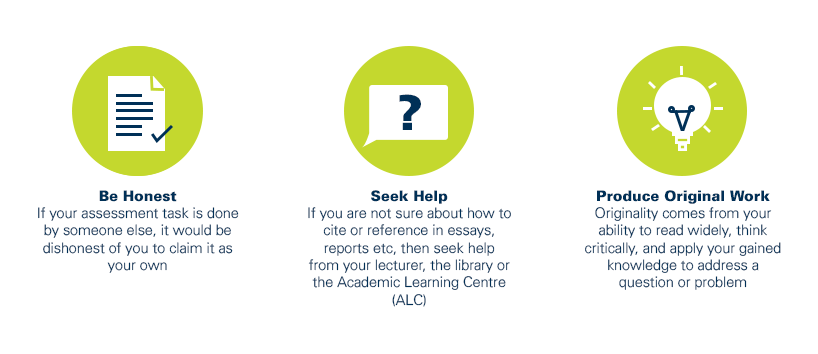
As a CQUniversity student you are expected to act honestly in all aspects of your academic work.
Any assessable work undertaken or submitted for review or assessment must be your own work. Assessable work is any type of work you do to meet the assessment requirements in the unit, including draft work submitted for review and feedback and final work to be assessed.
When you use the ideas, words or data of others in your assessment, you must thoroughly and clearly acknowledge the source of this information by using the correct referencing style for your unit. Using others’ work without proper acknowledgement may be considered a form of intellectual dishonesty.
Participating honestly, respectfully, responsibly, and fairly in your university study ensures the CQUniversity qualification you earn will be valued as a true indication of your individual academic achievement and will continue to receive the respect and recognition it deserves.
As a student, you are responsible for reading and following CQUniversity’s policies, including the Student Academic Integrity Policy and Procedure. This policy sets out CQUniversity’s expectations of you to act with integrity, examples of academic integrity breaches to avoid, the processes used to address alleged breaches of academic integrity, and potential penalties.
What is a breach of academic integrity?
A breach of academic integrity includes but is not limited to plagiarism, self-plagiarism, collusion, cheating, contract cheating, and academic misconduct. The Student Academic Integrity Policy and Procedure defines what these terms mean and gives examples.
Why is academic integrity important?
A breach of academic integrity may result in one or more penalties, including suspension or even expulsion from the University. It can also have negative implications for student visas and future enrolment at CQUniversity or elsewhere. Students who engage in contract cheating also risk being blackmailed by contract cheating services.
Where can I get assistance?
For academic advice and guidance, the Academic Learning Centre (ALC) can support you in becoming confident in completing assessments with integrity and of high standard.
What can you do to act with integrity?