Overview
This unit will introduce you to the fundamental synthesis of mechanisms and machines. You will start by carrying out analysis of linkages in terms of their transmission angles, toggle positions and mobility for a certain mechanism. The kinematic analysis of any mechanism requires an acceleration analysis that depends on its position and velocity. You will be able to carry out this position, velocity, and acceleration analysis of these mechanisms (kinematic systems) using analytical equations and graphical methods. This unit will enable you to work on 3D CAD modelling and computer simulation of various mechanisms or machines. You will move on to kinetic analysis of systems thereby discussing static and dynamic balancing of rotating masses. After learning concepts of dynamics, you will study vibrations (free and forced) of single and multi-degree of freedom systems and will be able to carry out analysis of such systems using force and energy methods. In this unit, you must complete compulsory practical activities. Refer to the Engineering Undergraduate Course Moodle site for proposed dates.
Details
Pre-requisites or Co-requisites
MATH11219 Applied Calculus AND [ENEM12007 Statics & Dynamics OR ENEM12010 Engineering Dynamics].
Important note: Students enrolled in a subsequent unit who failed their pre-requisite unit, should drop the subsequent unit before the census date or within 10 working days of Fail grade notification. Students who do not drop the unit in this timeframe cannot later drop the unit without academic and financial liability. See details in the Assessment Policy and Procedure (Higher Education Coursework).
Offerings For Term 1 - 2026
Attendance Requirements
All on-campus students are expected to attend scheduled classes - in some units, these classes are identified as a mandatory (pass/fail) component and attendance is compulsory. International students, on a student visa, must maintain a full time study load and meet both attendance and academic progress requirements in each study period (satisfactory attendance for International students is defined as maintaining at least an 80% attendance record).
Recommended Student Time Commitment
Each 6-credit Undergraduate unit at CQUniversity requires an overall time commitment of an average of 12.5 hours of study per week, making a total of 150 hours for the unit.
Class Timetable
Assessment Overview
Assessment Grading
This is a graded unit: your overall grade will be calculated from the marks or grades for each assessment task, based on the relative weightings shown in the table above. You must obtain an overall mark for the unit of at least 50%, or an overall grade of 'pass' in order to pass the unit. If any 'pass/fail' tasks are shown in the table above they must also be completed successfully ('pass' grade). You must also meet any minimum mark requirements specified for a particular assessment task, as detailed in the 'assessment task' section (note that in some instances, the minimum mark for a task may be greater than 50%). Consult the University's Grades and Results Policy for more details of interim results and final grades.
All University policies are available on the CQUniversity Policy site.
You may wish to view these policies:
- Grades and Results Policy
- Assessment Policy and Procedure (Higher Education Coursework)
- Review of Grade Procedure
- Student Academic Integrity Policy and Procedure
- Academic Progression Policy and Procedure
- Student Refund and Credit Balance Policy and Procedure
- Complaints Policy and Procedure
- Information and Communications Technology Acceptable Use Policy and Procedure
This list is not an exhaustive list of all University policies. The full list of University policies are available on the CQUniversity Policy site.
Feedback, Recommendations and Responses
Every unit is reviewed for enhancement each year. At the most recent review, the following staff and student feedback items were identified and recommendations were made.
Feedback from Teams channel and conversion in class
Students were overwhelmed by the number of assessment items within the unit.
The unit coordinator should review the assessment items and associated study load, making the necessary adjustments to ensure the required time and effort are appropriate.
- Apply key concepts of kinetics and kinematics to analyse machine design and synthesis
- Use analytical and graphical techniques to carry out position, velocity, and acceleration analysis
- Apply concepts of dynamics in balancing of rotating components
- Analyse vibrations in single and multiple degree of freedom systems
- Communicate professionally using relevant technical terminology, symbols, and diagrams and effectively document calculations and solutions
- Work autonomously and as a team member to analyse problems and present solutions.
The Learning Outcomes for this unit are linked with the Engineers Australia Stage 1 Competency Standards for Professional Engineers in the areas of 1. Knowledge and Skill Base, 2. Engineering Application Ability and 3. Professional and Personal Attributes at the following levels:
Intermediate
1.2 Conceptual understanding of the mathematics, numerical analysis, statistics, and computer and information sciences which underpin the engineering discipline. (LO: 1I 2I 3I 4I)
1.3 In-depth understanding of specialist bodies of knowledge within the engineering discipline. (LO: 1I 2I 3I 4I)
Advanced
1.1 Comprehensive, theory-based understanding of the underpinning natural and physical sciences and the engineering fundamentals applicable to the engineering discipline. (LO: 1A 2A 3A 4I)
1.4 Discernment of knowledge development and research directions within the engineering discipline. (LO: 1A 4A)
1.5 Knowledge of engineering design practice and contextual factors impacting the engineering discipline. (LO: 1A 4A)
1.6 Understanding of the scope, principles, norms, accountabilities and bounds of sustainable engineering practice in the specific discipline. (LO: 5A 6A)
2.1 Application of established engineering methods to complex engineering problem-solving. (LO: 1A 2A 3A 4A 6A)
2.2 Fluent application of engineering techniques, tools and resources. (LO: 4A)
2.3 Application of systematic engineering synthesis and design processes. (LO: 6A)
2.4 Application of systematic approaches to the conduct and management of engineering projects. (LO: 5A 6A)
3.2 Effective oral and written communication in professional and lay domains. (LO: 5A 6A)
3.4 Professional use and management of information. (LO: 5A 6A)
3.5 Orderly management of self, and professional conduct. (LO: 6A)
3.6 Effective team membership and team leadership. (LO: 6A)
Note: LO refers to the Learning Outcome number(s) which link to the competency and the levels: N – Introductory, I – Intermediate and A - Advanced.
Refer to the Engineering Undergraduate Course Moodle site for further information on the Engineers Australia's Stage 1 Competency Standard for Professional Engineers and course level mapping information https://moodle.cqu.edu.au/course/view.php?id=1511
Alignment of Assessment Tasks to Learning Outcomes
| Assessment Tasks | Learning Outcomes | |||||
|---|---|---|---|---|---|---|
| 1 | 2 | 3 | 4 | 5 | 6 | |
| 1 - Online Quiz(zes) - 20% | ||||||
| 2 - Written Assessment - 15% | ||||||
| 3 - Written Assessment - 20% | ||||||
| 4 - Practical Assessment - 15% | ||||||
| 5 - Portfolio - 30% | ||||||
Alignment of Graduate Attributes to Learning Outcomes
| Graduate Attributes | Learning Outcomes | |||||
|---|---|---|---|---|---|---|
| 1 | 2 | 3 | 4 | 5 | 6 | |
| 1 - Communication | ||||||
| 2 - Problem Solving | ||||||
| 3 - Critical Thinking | ||||||
| 4 - Information Literacy | ||||||
| 5 - Team Work | ||||||
| 6 - Information Technology Competence | ||||||
| 7 - Cross Cultural Competence | ||||||
| 8 - Ethical practice | ||||||
| 9 - Social Innovation | ||||||
| 10 - First Nations Knowledges | ||||||
| 11 - Aboriginal and Torres Strait Islander Cultures | ||||||
Textbooks
There are no required textbooks.
IT Resources
- CQUniversity Student Email
- Internet
- Unit Website (Moodle)
- MATLAB and Simulink Suite Software
- Autodesk Inventor
All submissions for this unit must use the referencing style: Harvard (author-date)
For further information, see the Assessment Tasks.
j.sul@cqu.edu.au
Week 1
Begin Date: 09 Mar 2026Module/Topic
Introduction and Kinematics fundamentals
- Introduction to the unit and information session
- Introduction to the machine design and vibration
- Applications of kinematics
- DoF in 2D and types of motion
- Joints, links and kinematic diagrams
Chapter
Events and Submissions/Topic
Week 2
Begin Date: 16 Mar 2026Module/Topic
Graphical linkage synthesis
- Linkage synthesis - Graphical, manual and dimensional techniques with examples
- Two-position synthesis
- Three-position synthesis
Chapter
Events and Submissions/Topic
Week 3
Begin Date: 23 Mar 2026Module/Topic
Position analysis of linkages
- Types of motion
- Position analysis - Graphical, algebraic and vector loop methods for four-bar linkages and four-bar-crank slider
Chapter
Events and Submissions/Topic
Week 4
Begin Date: 30 Mar 2026Module/Topic
Analytical linkage synthesis
- 2 and 3 position motion generation by analytical and graphical synthesis
- 4 and 5 position motion generation using analytical synthesis
Chapter
Events and Submissions/Topic
Week 5
Begin Date: 06 Apr 2026Module/Topic
Velocity analysis of linkages
- Recap of Engineering Dynamics
- Graphical (vector) and instant centre methods (Kennedy's theorem)
- Mechanical advantages
Chapter
Events and Submissions/Topic
Week 6
Begin Date: 13 Apr 2026Module/Topic
Acceleration analysis of linkages
- Graphical (vector) and analytical methods
- Coriolis acceleration
Chapter
Events and Submissions/Topic
Vacation Week
Begin Date: 20 Apr 2026Module/Topic
Chapter
Events and Submissions/Topic
Week 7
Begin Date: 27 Apr 2026Module/Topic
Dynamics fundamentals
- Lumped models
- Kinetics
- Virtual work
Chapter
Events and Submissions/Topic
Interim report - Design of a walking mechanism with minimum imbalance and vibration Due: Week 7 Monday (27 Apr 2026) 11:59 pm AEST
Week 8
Begin Date: 04 May 2026Module/Topic
Static and Dynamic balancing
- Static and dynamic balancing on rotating masses
- Effect of balancing on shaking and input torque
Chapter
Events and Submissions/Topic
Week 9
Begin Date: 11 May 2026Module/Topic
Basic concepts of vibration
- Importance and types of vibration
- Natural frequency
- Critical damping and damping ratio
- Introduction to mathematical modelling and Laplace transform
Chapter
Events and Submissions/Topic
Week 10
Begin Date: 18 May 2026Module/Topic
Free and forced vibration
- Forced harmonic vibration and resonance
- Logarithmic decrement
- Support motion
- Rotating unbalance
Chapter
Events and Submissions/Topic
Residential School, 13 May
Week 11
Begin Date: 25 May 2026Module/Topic
Transient vibration
- Stability of a system
- Poles and Zeros
- Root Locus
- Bode plot
Chapter
Events and Submissions/Topic
Week 12
Begin Date: 01 Jun 2026Module/Topic
Two degree-of-freedom system
- 2 DoF undamped free vibration
- 2 DoF damped free vibration
- 2 DoF forced vibration
- 2 DoF translational and rotational
Chapter
Events and Submissions/Topic
Exam Week
Begin Date: 08 Jun 2026Module/Topic
Chapter
Events and Submissions/Topic
Vacation/Exam Week
Begin Date: 15 Jun 2026Module/Topic
Chapter
Events and Submissions/Topic
1 Online Quiz(zes)
This assignment assesses students on the content from Week 1 to Week 5. You will be given 14 questions. You must provide detailed solutions to the problems given in the assignment in order to demonstrate your knowledge and understanding of the concepts and processes, incorporating relevant sketches, clear step-by-step solutions and a conclusion/judgement on answers.
AI Assessment Scale for this assessment: NO AI - You must not use AI at any point during the assessment. You must demonstrate your core skills and knowledge.
IMPORTANT NOTE: This assessment is exempted from the 72‑hour submission grace period and must be completed by the stated submission date/time.
Week 7 Monday (27 Apr 2026) 11:59 pm AEST
You get unlimited attempts until the due date.
Week 7 Friday (1 May 2026)
Students will get their results immediately after the due time, except for their sketches.
- Correctly identify the problem to be solved (key terms, units, elements, or parts of a problem)
- Choose the most appropriate approach to solving the problem
- Clearly present the solutions with sketches (if necessary) for the problems
- Attempt logical alternative approaches to solving the problem
- The following should be considered when entering your answer.
- You will be given problems with different marks shown next to each problem number.
- You have unlimited attempts. However, each attempt allows 10 tries after which you will need to start a new attempt. A new attempt will generate a new set of numbers in the problems.
- You can navigate through the problems using 'QUIZ NAVIGATION' on the left.
- Numerical answers must be entered to 3 significant figures, and there is no harm in entering answers to 4 or 5 significant figures. An answer of 0.1467 has 4 significant figures; if you enter such an answer as "0.15", it will be marked incorrect. Always keep at least 3 or 4 decimal places during your working.
- The default sign convention for rotation is that anticlockwise is positive. If you are asked to enter an angle as an answer, this is the convention that the computer will be using.
- Unit for acceleration: m/s^2
- Unit for angles: deg or rad
- When you type your answer, remember 3 things: sign (+ or -), numbers, and units!
- Apply key concepts of kinetics and kinematics to analyse machine design and synthesis
- Use analytical and graphical techniques to carry out position, velocity, and acceleration analysis
2 Written Assessment
Task 1: Design (or find) a 1 (or 2) DOF walking mechanism that is reasonably simple but still functional. You will need to assume the working condition of the walking mechanism, such as its walking speed, motor speed, and weight and materials of each link and the main body. This task will need to be completed concurrently with Task 2.
Task 2: Demonstrate the kinematic and kinetic analysis of the design of your choice. This task will need to be completed concurrently with Task 1.
AI Assessment Scale for this assessment: AI Planning - You may use AI for planning, idea development, and research. Your final submission should show how you have developed and refined these ideas.
Week 7 Monday (27 Apr 2026) 11:59 pm AEST
Peer and self-assessment task to be completed by Week 8
Week 8 Friday (8 May 2026)
Students to see feedback through the submission link.
You are required to assess your peers' interim reports as well as your own according to the following marking guidelines and are expected to provide sincere feedback and accurate marks for your peers. This is a valuable chance for reflection after viewing other submissions. 67% of this assessment will be from the marks from your peers and the rest will be from the quality of your feedback to your peers.
- Presentation (/20)
- Does the report overall give you a good impression?
- Does the quality of the presentation give you confidence in the quality of the content?
- What is the overall quality of English expression? Is technical jargon correctly used? Is the language clear and concise?
- Is the report correctly sectioned? Do the sections flow correctly and aid the overall argument?
- Are figures presented in a clear way that maximises the communication of information?
- Is the referencing consistent and easy to follow?
- Does the abstract/executive cover all aspects of the report while maintaining its conciseness?
- Overall, is the contained information efficiently communicated to the reader?
- Context and aims (/20)
- What background information has been provided to justify that the project is meaningful/achievable?
- Do you, as a reader, understand the context of the problem and how solving it makes a valuable contribution to knowledge?
- Design of a mechanism and kinematic diagram (/20)
- A kinematic diagram that clearly describes the mechanism
- Its design meets the requirement specified in the assignment document.
- Reasonable assumptions for its dimensions and materials; therefore, the mass of each link and the entire system is justified.
- Kinematic analysis and verification process (/20)
- Good position, velocity and acceleration analysis with relevant diagrams
- The relationship between the input motor speed and operation speed has been defined.
- Presentation of Autodesk Inventor model
- Hand calculations have been verified with Dynamic Simulation in Autodesk Inventor
- Discussions and conclusions (/10)
- Correct interpretations and descriptions of the design and results
- A good summary of the report and clear statements of meeting aims and objectives defined in the introductory part.
- Identification of items to improve in the final report
- Progress (/10)
- Completion of Task 1 with all required deliverables
- Completion of Task 2 with all required deliverables
- Apply key concepts of kinetics and kinematics to analyse machine design and synthesis
- Use analytical and graphical techniques to carry out position, velocity, and acceleration analysis
3 Written Assessment
You, as an engineer, are requested by Queensland Police to design a shock absorber system for the Segway patroller.
Task 1: Design of a shock absorber system - Find the necessary stiffness and damping constant of the shock absorber system when the damped period of vibration is (to be given) seconds to meet the requirement of Queensland police specified below.
Design requirement
- The current Segway patroller weighs 55 kg. The total weight of the new suspension system and its rider is expected to be (to be given) kg.
- The new suspension system is expected to reduce the vibration amplitude to (to be given) in (to be given) cycles when the Segway patroller is subjected to an initial vertical displacement due to a road bump.
Task 2: Demonstrate the performance of your design – The new Segway patroller with your suspension system is to be tested on a rough road whose surface varies sinusoidally with an amplitude of Y = 0.05 m and a wavelength of 3 m. If the Segway patroller travels at (to be given) km/h, what is the displacement amplitude of the new Segway patroller with the suspension system from Task 1.
AI Assessment Scale for this assessment: AI Planning - You may use AI for planning, idea development, and research. Your final submission should show how you have developed and refined these ideas.
Week 12 Monday (1 June 2026) 11:59 pm AEST
Week 12 Friday (5 June 2026)
Students to see feedback through the submission link
- Presentation (/25%)
- The report is in a professional and consistent format.
- The report meets the proposed specification (file format, length, etc.)
- Good quality of English expression is demonstrated, and its language is clear and concise.
- The report is sectioned properly to aid the overall argument.
- All figures and tables are labelled properly and discussed in the text.
- Figures and tables are relevant and informative.
- Correct citation and reference styles are used in accordance with the suggested referencing system.
- Good use of visual aids is demonstrated.
- Introduction and background (/15%)
- A clear statement about why the report was commissioned in the first place.
- Comprehensive, detailed and focused context about the presented work is given.
- Succinctly lead the reader to the purpose of the work being documented.
- The objectives of the work are expressed well.
- Previous reports and research, if the present report builds on, are included.
- Methods and results (/25%)
- Detailed information on the approach and/or materials used in the study
- Sufficient references are provided to support the methodology used in the report.
- Results are presented in a logical way.
- Clear but concise evidence in the form of statistics, graphs and tables
- Justification for conclusions and recommendations
- Discussion (/20%)
- Analysis using your own words on the method and results
- Good interpretation and explanation of the results
- Relation of the results with the literature
- Examine whether and how the questions raised in the introduction have been answered.
- Conclusions (/15%)
- Clear agreement with all the objectives that were set out in the introduction is made.
- The significant findings and elements from the report are highlighted.
- The main points of the report are drawn.
- A clear statement about how the topic relates to its context (an evaluation of the importance of the topic, implication and/or recommendation for future studies)
- Apply concepts of dynamics in balancing of rotating components
- Analyse vibrations in single and multiple degree of freedom systems
4 Practical Assessment
You are going to conduct three labs, namely Free vibration, Forced vibration, and Mass balance. After conducting these labs, you will complete each task given in the lab worksheet template. You don't need to give lengthy answers for the discussion tasks. You must show all workings where applicable. You must cite the sources of your argument and discussions as per the referencing style specified in the unit profile. This lab worksheet must NOT exceed 15 pages. You will submit it to the submission link provided in Moodle.
AI Assessment Scale for this assessment: AI Planning - You may use AI for planning, idea development, and research. Your final submission should show how you have developed and refined these ideas.
Exam Week Monday (8 June 2026) 11:59 pm AEST
Exam Week Friday (12 June 2026)
Students to see feedback through the submission link
- Accurate results
- Accurate plots with correct axis titles and legends
- Appropriate discussions with supporting references
- Communicate professionally using relevant technical terminology, symbols, and diagrams and effectively document calculations and solutions
- Work autonomously and as a team member to analyse problems and present solutions.
5 Portfolio
Your final report will include Tasks 1 and 2 with further improvement from your interim report.
Task 3: Conduct vibration analysis of your design
- Isolate the walking mechanism including its body with a housing and motor from its surrounding
- Assume its motor is placed right in the middle of the housing on top of a beam as below. You will need to assume the length, width, thickness and material of the beam, based on the size of your mechanism.
- Determine the global mass centre of your design and demonstrate an analytical approach to determine the forced amplitude of the motor under the operating condition defined earlier. (Hint: You will first need to calculate the flexural stiffness and spring constant of the system, thereby defining the natural frequency and frequency ratio)
- Suggest how the forced amplitude can be minimised and prove your solutions
Task 4: Verification of your analysis and Evaluation of your design
- Replicate your design in Autodesk Inventor
- Verify your analysis in Task 2 using Dynamic Simulation in Autodesk Inventor
- Verify your analysis in Task 3 using Dynamic Simulation in Autodesk Inventor
AI Assessment Scale for this assessment: AI Collaboration - You may use AI to assist with specific tasks such as drafting text, refining and evaluating your work. You must critically evaluate and modify any AI-generated content you use.
IMPORTANT NOTE: This assessment is exempted from the 72‑hour submission grace period and must be completed by the stated submission date/time.
Vacation/Exam Week Monday (15 June 2026) 11:59 pm AEST
Students to see feedback through the submission link
The following criteria will be used to grade your report. This is not the suggested structure of your report.
- Innovation and creativity (/20%)
- The demonstrated mechanism is designed by oneself or an effort is made to improve the current design.
- How complex or simple the chosen design is.
- How accurate the chosen mechanism is interpreted.
- Presentation (/20%)
- The report is in a professional and consistent format.
- Good quality of English expression is demonstrated, and its language is clear and concise.
- The report is sectioned properly to aid the overall argument.
- All figures and tables are labelled properly and discussed in the text.
- Figures and tables are relevant and informative.
- Correct citation and reference styles are used in accordance with the suggested referencing system.
- Good use of visual aids is demonstrated.
- Introduction and background (/15%)
- A clear statement about why the report was commissioned in the first place.
- Comprehensive, detailed and focused context about the presented work is given.
- Succinctly lead the reader to the purpose of the work being documented.
- The objectives of the work are expressed well.
- Previous reports and research, if the present report builds on, are included.
- Methods and results (/20%)
- Detailed information on the approach and/or materials used in the study
- Sufficient references are provided to support the methodology used in the report.
- Results are presented in a logical way.
- Clear but concise evidence in the form of statistics, graphs and tables
- Justification for conclusions and recommendations
- Discussion (/15%)
- Analysis using your own words on the method and results
- Good interpretation and explanation of the results
- Relation of the results with the literature
- Examine whether and how the questions raised in the introduction have been answered
- Conclusions (/10%)
- Clear agreement with all the objectives that were set out in the introduction is made.
- The significant findings and elements from the report are highlighted.
- The main points of the report are drawn.
- A clear statement about how the topic relates to its context (an evaluation of the importance of the topic, implication and/or recommendation for future studies)
- Apply concepts of dynamics in balancing of rotating components
- Analyse vibrations in single and multiple degree of freedom systems
- Communicate professionally using relevant technical terminology, symbols, and diagrams and effectively document calculations and solutions
- Work autonomously and as a team member to analyse problems and present solutions.
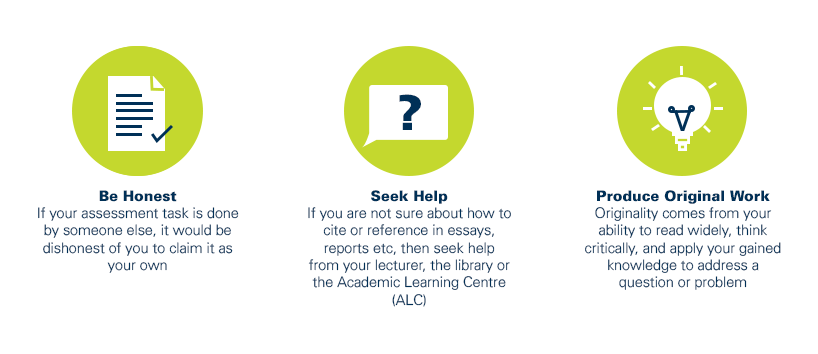
As a CQUniversity student you are expected to act honestly in all aspects of your academic work.
Any assessable work undertaken or submitted for review or assessment must be your own work. Assessable work is any type of work you do to meet the assessment requirements in the unit, including draft work submitted for review and feedback and final work to be assessed.
When you use the ideas, words or data of others in your assessment, you must thoroughly and clearly acknowledge the source of this information by using the correct referencing style for your unit. Using others’ work without proper acknowledgement may be considered a form of intellectual dishonesty.
Participating honestly, respectfully, responsibly, and fairly in your university study ensures the CQUniversity qualification you earn will be valued as a true indication of your individual academic achievement and will continue to receive the respect and recognition it deserves.
As a student, you are responsible for reading and following CQUniversity’s policies, including the Student Academic Integrity Policy and Procedure. This policy sets out CQUniversity’s expectations of you to act with integrity, examples of academic integrity breaches to avoid, the processes used to address alleged breaches of academic integrity, and potential penalties.
What is a breach of academic integrity?
A breach of academic integrity includes but is not limited to plagiarism, self-plagiarism, collusion, cheating, contract cheating, and academic misconduct. The Student Academic Integrity Policy and Procedure defines what these terms mean and gives examples.
Why is academic integrity important?
A breach of academic integrity may result in one or more penalties, including suspension or even expulsion from the University. It can also have negative implications for student visas and future enrolment at CQUniversity or elsewhere. Students who engage in contract cheating also risk being blackmailed by contract cheating services.
Where can I get assistance?
For academic advice and guidance, the Academic Learning Centre (ALC) can support you in becoming confident in completing assessments with integrity and of high standard.
What can you do to act with integrity?