Overview
In this unit you will learn how exercise is used in the assessment, treatment, or prevention of chronic or complex health conditions. You will also undertake a supervised placement in a clinical setting where you will apply and reflect on your knowledege and skills in the use of exercise in this population. The knowledge and experience gained in this unit will enhance your understanding of the healthcare sector, and of employment opportunities in the field.
Details
Pre-requisites or Co-requisites
Pre-requisites ESSC13008 - Advanced Exercise Prescription and Delivery
Important note: Students enrolled in a subsequent unit who failed their pre-requisite unit, should drop the subsequent unit before the census date or within 10 working days of Fail grade notification. Students who do not drop the unit in this timeframe cannot later drop the unit without academic and financial liability. See details in the Assessment Policy and Procedure (Higher Education Coursework).
Offerings For Term 2 - 2026
Attendance Requirements
All on-campus students are expected to attend scheduled classes - in some units, these classes are identified as a mandatory (pass/fail) component and attendance is compulsory. International students, on a student visa, must maintain a full time study load and meet both attendance and academic progress requirements in each study period (satisfactory attendance for International students is defined as maintaining at least an 80% attendance record).
Recommended Student Time Commitment
Each 6-credit Undergraduate unit at CQUniversity requires an overall time commitment of an average of 12.5 hours of study per week, making a total of 150 hours for the unit.
Class Timetable
Assessment Overview
Assessment Grading
This is a graded unit: your overall grade will be calculated from the marks or grades for each assessment task, based on the relative weightings shown in the table above. You must obtain an overall mark for the unit of at least 50%, or an overall grade of 'pass' in order to pass the unit. If any 'pass/fail' tasks are shown in the table above they must also be completed successfully ('pass' grade). You must also meet any minimum mark requirements specified for a particular assessment task, as detailed in the 'assessment task' section (note that in some instances, the minimum mark for a task may be greater than 50%). Consult the University's Grades and Results Policy for more details of interim results and final grades.
All University policies are available on the CQUniversity Policy site.
You may wish to view these policies:
- Grades and Results Policy
- Assessment Policy and Procedure (Higher Education Coursework)
- Review of Grade Procedure
- Student Academic Integrity Policy and Procedure
- Academic Progression Policy and Procedure
- Student Refund and Credit Balance Policy and Procedure
- Complaints Policy and Procedure
- Information and Communications Technology Acceptable Use Policy and Procedure
This list is not an exhaustive list of all University policies. The full list of University policies are available on the CQUniversity Policy site.
Feedback, Recommendations and Responses
Every unit is reviewed for enhancement each year. At the most recent review, the following staff and student feedback items were identified and recommendations were made.
Feedback from Personal reflection.
Moodle forums could be better utilised as a form of communication and interaction between students and teaching staff.
It is recommended to continue to pursue strategies including consultation with colleagues on how to increase student engagement through the forums.
Feedback from Student discussion.
Opportunities for students to undertake Professional Practicum Placement across a wide variety of location is well-appreciated by students.
It is recommended to continue to work closely with the placement co-ordinator to identify suitable sites and supervisors for the Professional Practicum Placement aspect of this unit.
Feedback from SUTE report
Students report the teaching strategies utilised in this unit to be extremely effective.
It is recommended to continue with many of the current teaching strategies employed in this unit.
- Apply exercise science knowledge and/or skills to the assessment, treatment, or prevention of chronic or complex health conditions seen in the clinical setting.
- Appraise the role of exercise in the assessment, treatment, or prevention of chronic or complex health conditions seen in the clinical setting.
- Identify, analyse and discuss relevant issues related to professional service in the clinic setting, with emphasis on the role of the professional in delivering these services and programmes.
- Work independently and/or collaborate with others as a team member.
- Practice inclusively, respecting diverse backgrounds, including Aboriginal and Torres Strait Islander peoples, gender and sexually diverse persons, persons of culturally and linguistically diverse backgrounds, and those living with a disability.
These Unit Learning Outcomes align with Exercise and Sports Science Australia accreditation standards to gain accreditation as an Accredited Exercise Scientist.
Alignment of Assessment Tasks to Learning Outcomes
| Assessment Tasks | Learning Outcomes | ||||
|---|---|---|---|---|---|
| 1 | 2 | 3 | 4 | 5 | |
| 1 - Written Assessment - 60% | |||||
| 2 - Presentation - 40% | |||||
| 3 - Professional Practice Placement - 0% | |||||
| 4 - Learning logs / diaries / Journal / log books - 0% | |||||
Alignment of Graduate Attributes to Learning Outcomes
| Graduate Attributes | Learning Outcomes | ||||
|---|---|---|---|---|---|
| 1 | 2 | 3 | 4 | 5 | |
| 1 - Communication | |||||
| 2 - Problem Solving | |||||
| 3 - Critical Thinking | |||||
| 4 - Information Literacy | |||||
| 5 - Team Work | |||||
| 6 - Information Technology Competence | |||||
| 7 - Cross Cultural Competence | |||||
| 8 - Ethical practice | |||||
| 9 - Social Innovation | |||||
| 10 - First Nations Knowledges | |||||
| 11 - Aboriginal and Torres Strait Islander Cultures | |||||
Textbooks
ACSM’s Guidelines for Exercise Testing and Prescription
- Edition: 12th (2025)
- Authors: American College of Sports Medicine
- Lippincott Williams & Wilkins
- Philadelphia Philadelphia , PA , USA
- ISBN: 9781975219208
- Binding: eBook
Additional Textbook Information
An e-Book version is available from the ACSM website which some students may prefer. It can be found here.
IT Resources
- CQUniversity Student Email
- Internet
- Unit Website (Moodle)
- Computer / laptop with webcam to allow videoconferencing.
- EndNote or similar bibliographic software is recommended. EndNote is available free of charge from CQUniversity via the Library or IT services.
- Microsoft Office (or equivalent) software for preparation of assessment items in the appropriate format.
- Adobe Acrobat Reader (or similar) software for viewing PDF documents.
- ZOOM Videoconferencing software. A ZOOM account is available with your student credentials. We will use this software for case study presentations.
- Microsoft CoPilot Generative Artificial Intelligence tool.
All submissions for this unit must use the referencing style: American Psychological Association 7th Edition (APA 7th edition)
For further information, see the Assessment Tasks.
s.fien@cqu.edu.au
r.stanton@cqu.edu.au
Week 1
Begin Date: 13 Jul 2026Module/Topic
Unit introduction: Exercise as medicine, work placement, and assessment.
Chapter
ACSM Guidelines for Exercise Testing and Prescription (12th Edition) 2025. Chapter 5 (p 151 - 166) and online reading resources on Moodle.
Events and Submissions/Topic
Mandatory tutorial for information regarding Work Integrated Learning (placement) for those who did not complete ESSC13008 in T1 2026. See ESSC13005 Moodle site for specific date, time, and Zoom link.
Week 2
Begin Date: 20 Jul 2026Module/Topic
Exercise pre-participation health screening, clinical exercise testing, and interpretation.
Chapter
ACSM Guidelines for Exercise Testing and Prescription (12th Edition) 2025. Chapters 2 (p 28 - 56) and 4 (p119 - 149).
Events and Submissions/Topic
Week 3
Begin Date: 27 Jul 2026Module/Topic
Health coaching.
Chapter
ACSM Guidelines for Exercise Testing and Prescription (12th Edition) 2025. Chapter 12 (p 554 - 589) and online reading resources on Moodle.
Events and Submissions/Topic
Week 4
Begin Date: 03 Aug 2026Module/Topic
Special considerations for diverse populations.
Chapter
ACSM Guidelines for Exercise Testing and Prescription (12th Edition) 2025. Chapter 6 (p 234 - 237), Chapter 11 (p 488 - 496) and online reading resources on Moodle.
Events and Submissions/Topic
Week 5
Begin Date: 10 Aug 2026Module/Topic
Age-related considerations for exercise prescription.
Chapter
ACSM Guidelines for Exercise Testing and Prescription (12th Edition) 2025. Chapter 6 (p 201 - 206 and p 221 - 233) and online reading resources on Moodle.
Events and Submissions/Topic
Week 6
Begin Date: 17 Aug 2026Module/Topic
Special considerations for females.
Chapter
ACSM Guidelines for Exercise Testing and Prescription (12th Edition) 2025. Chapter 6 (p 207 - 214), Chapter 10 (p 443 - 446), and online reading resources on Moodle.
Events and Submissions/Topic
Vacation Week
Begin Date: 24 Aug 2026Module/Topic
No lecture this week.
Chapter
Events and Submissions/Topic
Week 7
Begin Date: 31 Aug 2026Module/Topic
Special considerations for cardiovascular disease.
Chapter
ACSM Guidelines for Exercise Testing and Prescription (12th Edition) 2025. Chapter 8 (p 278 - 309) and online reading resources on Moodle.
Events and Submissions/Topic
Week 8
Begin Date: 07 Sep 2026Module/Topic
Special considerations for pulmonary disease.
Chapter
ACSM Guidelines for Exercise Testing and Prescription (12th Edition) 2025. Chapter 8 (p 310 - 331) and online reading resources on Moodle.
Events and Submissions/Topic
Week 9
Begin Date: 14 Sep 2026Module/Topic
Special considerations for metabolic and renal disease.
Chapter
ACSM Guidelines for Exercise Testing and Prescription (12th Edition) 2025. Chapter 9 (p 348 - 366) and Chapter 10 (p 429 - 434).
Events and Submissions/Topic
Week 10
Begin Date: 21 Sep 2026Module/Topic
Special considerations for cancer.
Chapter
ACSM Guidelines for Exercise Testing and Prescription (12th Edition) 2025. Chapter 10 (p 394 - 405) and online reading resources on Moodle.
Events and Submissions/Topic
Case Study Presentation due Week 10. Various times are available. Check Moodle for details.
Slides for Case Study Presentation due Week 10 (Friday 25 September 2026) 5:00 pm AEST.
Week 11
Begin Date: 28 Sep 2026Module/Topic
Special considerations for mental health.
Chapter
ACSM Guidelines for Exercise Testing and Prescription (12th Edition) 2025. Chapter 11 (p 482 - 487) and online reading resources on Moodle.
Events and Submissions/Topic
Week 12
Begin Date: 05 Oct 2026Module/Topic
Special considerations for common orthopaedic conditions.
Chapter
ACSM Guidelines for Exercise Testing and Prescription (12th Edition) 2025. Chapter 6 (p 216 - 220), Chapter 10 (p 389 - 392), and online reading resources on Moodle.
Events and Submissions/Topic
Please Note: The scheduled lecture for Week 12 (Monday 5th October) falls on a public holiday in Queensland (King's Birthday Holiday). As a result, the lecture will be pre-recorded and placed online prior to this date. A ZOOM drop-in session will be scheduled for Tuesday 6th October from 9.00 am - 10.00 am AEST for those who have questions about the Week 12 lecture content.
Minimum 50 hour Professional Practice Placement must be completed by Week 12 Friday (9 October 2026) 5:00 pm AEST.
Exam Week
Begin Date: 12 Oct 2026Module/Topic
Chapter
Events and Submissions/Topic
Professional Practice Placement
Final date for submission of Professional Practice Evaluations is Review/Exam Week Tuesday (13 October 2026) at 11:59 pm AEST.
Record of Student Engagement
Final date for submission of the Record of Student Engagement is Review/Exam Week Tuesday (13 October 2026) at 11:59 pm AEST
Vacation/Exam Week
Begin Date: 19 Oct 2026Module/Topic
Chapter
Events and Submissions/Topic
In this unit, you will undertake a mandatory Professional Practice Placement comprising a minimum 50 hours of Professional Practice Placement under the supervision of an Accredited Exercise Physiologist. Once enrolled in this unit, you can access Sonia (Work Integrated Learning student portal) to arrange and/or view details of your Professional Practice Placement site. You must complete your mandatory checks and student nomination form on Sonia. You are not able to begin your Professional Practice Placement until the beginning of Term 2 and all mandatory checks have been completed via Sonia. You should contact the WIL team as soon as possible to arrange your Professional Practice Placement if you have not already received your Professional Practice Placement nomination form. Please note you may be required to travel and make necessary work arrangements to complete the minimum 50 hours of Professional Practice Placement in this unit. Further WIL information is available on the ESSC13005 Moodle site.
Please note: Failure to comply with the Professional Practice Placement agreement for any site regarding student attendance, expectations, behaviour, or communication during a placement may result in cancellation of all Professional Practice Placements at that site. Consequently, this situation may result in a Fail grade being awarded for the unit to which noncompliance applies and rescheduling of Professional Practice Placement site(s) for other units where WIL activities are required.
Grace period for submission of assessment tasks: Changes to the Assessment Policy and Procedure (Higher Education Coursework) will see the implementation of a grace period of 72 hours for the submission of some assessment tasks. The means you will be able to submit some assessment tasks up to 72 hours after the due date without incurring late penalties. This Unit Profile and the ESSC13005 Moodle site clearly identify the assessment tasks for which this grace period DOES NOT apply.
Week 12 Lecture: The schedule lecture for Week 12 (Monday 5th October) falls on a public holiday in Queensland (King's Birthday Holiday). As a result, the lecture will be pre-recorded and placed online prior to this date. A ZOOM drop-in session will be scheduled for Tuesday 6th October from 9.00 am - 10.00 am AEST for those who have questions about the Week 12 lecture content.
1 Written Assessment
Clinical Practice Guidelines (60% of overall grade). In the current age, artificial intelligence tools are increasingly used in healthcare including in the development of exercise programs. In this assessment item, you will firstly use Microsoft Copilot (available at https://copilot.microsoft.com/), a generative artificial intelligence tool (GenAI), to produce a set of clinical practice guidelines which details how exercise can be used in the treatment of a chronic or complex health condition of your choice. You will do this by creating a series of prompts to generate the desired output. You may need to use multiple prompts to refine the output to your desired level of detail.
You will then critically analyse the Microsoft Copilot-generated output for congruence with recent (within the past 10 years) peer-reviewed, published guidelines for exercise prescription for that condition. Your critical analysis must include the following information:
- A detailed discussion on the depth and breadth of information contained in the Microsoft Copilot-generated guidelines;
- A synthesis of recent (published within the past 10 years) evidence-based exercise guidelines for your chosen condition, drawn from a minimum of five (5) peer-reviewed sources;
- A detailed critique of the similarities and differences between the Microsoft Copilot-generated guidelines and those sourced from the peer-reviewed published literature; and,
- Your perspective of the value of using GenAI tools such as Microsoft CoPilot for the preparation of clinical practice guidelines for the prescription of exercise for your chosen condition.
Your submission will include the following information:
- The name of the condition you have chosen for your assessment task;
- The prompts you have used to generate the output;
- The output generated by Microsoft Copilot; and,
- The critical analysis of the Microsoft Copilot-generated output.
Your Clinical Practice Guidelines will be no less than six (6) pages in length, and no more than eight (8) pages in length (not including the Microsoft Copilot prompts and output, a title page and references), and be prepared according to the following instructions:
- Document type: Microsoft Word (.doc or .docx).
- Page size: A4.
- Font: Calibri 12 point.
- Line spacing: Double spaced throughout.
- Language: Australian English.
- Margins: 2.54cm on all sides
- Tables and Figures: May be used but will be included in the 8-page limit.
- Your critical analysis section must be supported by relevant references where necessary.
Your Clinical Practice Guidelines will be marked against the criteria described in the Assessment Criteria section below. The Clinical Practice Guidelines will be marked out of 120 marks and contribute 60% of your overall grade for this unit. More details, including a template for preparing the Clinical Practice Guidelines and the marking rubric, will be available on the ESSC13005 Moodle site.
Level of GenAI use allowed: Level 4: You may use Al extensively throughout your work either as you wish, or as specifically directed in your assessment. Focus on directing Al to achieve your goals while demonstrating your critical thinking.
Week 7 Tuesday (1 Sept 2026) 5:00 pm AEST
In the absence of an approved extension, any submissions received more than 72 hours after the due date will incur penalties in accordance with CQUniversity Assessment Policy and Procedure (Higher Education Coursework).
Week 9 Tuesday (15 Sept 2026)
Marks for the Clinical Practice Guidelines will be available 2 weeks following the due date.
The Clinical Practice Guidelines will be marked out of 120 marks using the criteria described below.
- Present the complete set of Microsoft Copilot prompts used, including how these were developed (10 marks)
- Present the final clinical practice guidelines produced by Microsoft Copilot in complete detail (10 marks)
- Present a detailed discussion on the depth and breadth of information contained in the Microsoft Copilot-generated guidelines (20 marks)
- Undertake a detailed synthesis of recent (published within the past 10 years) evidence-based exercise guidelines
for your chosen condition, drawn from a minimum of five (5) peer-reviewed sources (20 marks) - Provide a detailed comparison of the similarities and differences between the Microsoft Copilot-generated clinical practice guidelines and those obtained from your synthesis of the published evidence-based guidelines (20 marks)
- Provided a detailed perspective of the utility of using Microsoft Copilot for the preparation of clinical practice guidelines for the prescription of exercise for your chosen condition (10 marks)
- Adhere to the submission guidelines (10 marks)
- Use a writing style, including grammar and spelling commensurate with the level of work expected (10 marks)
- Use relevant references formatted according to APA style (7th Edition) (including in-text references) (10 marks)
Marks will be awarded using a marking rubric which is available on the ESSC13005Moodle site.
- Appraise the role of exercise in the assessment, treatment, or prevention of chronic or complex health conditions seen in the clinical setting.
- Identify, analyse and discuss relevant issues related to professional service in the clinic setting, with emphasis on the role of the professional in delivering these services and programmes.
2 Presentation
Online Case Study Presentation (40% of overall grade). At the commencement of Term 2 you will be randomly assigned a case study describing a client with a chronic health condition. The case study will include additional information relevant to the assessment, screening, and exercise prescription tasks you would undertake in a clinical setting. You will present a case study as an oral presentation supported by PowerPoint slides or similar presentation software. In your oral presentation, you will describe the disease aetiology and pathophysiology, recommended exercise screening and/or testing protocols, exercise prescription including contraindications, behaviour change strategies, and the potential benefits of exercise, for your assigned case. Your presentation content must be supported by evidence drawn from recent (within the past 10 years) peer-reviewed literature such as published journal articles, best practice recommendations, or other high-quality sources (NOT websites, Wikipedia, or magazines). You will present the case study during designated presentation sessions scheduled from Monday to Friday of Week 10 of Term 2, 2026 (Sept 21 - Sept 25, 2026). Your case study must be presented ‘live’ using ZOOM video conference software and cannot be pre-recorded. The presentation must include video of yourself in addition to your presentation slides. Your webcam must remain on throughout the entire session in which you present. You should be familiar with screen sharing in ZOOM prior to commencement of your presentation. All presentation sessions will be recorded. The case study presentation will be marked against the criteria described in the Assessment Criteria section below. More details, including the marking rubric, will be available on the ESSC13005 Moodle site.
This assessment item will be marked out of 70 marks and contribute 40% of your overall grade for this unit. You will submit the slides for your presentation via Moodle. The final date for submission of slides is Week 10 Friday (25 September 2026) 5:00 pm AEST. Each allocated session can accommodate up to eight (8) presentations, and each Online Case Study Presentation will be no less than eight (8) minutes in duration, and no more than ten (10) minutes in duration. Presentations longer than ten (10) minutes will be interrupted and no further presentation time will be allocated. On completion of the presentation, up to ten (10) minutes will be allocated for questions. Questions will come from the Unit Coordinator; however, time permitting, questions may be invited from other students who are attending the same session. You are required to attend the case study session for the full duration (approximately three (3) hours), and not just for your own presentation. You are only required to attend the case study presentation session in which you are scheduled to present, but you may attend other sessions if you choose.
Due date: Online Case Study Presentations will be held at various times during Week 10. A 'Choice' option will be available on Moodle where you can select your preferred presentation time. These sessions will be available on a 'first in first served' basis and no additional times will be made available unless an approved extension is granted. All case study presentations must be completed by Week 10 Friday (25 September 2026) 5:00 pm AEST. In the absence of an approved extension, any submissions received after the due date will incur penalties in accordance with CQUniversity Assessment Policy and Procedure (Higher Education Coursework).
The 72-hour grace period does not apply to this assessment.
Level of GenAI us allowed: Level 3: You may use Al to assist with specific tasks such as drafting text, refining and evaluating your work. You must critically evaluate and modify any Al-generated content you use.
Online Case Study Presentations will occur Monday to Friday during Week 10 (Sept 21 - Sept 25, 2026). All case study presentations must be completed by Week 10 Friday (25 September 2026) 5:00 pm AEST.
Week 12 Friday (9 Oct 2026)
Marks for the Online Case Study Presentation will be available 2 weeks following the due date.
The Online Case Study Presentation will be marked out of 70 marks using the criteria described below.
- Provide a description of the aetiology and pathophysiology of the condition described in the case study including any functional or other limitations or comorbidities associated with the condition. (10 marks)
- Describe the benefits associated with exercise participation for the condition described in the case study. (10 marks)
- Describe in detail, an evidence-based exercise protocol including how and when progressions or regressions might be implemented. (10 marks)
- Explain potential barriers to exercise participation and how you would address those barriers. (10 marks)
- Make recommendations regarding referrals to other health professionals who might be relevant to the care of the client described in the case study including how those referrals would be facilitated. (10 marks)
- Present the case study in an enthusiastic and competent manner. (5 marks)
- Respond to questions in a correct and appropriate manner. (10 marks)
- Relevant aspects of the presentation are supported with recent (within the past 10 years) and relevant references. (5 marks)
Marks will be awarded using a marking rubric which is available on the ESSC13005 Moodle site.
- Appraise the role of exercise in the assessment, treatment, or prevention of chronic or complex health conditions seen in the clinical setting.
- Identify, analyse and discuss relevant issues related to professional service in the clinic setting, with emphasis on the role of the professional in delivering these services and programmes.
3 Professional Practice Placement
In this assessment task, you will undertake a minimum 50 hours of placement under the supervision of an Accredited Exercise Physiologist and be assessed on your competency as a student Exercise Scientist. Irrespective of when you commence your placement, your placement hours must be completed no later than Week 12 Friday (9 October 2026) 5:00 pm AEST. Your competency in this assessment will be graded as Pass or Fail.
You are required to submit two (2) Professional Placement Evaluations.
Professional Practice Evaluation 1 is due at the completion of the first 25 hours (mid-point).
Professional Practice Evaluation 2 is due at the completion of the second 25 hours (end-point).
Irrespective of when you commence your placement, both Evaluations must be submitted by Review/Exam Week Tuesday (13 October 2026) at 11:59 pm AEST. In the event your documentation contains insufficient detail or is incomplete and requires resubmission, the resubmission must be no later than Review/Exam Week Tuesday (16 October 2026) at 11:59 pm AEST.
The Professional Practice Evaluation assessment item comprises an assessment tool that your placement supervisor will complete regarding your goals, performance, and capabilities while on placement. It is expected that you and your placement supervisor complete the Professional Practice Evaluations together. This should be viewed as an open process designed to enhance your placement experience and exercise assessment, prescription, and delivery skills and competency. You must complete the templates available on the ESSC13005 Moodle site for Professional Placement Evaluation 1, which documents the first 25 hours of your placement, and for Professional Placement Evaluation 2, which documents the second 25 hours of your placement. During your placement, you will be evaluated by your placement supervisor at the end of 25 hours and the end of 50 hours of placement. Together, Professional Placement Evaluation 1 and Professional Placement Evaluation 2 must show evidence of your competency in completing your minimum 50 hour placement. In the absence of an approved extension, Evaluations that do not contain sufficient detail, or are not completed by the placement supervisor(s) will be returned for corrections and you may not be able to pass this assessment item, or this unit, unless the Evaluations are completed according to these instructions. You will have one (1) opportunity to resubmit returned Evaluations.
Please Note: Failure to comply with the Professional Practice Placement agreement for any site regarding student attendance, expectations, behaviour, or communication during a placement may result in cancellation of all placements at that site. Consequently, this situation may result in a Fail grade being awarded for the unit to which non-compliance applies and rescheduling of placement site(s) for other units where WIL activities are required.
The 72-hour grace period does not apply to this assessment.
Level of GenAI use allowed:
Level 1: You must not use Al at any point during the assessment. You must demonstrate your core skills and knowledge.
Further detail regarding placement and this assessment task will be made available on the ESSC13005 Moodle site.
Professional Practice Evaluation 1 (formative assessment) must be submitted immediately on completion of the first 25 hours of your placement. Professional Practice Evaluation 2 (summative assessment) must be submitted on immediately on completion of the final 25 hours of your placement. Irrespective of when you commence your placement, both Evaluations must be submitted by Review/Exam Week Tuesday (13 October 2026) 11:59 pm AEST. In the event your documentation contains insufficient detail or is incomplete and requires resubmission, the resubmission must be no later than Review/Exam Week Friday (16 October 2026) 11:59 pm AEST. In the absence of an approved extension, any submissions received after the due date will not be graded and you may not be able to pass this unit.
Professional Practice Evaluations will be returned within two (2) weeks of submission.
The Professional Practice Evaluations comprises an assessment tool that your placement supervisor will complete regarding your performance and competency while on placement. The evaluation tool is made up of two (2) sections including Professional Practice Competencies and Exercise Scientist Competencies.
Professional Practice Evaluation 1 is a formative assessment and the outcomes of this assessment are used to help identify areas that you are doing well in, and areas that need improvement.
Professional Practice Evaluation 2 is a summative assessment and you must attain the minimum pass mark to pass this assessment item.
A template for this assessment will be made available on the ESSC13005 Moodle site, covering these areas:
Professional Practice Competencies
- Professional behaviour and demeanour
- Communication with clients, family members, and/or carers
- Communication and teamwork with colleagues
- Critical thinking and analysis
- Self-improvement and development
Exercise Scientist Competencies
- Client assessment
- Interpretation of findings
- Development of exercise plan(s)
- Implementation of exercise plan(s) (N.B. This must be assessed for ESSC13005)
- Evaluation of exercise plan(s)
Please note: In line with the practicum standards, exercise science students are able to deliver exercise programs designed by an Accredited Exercise Physiologist to clinical populations but are unable to deliver exercise assessment or prescription for clinical clients. Students are also not able to provide any part of the billed service under private health insurance schemes. Students and their supervisors should familiarise themselves with the relevant scope of practice before undertaking practicum activities.
- Apply exercise science knowledge and/or skills to the assessment, treatment, or prevention of chronic or complex health conditions seen in the clinical setting.
- Work independently and/or collaborate with others as a team member.
- Practice inclusively, respecting diverse backgrounds, including Aboriginal and Torres Strait Islander peoples, gender and sexually diverse persons, persons of culturally and linguistically diverse backgrounds, and those living with a disability.
4 Learning logs / diaries / Journal / log books
In this assessment task, you will provide detail and evidence of your minimum 50 hours of ESSA-approved placement and be assessed on how this evidence aligns to ESSA Accredited Exercise Scientist (AES) professional attributes. Your evidence presented in this assessment will be graded as Pass or Fail.
A separate Record of Student Engagement must be completed for each unit and each site where WIL is undertaken. You must complete the template available on the ESSC13005 Moodle site, which also includes a logbook of the hours you have completed. When completing this assessment please ensure you check the ESSC13005 box as the relevant ESSC unit. The Record of Student Engagement must also be signed by your placement supervisor. An example of the level of detail required for the Record of Student Engagement has previously been provided on the ESSC13008 Moodle site.
The 72-hour grace period does not apply to this assessment.
Level of GenAI use allowed:
Level 1: You must not use Al at any point during the assessment. You must demonstrate your core skills and knowledge.
Your Record of Student Engagement is due Review/Exam Week Tuesday (13 October 2026) 11:59 pm AEST. In the event your documentation contains insufficient detail or is incomplete and requires resubmission, the resubmission must be no later than Review/Exam Week Friday (16 October 2026) 11:59 pm AEST. In the absence of an approved extension, any submissions received after the due date will not be graded and you may not be able to pass this unit.
Your Record of Student Engagement will be returned within two (2) weeks of submission.
The Record of Student Engagement is graded as Pass/Fail. Sufficient detail is required in regard to the client description and description of services, reference to the appropriate ESSA AES professional attributes, as well as the detail and adequacy of the placement hours. In the event of completing placement across multiple sites, the Record of Student Engagement must be completed for each site.
Your Record of Student Engagement will be marked according to the following criteria to comply with guidelines stipulated by ESSA:
- Sufficient detail of dates, hours, client(s) description (anonymised), description of services, supervisor's name, and supervisor's signature. N.B. Clinical exercise delivery must be included in these hours.
- Reference to the appropriate ESSA AES professional attributes completed during placement.
- A breakdown of hours for "Exercise Assessment, Prescription, and Delivery" (Category 1) and "Sport Science Other" (Category 2) tasks is included, using the descriptors previously given in ESSC13008.
- Typed and uploaded as a .doc, .docx, or .pdf file.
Records of Student Engagement that do not contain sufficient detail, are not signed by the placement supervisor, or are not clearly typed, will be returned for corrections. You may not be able to pass this assessment item, or this unit unless the Record of Student Engagement meets the requirements described above, which are in accordance with ESSA standards. If a Record of Student Engagement is returned for corrections you will be given one (1) opportunity to resubmit that Record of Student Engagement.
- Apply exercise science knowledge and/or skills to the assessment, treatment, or prevention of chronic or complex health conditions seen in the clinical setting.
- Work independently and/or collaborate with others as a team member.
- Practice inclusively, respecting diverse backgrounds, including Aboriginal and Torres Strait Islander peoples, gender and sexually diverse persons, persons of culturally and linguistically diverse backgrounds, and those living with a disability.
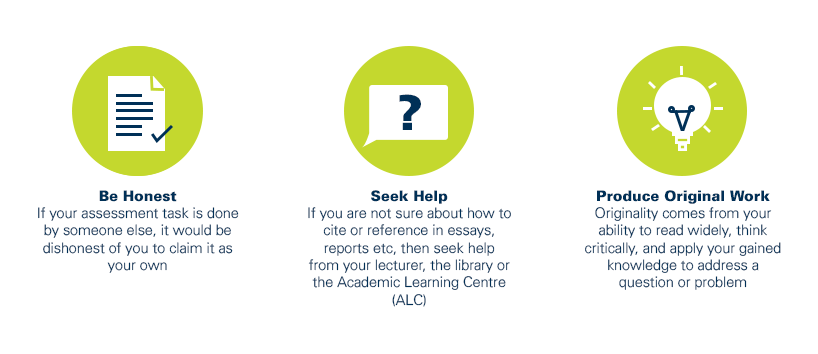
As a CQUniversity student you are expected to act honestly in all aspects of your academic work.
Any assessable work undertaken or submitted for review or assessment must be your own work. Assessable work is any type of work you do to meet the assessment requirements in the unit, including draft work submitted for review and feedback and final work to be assessed.
When you use the ideas, words or data of others in your assessment, you must thoroughly and clearly acknowledge the source of this information by using the correct referencing style for your unit. Using others’ work without proper acknowledgement may be considered a form of intellectual dishonesty.
Participating honestly, respectfully, responsibly, and fairly in your university study ensures the CQUniversity qualification you earn will be valued as a true indication of your individual academic achievement and will continue to receive the respect and recognition it deserves.
As a student, you are responsible for reading and following CQUniversity’s policies, including the Student Academic Integrity Policy and Procedure. This policy sets out CQUniversity’s expectations of you to act with integrity, examples of academic integrity breaches to avoid, the processes used to address alleged breaches of academic integrity, and potential penalties.
What is a breach of academic integrity?
A breach of academic integrity includes but is not limited to plagiarism, self-plagiarism, collusion, cheating, contract cheating, and academic misconduct. The Student Academic Integrity Policy and Procedure defines what these terms mean and gives examples.
Why is academic integrity important?
A breach of academic integrity may result in one or more penalties, including suspension or even expulsion from the University. It can also have negative implications for student visas and future enrolment at CQUniversity or elsewhere. Students who engage in contract cheating also risk being blackmailed by contract cheating services.
Where can I get assistance?
For academic advice and guidance, the Academic Learning Centre (ALC) can support you in becoming confident in completing assessments with integrity and of high standard.
What can you do to act with integrity?