Overview
This unit examines Australians at war from 1788 to the present, not from the point of view of the military historian but with respect to the conflict and division that wars have caused on the home front. You will learn about several conflicts and their impact on Australian society including the struggle between First Nations Peoples and settlers on the frontier, colonial wars, World War I and World War II, Vietnam, Afghanistan, Iraq and the war on terrorism. You will also learn about the interplay between war and society by considering the conscription debates and the peace movements that came about in response to various conflicts. This unit explores the way war impacts society and the public debates that arise as the result of war.
Details
Pre-requisites or Co-requisites
Admission to CC10 or completion of 90 credit points in CA10, CB94, CC13, CG85 or CC43.
Important note: Students enrolled in a subsequent unit who failed their pre-requisite unit, should drop the subsequent unit before the census date or within 10 working days of Fail grade notification. Students who do not drop the unit in this timeframe cannot later drop the unit without academic and financial liability. See details in the Assessment Policy and Procedure (Higher Education Coursework).
Offerings For Term 2 - 2026
Attendance Requirements
All on-campus students are expected to attend scheduled classes - in some units, these classes are identified as a mandatory (pass/fail) component and attendance is compulsory. International students, on a student visa, must maintain a full time study load and meet both attendance and academic progress requirements in each study period (satisfactory attendance for International students is defined as maintaining at least an 80% attendance record).
Recommended Student Time Commitment
Each 6-credit Postgraduate unit at CQUniversity requires an overall time commitment of an average of 12.5 hours of study per week, making a total of 150 hours for the unit.
Class Timetable
Assessment Overview
Assessment Grading
This is a graded unit: your overall grade will be calculated from the marks or grades for each assessment task, based on the relative weightings shown in the table above. You must obtain an overall mark for the unit of at least 50%, or an overall grade of 'pass' in order to pass the unit. If any 'pass/fail' tasks are shown in the table above they must also be completed successfully ('pass' grade). You must also meet any minimum mark requirements specified for a particular assessment task, as detailed in the 'assessment task' section (note that in some instances, the minimum mark for a task may be greater than 50%). Consult the University's Grades and Results Policy for more details of interim results and final grades.
All University policies are available on the CQUniversity Policy site.
You may wish to view these policies:
- Grades and Results Policy
- Assessment Policy and Procedure (Higher Education Coursework)
- Review of Grade Procedure
- Student Academic Integrity Policy and Procedure
- Academic Progression Policy and Procedure
- Student Refund and Credit Balance Policy and Procedure
- Complaints Policy and Procedure
- Information and Communications Technology Acceptable Use Policy and Procedure
This list is not an exhaustive list of all University policies. The full list of University policies are available on the CQUniversity Policy site.
Feedback, Recommendations and Responses
Every unit is reviewed for enhancement each year. At the most recent review, the following staff and student feedback items were identified and recommendations were made.
Feedback from Student feedback
Greater diversity of sources
Update resources available on the unit moodle page to better reflect the diversity of views.
- Analyse primary material on the Australian home front from several conflicts
- Apply effective oral and written communication skills to present on the impact of war on Australian society from 1788 to present
- Apply academic research skills to critically examine an identified historical event.
N/A
Alignment of Assessment Tasks to Learning Outcomes
| Assessment Tasks | Learning Outcomes | ||
|---|---|---|---|
| 1 | 2 | 3 | |
| 1 - Presentation - 40% | |||
| 2 - Group Discussion - 10% | |||
| 3 - Written Assessment - 50% | |||
Alignment of Graduate Attributes to Learning Outcomes
| Graduate Attributes | Learning Outcomes | ||
|---|---|---|---|
| 1 | 2 | 3 | |
| 1 - Knowledge | |||
| 2 - Communication | |||
| 3 - Cognitive, technical and creative skills | |||
| 4 - Research | |||
| 5 - Self-management | |||
| 6 - Ethical and Professional Responsibility | |||
| 7 - Leadership | |||
| 8 - First Nations Knowledges | |||
| 9 - Aboriginal and Torres Strait Islander Cultures | |||
Textbooks
There are no required textbooks.
IT Resources
- CQUniversity Student Email
- Internet
- Unit Website (Moodle)
All submissions for this unit must use the referencing style: Turabian
For further information, see the Assessment Tasks.
b.t.jones@cqu.edu.au
Week 1
Begin Date: 13 Jul 2026Module/Topic
Introduction: the problem of war and Australian society
Chapter
Events and Submissions/Topic
Week 2
Begin Date: 20 Jul 2026Module/Topic
The Frontier Wars
Chapter
Events and Submissions/Topic
Week 3
Begin Date: 27 Jul 2026Module/Topic
Response to Colonial Wars
Chapter
Events and Submissions/Topic
Week 4
Begin Date: 03 Aug 2026Module/Topic
Home Front: WWI
Chapter
Events and Submissions/Topic
Workshop 1 on Thursday 6 August (6-7pm). Please listen to the lecture and read Chapter 5 Anzac Day: How did it become Australia’s national day? from Marilyn Lake and Henry Reynolds, What's wrong with Anzac?: the militarisation of Australian history (Sydney: NewSouth Books, 2010).
Week 5
Begin Date: 10 Aug 2026Module/Topic
Home Front: WWII
Chapter
Events and Submissions/Topic
Week 6
Begin Date: 17 Aug 2026Module/Topic
Conscription in Australia
Chapter
Events and Submissions/Topic
Workshop 2 on Thursday 20 August (6-7pm). Please listen to the lecture and read Chapter 6 How do schoolchildren learn about the spirit of Anzac? from Marilyn Lake and Henry Reynolds, What's wrong with Anzac?: the militarisation of Australian history (Sydney: NewSouth Books, 2010).
Group Discussion Due: Week 6 Monday (17 Aug 2026) 11:45 pm AEST
Vacation Week
Begin Date: 24 Aug 2026Module/Topic
Chapter
Events and Submissions/Topic
Week 7
Begin Date: 31 Aug 2026Module/Topic
The Cold War
Chapter
Events and Submissions/Topic
Week 8
Begin Date: 07 Sep 2026Module/Topic
Vietnam: Age of Dissent
Chapter
Events and Submissions/Topic
Presentations
Week 9
Begin Date: 14 Sep 2026Module/Topic
The War on Terror
Chapter
Events and Submissions/Topic
Presentations
Week 10
Begin Date: 21 Sep 2026Module/Topic
The Anti-War Movement
Chapter
Events and Submissions/Topic
Presentations
Oral Presentation Due: Week 10 Monday (21 Sept 2026) 11:45 pm AEST
Week 11
Begin Date: 28 Sep 2026Module/Topic
Lest We Forget: Public Memory and War
Chapter
Events and Submissions/Topic
Essay due 2 October 11:45pm
Essay 2 and Literature Review Due: Week 11 Friday (2 Oct 2026) 11:45 pm AEST
Week 12
Begin Date: 05 Oct 2026Module/Topic
Review
Chapter
Events and Submissions/Topic
Exam Week
Begin Date: 12 Oct 2026Module/Topic
Chapter
Events and Submissions/Topic
Vacation/Exam Week
Begin Date: 19 Oct 2026Module/Topic
Chapter
Events and Submissions/Topic
1 Presentation
Students are required to choose one of the topics from weeks 1 to 10 that interests them. After listening to the weekly lecture and conducting some initial research through the CQU library, students are required to devise their own essay question. In a presentation of around 10 minutes, students are will be asked to share what topic they have chosen and what essay question they have chosen they have devised. The talk should include a description of what research tools and search engines have been used and also any AI tools being used. The presentation must include a detailed description of three (3) scholarly sources they have found through the CQU library and how these sources helped them form their essay question. Students should use power point slides (or a similar program) to share the citation details of the sources and provide some notes on the basic arguments and at least one key quote. Finally, presenters will answer questions from the group about their approach. To complete this task successfully, the student must have chosen a topic, conducted some research and devised an essay question. It is expected that students take on any feedback from the presentation to improve their research essay. The presentations will take place in weeks 8, 9, and 10. There will be a 1pm and 6pm class in those weeks. There will be limited spots to present in each slot and it will go on a first in best dressed basis so plan ahead when you would like to present.
Use of Generative Artificial Intelligence agents (Gen AI)
Within this assessment, the use of Microsoft Copilot, Chat GPT or other Gen AI agents is as follows:
• Gen AI content is used to generate ideas and general structures.
Week 10 Monday (21 Sept 2026) 11:45 pm AEST
Oral presentation must be completed in week 8, 9, or 10
Oral presentations will be marked on the following criteria:
* Demonstrate that deep thought has gone into crafting an essay question on a specific week's topic
* Explain the key concepts in 3 relevant scholarly sources
* Answer questions from the group about the essay plan
No submission method provided.
- Analyse primary material on the Australian home front from several conflicts
- Apply effective oral and written communication skills to present on the impact of war on Australian society from 1788 to present
- Apply academic research skills to critically examine an identified historical event.
2 Group Discussion
In Weeks 4 and 6 there will be a workshop based on two chapters from the book What's Wrong With Anzac?
It is expected that you attend the workshops having read and taken notes from the set reading. The conversation will be informal and you are welcome to make any observations from the readings. I will make sure that everyone has a chance to speak and if called on, you should be able to respond to questions such as:
• What was the reading about?
• Do you agree with authors main points or were there things you disagreed with?
• Was there anything that surprised or interested you in the reading?
• Are the topics raised in the reading still relevant today?
You are particularly encouraged to come with your own question from the reading to pose to the group. The main thing you are assessed on in the workshops is your ability to be an active participant in the discussion and to contribute and answer questions when called upon. This is not a memory test and you are not expected to remember every detail from the reading, just that you have read it and thought deeply about it.
Use of Generative Artificial Intelligence agents (Gen AI)
Within this assessment, the use of Microsoft Copilot, Chat GPT or other Gen AI agents is as follows:
• No Gen AI use at any point during this assessment.
Week 6 Monday (17 Aug 2026) 11:45 pm AEST
Attend the online workshops via zoom.
You will be assessed on the following criteria:
1. Demonstrate that you have read and thought deeply about the set reading
2. Be able to speak about the reading when asked
3. Contribute to the remainder of the workshop by participating in the discussion
No submission method provided.
- Apply effective oral and written communication skills to present on the impact of war on Australian society from 1788 to present
3 Written Assessment
Essay 2 and Literature Review
Use of Generative Artificial Intelligence agents (Gen AI)
Within this assessment, the use of Microsoft Copilot, Chat GPT or other Gen AI agents is as follows:
• Gen AI content is used to generate ideas and general structures.
3000 words (a 10% variation is acceptable). The word count is considered from the first word of the Introduction to the last word of the Conclusion. It excludes the cover page, abstract, contents page, reference page and appendices. It includes in-text references and direct quotations.
Students are asked to provide a Literature Review of four (4) scholarly sources that are relevant to their essay question. This involves identifying four scholarly sources from the CQU library and demonstrating that they have been read and understood. For each of the four sources, students should provide a concise summary of up to 200 words. Students should accurately describe the author's argument and main points, the evidence they use and the conclusions they draw. In total, the Literature Review should be no more than 800 words. An example is on the Moodle site.
Following the Literature Review, students should write an essay of 2200 words. The criteria and description and the same for Essay 1. Students are expected to take on board feedback from the first essay and improve for the second one. Again, a minimum of six (6) scholarly sources from the CQU library must be used in addition to other research. It is expected that students use the CQU library and course materials. The essay should use footnotes and a bibliography in Turabian style.
The essay questions for this task are available on the Moodle site.
Week 11 Friday (2 Oct 2026) 11:45 pm AEST
Submit as a Word doc or docx via the Turnitin link on Moodle
Vacation/Exam Week Friday (23 Oct 2026)
Essays will be marked and returned within two weeks of receipt by the Unit Coordinator.
Assessment Criteria
The essays are marked on three principle criteria that can be summarised as CREW. This stands for: Content, Research, and Essay Writing.
Content:
• presentation of accurate, relevant and unbiased historical evidence
• evidence that the relevant(s) lecture has been listened to
Research (and referencing):
• evidence drawn primarily from scholarly texts
• acknowledgement of all sources of ideas/evidence (footnote) and any quotations
(footnote and quote marks)
• correct use of the Turabian referencing style
Essay Writing:
• meeting the required number of words, the bulk of which should be own wording
• logical structure/organisation of ideas
• clear, concise and correct written English
• presentation in formal essay style and layout
- Analyse primary material on the Australian home front from several conflicts
- Apply effective oral and written communication skills to present on the impact of war on Australian society from 1788 to present
- Apply academic research skills to critically examine an identified historical event.
As a CQUniversity student you are expected to act honestly in all aspects of your academic work.
Any assessable work undertaken or submitted for review or assessment must be your own work. Assessable work is any type of work you do to meet the assessment requirements in the unit, including draft work submitted for review and feedback and final work to be assessed.
When you use the ideas, words or data of others in your assessment, you must thoroughly and clearly acknowledge the source of this information by using the correct referencing style for your unit. Using others’ work without proper acknowledgement may be considered a form of intellectual dishonesty.
Participating honestly, respectfully, responsibly, and fairly in your university study ensures the CQUniversity qualification you earn will be valued as a true indication of your individual academic achievement and will continue to receive the respect and recognition it deserves.
As a student, you are responsible for reading and following CQUniversity’s policies, including the Student Academic Integrity Policy and Procedure. This policy sets out CQUniversity’s expectations of you to act with integrity, examples of academic integrity breaches to avoid, the processes used to address alleged breaches of academic integrity, and potential penalties.
What is a breach of academic integrity?
A breach of academic integrity includes but is not limited to plagiarism, self-plagiarism, collusion, cheating, contract cheating, and academic misconduct. The Student Academic Integrity Policy and Procedure defines what these terms mean and gives examples.
Why is academic integrity important?
A breach of academic integrity may result in one or more penalties, including suspension or even expulsion from the University. It can also have negative implications for student visas and future enrolment at CQUniversity or elsewhere. Students who engage in contract cheating also risk being blackmailed by contract cheating services.
Where can I get assistance?
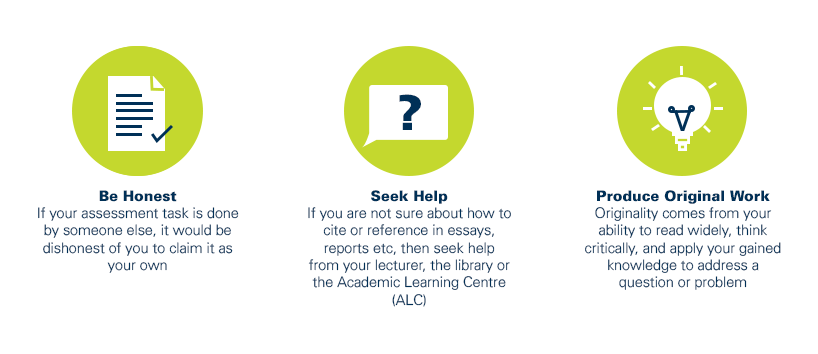
For academic advice and guidance, the Academic Learning Centre (ALC) can support you in becoming confident in completing assessments with integrity and of high standard.
What can you do to act with integrity?