Overview
Unlike prior units which focus on law as it is - 'black-letter' law - this capstone unit considers more theoretical, analytical, doctrinal and philosophical aspects of the entire law enterprise - a specialised societal subsystem. This unit canvasses several philosophical doctrines including: natural law, legal positivism, sociological context of law and economic analyses of the law. These and related topics are explored in this unit to enable you to integrate legal knowledge into the broad inter-disciplinary mainstream and equip you with enhanced practical legal reasoning skills.
Details
Pre-requisites or Co-requisites
48 credit points of LAW units
Important note: Students enrolled in a subsequent unit who failed their pre-requisite unit, should drop the subsequent unit before the census date or within 10 working days of Fail grade notification. Students who do not drop the unit in this timeframe cannot later drop the unit without academic and financial liability. See details in the Assessment Policy and Procedure (Higher Education Coursework).
Offerings For Term 2 - 2023
Attendance Requirements
All on-campus students are expected to attend scheduled classes - in some units, these classes are identified as a mandatory (pass/fail) component and attendance is compulsory. International students, on a student visa, must maintain a full time study load and meet both attendance and academic progress requirements in each study period (satisfactory attendance for International students is defined as maintaining at least an 80% attendance record).
Recommended Student Time Commitment
Each 6-credit Undergraduate unit at CQUniversity requires an overall time commitment of an average of 12.5 hours of study per week, making a total of 150 hours for the unit.
Class Timetable
Assessment Overview
Assessment Grading
This is a graded unit: your overall grade will be calculated from the marks or grades for each assessment task, based on the relative weightings shown in the table above. You must obtain an overall mark for the unit of at least 50%, or an overall grade of 'pass' in order to pass the unit. If any 'pass/fail' tasks are shown in the table above they must also be completed successfully ('pass' grade). You must also meet any minimum mark requirements specified for a particular assessment task, as detailed in the 'assessment task' section (note that in some instances, the minimum mark for a task may be greater than 50%). Consult the University's Grades and Results Policy for more details of interim results and final grades.
All University policies are available on the CQUniversity Policy site.
You may wish to view these policies:
- Grades and Results Policy
- Assessment Policy and Procedure (Higher Education Coursework)
- Review of Grade Procedure
- Student Academic Integrity Policy and Procedure
- Monitoring Academic Progress (MAP) Policy and Procedure - Domestic Students
- Monitoring Academic Progress (MAP) Policy and Procedure - International Students
- Student Refund and Credit Balance Policy and Procedure
- Student Feedback - Compliments and Complaints Policy and Procedure
- Information and Communications Technology Acceptable Use Policy and Procedure
This list is not an exhaustive list of all University policies. The full list of University policies are available on the CQUniversity Policy site.
Feedback, Recommendations and Responses
Every unit is reviewed for enhancement each year. At the most recent review, the following staff and student feedback items were identified and recommendations were made.
Feedback from Unit Coordinator
Ongoing improvement of Schedule, Study Guides and Assessments
Continuous improvement of newly introduced materials will embed improvements into the unit.
Feedback from Unit Coordinator
Revise Reference Materials
Reference materials are important, extensive and varied in a theory unit such as this one, and require careful ongoing attention.
- Identify and discuss various legal theories in light of their developments over ancient and modern times, giving consideration for the contemporary political and legal implications
- Demonstrate sound knowledge of the main theories of law, intrinsic disputes, core doctrines, common themes, main principles, premises and presuppositions canvassed in the unit and explain their ongoing relevance to contemporary legal systems
- Critically analyse the various theories of law by drawing on the relevant primary and secondary sources as well as prescribed reading and historic knowledge
- Develop a research question and undertake a suitable research project on one or more of the specific theories of law examined in this unit, drawing out the nuances between the theories and considering the logical implications by reference to reputable scholarly texts and knowledge learnt in this unit
- Demonstrate appropriate communication skills pertaining to critical reasoning: presenting logically coherent arguments in the relevant rhetorical styles: deductive reasoning, descriptive and normative reasoning, ethical reasoning and legal reasoning.
Alignment of Assessment Tasks to Learning Outcomes
| Assessment Tasks | Learning Outcomes | ||||
|---|---|---|---|---|---|
| 1 | 2 | 3 | 4 | 5 | |
| 1 - Critical Review - 20% | |||||
| 2 - Take Home Exam - 40% | |||||
| 3 - Research Assignment - 40% | |||||
Alignment of Graduate Attributes to Learning Outcomes
| Graduate Attributes | Learning Outcomes | ||||
|---|---|---|---|---|---|
| 1 | 2 | 3 | 4 | 5 | |
| 1 - Communication | |||||
| 2 - Problem Solving | |||||
| 3 - Critical Thinking | |||||
| 4 - Information Literacy | |||||
| 5 - Team Work | |||||
| 6 - Information Technology Competence | |||||
| 7 - Cross Cultural Competence | |||||
| 8 - Ethical practice | |||||
| 9 - Social Innovation | |||||
| 10 - First Nations Knowledges | |||||
| 11 - Aboriginal and Torres Strait Islander Cultures | |||||
Alignment of Assessment Tasks to Graduate Attributes
| Assessment Tasks | Graduate Attributes | ||||||||||
|---|---|---|---|---|---|---|---|---|---|---|---|
| 1 | 2 | 3 | 4 | 5 | 6 | 7 | 8 | 9 | 10 | 11 | |
| 1 - Critical Review - 20% | |||||||||||
| 2 - Take Home Exam - 40% | |||||||||||
| 3 - Research Assignment - 40% | |||||||||||
Textbooks
Legal Theory
- Edition: 3 (2019)
- Authors: Jonathan Crowe
- Lawbook Co of Australia
- Sydney Sydney , NSW , Australia
- ISBN: 9780455240671
- Binding: Paperback
Jurisprudence
- Edition: 2 (2013)
- Authors: Suri Ratnapala
- Cambridge University Press
- Melbourne Melbourne , VIC , Australia
- ISBN: 9781107612570
- Binding: Paperback
IT Resources
- CQUniversity Student Email
- Internet
- Unit Website (Moodle)
All submissions for this unit must use the referencing style: Australian Guide to Legal Citation, 4th ed
For further information, see the Assessment Tasks.
c.walshaw2@cqu.edu.au
l.price@cqu.edu.au
Topic 1: Legal Theory
Begin Date: 10 Jul 2023Module/Topic
Legal Theory
Chapter
Events and Submissions/Topic
Weekly online tutorial sessions.
Topic 2: Law as a Social Phenomenon
Begin Date: 17 Jul 2023Module/Topic
Chapter
Weber, Pound
Events and Submissions/Topic
Weekly online tutorial sessions.
Topic 3: Legal Positivism I
Begin Date: 24 Jul 2023Module/Topic
Legal Positivism I
Chapter
Introduction, Kelsen
Events and Submissions/Topic
Weekly online tutorial sessions.
Topic 4: Legal Positivism II
Begin Date: 31 Jul 2023Module/Topic
Legal Positivism II
Chapter
Hart, Raz
Events and Submissions/Topic
Weekly online tutorial sessions.
Topic 5: Challenges to Legal Positivism
Begin Date: 07 Aug 2023Module/Topic
Challenges to Legal Positivism
Chapter
Events and Submissions/Topic
Weekly online tutorial sessions.
Critical Review Due: Week 5 Friday (11 Aug 2023) 11:59 pm AEST
Vacation Week
Begin Date: 14 Aug 2023Module/Topic
Chapter
Events and Submissions/Topic
No zoom tutorial sessions this week.
Topic 6: Natural Law
Begin Date: 21 Aug 2023Module/Topic
Natural Law
Chapter
Aristotle, Aquinas, Finnis
Events and Submissions/Topic
Weekly online tutorial sessions.
Topic 7: Theories of Adjudication
Begin Date: 28 Aug 2023Module/Topic
Theories of Adjudication
Chapter
Hart / Fuller / Dworkin, American and Nordic Realism
Events and Submissions/Topic
Weekly online tutorial sessions.
Topic 8: Interpretation and Narratives
Begin Date: 04 Sep 2023Module/Topic
Interpretation and Narratives
Chapter
Postmodernism, Sunstein, Hermeneutics, Ricoeur
Events and Submissions/Topic
Weekly online tutorial session.
Topic 9: Coherence and Legality
Begin Date: 11 Sep 2023Module/Topic
Coherence and Legality
Chapter
Burrows, French
Events and Submissions/Topic
Weekly online tutorial sessions.
Topic 10: Legal Reasoning
Begin Date: 18 Sep 2023Module/Topic
Legal Reasoning
Chapter
Crowe
Events and Submissions/Topic
Weekly online tutorial sessions.
Online Quiz Due: Week 10 Wednesday (20 Sept 2023) 10:00 pm AEST
Week 11: Balancing Rights - Freedom of Expression
Begin Date: 25 Sep 2023Module/Topic
Balancing Rights - Freedom of Expression
Chapter
Monis Case
Events and Submissions/Topic
Weekly online tutorial sessions.
1 Critical Review
In this first assessment, your task will be to make a written submission demonstrating your critical response to one of two (2) readings decided by the unit coordinator. These readings will be made available on the Moodle site.
Word limit 600 words, excluding references.
Week 5 Friday (11 Aug 2023) 11:59 pm AEST
Submission online to Moodle.
Grades will be returned to students approximately 3 weeks after submission.
1. Demonstrate sound knowledge of the theories of law canvassed in the unit so far.
2. Demonstrate an ability to formulate and express your own point of view about the content of the reading.
3. Demonstrate problem solving and critical thinking skills in response to one of the designated readings.
Rubrics for marking
0 marks for non-submission
1-3 marks minimal content
4-6 marks good content
7-9 marks very good content
10-12 marks excellent content including original ideas
PLUS 0-8 marks for critical reasoning and reflection
Please refer to the rubric on Moodle site for this unit.
- Identify and discuss various legal theories in light of their developments over ancient and modern times, giving consideration for the contemporary political and legal implications
- Critically analyse the various theories of law by drawing on the relevant primary and secondary sources as well as prescribed reading and historic knowledge
- Communication
- Critical Thinking
2 Take Home Exam
A written assessment in the form of a take home paper posted on Wednesday, 13 September 2023 at 10 AM (AEST) available for just one (1) week until Wednesday, 21 September 2023 10 PM (AEST), to be completed and submitted within four (4) hours between the time the student first opens the exam and the time the student posts her or his answer. This is so as to allow students the flexibility to opt for the most suitable 4 hour window to complete the assessment task in the period.
Note: If not completed after 4 hours of opening, whatever is on the online response section will be automatically submitted.
The paper contains two (2) compulsory questions each worth 20% each. Word limit for each answer for each of the questions is 750 words, excluding references.
The paper questions will test your knowledge of any of the Topics 1 – 8 of the unit.
Week 10 Wednesday (20 Sept 2023) 10:00 pm AEST
This exam is via Moodle online. Once submitted, it cannot be reversed.
Grades will be returned to students approximately 3 weeks after submission.
1. Demonstrate a sound knowledge of the main theories of law and justice canvassed in the unit so far.
2. Demonstrate an ability to formulate and express your own point of view about the theories of law and justice canvassed in the unit so far.
3. Apply appropriate and professional written language skills.
4. Demonstrate problem solving and critical thinking skills in response to each of the questions.
Rubrics for marking
The rubrics apply to each of the two questions.
The benchmark for each criterion includes each of the benchmark levels before it. For example to achieve a distinction you also need to meet the criteria for a credit and pass.
Students must achieve ALL the minimum benchmark criteria at a particular grade level to be awarded an overall final grade at that level. Marks are not divided among each individual criterion, but are benchmarked to minimum standards.
Pass
Fair understanding of the fundamental concepts being examined by the question. Identifies the topic relevant to the question and provides a coherent answer to the question. Basic understanding of the topic and basic confidence with the jurisprudential materials. Some deficiencies in written language skills.
Credit
Solid understanding of the fundamental concepts being examined by the question. Good presentation and moderate written language skills. Demonstrates some understanding of the topic and some confidence with the jurisprudential materials. Provides an accurate but incomplete answer to the question. Demonstrates some critical thinking.
Distinction
Sophisticated understanding of the fundamental concepts being examined by the question. Superior presentation and written language skills. Demonstrates good understanding of the topic and confidence with the jurisprudential materials. Demonstrates critical thinking. Demonstrates a willingness and ability to form and express own point of view, supported by relevant materials. Provides a relatively complete answer to the question.
High Distinction
Nuanced understanding of the fundamental concepts being examined by the question. Demonstrates superior understanding of the topic, superior confidence with the jurisprudential materials and strong critical thinking. Demonstrates clearly a willingness and ability to form and express own point of view, supported by relevant materials together with an ability to think for oneself, supported with discussion of key theorists. Provides a complete answer to the question.
- Identify and discuss various legal theories in light of their developments over ancient and modern times, giving consideration for the contemporary political and legal implications
- Demonstrate sound knowledge of the main theories of law, intrinsic disputes, core doctrines, common themes, main principles, premises and presuppositions canvassed in the unit and explain their ongoing relevance to contemporary legal systems
- Develop a research question and undertake a suitable research project on one or more of the specific theories of law examined in this unit, drawing out the nuances between the theories and considering the logical implications by reference to reputable scholarly texts and knowledge learnt in this unit
- Demonstrate appropriate communication skills pertaining to critical reasoning: presenting logically coherent arguments in the relevant rhetorical styles: deductive reasoning, descriptive and normative reasoning, ethical reasoning and legal reasoning.
- Communication
- Problem Solving
- Critical Thinking
- Information Technology Competence
3 Research Assignment
Each student must prepare a written assessment in the form of a Research Essay in response to one of the essay questions set on topics 1-11 .
Maximum word count is 2,000 words, excluding references/footnotes
Exam Week Monday (16 Oct 2023) 11:59 pm AEST
Deductions of 5% to apply for each day after this submission date. Extension requests must be made prior to submission due date through Moodle.
Grades will be released on Certification of grades date.
1. Demonstrate an ability to formulate and express your own point of view on the topic you have chosen.
2. Demonstrate problem solving and critical thinking skills in response to the topic you have chosen, in particular in relating your research assignment to aspects of the main theories of law and justice canvassed in the unit.
3. Demonstrate an ability to engage in relevant research.
4. Apply appropriate and professional written language skills.
Rubrics for marking
The benchmark for each criterion includes each of the benchmark levels before it. For example to achieve a distinction you also need to meet the criteria for a credit and pass.
Students must achieve ALL the minimum benchmark criteria at a particular grade level to be awarded an overall final grade at that level. Marks are not divided among each individual criterion, but are benchmarked to minimum standards.
Pass 20 - 25
Identifies a theme relevant to the discussion topic and addresses that theme with reference to at least one aspect of the main theories of jurisprudence canvassed in the unit. Basic understanding of the topic and basic confidence with the jurisprudential materials. Some deficiencies in written language skills. Some research.
Credit 26 - 29
Good presentation and moderate written language skills. Evidence of research planning. Moderate development of the theme. Demonstrates some understanding of the topic and some confidence with the jurisprudential materials
Distinction 30 - 33
Excellent presentation and written language skills. Good and interesting development of the topic supported by relevant research. Demonstrates great understanding of the topic and confidence with the jurisprudential materials. Demonstrates excellent critical thinking. Demonstrates a willingness and ability to form and express own point of view, supported by relevant materials.
High Distinction 34 - 40
Very high standard of presentation and written language skills comparable to jurisprudential articles referred to in the unit. Superior understanding of the topic and superior confidence with the jurisprudential materials. Demonstrates superior critical thinking. Demonstrates a clear ability to think for oneself. Superior research which is supported by relevant materials.
- Demonstrate sound knowledge of the main theories of law, intrinsic disputes, core doctrines, common themes, main principles, premises and presuppositions canvassed in the unit and explain their ongoing relevance to contemporary legal systems
- Critically analyse the various theories of law by drawing on the relevant primary and secondary sources as well as prescribed reading and historic knowledge
- Develop a research question and undertake a suitable research project on one or more of the specific theories of law examined in this unit, drawing out the nuances between the theories and considering the logical implications by reference to reputable scholarly texts and knowledge learnt in this unit
- Demonstrate appropriate communication skills pertaining to critical reasoning: presenting logically coherent arguments in the relevant rhetorical styles: deductive reasoning, descriptive and normative reasoning, ethical reasoning and legal reasoning.
- Communication
- Critical Thinking
- Information Technology Competence
- Ethical practice
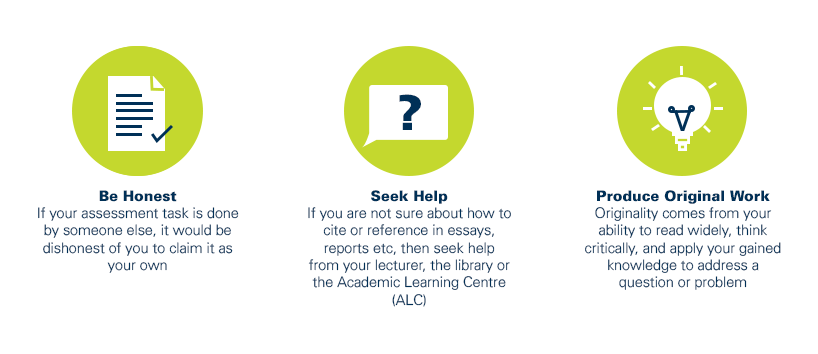
As a CQUniversity student you are expected to act honestly in all aspects of your academic work.
Any assessable work undertaken or submitted for review or assessment must be your own work. Assessable work is any type of work you do to meet the assessment requirements in the unit, including draft work submitted for review and feedback and final work to be assessed.
When you use the ideas, words or data of others in your assessment, you must thoroughly and clearly acknowledge the source of this information by using the correct referencing style for your unit. Using others’ work without proper acknowledgement may be considered a form of intellectual dishonesty.
Participating honestly, respectfully, responsibly, and fairly in your university study ensures the CQUniversity qualification you earn will be valued as a true indication of your individual academic achievement and will continue to receive the respect and recognition it deserves.
As a student, you are responsible for reading and following CQUniversity’s policies, including the Student Academic Integrity Policy and Procedure. This policy sets out CQUniversity’s expectations of you to act with integrity, examples of academic integrity breaches to avoid, the processes used to address alleged breaches of academic integrity, and potential penalties.
What is a breach of academic integrity?
A breach of academic integrity includes but is not limited to plagiarism, self-plagiarism, collusion, cheating, contract cheating, and academic misconduct. The Student Academic Integrity Policy and Procedure defines what these terms mean and gives examples.
Why is academic integrity important?
A breach of academic integrity may result in one or more penalties, including suspension or even expulsion from the University. It can also have negative implications for student visas and future enrolment at CQUniversity or elsewhere. Students who engage in contract cheating also risk being blackmailed by contract cheating services.
Where can I get assistance?
For academic advice and guidance, the Academic Learning Centre (ALC) can support you in becoming confident in completing assessments with integrity and of high standard.
What can you do to act with integrity?