Overview
LAWS13017 Civil procedure explores the issues of cost, delay and access to justice as critical issues in modern case management. In this unit you will examine in detail the following issues in civil litigation: court adjudication under an adversary system; the cost of litigation and the use of costs to control litigation; service of originating process - as foundation of jurisdiction, including service out of the relevant State or Territory and choice of forum; joinder of claims and parties, including group proceedings and the defence of prior adjudication as instances of the public interest in avoiding a multiplicity of proceedings and inconsistent verdicts; defining the questions for trial - pleadings, notices to admit and other devices; obtaining evidence - discovery of documents, interrogatories, subpoena and other devices; disposition without trial, including the compromise of litigation; extra-judicial determination of issues arising in the course of litigation; judgment; appeal; enforcement; alternative dispute resolution; and obligations of parties and practitioners relating to the resolution of disputes. This unit meets the LPAB requirements for civil dispute resolution.
Details
Pre-requisites or Co-requisites
Pre-requisites: LAWS11059, LAWS11066, LAWS11069, LAWS12066.
Important note: Students enrolled in a subsequent unit who failed their pre-requisite unit, should drop the subsequent unit before the census date or within 10 working days of Fail grade notification. Students who do not drop the unit in this timeframe cannot later drop the unit without academic and financial liability. See details in the Assessment Policy and Procedure (Higher Education Coursework).
Offerings For Term 2 - 2026
Attendance Requirements
All on-campus students are expected to attend scheduled classes - in some units, these classes are identified as a mandatory (pass/fail) component and attendance is compulsory. International students, on a student visa, must maintain a full time study load and meet both attendance and academic progress requirements in each study period (satisfactory attendance for International students is defined as maintaining at least an 80% attendance record).
Recommended Student Time Commitment
Each 6-credit Undergraduate unit at CQUniversity requires an overall time commitment of an average of 12.5 hours of study per week, making a total of 150 hours for the unit.
Class Timetable
Assessment Overview
Assessment Grading
This is a graded unit: your overall grade will be calculated from the marks or grades for each assessment task, based on the relative weightings shown in the table above. You must obtain an overall mark for the unit of at least 50%, or an overall grade of 'pass' in order to pass the unit. If any 'pass/fail' tasks are shown in the table above they must also be completed successfully ('pass' grade). You must also meet any minimum mark requirements specified for a particular assessment task, as detailed in the 'assessment task' section (note that in some instances, the minimum mark for a task may be greater than 50%). Consult the University's Grades and Results Policy for more details of interim results and final grades.
All University policies are available on the CQUniversity Policy site.
You may wish to view these policies:
- Grades and Results Policy
- Assessment Policy and Procedure (Higher Education Coursework)
- Review of Grade Procedure
- Student Academic Integrity Policy and Procedure
- Academic Progression Policy and Procedure
- Student Refund and Credit Balance Policy and Procedure
- Complaints Policy and Procedure
- Information and Communications Technology Acceptable Use Policy and Procedure
This list is not an exhaustive list of all University policies. The full list of University policies are available on the CQUniversity Policy site.
Feedback, Recommendations and Responses
Every unit is reviewed for enhancement each year. At the most recent review, the following staff and student feedback items were identified and recommendations were made.
Feedback from Chatbot usage data and analysis of questions asked.
The chatbot has been a welcome addition to the unit.
The chatbot be continually updated and included in the unit.
Feedback from General in class comments.
The addition of a second practice assessment was appreciated.
Practical authentic assessments will be used wherever possible subject to accreditation requirements.
- Comprehend and critically examine the court adjudication process under the adversarial system in Australia in comparison with the Civil Law inquisitorial system
- Articulate and apply Supreme Court civil procedure, referencing legislation, rules, practice directions and court forms
- Research and draft appropriate pleadings for a hypothetical fact situation
- Apply civil procedure knowledge in a clinical setting including ethical considerations
Alignment of Assessment Tasks to Learning Outcomes
| Assessment Tasks | Learning Outcomes | |||
|---|---|---|---|---|
| 1 | 2 | 3 | 4 | |
| 1 - Practical Assessment - 30% | ||||
| 2 - Examination - 70% | ||||
Alignment of Graduate Attributes to Learning Outcomes
| Graduate Attributes | Learning Outcomes | |||
|---|---|---|---|---|
| 1 | 2 | 3 | 4 | |
| 1 - Communication | ||||
| 2 - Problem Solving | ||||
| 3 - Critical Thinking | ||||
| 4 - Information Literacy | ||||
| 5 - Team Work | ||||
| 6 - Information Technology Competence | ||||
| 7 - Cross Cultural Competence | ||||
| 8 - Ethical practice | ||||
| 9 - Social Innovation | ||||
| 10 - First Nations Knowledges | ||||
| 11 - Aboriginal and Torres Strait Islander Cultures | ||||
Textbooks
Civil Procedure: Commentary and Materials, 9th edition
- Edition: 9th (2025)
- Authors: Stephen Colbran, Peta Spender, Tania Penovic (Contributor)
- LexisNexis
- North Ryde North Ryde , NSW , Australia
- ISBN: 9780409361315
IT Resources
- CQUniversity Student Email
- Internet
- Unit Website (Moodle)
All submissions for this unit must use the referencing style: Australian Guide to Legal Citation, 4th ed
For further information, see the Assessment Tasks.
a.turner3@cqu.edu.au
Week 1 Court adjudication, Case management and ADR
Begin Date: 13 Jul 2026Module/Topic
Week 1 Court adjudication, case management and ADR
Chapter
Colbran, S., Spender, P. and Penovic, T., Civil Procedure: Commentary and Materials (LexisNexis, 9th ed, 2025) Ch 1, 2, 3.
Visit the Conflict Resolution Network website www.crnhq.org and examine the free training material. Make sure you study: the Self-study guide, 12 skills summary, and the CR Kit.
Conflict Resolution Network, Conflict Resolution Network https://www.crnhq.org accessed 18 June 2026
Events and Submissions/Topic
Week 2 Jurisdiction and Limitation of Actions
Begin Date: 20 Jul 2026Module/Topic
Week 2 Jurisdiction and Limitation of Actions
Chapter
Colbran, S., Spender, P. and Penovic, T., Civil Procedure: Commentary and Materials (LexisNexis, 9th ed, 2025) Ch 4, 6.
Events and Submissions/Topic
Week 3 Instituting proceedings, Service, and Notice of Intention to Defend
Begin Date: 27 Jul 2026Module/Topic
Week 3 Instituting proceedings, Service, and Notice of Intention to Defend
Chapter
Colbran, S., Spender, P. and Penovic, T., Civil Procedure: Commentary and Materials (LexisNexis, 9th ed, 2025) Ch 7, 8, 9.
Events and Submissions/Topic
Week 4 Parties and Joinder, Non-compliance, Amendment and Time
Begin Date: 03 Aug 2026Module/Topic
Week 4 Parties and Joinder, Non-compliance, Amendment and Time
Chapter
Colbran, S., Spender, P. and Penovic, T., Civil Procedure: Commentary and Materials (LexisNexis, 9th ed, 2025) Ch 5, 10, 11.
Kylie Downes QC and Hamish Clift, “Queensland’s new class action regime”. (May 2017) Proctor 28-29.
Events and Submissions/Topic
Week 5 Pleadings and Summary Disposition
Begin Date: 10 Aug 2026Module/Topic
Week 5 Pleadings and Summary Disposition
Chapter
Colbran, S., Spender, P. and Penovic, T., Civil Procedure: Commentary and Materials (LexisNexis, 9th ed, 2025) Ch 12, 13.
Events and Submissions/Topic
Week 6 Disclosure
Begin Date: 17 Aug 2026Module/Topic
Week 6 Disclosure
Chapter
Colbran, S., Spender, P. and Penovic, T., Civil Procedure: Commentary and Materials (LexisNexis, 9th ed, 2025) Ch 14.
Events and Submissions/Topic
AI-Assisted Civil Litigation File Review Assessment due Monday 24 August 2026 at 9:00am (Vacation Week)
Vacation Week
Begin Date: 24 Aug 2026Module/Topic
Chapter
Events and Submissions/Topic
Week 7 Further means of obtaining evidence and Affidavits
Begin Date: 31 Aug 2026Module/Topic
Week 7 Further means of obtaining evidence and Affidavits
Chapter
Colbran, S., Spender, P. and Penovic, T., Civil Procedure: Commentary and Materials (LexisNexis, 9th ed, 2025) Ch 15, 16.
Events and Submissions/Topic
Week 8 Interlocutory procedures
Begin Date: 07 Sep 2026Module/Topic
Week 8 Interlocutory procedures
Chapter
Colbran, S., Spender, P. and Penovic, T., Civil Procedure: Commentary and Materials (LexisNexis, 9th ed, 2025) Ch 17.
Events and Submissions/Topic
Week 9 Disposition without trial
Begin Date: 14 Sep 2026Module/Topic
Week 9 Disposition without trial
Chapter
Colbran, S., Spender, P. and Penovic, T., Civil Procedure: Commentary and Materials (LexisNexis, 9th ed, 2025) Ch 18.
Events and Submissions/Topic
Week 10 Trial
Begin Date: 21 Sep 2026Module/Topic
Week 10 Trial
Chapter
Colbran, S., Spender, P. and Penovic, T., Civil Procedure: Commentary and Materials (LexisNexis, 9th ed, 2025) Ch 19.
Events and Submissions/Topic
Week 11 Appeal and New Trial
Begin Date: 28 Sep 2026Module/Topic
Week 11 Appeal and New Trial
Chapter
Colbran, S., Spender, P. and Penovic, T., Civil Procedure: Commentary and Materials (LexisNexis, 9th ed, 2025) Ch 20.
Events and Submissions/Topic
Week 12 Costs and Enforcement
Begin Date: 05 Oct 2026Module/Topic
Week 12 Costs and Enforcement
Chapter
Colbran, S., Spender, P. and Penovic, T., Civil Procedure: Commentary and Materials (LexisNexis, 9th ed, 2025) Ch 21, 22.
Events and Submissions/Topic
Exam Week
Begin Date: 12 Oct 2026Module/Topic
Chapter
Events and Submissions/Topic
Vacation/Exam Week
Begin Date: 19 Oct 2026Module/Topic
Chapter
Events and Submissions/Topic
1 Practical Assessment
LAWS13017 Civil Procedure AI-Assisted Civil Litigation File Review Assessment Instructions 2026
You will be provided with a realistic factual scenario and supporting documents and will be required to utilise a generative artificial intelligence (AI) platform to generate procedural court documents that may be required to commence proceedings and seek default judgment.
The assessment is divided into three parts:
Part A – Generation of Court Documents
You will generate the relevant procedural documents using a generative AI platform and submit both the prompts used and the resulting AI-generated output.
Part B – Procedural Analysis and Critique
You will critically evaluate the AI-generated documents and provide advice regarding their procedural compliance, suitability for filing, and any issues arising under the Uniform Civil Procedure Rules 1999 (Qld). This will include consideration of pleading adequacy, missing particulars, service requirements, default judgment procedures, strategic considerations, and any assumptions made by the AI system.
Part C – Reflection on AI Use
You will reflect upon the usefulness, limitations and risks associated with the use of AI in legal practice, together with the professional and ethical responsibilities of lawyers who utilise AI-generated work.
This assessment has been designed to reflect contemporary legal practice, where lawyers are increasingly required to supervise, evaluate and verify AI-generated work rather than simply produce documents themselves. The assessment focuses on procedural reasoning, professional judgement, litigation strategy, ethical decision-making and responsible AI use.
A detailed assessment brief and marking rubric are available on Moodle.
Your submission must be uploaded via Moodle as a single document by the due date specified in the Unit Profile.
The assessment has a maximum word limit of 2,000 words, comprising:
Part B – Procedural Analysis and Critique: 1,500 words
Part C – Reflection on AI Use: 500 words
The word limit applies only to Parts B and C.
The following are excluded from the word count:
- Part A (AI prompts, AI-generated outputs and hyperlinks);
- court forms and procedural documents generated by the AI;
- headings;
- references and bibliography.
Students are expected to write concisely and professionally. No consideration will be given to material exceeding the prescribed word limit.
This assessment complies with CQUniversity's Guided-Assured Assessment Model and permits the use of generative AI in accordance with the assessment instructions provided.
Level of GenAI use permitted:
Level 2 – AI Integration (Authentic Professional Use). Students are required to use a generative AI platform to generate draft procedural documents and must disclose the prompts used and the AI-generated outputs. Students are assessed on their ability to critically evaluate, verify and critique the AI-generated work. Students remain responsible for the accuracy, legality and appropriateness of all content submitted.
The answers must be saved as one document in MS Word (not as a PDF) in the following format: LastName_FirstName.docx.
Vacation Week Monday (24 Aug 2026) 9:00 am AEST
This assessment must be submitted by the specified due date and time. Due to the nature of this task, the standard 72-hour grace period does not apply. Extensions of more than 14 days are not available for this assessment. Due to the need to provide prompt feedback to students and the content of feedback provided, submissions received after the assessment has been returned to students cannot be accepted for academic integrity reasons. Students seeking extensions beyond this timeframe will be required to undertake a different version of the assessment task.
Estimated return time is two weeks from the due date. Papers will be returned once all submissions, including those with authorised extensions have been marked.
| Criteria | HD | D | C | P | F | Marks |
| Part A – AI Process Record | Complete and transparent record of prompts, outputs and AI use. Demonstrates thoughtful interaction with AI. | Minor omissions. Clear record of AI use. | Adequate documentation of AI use. | Limited documentation. | Incomplete or absent documentation. | /5 |
| Part B – Identification of Procedural Issues and Deficiencies | Identifies almost all significant procedural, factual and strategic issues including omissions, assumptions, pleading deficiencies, service concerns and jurisdictional issues. | Identifies most significant issues. | Identifies several important issues. | Identifies some issues but misses significant concerns. | Very limited identification of issues. | /8 |
| Part B – Procedural Analysis and Application of Civil Procedure Principles | Demonstrates sophisticated understanding of civil procedure. Accurately applies UCPR principles and explains consequences and corrective action. | Strong understanding and application of procedural principles. | Sound procedural understanding with some analysis. | Basic procedural understanding. | Significant misunderstandings or incorrect application of principles. | /7 |
| Part B – Professional Judgement and Critical Evaluation of AI Output | Demonstrates excellent professional judgement. Critically evaluates AI assumptions, reliability, risks and suitability for filing. Identifies where further instructions or information are required. | Strong critical evaluation and professional judgement. | Competent evaluation of AI output. | Limited evaluation. | Accepts AI output largely uncritically. | /5 |
| Part C – Reflection on AI Use in Legal Practice | Insightful reflection demonstrating mature understanding of benefits, limitations, risks and ethical obligations associated with AI use in legal practice. | Thoughtful reflection with good insight. | Competent reflection. | Descriptive reflection with limited insight. | Superficial or incomplete reflection. | /5 |
- Comprehend and critically examine the court adjudication process under the adversarial system in Australia in comparison with the Civil Law inquisitorial system
- Articulate and apply Supreme Court civil procedure, referencing legislation, rules, practice directions and court forms
- Research and draft appropriate pleadings for a hypothetical fact situation
- Apply civil procedure knowledge in a clinical setting including ethical considerations
Examination
Law dictionaries, Business and Law dictionaries (discipline specific dictionaries) are authorised.
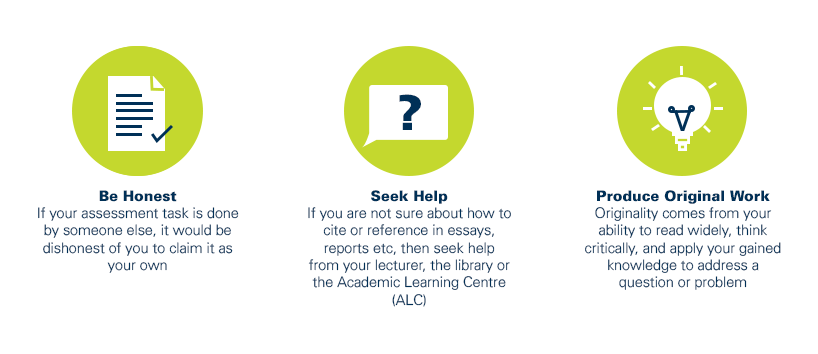
As a CQUniversity student you are expected to act honestly in all aspects of your academic work.
Any assessable work undertaken or submitted for review or assessment must be your own work. Assessable work is any type of work you do to meet the assessment requirements in the unit, including draft work submitted for review and feedback and final work to be assessed.
When you use the ideas, words or data of others in your assessment, you must thoroughly and clearly acknowledge the source of this information by using the correct referencing style for your unit. Using others’ work without proper acknowledgement may be considered a form of intellectual dishonesty.
Participating honestly, respectfully, responsibly, and fairly in your university study ensures the CQUniversity qualification you earn will be valued as a true indication of your individual academic achievement and will continue to receive the respect and recognition it deserves.
As a student, you are responsible for reading and following CQUniversity’s policies, including the Student Academic Integrity Policy and Procedure. This policy sets out CQUniversity’s expectations of you to act with integrity, examples of academic integrity breaches to avoid, the processes used to address alleged breaches of academic integrity, and potential penalties.
What is a breach of academic integrity?
A breach of academic integrity includes but is not limited to plagiarism, self-plagiarism, collusion, cheating, contract cheating, and academic misconduct. The Student Academic Integrity Policy and Procedure defines what these terms mean and gives examples.
Why is academic integrity important?
A breach of academic integrity may result in one or more penalties, including suspension or even expulsion from the University. It can also have negative implications for student visas and future enrolment at CQUniversity or elsewhere. Students who engage in contract cheating also risk being blackmailed by contract cheating services.
Where can I get assistance?
For academic advice and guidance, the Academic Learning Centre (ALC) can support you in becoming confident in completing assessments with integrity and of high standard.
What can you do to act with integrity?