Overview
Remedies is a unit that provides you with an overview of the source and extent of remedies that are available in Australia by statute, at common law and in equity. The unit develops a clear understanding of remedial law by analysing legal problems and identifying appropriate solutions, primarily in private law causes of action, such as tort, contract and property law. The unit deals with a wide range of remedies, including compelling performance, compensation, unjust enrichment, restitution, punishment, proprietary remedies, and self-help remedies. Remedies is a practically orientated unit, that supports students to develop the skills required to answer questions in legal problem-based scenarios, such as ‘what is the remedy for this cause of action’, ‘what options are available to this litigant’, and ‘how would a court likely deal with this issue’? Students will consider the appropriate remedies that may be available for a particular cause of action. The unit considers remedies in a functional manner; that is, to compensate for loss, to compel performance, to vindicate, to deal with gain-based relief for wrong, to provide restitution and to consider proprietary remedies. The unit also considers the enforcement of remedies, on an interlocutory and final basis, and the appropriate methodology for the assessment of damages.
Details
Pre-requisites or Co-requisites
Pre-requisite: 48 cp of Laws units including LAWS11057, LAWS11066, LAWS11069 and LAWS12078.
Important note: Students enrolled in a subsequent unit who failed their pre-requisite unit, should drop the subsequent unit before the census date or within 10 working days of Fail grade notification. Students who do not drop the unit in this timeframe cannot later drop the unit without academic and financial liability. See details in the Assessment Policy and Procedure (Higher Education Coursework).
Offerings For Term 2 - 2026
Attendance Requirements
All on-campus students are expected to attend scheduled classes - in some units, these classes are identified as a mandatory (pass/fail) component and attendance is compulsory. International students, on a student visa, must maintain a full time study load and meet both attendance and academic progress requirements in each study period (satisfactory attendance for International students is defined as maintaining at least an 80% attendance record).
Recommended Student Time Commitment
Each 6-credit Undergraduate unit at CQUniversity requires an overall time commitment of an average of 12.5 hours of study per week, making a total of 150 hours for the unit.
Class Timetable
Assessment Overview
Assessment Grading
This is a graded unit: your overall grade will be calculated from the marks or grades for each assessment task, based on the relative weightings shown in the table above. You must obtain an overall mark for the unit of at least 50%, or an overall grade of 'pass' in order to pass the unit. If any 'pass/fail' tasks are shown in the table above they must also be completed successfully ('pass' grade). You must also meet any minimum mark requirements specified for a particular assessment task, as detailed in the 'assessment task' section (note that in some instances, the minimum mark for a task may be greater than 50%). Consult the University's Grades and Results Policy for more details of interim results and final grades.
All University policies are available on the CQUniversity Policy site.
You may wish to view these policies:
- Grades and Results Policy
- Assessment Policy and Procedure (Higher Education Coursework)
- Review of Grade Procedure
- Student Academic Integrity Policy and Procedure
- Academic Progression Policy and Procedure
- Student Refund and Credit Balance Policy and Procedure
- Complaints Policy and Procedure
- Information and Communications Technology Acceptable Use Policy and Procedure
This list is not an exhaustive list of all University policies. The full list of University policies are available on the CQUniversity Policy site.
- Identify the sources of remedies in Australia
- Discuss private law remedies that logically follow civil litigation, and recurring issues, such as the issue of remoteness when considering compensatory damages
- Outline and discuss the basic the nature and purpose of remedies in a theoretical and practical sense, when determining potential remedies in a given fact situation
- Analyse how remedies confer rights to litigants to seek, and obtain, an appropriate order, when relying upon statutory provisions, the common law or equity.
Alignment of Assessment Tasks to Learning Outcomes
| Assessment Tasks | Learning Outcomes | |||
|---|---|---|---|---|
| 1 | 2 | 3 | 4 | |
| 1 - Online Test - 30% | ||||
| 2 - Take Home Exam - 70% | ||||
Alignment of Graduate Attributes to Learning Outcomes
| Graduate Attributes | Learning Outcomes | |||
|---|---|---|---|---|
| 1 | 2 | 3 | 4 | |
| 1 - Communication | ||||
| 2 - Problem Solving | ||||
| 3 - Critical Thinking | ||||
| 4 - Information Literacy | ||||
| 5 - Team Work | ||||
| 6 - Information Technology Competence | ||||
| 7 - Cross Cultural Competence | ||||
| 8 - Ethical practice | ||||
| 9 - Social Innovation | ||||
| 10 - First Nations Knowledges | ||||
| 11 - Aboriginal and Torres Strait Islander Cultures | ||||
Textbooks
Principles of the Australian Law of Remedies
- First Edition (2020)
- Authors: David Wright
- Thompson Reuters
- Pyrmont Pyrmont , NSW , Australia
- ISBN: 9789455243870
Remedies in Australian Private Law
- Third Edition (2024)
- Authors: Katy Barnett and Sirko Harder
- Cambridge University Press
- Port Melbourne Port Melbourne , VIC , Australia
- ISBN: 9781999390163
IT Resources
- CQUniversity Student Email
- Internet
- Unit Website (Moodle)
- Zoom access: microphone and webcam required
All submissions for this unit must use the referencing style: Australian Guide to Legal Citation, 4th ed
For further information, see the Assessment Tasks.
m.nichol@cqu.edu.au
Week 1 - Introduction
Begin Date: 13 Jul 2026Module/Topic
Introduction to remedies, general principles of compensation and attribution of responsibility
Chapter
Katy Barnett and Sirko Harder, Remedies in Australian Private Law (2024, 3rd edition, Cambridge University Press), Chapters 1, 2 and 3
Alexander v Cambridge Credit Corporation Ltd (1979) 9 NSWLR 310
Elayoubi v Zisper [2008] NSWCA 335
Events and Submissions/Topic
Week 2 - Tort Remedies
Begin Date: 20 Jul 2026Module/Topic
Compensation for personal injury and death
Chapter
Katy Barnett and Sirko Harder, Remedies in Australian Private Law (2024, 3rd edition, Cambridge University Press), Chapter 7
Ranieri & Ors v The Nominal Defendant & Ors [2000] NSWSC 134
Events and Submissions/Topic
Week 3 - Issues of Damages
Begin Date: 27 Jul 2026Module/Topic
Assessment of compensation, plaintiff's contribution to the loss, multiple wrongdoers and contributory negligence
Chapter
Katy Barnett and Sirko Harder, Remedies in Australian Private Law (2024, 3rd edition, Cambridge University Press), Chapter 2, Chapter 3 pp 113-121, Chapter 4, Chapter 6 pp 211-220
McLean v Tedman & Brambles Holdings Ltd [1984] HCA 60
Events and Submissions/Topic
Week 4 - Contractual Remedies I
Begin Date: 03 Aug 2026Module/Topic
Compensation for breach of contract
Chapter
Katy Barnett and Sirko Harder, Remedies in Australian Private Law (2024, 3rd edition, Cambridge University Press), Chapter 5
Elisha v Vision Australia Ltd [2024] HCA 50
Events and Submissions/Topic
Week 5 - Contractual Remedies II
Begin Date: 10 Aug 2026Module/Topic
Specific performance
Chapter
Katy Barnett and Sirko Harder, Remedies in Australian Private Law (2024, 3rd edition, Cambridge University Press), Chapter 10
Events and Submissions/Topic
Week 6 - Injunctions
Begin Date: 17 Aug 2026Module/Topic
Injunctions and interlocutory injunctions
Chapter
Katy Barnett and Sirko Harder, Remedies in Australian Private Law (2024, 3rd edition, Cambridge University Press), Chapter 11, Chapter 21 pp 552-563
Samsung v Apple [2011] FCAFC 156
Events and Submissions/Topic
Vacation Week
Begin Date: 24 Aug 2026Module/Topic
Chapter
Events and Submissions/Topic
Week 7 - Equitable Remedies I
Begin Date: 31 Aug 2026Module/Topic
Equitable compensation for equitable wrongs, equitable damages of Lord Cairns' Act damages and accounts of profit and disgorgement
Chapter
Katy Barnett and Sirko Harder, Remedies in Australian Private Law (2024, 3rd edition, Cambridge University Press), Chapters 9, 12, 17
Warman International Ltd v Dwyer [1995] HCA 18
Events and Submissions/Topic
Week 8 - Equitable Remedies II
Begin Date: 07 Sep 2026Module/Topic
Proprietary remedies
Chapter
Katy Barnett and Sirko Harder, Remedies in Australian Private Law (2024, 3rd edition, Cambridge University Press), Chapter 20
The Uniting Church in Australia Property Trust (NSW) v David Grant Vincent & Anor [2009] NSWSC 375
Events and Submissions/Topic
Week 9 - Remedies Under the Competition and Consumer Act 2010 (Cth)
Begin Date: 14 Sep 2026Module/Topic
Compensation and injunctions under the Australian Consumer Law
Chapter
Katy Barnett and Sirko Harder, Remedies in Australian Private Law (2024, 3rd edition, Cambridge University Press), Chapter 8, Chapter 11 pp 360-362
World Series Cricket v Parish (1977) ATPR 4040
Events and Submissions/Topic
Week 10 - Corporations Law Remedies
Begin Date: 21 Sep 2026Module/Topic
Corporations law remedies
Chapter
Nicholas Bentley, Australian Company Law Commentary (CCH: Wolters Kluwer, 2025) 53-100, 53-240, 53-380, 43-030
Graywinter Properties Pty Ltd v Gas & Fuel Corporation Superannuation Fund (1996) 14 ACLC 1,703
Events and Submissions/Topic
Week 11 - Constitutional and Administrative Law Remedies
Begin Date: 28 Sep 2026Module/Topic
Constitutional law remedies and administrative law remedies
Chapter
David Wright, Principles of the Australian Law of Remedies (Thompson Reuters, 2020) Chapter 24 pp 649-666, Chapter 25 pp 673-690
Bodruddaza v Minister for Immigration and Multicultural Affairs [2007] HCA 14
Minister for Immigration and Citizenship v Li [2013] HCA 18
Events and Submissions/Topic
Week 12 - Enforcement of Remedies
Begin Date: 05 Oct 2026Module/Topic
Post-judgment enforcement
Chapter
Katy Barnett and Sirko Harder, Remedies in Australian Private Law (2024, 3rd edition, Cambridge University Press), Chapter 21 pp 569-576
Events and Submissions/Topic
Exam Week
Begin Date: 12 Oct 2026Module/Topic
Chapter
Events and Submissions/Topic
Vacation/Exam Week
Begin Date: 19 Oct 2026Module/Topic
Chapter
Events and Submissions/Topic
1 Online Test
This Test will focus on the introduction, tort remedies, issues of damages and contractual remedies I and II, which are covered in Weeks 1– 5. Students will have a maximum of 90 minutes to complete the Test. The Test will include both a case study and short answer questions.
The Test will be made available at 10:00 am on Friday 21 August 2026 (Week 6, Qld time).
You must complete the Test by submitting your answers to all questions online. You have one attempt to complete and submit your answers. You must therefore submit your answers online in one sitting (you cannot save your answers and return to them or amend them at a later date).
You will have 90 minutes to submit your answers online once you commence the Test.
You must complete your submission online by 11:59 pm on Friday 21 August 2026 (Week 6, Qld time). Note that answers must be submitted by this time.
Open attempts will be submitted automatically when the time limit (90 minutes) expires and/or when the due date/time is reached.
This assessment requires students to adhere to the guidelines on the use of artificial intelligence tools as specified in the Artificial Intelligence Assessment Scale (AIAS). Any misuse or lack of disclosure regarding the use of AI tools will be considered a breach of academic integrity. The use of AI tools or technology is prohibited in the completion of this assignment (level 1).
Extensions of more than 14 days are not available for this assessment. Due to the need to provide prompt feedback to students and the content of feedback provided, submissions received after the assessment has been returned to students cannot be accepted for academic integrity reasons. Students seeking extensions beyond this timeframe will be required to undertake a different version of the assessment task.
Due to the nature of this task, the 72-hour grace period does not apply to this assessment.
Week 6 Friday (21 Aug 2026) 11:59 pm AEST
Submitted online via Moodle
Week 8 Friday (11 Sept 2026)
Assessment results and feedback will be released via Moodle
The assessment task will be assessed according to the following criteria:
Problem solving: students must demonstrate problem solving skills by identifying and applying relevant legal rules and principles.
Critical thinking: students must demonstrate critical thinking by analysing, applying and evaluating facts and law in a problem solving context.
Information literacy: students must demonstrate information literacy by identifying, understanding and applying legal rules and principles.
Writing and presentation: students must submit answers with a clear writing style that uses appropriate grammar and expression. Ideas and arguments must be presented using a logical structure and order.
Referencing: students must appropriately cite relevant references when using legislation, cases and secondary materials.
- Identify the sources of remedies in Australia
- Discuss private law remedies that logically follow civil litigation, and recurring issues, such as the issue of remoteness when considering compensatory damages
- Outline and discuss the basic the nature and purpose of remedies in a theoretical and practical sense, when determining potential remedies in a given fact situation
- Analyse how remedies confer rights to litigants to seek, and obtain, an appropriate order, when relying upon statutory provisions, the common law or equity.
2 Take Home Exam
For this Take Home Exam, you must provide a response to a series of short answer questions and case studies. The questions will be based on topics discussed in the weekly workshops from Weeks 6 to 12 and includes injunctions, equitable remedies I and II, Competition and Consumer Act 2010 (Cth) remedies, corporations law remedies, constitutional and administrative law remedies and enforcement of remedies.
This assessment will be carried out as a 'take home paper', which is the equivalent of an exam. The take home exam is 2.5 hours (150 minutes) duration. You must be available to sit this take home exam as extensions are not permitted and submissions after the due date/time are not accepted.
The timing of the take home exam will be determined during the term. As these are coordinated by the School of Business and Law, the date and time of the take home exam will be advised in due course.
Note the following conditions apply to the take home exam:
- take home exams are for 2.5 hours (150 minutes) duration only;
- submissions received after the deadline has passed will not be accepted and will be graded as zero;
- extensions are not available for take home exams (although Accessibility adjustments still apply);
- exam conditions apply to take home papers; and
- for the duration of the assessment, the use of generative AI, large language models and other similar tools are prohibited.
This assessment must be submitted by the specified due date and time. Extensions are not permitted. Due to the nature of this task, the standard 72-hour grace period does not apply. We recognise that unexpected circumstances may arise, and encourage students to reach out as early as possible if they are experiencing difficulties, so that appropriate support or adjustments can be considered in line with university policy.
This assessment requires students to adhere to the guidelines on the use of artificial intelligence tools as specified in the Artificial Intelligence Assessment Scale (AIAS). Any misuse or lack of disclosure regarding the use of AI tools will be considered a breach of academic integrity. The use of AI tools or technology is prohibited in the completion of this assignment (level 1). You must not use AI tools or technology to produce substantive content in any manner. You are permitted to use technology or tools that assist with spelling, grammar or formatting.
The date and time of the take home paper will be released during the term
The assessment task will be assessed according to the following criteria:
Problem solving: students must demonstrate problem solving skills by identifying and applying relevant legal rules and principles.
Critical thinking: students must demonstrate critical thinking by analysing, applying and evaluating facts and law in a problem solving context.
Information literacy: students must demonstrate information literacy by identifying, understanding and applying legal rules and principles.
Writing and presentation: students must submit answers with a clear writing style that uses appropriate grammar and expression. Ideas and arguments must be presented using a logical structure and order.
Referencing: students must appropriately cite relevant references when using legislation, cases and secondary materials.
- Identify the sources of remedies in Australia
- Discuss private law remedies that logically follow civil litigation, and recurring issues, such as the issue of remoteness when considering compensatory damages
- Outline and discuss the basic the nature and purpose of remedies in a theoretical and practical sense, when determining potential remedies in a given fact situation
- Analyse how remedies confer rights to litigants to seek, and obtain, an appropriate order, when relying upon statutory provisions, the common law or equity.
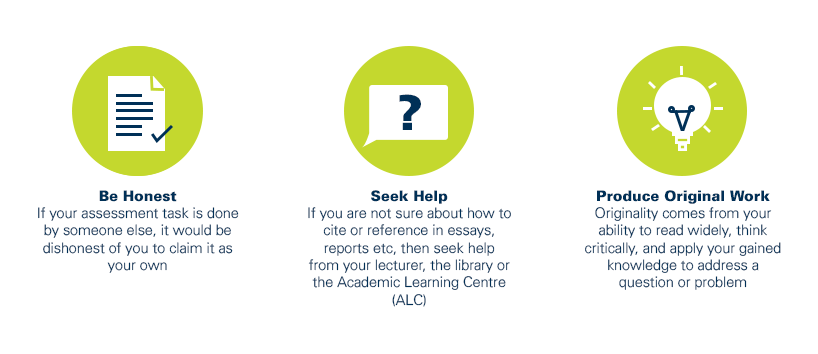
As a CQUniversity student you are expected to act honestly in all aspects of your academic work.
Any assessable work undertaken or submitted for review or assessment must be your own work. Assessable work is any type of work you do to meet the assessment requirements in the unit, including draft work submitted for review and feedback and final work to be assessed.
When you use the ideas, words or data of others in your assessment, you must thoroughly and clearly acknowledge the source of this information by using the correct referencing style for your unit. Using others’ work without proper acknowledgement may be considered a form of intellectual dishonesty.
Participating honestly, respectfully, responsibly, and fairly in your university study ensures the CQUniversity qualification you earn will be valued as a true indication of your individual academic achievement and will continue to receive the respect and recognition it deserves.
As a student, you are responsible for reading and following CQUniversity’s policies, including the Student Academic Integrity Policy and Procedure. This policy sets out CQUniversity’s expectations of you to act with integrity, examples of academic integrity breaches to avoid, the processes used to address alleged breaches of academic integrity, and potential penalties.
What is a breach of academic integrity?
A breach of academic integrity includes but is not limited to plagiarism, self-plagiarism, collusion, cheating, contract cheating, and academic misconduct. The Student Academic Integrity Policy and Procedure defines what these terms mean and gives examples.
Why is academic integrity important?
A breach of academic integrity may result in one or more penalties, including suspension or even expulsion from the University. It can also have negative implications for student visas and future enrolment at CQUniversity or elsewhere. Students who engage in contract cheating also risk being blackmailed by contract cheating services.
Where can I get assistance?
For academic advice and guidance, the Academic Learning Centre (ALC) can support you in becoming confident in completing assessments with integrity and of high standard.
What can you do to act with integrity?