Overview
Applied Computational Modelling will further your understanding of and ability in mathematical modelling of scientific and engineering problems. You will use built-in MATLAB functions to solve general problems in various disciplines. You will also learn to program in MATLAB to obtain solutions to complex problems through both analytical and numerical approaches. This unit will teach you to approach problems in a way that demonstrates a clear, logical, and systematic procedure of modelling through integrating mathematical and programming knowledge and techniques. You will also learn how to document problems and findings. Course work leads you to approach posed problems in a way that demonstrates a clear, logical, and systematic procedure of modelling through integrating mathematical and programming knowledge and techniques learnt.
Details
Pre-requisites or Co-requisites
Pre-requisite: MATH11219
Important note: Students enrolled in a subsequent unit who failed their pre-requisite unit, should drop the subsequent unit before the census date or within 10 working days of Fail grade notification. Students who do not drop the unit in this timeframe cannot later drop the unit without academic and financial liability. See details in the Assessment Policy and Procedure (Higher Education Coursework).
Offerings For Term 1 - 2026
Attendance Requirements
All on-campus students are expected to attend scheduled classes - in some units, these classes are identified as a mandatory (pass/fail) component and attendance is compulsory. International students, on a student visa, must maintain a full time study load and meet both attendance and academic progress requirements in each study period (satisfactory attendance for International students is defined as maintaining at least an 80% attendance record).
Recommended Student Time Commitment
Each 6-credit Undergraduate unit at CQUniversity requires an overall time commitment of an average of 12.5 hours of study per week, making a total of 150 hours for the unit.
Class Timetable
Assessment Overview
Assessment Grading
This is a graded unit: your overall grade will be calculated from the marks or grades for each assessment task, based on the relative weightings shown in the table above. You must obtain an overall mark for the unit of at least 50%, or an overall grade of 'pass' in order to pass the unit. If any 'pass/fail' tasks are shown in the table above they must also be completed successfully ('pass' grade). You must also meet any minimum mark requirements specified for a particular assessment task, as detailed in the 'assessment task' section (note that in some instances, the minimum mark for a task may be greater than 50%). Consult the University's Grades and Results Policy for more details of interim results and final grades.
All University policies are available on the CQUniversity Policy site.
You may wish to view these policies:
- Grades and Results Policy
- Assessment Policy and Procedure (Higher Education Coursework)
- Review of Grade Procedure
- Student Academic Integrity Policy and Procedure
- Academic Progression Policy and Procedure
- Student Refund and Credit Balance Policy and Procedure
- Complaints Policy and Procedure
- Information and Communications Technology Acceptable Use Policy and Procedure
This list is not an exhaustive list of all University policies. The full list of University policies are available on the CQUniversity Policy site.
Feedback, Recommendations and Responses
Every unit is reviewed for enhancement each year. At the most recent review, the following staff and student feedback items were identified and recommendations were made.
Feedback from Unit Evaluation
Unit Evaluation feedback showed a low score for 'Useful Knowledge/Skills'.
Modular GUI (Windows) interface programming should be considered for inclusion in the unit (instead of text-only user interaction), so that students can appreciate the relevance of MATLAB more.
Feedback from Unit Evaluation
Some students felt that the unit could be made more relevant to their degree.
More relevant civil and mechanical engineering problems should be incorporated into the assessment items.
- Solve general problems in various disciplines using existing functions in MATLAB
- Program in MATLAB to solve complicated problems
- Manipulate and interpret input/output data utilising existing tools in MATLAB
- Formulate and implement procedures of mathematical modelling for authentic situations where analytical solutions exist
- Design and implement procedures of numeric modelling to develop useful solutions to complex applications
- Document the solution to posed problems in a way that demonstrates a clear, logical, and systematic procedure of modelling.
The Learning Outcomes for this unit are linked with the Engineers Australia Stage 1 Competency Standards for Professional Engineers in the areas of 1. Knowledge and Skill Base, 2. Engineering Application Ability and 3. Professional and Personal Attributes at the following levels:
Intermediate
Advanced
Refer to the Engineering Undergraduate Course Moodle site for further information on the Engineers Australia's Stage 1 Competency Standard for Professional Engineers and course level mapping information
Alignment of Assessment Tasks to Learning Outcomes
| Assessment Tasks | Learning Outcomes | |||||
|---|---|---|---|---|---|---|
| 1 | 2 | 3 | 4 | 5 | 6 | |
| 1 - Written Assessment - 20% | ||||||
| 2 - Written Assessment - 30% | ||||||
| 3 - Online Test - 50% | ||||||
Alignment of Graduate Attributes to Learning Outcomes
| Graduate Attributes | Learning Outcomes | |||||
|---|---|---|---|---|---|---|
| 1 | 2 | 3 | 4 | 5 | 6 | |
| 1 - Communication | ||||||
| 2 - Problem Solving | ||||||
| 3 - Critical Thinking | ||||||
| 4 - Information Literacy | ||||||
| 5 - Team Work | ||||||
| 6 - Information Technology Competence | ||||||
| 7 - Cross Cultural Competence | ||||||
| 8 - Ethical practice | ||||||
| 9 - Social Innovation | ||||||
| 10 - First Nations Knowledges | ||||||
| 11 - Aboriginal and Torres Strait Islander Cultures | ||||||
Textbooks
Applied Computational Modelling with MATLAB
- 1st edition (2018)
- Authors: Yucang Wang, William W Guo
- Pearson
- Melbourne Melbourne , VIC , Australia
- ISBN: 9781488624780
- Binding: Paperback
IT Resources
- CQUniversity Student Email
- Internet
- Unit Website (Moodle)
- Microsoft Word AND Excel or equivalent Mac or Open Source packages
- MATLAB Software (MathWorks does allow registered students to access their software and/or their online software platform. Information will be provided by your Unit Coordinator.)
All submissions for this unit must use the referencing style: Harvard (author-date)
For further information, see the Assessment Tasks.
p.jansevanrensburg@cqu.edu.au
l.piyathilaka@cqu.edu.au
Week 1 - Introduction to MATLAB
Begin Date: 09 Mar 2026Module/Topic
MATLAB: getting started;
Basic types and operations in MATLAB;
Built-in functions.
Chapter
Chapter 1 - Introduction to MATLAB.
Events and Submissions/Topic
Zoom Tutorial / Consultation Session.
Week 2 - Arrays, vectors and matrices
Begin Date: 16 Mar 2026Module/Topic
Arrays, vectors and matrices and their basic operation.
Chapter
Chapter 2 - Arrays, vectors and matrices.
Events and Submissions/Topic
Zoom Tutorial / Consultation Session.
Week 3 - Plotting and input/output in MATLAB
Begin Date: 23 Mar 2026Module/Topic
Plotting and visualization;
Input/output in MATLAB.
Chapter
Chapter 3 - Plotting and input/output in MATLAB.
Events and Submissions/Topic
Zoom Tutorial / Consultation Session.
Week 4 - M-files, scripts, user-defined functions and flow controls
Begin Date: 30 Mar 2026Module/Topic
M-files and user-defined functions;
Flow controls.
Chapter
Chapter 4 - M-files, scripts, user-defined functions and flow controls.
Events and Submissions/Topic
Zoom Tutorial / Consultation Session.
Week 5 - Curve fitting by the least squares method
Begin Date: 06 Apr 2026Module/Topic
MATLAB implementations of linear and quadratic curve fitting.
Chapter
Chapter 5 - Curve fitting by the least squares method.
Events and Submissions/Topic
Zoom Tutorial / Consultation Session.
Week 6 - Interpolation with MATLAB
Begin Date: 13 Apr 2026Module/Topic
MATLAB implementations of Lagrange interpolation; Newton interpolation and cubic splines.
Chapter
Chapter 6 - Interpolation with MATLAB.
Events and Submissions/Topic
Project Assignment A - Due Wednesday Week 6 - 11:00 PM AEST
Zoom Tutorial / Consultation Session.
Vacation Week
Begin Date: 20 Apr 2026Module/Topic
Chapter
Events and Submissions/Topic
Week 7 - Numerical methods for solving ODEs
Begin Date: 27 Apr 2026Module/Topic
MATLAB implementations of Euler method, improved Euler method and Runge-Kutta method.
Chapter
Chapter 7 - Numerical methods for solving ODEs.
Events and Submissions/Topic
Zoom Tutorial / Consultation Session.
Week 8 - Numerical methods using MATLAB built-in functions
Begin Date: 04 May 2026Module/Topic
Interpolating data using MATLAB built-in functions;
Curve fitting using MATLAB built-in functions;
Solving differential equations using MATLAB built-in functions.
Chapter
Chapter 8 - Numerical methods using MATLAB built-in functions.
Events and Submissions/Topic
Zoom Tutorial / Consultation Session.
Theory (Coding) Assignment Due: Week 8 Wednesday (6 May 2026) 11:00 pm AEST
Week 9 - Introduction to Machine Learning using MATLAB
Begin Date: 11 May 2026Module/Topic
Introducing Machine Learning concepts and relevant MATLAB tools.
Chapter
Refer to class notes which will be issued through Moodle.
Events and Submissions/Topic
Zoom Tutorial / Consultation Session.
Week 10 - Machine Learning case study using MATLAB
Begin Date: 18 May 2026Module/Topic
Machine Learning case study to reinforce concepts and relevant MATLAB tools.
Chapter
Refer to class notes which will be issued through Moodle.
Events and Submissions/Topic
Zoom Tutorial / Consultation Session.
Week 11 - Machine Learning review
Begin Date: 25 May 2026Module/Topic
Review of machine learning and further discussions as required for Project B.
Chapter
Refer to class notes which will be issued through Moodle.
Events and Submissions/Topic
Zoom Tutorial / Consultation Session.
Week 12 - Unit Review
Begin Date: 01 Jun 2026Module/Topic
Review of unit and work related to Assessment 3.
Chapter
Events and Submissions/Topic
Project Assignment B - Due Wednesday Week 12 - 11:00 PM AEST
Zoom Tutorial / Consultation Session.
Exam Week
Begin Date: 08 Jun 2026Module/Topic
Chapter
Events and Submissions/Topic
Final Online (Coding) Test - Will take place during the exam period. The date and time will be finalised by week 10 and will be announced on Moodle.
Vacation/Exam Week
Begin Date: 15 Jun 2026Module/Topic
Chapter
Events and Submissions/Topic
1 Written Assessment
Two Project tasks will be issued, the first one being an introductory coding task and the second being a more technical or discipline-specific coding task.
To capture the work done, a team report will be required for each of the two project tasks (a video may be specified instead for the second task, refer to Moodle).
Team work is required (only 2 persons per team), and a combined report or video needs to be submitted by both students for a complete Moodle record.
A CQU plagiarism statement and declaration of how the team work was shared, has to be signed by both team members.
It is expected that the 2 team members alternate tasks so that each student gets exposure to all types of tasks, including background research, code development and report writing. Include details on your report or video cover page.
Team reports must be professional and typed, including references.
Photographic or video evidence is required to prove that both team members were involved in the coding / modeling. For this reason it is required that photo's of each team member's fingers are shown in front of the active MATLAB result windows.
(For national and international accreditation, we get audited by Engineers Australia, and this photographic proof makes it easy to satisfy the auditors that each student has fully participated in all projects.)
Project work is compulsory and all students must pass the Project assessment in order to pass the unit.
Details of the project tasks will be posted on the unit website at least 2 weeks before submission is due.
Guidelines on AI Tool Usage - AI Assessment Scale: No AI
This assessment must be completed without the use of AI tools such as ChatGPT, Copilot, or other generative
technologies, even if completed outside a controlled environment.
Please ensure your submission reflects your own understanding and problem-solving process.
Project A is due in Week 6 while Project B is due in Week 12.
We strive to return assessments to students within 2 weeks.
A marking rubric will be issued with the Project Instructions. Rubric grading will include the following criteria:
Report style, language, uniformity, tidiness;
Background research done and proven with mini literature review and proper referencing;
Graphics content quality and usefulness;
Technical / theoretical content and correctness including calculations, analysis / design and justification;
Code content: efficiency, correctness, tidiness / spacing, and commenting;
Photographic, video and/or other evidence that project was sufficiently modelled by the team;
Discussion and understanding of modelling results.
- Solve general problems in various disciplines using existing functions in MATLAB
- Program in MATLAB to solve complicated problems
- Design and implement procedures of numeric modelling to develop useful solutions to complex applications
- Document the solution to posed problems in a way that demonstrates a clear, logical, and systematic procedure of modelling.
2 Written Assessment
This assessment covers MATLAB fundamentals and numeric methods, done in Weeks 1-6.
Coding solutions will be required for practical applications as described in the assignment instructions.
Individual work is mandatory - this is a take-home test. None of your steps or solutions may be discussed or divulged to a fellow student.
Please refer to the CQU plagiarism policy - a signed cover page declaring individual work is required.
The assignment questions will be released on the unit website at least 2 weeks before the assignment is due to be submitted.
Legible and tidy screenshots of all your work (code, text results and plots) should be pasted into a MS Word file, then converted to PDF for marking (from the PDF).
All MATLAB files are to be zipped and submitted as a .zip file.
Guidelines on AI Tool Usage - AI Assessment Scale: No AI
This assessment must be completed without the use of AI tools such as ChatGPT, Copilot, or other generative
technologies, even if completed outside a controlled environment.
Please ensure your submission reflects your own understanding and problem-solving process.
Week 8 Wednesday (6 May 2026) 11:00 pm AEST
We strive to return assessments to students within 2 weeks.
A marking rubric will be issued with the assignment.
Sub-sections of the marking rubric are awarded full marks if they are error-free, partial marks if there are some problems, and no marks if not attempted or contain so many errors as to render the attempt to be without value.
Legible and tidy screenshots of all your work (code, text results and plots) should be pasted into a MS Word file, then converted to PDF for marking (from the PDF).
All MATLAB files are to be zipped and submitted as a .zip file.
For detailed information on what to submit, refer to the Assessment Instructions that will be issued through Moodle.
- Program in MATLAB to solve complicated problems
- Manipulate and interpret input/output data utilising existing tools in MATLAB
- Formulate and implement procedures of mathematical modelling for authentic situations where analytical solutions exist
- Design and implement procedures of numeric modelling to develop useful solutions to complex applications
- Document the solution to posed problems in a way that demonstrates a clear, logical, and systematic procedure of modelling.
3 Online Test
This assessment item covers the weekly Topics 1 - 8.
This will be an 'open resource' online test but you will be required to sign a declaration of individual work done and include this with your submission.
No contact is allowed with fellow students or any person proficient in the field, i.e. no virtual contact via the Moodle forums, neither using any communications technology to exchange information etc.
The final online test questions will be released on the unit website on the day of the assessment.
5 Hours will be allowed, but this includes scanning and uploading. Late penalties will be deducted at 20% per hour (or proportional part).
This assessment is exempted from the 72-hour submission grace period and must be completed by the stated submission date/time.
Guidelines on AI Tool Usage - AI Assessment Scale: No AI
This assessment must be completed without the use of AI tools such as ChatGPT, Copilot, or other generative
technologies, even if completed outside a controlled environment.
Please ensure your submission reflects your own understanding and problem-solving process.
The Final Online (Coding) Test will take place during the exam period. The date and time will be finalised by week 10 and will be announced on Moodle.
CQU does not require that marked End of Term Online Test papers be made available to students. The assessment marks will be released with the certification of Grades.
Sub-sections of the Final Online Test are awarded full marks if they are error-free, partial marks if there are some problems, and no marks if not attempted or contain so many errors as to render the attempt to be without value.
Legible and tidy screenshots of all your work (code, text results and plots) should be pasted into a MS Word file, then converted to PDF for marking (from the PDF).
All MATLAB files are to be zipped and submitted as a .zip file.
For detailed information on what to submit, refer to the Assessment Instructions that will be issued through Moodle.
- Solve general problems in various disciplines using existing functions in MATLAB
- Manipulate and interpret input/output data utilising existing tools in MATLAB
- Formulate and implement procedures of mathematical modelling for authentic situations where analytical solutions exist
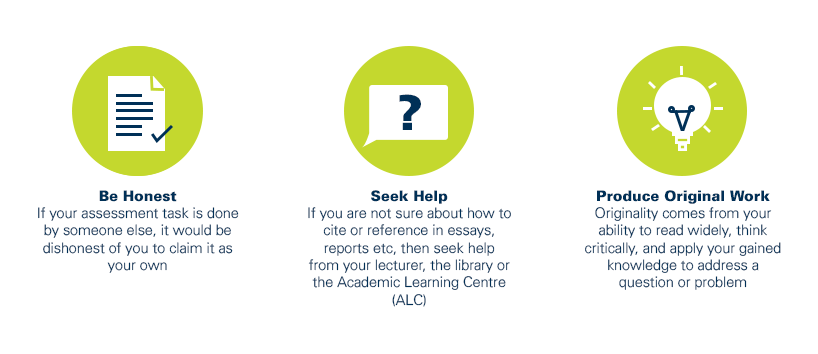
As a CQUniversity student you are expected to act honestly in all aspects of your academic work.
Any assessable work undertaken or submitted for review or assessment must be your own work. Assessable work is any type of work you do to meet the assessment requirements in the unit, including draft work submitted for review and feedback and final work to be assessed.
When you use the ideas, words or data of others in your assessment, you must thoroughly and clearly acknowledge the source of this information by using the correct referencing style for your unit. Using others’ work without proper acknowledgement may be considered a form of intellectual dishonesty.
Participating honestly, respectfully, responsibly, and fairly in your university study ensures the CQUniversity qualification you earn will be valued as a true indication of your individual academic achievement and will continue to receive the respect and recognition it deserves.
As a student, you are responsible for reading and following CQUniversity’s policies, including the Student Academic Integrity Policy and Procedure. This policy sets out CQUniversity’s expectations of you to act with integrity, examples of academic integrity breaches to avoid, the processes used to address alleged breaches of academic integrity, and potential penalties.
What is a breach of academic integrity?
A breach of academic integrity includes but is not limited to plagiarism, self-plagiarism, collusion, cheating, contract cheating, and academic misconduct. The Student Academic Integrity Policy and Procedure defines what these terms mean and gives examples.
Why is academic integrity important?
A breach of academic integrity may result in one or more penalties, including suspension or even expulsion from the University. It can also have negative implications for student visas and future enrolment at CQUniversity or elsewhere. Students who engage in contract cheating also risk being blackmailed by contract cheating services.
Where can I get assistance?
For academic advice and guidance, the Academic Learning Centre (ALC) can support you in becoming confident in completing assessments with integrity and of high standard.
What can you do to act with integrity?