Overview
In this unit you will be provided with essential knowledge on the role of microorganisms and infection control within the context of health care. The unit will also cover host defences and the immune response, including the host-pathogen relationship and the mechanisms of microbial disease. Microbial epidemiology will be examined, with emphasis on worldwide discipline-specific examples.
Details
Pre-requisites or Co-requisites
Prereq: BMSC11002 Human Body Systems 2 or BIOH11005 Introductory Anatomy and Physiology or ALLH11004 Anatomy and Physiology for Health Professionals 2 or BMSC11008 Medical Anatomy and Physiology 2 or BMSC11011 Human Anatomy and Physiology 2. Condition: Be enrolled in any of the following courses: CB77, CB29, CB66, CB70, CB86, CB26, CM51, CM60 or CM61. This unit is incompatible with MBIO19012 Microbiology.
Important note: Students enrolled in a subsequent unit who failed their pre-requisite unit, should drop the subsequent unit before the census date or within 10 working days of Fail grade notification. Students who do not drop the unit in this timeframe cannot later drop the unit without academic and financial liability. See details in the Assessment Policy and Procedure (Higher Education Coursework).
Offerings For Term 2 - 2026
Attendance Requirements
All on-campus students are expected to attend scheduled classes - in some units, these classes are identified as a mandatory (pass/fail) component and attendance is compulsory. International students, on a student visa, must maintain a full time study load and meet both attendance and academic progress requirements in each study period (satisfactory attendance for International students is defined as maintaining at least an 80% attendance record).
Recommended Student Time Commitment
Each 6-credit Undergraduate unit at CQUniversity requires an overall time commitment of an average of 12.5 hours of study per week, making a total of 150 hours for the unit.
Class Timetable
Assessment Overview
Assessment Grading
This is a graded unit: your overall grade will be calculated from the marks or grades for each assessment task, based on the relative weightings shown in the table above. You must obtain an overall mark for the unit of at least 50%, or an overall grade of 'pass' in order to pass the unit. If any 'pass/fail' tasks are shown in the table above they must also be completed successfully ('pass' grade). You must also meet any minimum mark requirements specified for a particular assessment task, as detailed in the 'assessment task' section (note that in some instances, the minimum mark for a task may be greater than 50%). Consult the University's Grades and Results Policy for more details of interim results and final grades.
All University policies are available on the CQUniversity Policy site.
You may wish to view these policies:
- Grades and Results Policy
- Assessment Policy and Procedure (Higher Education Coursework)
- Review of Grade Procedure
- Student Academic Integrity Policy and Procedure
- Academic Progression Policy and Procedure
- Student Refund and Credit Balance Policy and Procedure
- Complaints Policy and Procedure
- Information and Communications Technology Acceptable Use Policy and Procedure
This list is not an exhaustive list of all University policies. The full list of University policies are available on the CQUniversity Policy site.
Feedback, Recommendations and Responses
Every unit is reviewed for enhancement each year. At the most recent review, the following staff and student feedback items were identified and recommendations were made.
Feedback from SUTE comment
One student would prefer the learning material to be in a format other than videos.
Lecture transcripts are available but this may not be clear to the students. This will be stated at the beginning of the unit, as well as instructions on how to access them.
Feedback from SUTE comment
One student commented that the multiple parts to some assessments were a bit much.
The assessments will be evaluated and possibly revised to reduce the number of parts.
- Describe the relationship between form and function in the major groups of microorganisms.
- Discuss the role of microorganisms in relation to human health, with particular reference to the normal microbiota and exogenous microorganisms
- Describe the mechanisms of microbial diseases, including host-microbe interactions and disease transmission
- Explain the fundamental principles of innate and adaptive (specific) immunity
- Describe the major cells and tissues of the immune system and state their function in the immune response
- Apply the fundamental principles of microbial epidemiology to current issues relating to human health
- Interpret the principles of sterilisation, disinfection, and infection control in relation to the student’s discipline area
- Interpret the results of laboratory experiments in the context of the underlying microbiological principles.
Alignment of Assessment Tasks to Learning Outcomes
| Assessment Tasks | Learning Outcomes | |||||||
|---|---|---|---|---|---|---|---|---|
| 1 | 2 | 3 | 4 | 5 | 6 | 7 | 8 | |
| 1 - Online Quiz(zes) - 20% | ||||||||
| 2 - Written Assessment - 30% | ||||||||
| 3 - Online Test - 50% | ||||||||
Alignment of Graduate Attributes to Learning Outcomes
| Graduate Attributes | Learning Outcomes | |||||||
|---|---|---|---|---|---|---|---|---|
| 1 | 2 | 3 | 4 | 5 | 6 | 7 | 8 | |
| 1 - Communication | ||||||||
| 2 - Problem Solving | ||||||||
| 3 - Critical Thinking | ||||||||
| 4 - Information Literacy | ||||||||
| 5 - Team Work | ||||||||
| 6 - Information Technology Competence | ||||||||
| 7 - Cross Cultural Competence | ||||||||
| 8 - Ethical practice | ||||||||
| 9 - Social Innovation | ||||||||
| 10 - First Nations Knowledges | ||||||||
| 11 - Aboriginal and Torres Strait Islander Cultures | ||||||||
Textbooks
Microbiology and infection control for health professionals
- Edition: 6th (2015)
- Authors: Lee & Bishop
- Pearson
- Frenchs Forest Frenchs Forest , NSW , Australia
- ISBN: 9781442549128
- Binding: Other
IT Resources
- CQUniversity Student Email
- Internet
- Unit Website (Moodle)
All submissions for this unit must use the referencing styles below:
For further information, see the Assessment Tasks.
s.makiela@cqu.edu.au
Week 1
Begin Date: 13 Jul 2026Module/Topic
Introduction, bacteria.
Chapter
Lee & Bishop, ch 1 & 3.
Events and Submissions/Topic
Week 2
Begin Date: 20 Jul 2026Module/Topic
Fungi, protozoans and parasites.
Chapter
Lee & Bishop, ch 6.
Events and Submissions/Topic
Week 3
Begin Date: 27 Jul 2026Module/Topic
Viruses.
Chapter
Lee & Bishop, ch 3 & 5.
Events and Submissions/Topic
Week 4
Begin Date: 03 Aug 2026Module/Topic
Microbial growth, replication and genetics.
Chapter
Lee & Bishop, ch 2-6.
Events and Submissions/Topic
Week 5
Begin Date: 10 Aug 2026Module/Topic
Immunity.
Chapter
Lee & Bishop, ch 9.
Events and Submissions/Topic
Online test 1 opens Friday 14th August at 9am AEST and close in 24h.
Week 6
Begin Date: 17 Aug 2026Module/Topic
Principles of disease.
Chapter
Lee & Bishop, ch 7, 8 & 10.
Events and Submissions/Topic
Vacation Week
Begin Date: 24 Aug 2026Module/Topic
Chapter
Events and Submissions/Topic
Week 7
Begin Date: 31 Aug 2026Module/Topic
Principles of disease.
Chapter
Lee & Bishop, ch 7, 8 & 10.
Events and Submissions/Topic
Week 8
Begin Date: 07 Sep 2026Module/Topic
Control of growth, infection control.
Chapter
Lee & Bishop, ch 11 & 12.
Events and Submissions/Topic
Week 9
Begin Date: 14 Sep 2026Module/Topic
Issues in public health.
Chapter
Lee & Bishop, ch 13 & 14.
Events and Submissions/Topic
Case Study Analysis Due: Week 9 Friday (18 Sept 2026) 11:59 pm AEST
Week 10
Begin Date: 21 Sep 2026Module/Topic
Module A or Module B or Module C
(see Term Specific Information)
Chapter
Specific readings for each module will be provided on the Moodle site.
Events and Submissions/Topic
Online test 2 opens Friday 25th September at 9am AEST and close in 24h.
Week 11
Begin Date: 28 Sep 2026Module/Topic
Continuation of modules.
Chapter
Events and Submissions/Topic
Week 12
Begin Date: 05 Oct 2026Module/Topic
Continuation of modules.
Chapter
Events and Submissions/Topic
Online test 3 opens Friday 9th October at 9am AEST and close in 24h.
Exam Week
Begin Date: 12 Oct 2026Module/Topic
Chapter
Events and Submissions/Topic
Vacation/Exam Week
Begin Date: 19 Oct 2026Module/Topic
Chapter
Events and Submissions/Topic
Assessment 1:
For part 1 of your Practicals and Virtual Laboratory you will require a Microbiology Kit. These are available free. You will automatically have one sent to your address as recorded on MyCentre. If you need it sent to a different address, please
contact the unit coordinator ASAP. If you are in Rockhampton and would like to pick yours up from campus, please let the unit coordinator know so you can be added to that list. Your kit should arrive by the end of week 3. If not, please
contact the unit coordinator via email (s.makiela@cqu.edu.au) to follow up on your kit.
Modules:
You will notice in the Schedule that there are different module choices in weeks 10-12. Each module has different topics; this is done to make the unit more relevant to your discipline area. Later in the term, you will need to choose which
module you want to do using a Choice activity on the Moodle site.
1 Online Quiz(zes)
This assessment uses two complementary assessment tasks designed to develop and evaluate your practical and theoretical understanding of microbiology.
1. Practical Microbiology Task (10%)
You will complete a hands‑on microbiology experiment using a Microbiology Kit (see Term Specific Information section). This involves 5 tasks where you will be collecting and culturing microbial samples (eg. before and after handwashing or surface disinfection), recording your observations, and submitting clear photos of your plates along with your data. Details of these tasks, including instructional videos, will be available on the Moodle site. You will also be required to answer some questions based on both your own data and the class data from previous years, explaining what your results show about normal microbiota, transient microbes, and infection control principles. This assessment develops your practical skills and your ability to interpret real microbiological outcomes.
2. Virtual Labs and Microbiology Quiz (10%)
You will complete three virtual laboratory activities on the Moodle site. These activities are not graded and you may attempt each one as many times as you wish. They introduce key concepts such as host–microbe interactions, population‑level infection dynamics, and disinfection and sterilisation. Your understanding of these virtual labs is assessed through a timed multiple‑choice quiz, which evaluates your ability to apply microbiological principles to practical and clinical scenarios.
Please note:
While both parts are due at the same time, you are encouraged to complete Part 1 as soon as you receive your kit. This allows time to repeat the activity if something doesn’t work as expected. You may email your plate photos to the unit coordinator at any stage for formative feedback so you can confirm whether your results are suitable or need to be redone.
The 72 hour grace period does not apply to the quiz.
Level of GenAI use allowed:
Level 1: You must not use Al at any point during the assessment. You must demonstrate your core skills and knowledge.
Week 9 Monday (14 Sept 2026) 11:59 pm AEST
Week 11 Friday (2 Oct 2026)
This assessment piece is worth 20% of the total unit marks, with 10% allocated to each part.
Part 1 (10%) consists of 5 separate tasks and the associated questions. For each task, you must upload one picture of your work and the required data. Marks will be awarded for the reporting of valid data (including the photo) and successful completion of the task (1% each for a total of 5%). The questions on the data is worth the other 5%.
Part 2 (10%) is assessed via an online quiz based on the virtual laboratory exercises. The quiz is marked based on the correctness of the answer.
- Discuss the role of microorganisms in relation to human health, with particular reference to the normal microbiota and exogenous microorganisms
- Interpret the principles of sterilisation, disinfection, and infection control in relation to the student’s discipline area
- Interpret the results of laboratory experiments in the context of the underlying microbiological principles.
2 Written Assessment
Part A:
You will be provided with video footage of a workplace situation relevant to a health care future workplace. There will be a few videos for you to choose from (available from the unit Moodle site) and you will need to choose one video only for this assessment, unless otherwise specified. The videos will depict typical workplace occurrences but with flaws in infection control procedures. Using Moodle forums, chat rooms, or other means, you may discuss the footage with other students and identify the flaws in infection control procedures.
The case study analysis (report) will be done individually. You will be limited to a maximum of 5 incidents in your reports. Since there will be more than 5 incidents on the videos, you will be asked to report on those which you believe are the most important, and will be asked to justify your decision. The report will need to discuss how each incident may transmit and cause disease, and reflect on the infection control measures needed to rectify the situation. This will need to be substantiated with evidence from the literature.
Part B:
After the 5 incidents, you will need to critically evaluate information from the literature on the spread of infection in your future workplace. You will need to identify and evaluate an actual disease outbreak from your discipline area or similar, using several sources of information. This evaluation will include your discipline area's current infection control policies and procedures. Please note: you cannot use COVID for this part of the assessment. Using COVID will result in a mark of 0 for this part.
As this assessment will commence at the beginning of term, you will be encouraged to revisit the video as more unit material is covered in lectures. Detailed guidelines for this task will be available from the unit Moodle site.
Suggested length: 2000 - 2500 words.
Level of GenAI use allowed:
Level 3: You may use Al to assist with specific tasks such as drafting text, refining and evaluating your work. You must critically evaluate and modify any Al-generated content you use.
A note on the use of AI:
Student are permitted to use Generative AI for this assessment in the following ways:
- developing literature search strategies
- compiling suitable literature sources and locating data
- guidance for structuring the assignment
All students (whether you used AI or not) must submit an AI Declaration Form with their assessment, available on the Moodle site in this assessment.
As per academic writing requirements and assessment criteria, citations of information should be of the primary source (i.e statistics returned by AI must be fact-checked and referenced from their original source as well as the AI source). Failure to cite primary sources as well as AI sources could be considered breach of academic integrity. Your use of Generative AI must be clearly outlined in the AI Declaration Form which includes the prompt(s) used and Generative AI response(s). Failure to include this may result in academic integrity investigation.
Week 9 Friday (18 Sept 2026) 11:59 pm AEST
Week 12 Monday (5 Oct 2026)
The complete assessment marking rubrics will be available on the Moodle site and will be based on the following criteria:
- Identification of problems (15%)
- Discussion of disease potential (10%)
- Recommended infection control solution and relevance to future workplace (25%)
- Application of critical analysis (20%)
- Presentation (10%)
- Clarity of expression (10%)
- Referencing (10%)
- Describe the mechanisms of microbial diseases, including host-microbe interactions and disease transmission
- Apply the fundamental principles of microbial epidemiology to current issues relating to human health
- Interpret the principles of sterilisation, disinfection, and infection control in relation to the student’s discipline area
3 Online Test
An understanding of fundamental microbiological concepts is essential in many health professions. Your knowledge of the content and concepts will be examined by three online tests held at irregular intervals throughout the term. All test topics will be covered during lectures and tutorials.
The first online test will be in week 5, opening Friday 14th August, and will cover the content of weeks 1-4. The second will be in week 10, opening Friday 25th September, and cover the content of weeks 5-9. The third will be in week 12, opening Friday 9th October, and will cover the content of weeks 10-12 (modules). Each test opens at 9am AEST on the specified date, will be open for a 24h period, and will be timed. You may do your test at any time during this period.
These online tests will be done as quizzes in Moodle. The quizzes consist of both multiple choice and short answer questions.
You must undertake these tests as an indivitual and not with classmates or others. As with all other University assessments, colluding with other students on a non-group work task is considered academic misconduct and will be dealt with in accordance with the Student Academic Integrity Policy.
Referencing:
For all short answer questions, you must cite your sources using the prescribed referencing styles (Harvard or APA). Failure to cite the source (or incorrectly citing your source) constitutes a breach of academic integrity and will be dealt with in accordance of the relevant policy.
If your answer came from lectures, simply cite as: Lectures, week x. If from the textbook, simply cite as: Textbook, chapter x. If your answer came from any other source, the full citation must be given (not just author and date).
Level of GenAI use Allowed:
Level 1: You must not use Al at any point during the assessment. You must demonstrate your core skills and knowledge.
The 72 hour grace period does not apply to this assessment.
First test closes on the Saturday of week 5, 9am AEST; the second test on the Saturday of week 10, 9am AEST; the third test on the Saturday of week 12, 9am AEST.
Marks will be available after each quiz (online test) closes, within 10 working days.
Each multiple choice question in each online test will be marked automatically by Moodle, and will be based on correctness. Short answer questions will be marked manually, and will be based on completeness and correctness of your answer. Your total mark for this assessment will be the sum of all three online test marks.
- Describe the relationship between form and function in the major groups of microorganisms.
- Discuss the role of microorganisms in relation to human health, with particular reference to the normal microbiota and exogenous microorganisms
- Describe the mechanisms of microbial diseases, including host-microbe interactions and disease transmission
- Explain the fundamental principles of innate and adaptive (specific) immunity
- Describe the major cells and tissues of the immune system and state their function in the immune response
- Apply the fundamental principles of microbial epidemiology to current issues relating to human health
- Interpret the principles of sterilisation, disinfection, and infection control in relation to the student’s discipline area
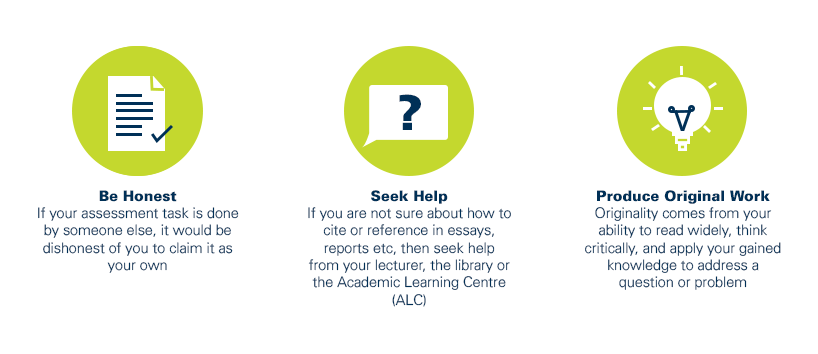
As a CQUniversity student you are expected to act honestly in all aspects of your academic work.
Any assessable work undertaken or submitted for review or assessment must be your own work. Assessable work is any type of work you do to meet the assessment requirements in the unit, including draft work submitted for review and feedback and final work to be assessed.
When you use the ideas, words or data of others in your assessment, you must thoroughly and clearly acknowledge the source of this information by using the correct referencing style for your unit. Using others’ work without proper acknowledgement may be considered a form of intellectual dishonesty.
Participating honestly, respectfully, responsibly, and fairly in your university study ensures the CQUniversity qualification you earn will be valued as a true indication of your individual academic achievement and will continue to receive the respect and recognition it deserves.
As a student, you are responsible for reading and following CQUniversity’s policies, including the Student Academic Integrity Policy and Procedure. This policy sets out CQUniversity’s expectations of you to act with integrity, examples of academic integrity breaches to avoid, the processes used to address alleged breaches of academic integrity, and potential penalties.
What is a breach of academic integrity?
A breach of academic integrity includes but is not limited to plagiarism, self-plagiarism, collusion, cheating, contract cheating, and academic misconduct. The Student Academic Integrity Policy and Procedure defines what these terms mean and gives examples.
Why is academic integrity important?
A breach of academic integrity may result in one or more penalties, including suspension or even expulsion from the University. It can also have negative implications for student visas and future enrolment at CQUniversity or elsewhere. Students who engage in contract cheating also risk being blackmailed by contract cheating services.
Where can I get assistance?
For academic advice and guidance, the Academic Learning Centre (ALC) can support you in becoming confident in completing assessments with integrity and of high standard.
What can you do to act with integrity?