Overview
The integument is the body’s mirror. When alterations occur in skin integrity there is the potential that this will impact on every aspect of the person. Wound management is a complex area with new information being continually generated. You will apply an evidence based approach in exploring the principles and practice of contemporary wound management.
Details
Pre-requisites or Co-requisites
Pre-requisites Students must have completed 96 credit points and NURS12158 Clinical Nursing Practice 3 or NURS13126 Critical Care Nursing
Important note: Students enrolled in a subsequent unit who failed their pre-requisite unit, should drop the subsequent unit before the census date or within 10 working days of Fail grade notification. Students who do not drop the unit in this timeframe cannot later drop the unit without academic and financial liability. See details in the Assessment Policy and Procedure (Higher Education Coursework).
Offerings For Term 1 - 2020
Attendance Requirements
All on-campus students are expected to attend scheduled classes - in some units, these classes are identified as a mandatory (pass/fail) component and attendance is compulsory. International students, on a student visa, must maintain a full time study load and meet both attendance and academic progress requirements in each study period (satisfactory attendance for International students is defined as maintaining at least an 80% attendance record).
Recommended Student Time Commitment
Each 6-credit Undergraduate unit at CQUniversity requires an overall time commitment of an average of 12.5 hours of study per week, making a total of 150 hours for the unit.
Class Timetable
Assessment Overview
Assessment Grading
This is a graded unit: your overall grade will be calculated from the marks or grades for each assessment task, based on the relative weightings shown in the table above. You must obtain an overall mark for the unit of at least 50%, or an overall grade of 'pass' in order to pass the unit. If any 'pass/fail' tasks are shown in the table above they must also be completed successfully ('pass' grade). You must also meet any minimum mark requirements specified for a particular assessment task, as detailed in the 'assessment task' section (note that in some instances, the minimum mark for a task may be greater than 50%). Consult the University's Grades and Results Policy for more details of interim results and final grades.
All University policies are available on the CQUniversity Policy site.
You may wish to view these policies:
- Grades and Results Policy
- Assessment Policy and Procedure (Higher Education Coursework)
- Review of Grade Procedure
- Student Academic Integrity Policy and Procedure
- Monitoring Academic Progress (MAP) Policy and Procedure - Domestic Students
- Monitoring Academic Progress (MAP) Policy and Procedure - International Students
- Student Refund and Credit Balance Policy and Procedure
- Student Feedback - Compliments and Complaints Policy and Procedure
- Information and Communications Technology Acceptable Use Policy and Procedure
This list is not an exhaustive list of all University policies. The full list of University policies are available on the CQUniversity Policy site.
- Evaluate the principles of cultural awareness and communication to enable effective collaboration with individuals, families and other members of the multidisciplinary health care team to facilitate positive outcomes for wound healing.
- Apply best practice principles and wound management guidelines to the assessment and management of individuals with either acute or chronic wounds.
- Evaluate the use of alternative wound management strategies to faciliate wound healing.
- Examine safe and effective person centred nursing care for individuals undergoing diagnostic and therapeutic procedures related to wound healing.
Relate the significance of the Nursing and Midwifery Board of Australia (NMBA) registered nurse standards for practice and specific National Safety and Quality Health Service Standards to nursing practice.
Alignment of Assessment Tasks to Learning Outcomes
| Assessment Tasks | Learning Outcomes | |||
|---|---|---|---|---|
| 1 | 2 | 3 | 4 | |
| 1 - Written Assessment - 40% | ||||
| 2 - Presentation and Written Assessment - 60% | ||||
Alignment of Graduate Attributes to Learning Outcomes
| Graduate Attributes | Learning Outcomes | |||
|---|---|---|---|---|
| 1 | 2 | 3 | 4 | |
| 1 - Communication | ||||
| 2 - Problem Solving | ||||
| 3 - Critical Thinking | ||||
| 4 - Information Literacy | ||||
| 5 - Team Work | ||||
| 6 - Information Technology Competence | ||||
| 7 - Cross Cultural Competence | ||||
| 8 - Ethical practice | ||||
| 9 - Social Innovation | ||||
| 10 - First Nations Knowledges | ||||
| 11 - Aboriginal and Torres Strait Islander Cultures | ||||
Alignment of Assessment Tasks to Graduate Attributes
| Assessment Tasks | Graduate Attributes | ||||||||||
|---|---|---|---|---|---|---|---|---|---|---|---|
| 1 | 2 | 3 | 4 | 5 | 6 | 7 | 8 | 9 | 10 | 11 | |
| 1 - Written Assessment - 40% | |||||||||||
| 2 - Presentation and Written Assessment - 60% | |||||||||||
Textbooks
There are no required textbooks.
Additional Textbook Information
Recommended:
Wound Care
A practical guide for maintaining skin integrity
Kerrie Coleman & Glo Neilsen
ISBN : 9780729543170
Publication Date : 30-11-2019
Stock Status : Available for Pre-Order
Elsevier
IT Resources
- CQUniversity Student Email
- Internet
- Unit Website (Moodle)
All submissions for this unit must use the referencing style: American Psychological Association 6th Edition (APA 6th edition)
For further information, see the Assessment Tasks.
g.neilsen@cqu.edu.au
p.heidke@cqu.edu.au
Week 1 The integumentary system and stages of healing
Begin Date: 09 Mar 2020Module/Topic
Principles of Wound Healing including a review of the integumentary system, the stages of healing, dressing selection and the role of infection control in wound healing
Chapter
Read Chapter one of the recommended text Coleman & Neilsen and literature related to the stages of wound healing and infection control
Events and Submissions/Topic
Commence your study guide. Complete formative quiz Week One. This is an optional review quiz and does not contribute to your assessment or final grades. The zoom session will discuss how to be successful in this unit. This includes asking you, the student, what you expect to learn in this unit.
Week 2 Wound assessment
Begin Date: 16 Mar 2020Module/Topic
Wound assessment - an holistic approach
Chapter
Read the literature on the Moodle site related to wound assessment
Events and Submissions/Topic
Complete formative quiz Week Two. This is an optional review quiz and does not contribute to your assessment or final grades. The zoom session will guide students to critically reflect on effective wound assessment.
Week 3 Wound management principles
Begin Date: 23 Mar 2020Module/Topic
Wound management principles
Chapter
Read the literature on the Moodle site related to wound management
Events and Submissions/Topic
Assessment one task due in two weeks. Complete formative quiz Week Three. This is an optional review quiz and does not contribute to your assessment or final grades. The zoom session aims to consolidate wound care principles and apply this to the assignment case studies.
Week 4 Cellulitis
Begin Date: 30 Mar 2020Module/Topic
Assessment of Chronic oedema/Cellulitis
Chapter
Read the literature on the Moodle site related to cellulitis
Events and Submissions/Topic
Assessment task 1 due midnight Tuesday next week. Complete formative quiz Week Four. This is an optional review quiz and does not contribute to your assessment or final grades. The zoom session will consider evidence based strategies for the assessment and management of lymphoedema.
Week 5 Wound infections/exudate
Begin Date: 06 Apr 2020Module/Topic
Wound infections and identifying exudate
Chapter
Read the literature on the Moodle site related to wound infections/exudate
Events and Submissions/Topic
Assessment One due this week. Complete formative quiz Week Five. This is an optional review quiz and does not contribute to your assessment or final grades. The zoom session will provide final support prior to the submission of assessment one. It will also examine the concepts surrounding wound healing, colonisation, bioburden, bacterial load, and wound infection.
Wound assessment templates and progress notes Due: Week 5 Tuesday (7 Apr 2020) 11:59 pm AEST
Vacation Week
Begin Date: 13 Apr 2020Module/Topic
Chapter
Events and Submissions/Topic
Week 6 Wound dressing selection
Begin Date: 20 Apr 2020Module/Topic
Principles of wound dressing selection
Chapter
Read the literature on the Moodle site related to the selection of wound dressings
Events and Submissions/Topic
Complete formative quiz Week Six. This is an optional review quiz and does not contribute to your assessment or final grades. The zoom session will discuss effectively choosing the best wound care product for your patient.
Week 7 Pressure injuries and venous leg ulcers
Begin Date: 27 Apr 2020Module/Topic
Pressure injuries and venous leg ulcers
Chapter
Read the literature on the Moodle site related to pressure injuries and venous leg ulcers
Events and Submissions/Topic
Complete formative quiz Week Seven. This is an optional review quiz and does not contribute to your assessment or final grades. The zoom session will explore issues relevant to pressure injuries and venous leg ulcers. Students will be encouraged to reflect on their tacit experience and acquired knowledge.
Week 8 Skin tears and acute wounds
Begin Date: 04 May 2020Module/Topic
Skin tears and acute wounds
Chapter
Read the literature on the Moodle site related to skin tears and acute wounds
Events and Submissions/Topic
Complete formative quiz Week Eight. This is an optional review quiz and does not contribute to your assessment or final grades. The zoom session will focus on the evidence-based management of acute wounds in diverse settings.
Week 9 Management of the Diabetic foot
Begin Date: 11 May 2020Module/Topic
Management of the Diabetic foot
Chapter
Read the literature on the Moodle site related to management of the Diabetic foot
Events and Submissions/Topic
Complete formative quiz Week Nine. This is an optional review quiz and does not contribute to your assessment or final grades. The zoom session will focus on the evidence based management of the diabetic foot wounds in diverse settings.
Week 10 Wound dressings part 2
Begin Date: 18 May 2020Module/Topic
Wound dressings part 2
Chapter
Read the literature on the Moodle site related to wound dressings part 2
Events and Submissions/Topic
Week 11 Tropical Wounds
Begin Date: 25 May 2020Module/Topic
Tropical Wounds
Chapter
Read the literature on the Moodle site related to tropical wounds
Events and Submissions/Topic
Complete formative quiz Week Eleven. This is an optional review quiz and does not contribute to your assessment or final grades. The zoom session will focus on tropical wounds and guidelines for optimising wound management.
Case studies and PowerPoint Due: Week 11 Tuesday (26 May 2020) 11:59 pm AEST
Week 12 Wound management guidelines
Begin Date: 01 Jun 2020Module/Topic
Wound management guidelines
Chapter
Read the literature on the Moodle site related to wound management guidelines
Events and Submissions/Topic
Complete formative quiz Week Twelve. This is an optional review quiz and does not contribute to your assessment or final grades. The zoom session will focus on standards and guidelines essential for optimising wound management.
1 Written Assessment
You are required to view the details of this case study through your Wound Education App (WEA). After working through WEA, you are required to complete the following tasks. This assessment has three parts.
Part 1
· Using the equipment found in the Assessment toolbox in the app, complete the wound assessment template based on the images from the App for each week [a total of four [CA1] wound assessments]. The wound assessment template for each week can be found on the Moodle site under the Assessment 1 TAB.
Part 2
· Please include a screen shot of Peter’s wound for each date [this will be four images in total]. You will only need to select one image from each group of images and these are also found under the Assessment 1 TAB. Click on the selected image and copy and paste to the base of your template.
Part 3
· For the final wound assessment only, complete the progress notes using the template provided on Moodle under Assessment 1 TAB. Your documentation should reflect descriptions of the wound, suggested wound management and education provided to Mr Z. This documentation should reflect current standards of documentation related to the NMBA standards. You are required to use the Assessment, Planning, Implementation and Evaluation framework[CA2] in your progress notes.
· Assessment Requirements:
· The progress notes must be double spaced with size 12 Arial or Calibri font, following the APIE framework.
· The length of the progress notes is 200 words + 10%
· Wound Template and progress notes requirements: Complete ALL sections of the wound assessment templates, using information available on the app.
· When completed, please upload each wound assessment and accompanying images under the Assessment One submission site. Progress notes will need to be uploaded separately.
Week 5 Tuesday (7 Apr 2020) 11:59 pm AEST
Please submit via Turnitin in the NURS13127 Moodle site
Week 7 Monday (27 Apr 2020)
Students will be able to access their returned files via the Moodle site
Marking Criteria NURS13127 Written assessment one
Student name: Student Number:
| HD 85-100% | D 75-84% | C 65-74% | P 50-64% | F <50% | Marks |
| Structure -20% | |||||
| Excellent presentation of assignment, Consistently accurate with spelling, grammar, and use of punctuation and paragraph structure. (8-10%) | Well-presented assignment. 1 or 2 errors in spelling, grammar, use of punctuation or paragraph structure. (7.5-8) | Well-presented assignment. 3 or 4 consistent errors with spelling, grammar, use of punctuation or paragraph structure. (6.5-7) | Adequate assignment presentation. 4 to 7 consistent errors with spelling, grammar, use of punctuation or paragraph structure. (5-6) | Poorly presented assignment. Many inaccuracies in spelling, grammar, use of punctuation or paragraph structure. (<5) | /20 |
| Uses all correct components: four templates accompanied by appropriate images and progress notes. Uses double line spacing, Arial or Times New Roman, 12-point size font, cover page and table of contents. (8-10%) | Uses all correct components except one: four templates accompanied by appropriate images and progress notes, double line spacing, Arial or Times New Roman, 12-point size font, cover page and table of contents. (7.5-8) | Does not include or use two of these components: four templates accompanied by appropriate images and progress notes, double line spacing, Arial or Times New Roman, 12-point size font, cover page and table of contents. (6.5-7) | Uses 12-point size font. Does not use double line spacing, Times New Roman. Does not include cover page and/or table of contents. Includes some but not all components: four templates, accompanied by appropriate images and progress notes. (5-6) | Less than half required components included: four templates accompanied by appropriate images and progress notes, double line spacing, Arial or Times New Roman, 12-point size font, cover page and table of contents. (<5) | |
| Templates (40%) | |||||
| Comprehensive and accurate completion of all four [4] templates accompanied by appropriate image. (34-40%) | Comprehensive completion of all four [4] templates accompanied by appropriate image with one error or omission. (30-33) | Accurate completion of all four [4] templates accompanied by appropriate image with two errors or omissions. (26-29) | Mostly accurate completion of all four [4] templates accompanied by appropriate image with three to four errors or omissions. (20-25) | Incomplete submission of four [4] or less templates with or without appropriate image. (<20) | /40 |
| Progress Notes - 40% | |||||
| /40 | |||||
| All information clearly organised in logical sequence; follows acceptable format using APIE. Treatment plan and patient education addresses all issues raised by diagnoses; excellent insight into patient’s needs. Evidence based decisions. (34-40%) | All information organised in logical sequence using APIE. Treatment plan and patient education addresses issue with insight into patient needs. (30-33) | Information generally organised in logical sequence; follows acceptable format using APIE. Treatment plan and patient education addresses most issues raised. (26-29) | Identifiable organisation of information in mostly logical sequence. APIE format not clearly used. Treatment plan and patient education identifiable. (20-25) | Errors in format; information disorganised. Minimal and/or no treatment plan and/or no patient education addressed. APIE not identifiable. (<20) | |
| Total |
- Evaluate the principles of cultural awareness and communication to enable effective collaboration with individuals, families and other members of the multidisciplinary health care team to facilitate positive outcomes for wound healing.
- Apply best practice principles and wound management guidelines to the assessment and management of individuals with either acute or chronic wounds.
- Evaluate the use of alternative wound management strategies to faciliate wound healing.
- Examine safe and effective person centred nursing care for individuals undergoing diagnostic and therapeutic procedures related to wound healing.
- Communication
- Problem Solving
- Critical Thinking
- Information Literacy
- Team Work
- Information Technology Competence
- Cross Cultural Competence
- Ethical practice
2 Presentation and Written Assessment
This assessment is in two parts
Part one – Short answer case studies
Part two – PowerPoint presentation of case studies
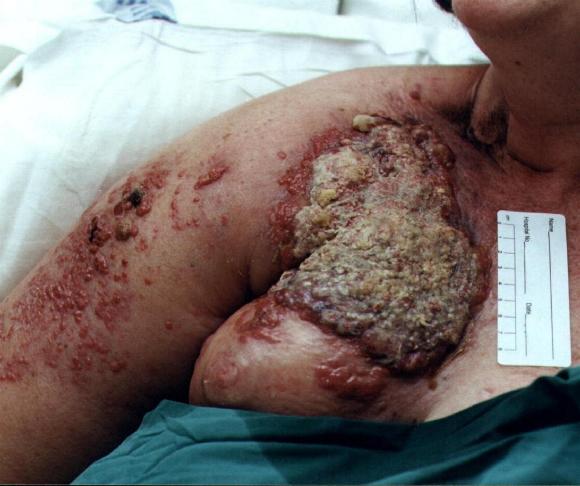 Case study 1: Fungating wound [review week 1, 2, 3 & 8]
Background
Fungating malignant wounds are present for some people with advanced cancer. The presence of these wounds are symptomatic of a primarily invasive and non-healing wound. They may be present for many years or they may become apparent towards the final few months of life requiring palliative management. In treating patients with fungating wounds, the goal of care is to maintain or improve quality of life through symptom control. Symptoms associated with fungating wounds can include disfigurement, exudate, malodour, bleeding and pain (Tilley, Lipson & Ramos, 2017).
Case study
Helen Merlon, a 54-year-old single woman working from home as a telemarketer for a non-profit organisation, has presented to your cancer clinic with a diagnosis of invasive breast cancer manifesting as a fungating tumour. The tumour extends from her neck, right breast, chest wall and right upper arm. She has not presented to a general practitioner for the last three years nor for a breast screen. Helen has omitted to tell her family: Jacob, 27, a firefighter and Melanie, 22, a receptionist, of her illness. She presented two weeks ago to her GP for pain management. Helen is embarrassed about the exudate because of the odour. Her current management is to wear sanitary pads over her breast for absorption of the exudate and long sleeves and scarves to cover the remaining wound.
Medical history
Nil significant medical history.
Fractured left collar bone at age six.
(600 words)
Ø Based on your understanding of wound dressing properties and using the image above as a basis, select two appropriate wound dressings for Helen. It is preferred you use generic names only if possible.
Ø Please discuss your rationale for your choice of wound dressings for Helen providing two options. These will include a first choice option and an alternative wound management strategy.
Ø You are then required to develop a brief wound management plan for Helen around one of these options including Marie’s preferences and education needs.
Case study 2: Breakdown of a surgical wound [review week, 1, 2, 3 & 6]

Background
A surgical wound is creating by an incision line intended to heal through primary intention with wound margins closed by either sutures, staples or glue. The role of dressings is to control the micro-environment of the wound site and may also stimulate activity in the healing cascade and speed up the healing process. There are many contributing factors relating to wound healing including lifestyle factors, intraoperative factors and pre-existing comorbidities. If some or all of these factors are present, they may delay wound healing and contribute to post-operative complications such as surgical site infection [SSI] (Sandy-Hodgetts, 2018).
Case study
Peter Williams is a 51-year old truck driver who presented to the emergency department one week ago with significant abdominal pain, nausea and vomiting and fever. Upon review, Joseph was scheduled for emergency surgery where a laparotomy was performed followed by excision and anastomosis of a perforated bowel caused by diverticula. Peter has a diet primarily of steak burgers and chips [his favourite] at local takeaways as he works long hours. He acknowledges he does smoke 30 cigarettes per day as he feels stressed and needs to be working all the time. He is slightly overweight due to his sedentary lifestyle and diet, taking oral hypoglycaemics and insulin [Glargin].
Medical history
Diabetes type two insulin dependent.
Diverticulitis with two admissions
Your short answer task
(600 words)
Ø Based on your understanding of wound dressing properties and using the image above as a basis, select two appropriate wound dressings for Peter. It is preferred you use generic names only if possible.
Ø Please discuss your rationale for your choice of wound dressings for Peter providing two options. These will include a first choice option and an alternative wound management strategy.
Ø You are then required to develop a brief wound management plan for Joseph around one of these options including Peter’s preferences and his education needs.
Assessment Requirements:
Part 1
Ø Your submission will consist of a title page, your response to the three case studies with each case study having a reference list relevant to the topic.
Ø A separate reference list is required at the end of each case study – this does NOT need to be duplicated at the end of the total assessment.
Ø The reference list at the end of each case study must include a minimum of three (3) peer reviewed journal articles and two (2) other recent, reliable, relevant references.
Ø Your submission must be double spaced with size 12 Arial or Calibri font only written in third person in academic format [Please DO NOT include and introduction or conclusion]..
Ø Websites must be from reliable sources (Avoid consumer websites).
Ø Referencing must adhere to APA guidelines [found on Moodle NURS13127].
Ø The length of each case study, wound management plan and education plan is 600 words + 10% including in text references.
Ø Please submit word.doc or word.docx format only.
Part 2 - PowerPoint presentation of case studies
Develop a power point presentation briefly outlining
Ø An overview of the type of wound for each wound presented in the case studies
Ø The aims of the wound dressings selected [what each wound requires]
Ø Evidence based information of the wound dressings selected
Ø The power point should be aimed at educating care staff about how to manage each type of wound presented
Ø 8-10 slides [excluding the title and reference slide] is acceptable
Ø Include references on each slide [at the base of each slide in smaller font]
Ø A title slide and reference slide is required
Week 11 Tuesday (26 May 2020) 11:59 pm AEST
Assessment to be submitted via NURS13127 Turnitin
This assessment will be returned three weeks after the due date. Any marks, grades or comments are provisional upon certification
Marking Criteria NURS13127 Written assessment two
Student name: Student Number:
| HD 85-100% | D 75-84% | C 65-74% | P 50-64% | F <50% | Marks |
| Structure -10% | |||||
| Excellent presentation of assignment, Consistently accurate with spelling, grammar, and use of punctuation and paragraph structure. (5%) | Well-presented assignment. 1 or 2 errors in spelling, grammar, use of punctuation or paragraph structure. (4) | Well-presented assignment. 3 or 4 consistent errors with spelling, grammar, use of punctuation or paragraph structure. (3) | Adequate assignment presentation. 4 to 7 consistent errors with spelling, grammar, use of punctuation or paragraph structure. (2.5) | Poorly presented assignment. Many inaccuracies in spelling, grammar, use of punctuation or paragraph structure. (<2.5) | /10 |
| Uses all correct components: cover page, short answer essay with individualised reference list. Completes two case studies, Uses double line spacing, Arial or Times New Roman, 12-point size font. (5%) | Uses all correct components except one: cover page, short answer essay with individualised reference list. Completes two case studies, Uses double line spacing, Arial or Times New Roman, 12-point size font. (4) | Does not include or complete two of these components: cover page, short answer essay with individualised reference list. Completes two case studies, Uses double line spacing, Arial or Times New Roman, 12-point size font. (3) | Does not include all components: cover page, short answer essay with individualised reference list. Completes two case studies, Uses double line spacing, Arial or Times New Roman, 12-point size font. (2.5) | Does not include both case studies. Less than half required components included: cover page, short answer essay with individualised reference list. May or may not use double line spacing, Arial or Times New Roman, 12-point size font. (<2.5) | |
| Discussion (80%) | |||||
| Comprehensively includes detailed and convincing rationale for your choice of evidence based and appropriate wound dressing selection for each case study with clear, convincing critical thought displayed. (17-20) | Extensively includes detailed and convincing rationale for your choice of evidence based and appropriate wound dressing selection for each case study with clear, convincing critical thought displayed. (15-16.5) | Includes convincing rationale for your choice of evidence based and appropriate wound dressing selection for each case study with convincing critical thought displayed. (13-14.5) | Mostly accurate rationale for your choice of evidence based and appropriate wound dressing selection for each case study with clear thought displayed. (10-12.5) | Incomplete rationale for your choice of evidence based and appropriate wound dressing selection for each case study. (< 10) | |
| Comprehensively includes a detailed and convincing rationale for your alternative wound product selection for both case studies with clear, coherent and convincing critical thought displayed. (17-20) | Extensively includes a detailed and convincing rationale for your alternative wound product selection for both case studies with clear, coherent and convincing critical thought displayed. (15-16.5) | Includes a detailed rationale for your alternative wound product selection for both case studies with clear and coherent critical thought displayed. (13-14.5) | Includes an acceptable rationale for your alternative wound product selection for both case studies with clear and coherent critical thought displayed. (10-12.5) | Does not include an acceptable rationale/or use appropriate dressing options for your alternative wound product selection. (< 10) | |
| Provides a succinct and convincing wound management plan outlining an appropriate plan for both case studies. (17-20) | Extensively includes a detailed wound management plan outlining an appropriate plan for both case studies. (15-16.5) | Includes a detailed wound management plan outlining an appropriate plan for both case studies. (13-14.5) | Includes a wound management plan outlining an appropriate plan for both case studies. Discussion is at times repetitive or lacks cohesion. (10-12.5) | Content does not address an appropriate plan for one or both case studies. Little or no discernible critical thought. (< 10) | /80 |
| Power-point includes comprehensive presentation of educational information for health professionals with accurate in-text referencing each slide and reference list. Presentation is supported by an excellent choice of appropriate and relevant visual images. (17-20) | Power-point includes detailed presentation of educational information for health professionals with accurate in-text referencing each slide and reference list. Presentation is supported by a considered choice of appropriate and relevant visual images. (15-16.5) | Power-point includes reasonable presentation of educational information for health professionals with accurate in-text referencing each slide and reference list. Presentation is supported by appropriate and relevant visual images. (13-14.5) | Power-point includes general presentation of educational information for health professionals with accurate in-text referencing most slides and reference list. Presentation is supported by mostly appropriate and relevant visual images. (10-12.5) | Power-point includes minimal or irrelevant or inaccurate presentation of educational information for health professionals with little to no or inaccurate in-text referencing or reference list. Presentation may or may not be supported by relevant visual images. (< 10) | |
| Referencing - 10% | |||||
| Consistently accurate with in-text referencing to support and reflect all ideas, factual information and quotations. Reference list appears in alphabetical order and fully adheres to reference list presentation guidelines APA style. (5) | Generally integrates up to date references to support and reflect ideas, factual information and quotations, with 1 exception. Reference list appears in alphabetical order and consistently adheres to reference list presentation guidelines APA style. 4 | Frequently integrates up to date references to support and reflect ideas, factual information and quotations, with 2 exceptions. Reference list appears in alphabetical order and frequently adheres to reference list presentation guidelines APA style. 3 | Occasionally integrates up to date references to support and reflect ideas, factual information and quotations (6-10 exceptions). Reference list appears in alphabetical order and occasionally adheres to reference list presentation guidelines APA style. 2.5 | Fails to or infrequent attempts to integrate up to date references to support and reflect ideas, factual information and quotations (>10). Reference list appears in no alphabetical order and does not adhere to reference list presentation guidelines APA style. <2.5 | /10 |
| 15-16 or more up to date* and recent, relevant and reliable references used for total assignment including twelve (12) or more up-to-date journal articles as well as relevant books are used. (5) | 13-14 up to date* recent, relevant and reliable references used including ten (10) up-to-date journal articles as well as relevant books are used. (4) | 11-12 up-to-date* recent, relevant and reliable references used including eight (8) up-to-date journal articles as well as relevant books are used. (3) | Ten (10) up to date* recent, relevant and reliable references used including six (6) up-to-date journal articles as well as relevant books or websites used. (2.5) | Less than the required number of 10 up to date* recent, relevant and reliable references used including 6 up-to-date journal articles as well as relevant books are used. (<2.5) |
- Evaluate the principles of cultural awareness and communication to enable effective collaboration with individuals, families and other members of the multidisciplinary health care team to facilitate positive outcomes for wound healing.
- Apply best practice principles and wound management guidelines to the assessment and management of individuals with either acute or chronic wounds.
- Evaluate the use of alternative wound management strategies to faciliate wound healing.
- Examine safe and effective person centred nursing care for individuals undergoing diagnostic and therapeutic procedures related to wound healing.
- Communication
- Problem Solving
- Critical Thinking
- Information Literacy
- Team Work
- Information Technology Competence
- Cross Cultural Competence
- Ethical practice
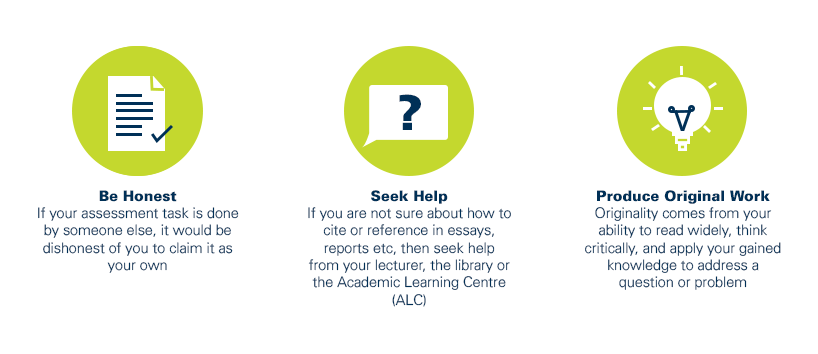
As a CQUniversity student you are expected to act honestly in all aspects of your academic work.
Any assessable work undertaken or submitted for review or assessment must be your own work. Assessable work is any type of work you do to meet the assessment requirements in the unit, including draft work submitted for review and feedback and final work to be assessed.
When you use the ideas, words or data of others in your assessment, you must thoroughly and clearly acknowledge the source of this information by using the correct referencing style for your unit. Using others’ work without proper acknowledgement may be considered a form of intellectual dishonesty.
Participating honestly, respectfully, responsibly, and fairly in your university study ensures the CQUniversity qualification you earn will be valued as a true indication of your individual academic achievement and will continue to receive the respect and recognition it deserves.
As a student, you are responsible for reading and following CQUniversity’s policies, including the Student Academic Integrity Policy and Procedure. This policy sets out CQUniversity’s expectations of you to act with integrity, examples of academic integrity breaches to avoid, the processes used to address alleged breaches of academic integrity, and potential penalties.
What is a breach of academic integrity?
A breach of academic integrity includes but is not limited to plagiarism, self-plagiarism, collusion, cheating, contract cheating, and academic misconduct. The Student Academic Integrity Policy and Procedure defines what these terms mean and gives examples.
Why is academic integrity important?
A breach of academic integrity may result in one or more penalties, including suspension or even expulsion from the University. It can also have negative implications for student visas and future enrolment at CQUniversity or elsewhere. Students who engage in contract cheating also risk being blackmailed by contract cheating services.
Where can I get assistance?
For academic advice and guidance, the Academic Learning Centre (ALC) can support you in becoming confident in completing assessments with integrity and of high standard.
What can you do to act with integrity?