Submission type to be added for all assessment tasks.
Assessment 1: Online submission
Assessment 2: Online submission
Assessment 3: Online submission
Assessment 4: Offline submission
The Assessment 3 (WIL Hours Log PASS/FAIL) Task Description has been updated to read: The purpose of this assessment task is to ensure you are meeting your Work Integrated Learning (WIL) requirements, as mandated by the World Federation of Occupational Therapy (WFOT). You will complete a WIL hours log (proforma to be provided) to record the hours you have completed across the term. All students must complete a minimum of 25 WIL hours. These hours are a combination of simulated and actual hours that are embedded within workshop activities. Meaningful engagement in the 25 WIL hours is a requirement and will be assessed through attendance, active engagement/participation in WIL activities and facilitation of feedback. Your WIL hours log must be signed off by the Unit Coordinator by assessment due date. Assessment 3 (WIL Hours Log PASS/FAIL) Criteria has been updated to read: 1. Pass: All WIL hours are attended, associated activities have been attempted and opportunity to recieve feedback was facilitated and this is documented on the WIL hours log and signed by yourself and the relevant teaching staff. 2. Iterim PO Grade: Offered for a limited time for incomplete hours: Students will recieve a message via email advising them to follow up their WIL hours log and complete it by a strict deadline (to be advised). 3. Fail: Students do not meaningfully engage in the required WIL hours evidenced by an incomplete and/or inaccurate WIL hours log document. There is no marking rubric associated with this Pass/Fail task
Overview
In this unit you will be introduced to professional reasoning, evidence based and culturally responsive practice for occupational therapy in the paediatric context from birth to middle childhood (0-12years). You will learn to adminster occupational therapy evaluations, create measurable goals and faciliate interventions for children supported by evidence based frames of reference and occupational therapy practice models. You will explore key elements of realistic occupational therapy service delivery, using case studies of children with a range of impairments and occupational profiles. You will take part in interprofessional case discussions that simulate collaboration in a paediatric allied health team. Specific paediatric skills and knowledge will be enhanced through work integrated learning within the term, during which you will gain practical experience working with children.
Details
Pre-requisites or Co-requisites
Students must have successfully completed the following Essential Prerequisites: OCCT11002 OCCT11001 PSYC11010 ALLH11001 ALLH11004 or BMSC11008 ALLH11005 or BMSC11007 ALLH11006 ALLH12007 or ALLH11009
Important note: Students enrolled in a subsequent unit who failed their pre-requisite unit, should drop the subsequent unit before the census date or within 10 working days of Fail grade notification. Students who do not drop the unit in this timeframe cannot later drop the unit without academic and financial liability. See details in the Assessment Policy and Procedure (Higher Education Coursework).
Offerings For Term 1 - 2026
Attendance Requirements
All on-campus students are expected to attend scheduled classes - in some units, these classes are identified as a mandatory (pass/fail) component and attendance is compulsory. International students, on a student visa, must maintain a full time study load and meet both attendance and academic progress requirements in each study period (satisfactory attendance for International students is defined as maintaining at least an 80% attendance record).
Recommended Student Time Commitment
Each 6-credit Undergraduate unit at CQUniversity requires an overall time commitment of an average of 12.5 hours of study per week, making a total of 150 hours for the unit.
Class Timetable
Assessment Overview
Assessment Grading
This is a graded unit: your overall grade will be calculated from the marks or grades for each assessment task, based on the relative weightings shown in the table above. You must obtain an overall mark for the unit of at least 50%, or an overall grade of 'pass' in order to pass the unit. If any 'pass/fail' tasks are shown in the table above they must also be completed successfully ('pass' grade). You must also meet any minimum mark requirements specified for a particular assessment task, as detailed in the 'assessment task' section (note that in some instances, the minimum mark for a task may be greater than 50%). Consult the University's Grades and Results Policy for more details of interim results and final grades.
All University policies are available on the CQUniversity Policy site.
You may wish to view these policies:
- Grades and Results Policy
- Assessment Policy and Procedure (Higher Education Coursework)
- Review of Grade Procedure
- Student Academic Integrity Policy and Procedure
- Academic Progression Policy and Procedure
- Student Refund and Credit Balance Policy and Procedure
- Complaints Policy and Procedure
- Information and Communications Technology Acceptable Use Policy and Procedure
This list is not an exhaustive list of all University policies. The full list of University policies are available on the CQUniversity Policy site.
Feedback, Recommendations and Responses
Every unit is reviewed for enhancement each year. At the most recent review, the following staff and student feedback items were identified and recommendations were made.
Feedback from SUTE comments
Request for additional video resources for students to access via Moodle to assist in consolidating unit content after scheduled lectures.
It is recommended that unit content is reviewed and additional learning resources are provided to meet the learning needs of all students.
Feedback from SUTE comments
Requirements of assessment tasks were unclear and associated information was difficult to locate on Moodle.
It is recommended that current assessments are reviewed for clarity and ensure expectations are made clear across learning resources, Moodle and written instruction.
- Identify key cultural, developmental and environmental factors influencing the occupational performance of infants and children
- Demonstrate professional and ethical behaviours consistent with a paediatric occupational therapy practiitioner
- Explain and demonstrate the use of allocated evaluation tools for children with specific impairments
- Create occupation-focused goals and recommendations for assigned paediatric contexts
- Apply professional reasoning to present evidence-based occupational therapy interventions for paediatric cases.
The unit overview, unit learning outcomes, and assessment pieces are aligned with requirements in the Australian Occupational Therapy Competency Standards (AOTCS, 2018). These competency standards acknowledge the diversity of roles and contexts that currently exist in occupational therapy practice.
Alignment of Assessment Tasks to Learning Outcomes
| Assessment Tasks | Learning Outcomes | ||||
|---|---|---|---|---|---|
| 1 | 2 | 3 | 4 | 5 | |
| 1 - Online Quiz(zes) - 30% | |||||
| 2 - Oral Examination - 50% | |||||
| 3 - Portfolio - 20% | |||||
| 4 - Learning logs / diaries / Journal / log books - 0% | |||||
Alignment of Graduate Attributes to Learning Outcomes
| Graduate Attributes | Learning Outcomes | ||||
|---|---|---|---|---|---|
| 1 | 2 | 3 | 4 | 5 | |
| 1 - Communication | |||||
| 2 - Problem Solving | |||||
| 3 - Critical Thinking | |||||
| 4 - Information Literacy | |||||
| 5 - Team Work | |||||
| 6 - Information Technology Competence | |||||
| 7 - Cross Cultural Competence | |||||
| 8 - Ethical practice | |||||
| 9 - Social Innovation | |||||
| 10 - First Nations Knowledges | |||||
| 11 - Aboriginal and Torres Strait Islander Cultures | |||||
Textbooks
Case Smith's Occupational Therapy for Children and Adolescents.
- Edition: 9th (2025)
- Authors: O'Brien, J. C. & Kuhaneck, H.
- Elsevier Mosby
- St. Louis St. Louis , MO , USA
- ISBN: 9780443110214
- Binding: eBook
Occupation Centred Practice with Children : A Practical Guide for Occupational Therapists
- Edition: 2nd (2017)
- Authors: Rodger, S. & Kennedy-Behr, A.
- Wiley-Blackwell
- Chichester Chichester , West Sussex , United Kingdom
- ISBN: ISBN: 978-1-119-05776-5
- Binding: eBook
Willard and Spackman's Occupational Therapy
- Edition: 14 (2024)
- Authors: Gillen, G., & Brown, C.
- Wolters Kluwer
- USA
- ISBN: 9781975174880
IT Resources
- CQUniversity Student Email
- Internet
- Unit Website (Moodle)
All submissions for this unit must use the referencing style: American Psychological Association 7th Edition (APA 7th edition)
For further information, see the Assessment Tasks.
r.reddiex@cqu.edu.au
k.l.graham@cqu.edu.au
Week 1
Begin Date: 09 Mar 2026Module/Topic
Introduction to Paediatric Occupational Therapy and Childhood Development: A focus on the first five years
Chapter
Please attend Week 1 having read the Occupational Therapy Australia. (2025). Capability Framework for Occupational Therpists working with Children, Young People and Families as this will be a guiding document throughout this unit.
Additional readings will be outlined on Moodle.
Events and Submissions/Topic
IPE Group Allocation: Students are required to allocate themselves to an IPE Meeting Time using the Moodle Choice Activity by 8:00pm AEST Friday 13/03/2026.
Week 2
Begin Date: 16 Mar 2026Module/Topic
Principles of Assessment: Children aged 0-5 years
Chapter
Readings to be outlined on Moodle.
Events and Submissions/Topic
WIL Mandatory Requirements due Monday 16/03/2026
Week 3
Begin Date: 23 Mar 2026Module/Topic
Common Conditions/Diagnoses: Recognsing atypical development in children aged 0-5 years
Chapter
Readings to be outlined on Moodle.
Events and Submissions/Topic
Week 4
Begin Date: 30 Mar 2026Module/Topic
Principles of Intervention: Children aged 0-5 years
Chapter
Readings to be outlined on Moodle.
Events and Submissions/Topic
Week 5
Begin Date: 06 Apr 2026Module/Topic
Cultural Responsiveness: Working with First Nations Children
Chapter
Readings to be outlined on Moodle.
Events and Submissions/Topic
Week 6
Begin Date: 13 Apr 2026Module/Topic
Infant Simulation Workshop
Chapter
Readings to be outlined on Moodle.
Events and Submissions/Topic
QUIZ 1 9:00am AEST: 60-minute (1 hour) duration with an additional 10-minute perusal time allowed. The quiz will cover the content (lecture, tutorial, and workshop) from Weeks 1-4 inclusive.
Infant Simulation Workshop: The infant simulation workshop will run in the allocated workshop time (12:00pm-3:00pm). Please ensure you wear clothing that allows you to move comfortably during floor-based activities (i.e., pants).
Vacation Week
Begin Date: 20 Apr 2026Module/Topic
Chapter
Events and Submissions/Topic
Week 7
Begin Date: 27 Apr 2026Module/Topic
Childhood Development: 6-12 years
Chapter
Readings to be outlined on Moodle.
Events and Submissions/Topic
Observational school visit to occur during workshop hours (12:00pm - 3:00pm). Additional details to be outlined on Moodle.
IPE Meeting #1 to occur during this week during pre-allocated group meeting time.
Week 8
Begin Date: 04 May 2026Module/Topic
Principles of Assessment: Children aged 6-12 years
Chapter
Readings to be outlined on Moodle.
Events and Submissions/Topic
Observational school visit to occur during workshop hours (12:00pm - 3:00pm). Additional details to be outlined on Moodle.
Week 9
Begin Date: 11 May 2026Module/Topic
Common Conditions/Diagnoses: Recognising atypical development in children aged 6-12 years
Chapter
Readings to be outlined on Moodle.
Events and Submissions/Topic
Observational school visit to occur during workshop hours (12:00pm - 3:00pm). Additional details to be outlined on Moodle.
IPE Meeting #2 to occur during this week during pre-allocated group meeting time.
Week 10
Begin Date: 18 May 2026Module/Topic
Principles of Intervention: Children aged 6-12 years
Chapter
Readings to be outlined on Moodle.
Events and Submissions/Topic
Guest Speaker: This week we will be joined by Dept. of Education occupational therapy staff from 9:00am - 3:00pm.
Week 11
Begin Date: 25 May 2026Module/Topic
Considering Contexts: Where paediatic occupational therapists work
Chapter
Readings to be outlined on Moodle.
Events and Submissions/Topic
QUIZ 2 9:00am AEST: 60-minute (1 hour) duration with an additional 10-minute perusal time allowed. The quiz will cover the content (lecture, tutorial, and workshop) from Weeks 7-10 inclusive.
Week 12
Begin Date: 01 Jun 2026Module/Topic
Bringing it all together in Paediatric Occupational Therapy
Chapter
Events and Submissions/Topic
WIL Hours Log Due: Week 12 Wednesday (3 June 2026) 5:00 pm AEST
Vacation/Exam Week
Begin Date: 08 Jun 2026Module/Topic
Chapter
Events and Submissions/Topic
Exam Week
Begin Date: 15 Jun 2026Module/Topic
Chapter
Events and Submissions/Topic
1 Online Quiz(zes)
To complete this assessment, you will undertake two in-class online quizzes.
Quiz 1: 60-minute (1 hour) duration with an additional 10-minute perusal time allowed. The quiz will occur in Week 6 and cover the content (lecture, tutorial, and workshop) from Weeks 1-4 inclusive.
Quiz 2: 60-minute (1 hour) duration with an additional 10-minute persual time allowed. The quiz will occur in Week 11 and cover the content (lecture, tutorial, and workshop) from Weeks 7-10 inclusive.
The in-class quizzes are closed book assessments which will be supervised by a CQUniversity staff member and must be completed at the scheduled time on your respective campus (Bundaberg or Rockhampton). Access to all resources other than your internet enabled device is prohibited (e.g., books, notes, phones, etc) and only one internet browsing tab (i.e., the Moodle quiz tab) is permitted to be open during the quiz. The in-class online quizzes will consist of a variety of question types, including multiple choice +/- short answer questions. There will be no essay questions. All questions will be marked numerically, and an overall percentage mark awarded.
Level of GenAI use allowed: Level 1; you must not use AI at any point during the assessment. You must demonstrate your core skills and knowledge.
Please note the 72-hour grace period does not apply to this assessment item.
Quiz 1 will occur in class time in Week 6 at 9:00am AEST. Quiz 2 will occur in class time in Week 11 at 9:00am AEST. It is essential that you arrive before the scheduled start of the quiz and set up your internet capable charged laptop. Once the quiz has commenced, latecomers will not be admitted to the room.
Results for each quiz will be released once ALL students (including any with extensions) have completed the quiz(zes).
As this is a quiz with pre-defined correct responses, there is no marking rubric for this Assessment task.
No submission method provided.
- Identify key cultural, developmental and environmental factors influencing the occupational performance of infants and children
- Explain and demonstrate the use of allocated evaluation tools for children with specific impairments
- Apply professional reasoning to present evidence-based occupational therapy interventions for paediatric cases.
2 Portfolio
This assessment task is comprised of two written reflections. Your first reflective task will require you to select an intervention that you have learnt about this term (e.g., sensory integration, toileting techniques, emotional regulation) and describe what you know about it, how it will change your practice and any future learning required. Your second reflection will require you to reflect on your Term 1 Inter-professional Education (IPE) experience and supply meeting attendance records as evidence of your engagement with the learning. Reflection proformas will be provided for both reflective tasks. This assessment is designed to introduce you to the process of Continuing Professional Development that you are required to engage in for the duration of your career.
Level of GenAI use allowed: Level 2; You may use AI for planning, idea development, and research. Your final submission should show how you developed and refined these ideas.
Week 12 Thursday (4 June 2026) 5:00 pm AEST
The two written reflections need to be uploaded to Moodle by the specified due date and time.
A marked rubric with relevant feedback will be uploaded to Moodle.
This assessment will be marked according to a rubric which will be made available to students via Moodle. The marking rubric will cover key criteria including description of the event, analysis of what occured, relevance of recommendations, written communictation and evidence of learning.
No submission method provided.
- Demonstrate professional and ethical behaviours consistent with a paediatric occupational therapy practiitioner
- Create occupation-focused goals and recommendations for assigned paediatric contexts
3 Learning logs / diaries / Journal / log books
The purpose of this assessment task is to ensure you are meeting your Work Integrated Learning (WIL) requirements, as mandated by the World Federation of Occupational Therapy (WFOT).
You will complete a WIL hours log (proforma to be provided) to record the hours you have completed across the term. All students must complete a minimum of 25 WIL hours. These hours are a combination of simulated and actual hours that are embedded within workshop activities. Your hours must be signed off by the Unit Coordinator by assessment due date.
Important Note: To ensure you can participate in the off-campus WIL experiences you must upload all evidence to SONIA online as per the 'Mandatory Checks Guide: Occupational Therapy (Honours)' document. This evidence is due by Week 2, Term 1, 2026. This requirement is monitored by the WIL team (wil-hmas@cqu.edu.au). Failure to complete the mandatory checks will compromise your ability to complete and pass the unit.
Level of GenAI use allowed: Level 1; You must not use AI at any point during the assessment. You must demonstrate your core skills and knowledge.
Week 12 Wednesday (3 June 2026) 5:00 pm AEST
Signed WIL log to be uploaded to Moodle by due date 5:00pm AEST Wednesday 03/06/2026
Vacation/Exam Week Wednesday (17 June 2026)
Results will be returned via Moodle
No submission method provided.
- Demonstrate professional and ethical behaviours consistent with a paediatric occupational therapy practiitioner
4 Oral Examination
This assessment is an oral examination in which you will demonstrate your professional reasoning skills and clinical communication skills as they relate specifically to interpreting sensory assessment data. This will occur as an individual assessment and will be for a duration of 15 minutes (with an additional 5 minutes of persual time at the beginning). It will be conducted by via Zoom and will be recorded for the purposes of assessment moderation. Please set aside 25 minutes for this assessment as per the schedule which will be made available on Moodle by the end of Week 3, Term 1.
All oral examinations will occur during Week 13, Term 1.
In this oral examination, you will demonstrate your working knowledge of the Occupational Therapy Australia Working with Children Capability Framework 2025 and professional reasoning skills. Sample case scenarios with relevant questions will be supplied on the Moodle platform throughout the term to consolidate lecture content and will scaffold your learning and prepare you. You are encouraged to fully engage with these learning opportunities.
Levell of GenAI use allowed: Level 1; You must not use AI at any point during the assessment. You must demonstrate your core skills and knowledge.
Please note the 72-hour grace period does not apply to this assessment item.
Exam Week Wednesday (10 June 2026) 8:00 am AEST
You will be provided with your scheduled oral examination time in Week 3 of Term. Your oral examination will be scheduled between the hours of 8:00am-5:00pm. The 72-hour grace period does not apply for this assessment.
Oral Examination results will be uploaded to Moodle by 5:00pm Friday 26/06/2026
This assessment will be marked according to a rubric which will be made available to students via Moodle. The marking rubric will cover key criteria including clinical knowledge application, clinical/professional reasoning, client-centred approach and verbal commuication skills.
No submission method provided.
- Identify key cultural, developmental and environmental factors influencing the occupational performance of infants and children
- Explain and demonstrate the use of allocated evaluation tools for children with specific impairments
- Create occupation-focused goals and recommendations for assigned paediatric contexts
- Apply professional reasoning to present evidence-based occupational therapy interventions for paediatric cases.
As a CQUniversity student you are expected to act honestly in all aspects of your academic work.
Any assessable work undertaken or submitted for review or assessment must be your own work. Assessable work is any type of work you do to meet the assessment requirements in the unit, including draft work submitted for review and feedback and final work to be assessed.
When you use the ideas, words or data of others in your assessment, you must thoroughly and clearly acknowledge the source of this information by using the correct referencing style for your unit. Using others’ work without proper acknowledgement may be considered a form of intellectual dishonesty.
Participating honestly, respectfully, responsibly, and fairly in your university study ensures the CQUniversity qualification you earn will be valued as a true indication of your individual academic achievement and will continue to receive the respect and recognition it deserves.
As a student, you are responsible for reading and following CQUniversity’s policies, including the Student Academic Integrity Policy and Procedure. This policy sets out CQUniversity’s expectations of you to act with integrity, examples of academic integrity breaches to avoid, the processes used to address alleged breaches of academic integrity, and potential penalties.
What is a breach of academic integrity?
A breach of academic integrity includes but is not limited to plagiarism, self-plagiarism, collusion, cheating, contract cheating, and academic misconduct. The Student Academic Integrity Policy and Procedure defines what these terms mean and gives examples.
Why is academic integrity important?
A breach of academic integrity may result in one or more penalties, including suspension or even expulsion from the University. It can also have negative implications for student visas and future enrolment at CQUniversity or elsewhere. Students who engage in contract cheating also risk being blackmailed by contract cheating services.
Where can I get assistance?
For academic advice and guidance, the Academic Learning Centre (ALC) can support you in becoming confident in completing assessments with integrity and of high standard.
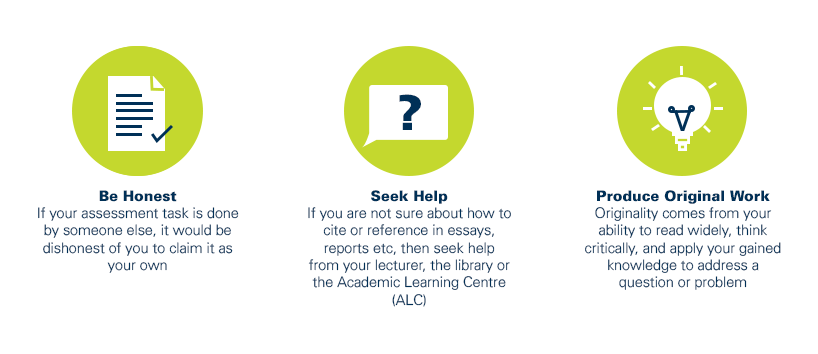
What can you do to act with integrity?