Overview
This unit builds upon the foundation knowledge and practice experience you have built throughout the occupational therapy course. The focus of this unit is to equip you to undertake autonomous, evidence-based practice as a new graduate in regional Australia. It is comprised of various modules which will advance your professional skills for independent practice. Each module will be offered in semi-block mode to enable immersion in a specialised area of clinical practice. The range of modules will be subject to resources including availability of experts to contribute. Depending on the number and scope of modules offered, there may be some choice in which modules you undertake. However, a compulsory module will focus on research and evidence-based practice in occupational therapy, and you will work on a research project that follows on from the Evidence Review you undertook in OCCT13008, and then further developed in OCCT14006.
Details
Pre-requisites or Co-requisites
Prerequisites: OCCT13008 (or OCC13005 and OCCT13006)
Important note: Students enrolled in a subsequent unit who failed their pre-requisite unit, should drop the subsequent unit before the census date or within 10 working days of Fail grade notification. Students who do not drop the unit in this timeframe cannot later drop the unit without academic and financial liability. See details in the Assessment Policy and Procedure (Higher Education Coursework).
Offerings For Term 2 - 2021
Attendance Requirements
All on-campus students are expected to attend scheduled classes - in some units, these classes are identified as a mandatory (pass/fail) component and attendance is compulsory. International students, on a student visa, must maintain a full time study load and meet both attendance and academic progress requirements in each study period (satisfactory attendance for International students is defined as maintaining at least an 80% attendance record).
Recommended Student Time Commitment
Each 6-credit Undergraduate unit at CQUniversity requires an overall time commitment of an average of 12.5 hours of study per week, making a total of 150 hours for the unit.
Class Timetable
Assessment Overview
Assessment Grading
This is a graded unit: your overall grade will be calculated from the marks or grades for each assessment task, based on the relative weightings shown in the table above. You must obtain an overall mark for the unit of at least 50%, or an overall grade of 'pass' in order to pass the unit. If any 'pass/fail' tasks are shown in the table above they must also be completed successfully ('pass' grade). You must also meet any minimum mark requirements specified for a particular assessment task, as detailed in the 'assessment task' section (note that in some instances, the minimum mark for a task may be greater than 50%). Consult the University's Grades and Results Policy for more details of interim results and final grades.
All University policies are available on the CQUniversity Policy site.
You may wish to view these policies:
- Grades and Results Policy
- Assessment Policy and Procedure (Higher Education Coursework)
- Review of Grade Procedure
- Student Academic Integrity Policy and Procedure
- Monitoring Academic Progress (MAP) Policy and Procedure - Domestic Students
- Monitoring Academic Progress (MAP) Policy and Procedure - International Students
- Student Refund and Credit Balance Policy and Procedure
- Student Feedback - Compliments and Complaints Policy and Procedure
- Information and Communications Technology Acceptable Use Policy and Procedure
This list is not an exhaustive list of all University policies. The full list of University policies are available on the CQUniversity Policy site.
Feedback, Recommendations and Responses
Every unit is reviewed for enhancement each year. At the most recent review, the following staff and student feedback items were identified and recommendations were made.
Feedback from Have Your Say
Students highly valued the knowledge and resources they gained from the specialist intensive modules.
It is recommended that we continue to provide specialist intensive modules in the final term of the CB84 course to support student readiness for professional practice.
Feedback from Have Your Say; occupational therapy team reflections and discussions
It is possible that requiring students to propose an RCT research protocol is represents an unrealistically high expectation at this undergraduate honours level. Students requested a review of the research content taught throughout the CB84 course to ensure that expectations in this unit reasonably reflect prior student learning and that additional classes are provided for new content e.g., sample size calculations.
A full review of research teaching is underway, with CB84 transitioning to the ALLH honours research units, commencing for 3rd year students in Term 2 2022. This means that OCCT14002 will be offered in its present format on only two more occasions. It is recommended that, for these offerings, extra classes be added to the Research Module for OCCT14002 to accommodate the content that students reported to be challenging.
- Develop client-centered, evidence-based intervention plans for clients in specialty areas
- Prepare research plans (including protocols and ethics applications) for projects that provide evidence to improve occupational therapy practice in specialist areas
- Communicate evidence orally to a wide range of stakeholders to improve occupational therapy practice in emerging or specialist areas.
Per NPC1301
Alignment of Assessment Tasks to Learning Outcomes
| Assessment Tasks | Learning Outcomes | ||
|---|---|---|---|
| 1 | 2 | 3 | |
| 1 - Research Proposal - 50% | |||
| 2 - Written Assessment - 30% | |||
| 3 - Presentation - 20% | |||
| 4 - Case Study - 0% | |||
Alignment of Graduate Attributes to Learning Outcomes
| Graduate Attributes | Learning Outcomes | ||
|---|---|---|---|
| 1 | 2 | 3 | |
| 1 - Communication | |||
| 2 - Problem Solving | |||
| 3 - Critical Thinking | |||
| 4 - Information Literacy | |||
| 5 - Team Work | |||
| 6 - Information Technology Competence | |||
| 7 - Cross Cultural Competence | |||
| 8 - Ethical practice | |||
| 9 - Social Innovation | |||
| 10 - First Nations Knowledges | |||
| 11 - Aboriginal and Torres Strait Islander Cultures | |||
Textbooks
Evidence-Based Practice Across the Health Professions
- Edition: 3rd ed (2017)
- Authors: Tammy Hoffman, Sally Bennett, Chris Del Mar
- Elsevier
- ISBN: 9780729542555
- Binding: Paperback
An occupational therapist’s guide to home modification practice.
- Edition: 2nd (2018)
- Authors: Ainsworth, E., & de Jonge, D.
- SLACK Inc.
- Thorofare Thorofare , NJ , USA
- Binding: Paperback
Introduction to Research: Understanding and applying multiple strategies
- Edition: 5th ed (2016)
- Authors: DePoy, E., & Gitlin, L.N.
- Elsevier
- New York New York , New York , USA
- Binding: Paperback
Pain: A textbook for health professionals
- Edition: 2nd ed. (2014)
- Authors: Van Griensven, H., Strong, J., & Unruh, A.M.
- Churchill Livingstone Elsevier
- Edinburgh Edinburgh , Scotland
- Binding: Paperback
Additional Textbook Information
Both paper and eBook versions of the prescribed text can be purchased at the CQUni Bookshop here: http://bookshop.cqu.edu.au (search on the Unit code).
The supplementary texts are paper only.
IT Resources
- CQUniversity Student Email
- Internet
- Unit Website (Moodle)
- Microsoft office suite
- PowerPoint
- Zoom
- Adobe Acrobat Reader (or similar) software for viewing PDF documents.
- Pdf creator/scanner
All submissions for this unit must use the referencing style: American Psychological Association 7th Edition (APA 7th edition)
For further information, see the Assessment Tasks.
m.oreilly@cqu.edu.au
Week 1
Begin Date: 12 Jul 2021Module/Topic
Research & EBP Module 1
- Writing a research proposal
- Conducting ethical research
Chapter
O'Leary, Z. (2017). The Essential Guide to doing your research project (3rd ed). Thousand Oaks CA: Sage. Chapter 3.
DePoy, E., & Gitlin, L.N. (2016). Introduction to Research: Understanding and applying multiple strategies (5th ed). New York: Elsevier.
Portney, L., & Watkins, M. (2015). Asking the research questions (pp. 121-138) and Writing a Research Proposal (pp. 759-770). In Foundations of clinical research (3rd ed.) Upper Saddle River, NJ: Prentice-Hall Inc.
Talbot, L.., & Verrinder, G. (2008). Turn a stack of papers into a literature review: Useful tools for beginners. Focus on Health Professional Education: A Multidisciplinary Journal, 10(1), 51.
Events and Submissions/Topic
Week 2
Begin Date: 19 Jul 2021Module/Topic
Research & EBP Module 2
- Presenting your research
- Group meetings
Chapter
Portney, L., & Watkins, M. (2015). Ethical issues in Clinical Research. In Foundations of clinical research (3rd ed.) (pp. 47-60). Upper Saddle River, NJ: Prentice-Hall Inc.
Fitzgerald, M.H., Phillips, P.A., & Yule, E. (2006). The research ethics review process and ethics review narratives. Ethics & Behavior, 16(4), 377-395.
DePoy, E., & Gitlin, L.N. (2015). Research Ethics. In Introduction to research: Understanding and applying multiple strategies. Elsevier Health Sciences.
Events and Submissions/Topic
Meeting schedule to be posted on Moodle
Week 3
Begin Date: 26 Jul 2021Module/Topic
Research & EBP Module 3
- Q&A
- Group meetings with Maria
Chapter
Events and Submissions/Topic
Meeting schedule to be posted on Moodle
Week 4
Begin Date: 02 Aug 2021Module/Topic
Advanced Home Modifications Module 1
Chapter
Ainsworth, E., & de Jonge, D. (2nd ed) (2018). An occupational therapist’s guide to home modification practice. Thorofare, NJ: SLACK Inc. (Specific chapters will be nominated on Moodle.)
Parts of the following documents as loaded onto Moodle:
- Standards Australia. (2009). AS1428.1. Design for access and mobility – General requirements for access – New building work.
- Standards Australia. (1995). AS4299 – Adaptable Housing.
- Standards Australia. (1992). AS1428.2. Design for access and mobility – Enhanced and additional requirements – Buildings and facilities.
Events and Submissions/Topic
Week 5
Begin Date: 09 Aug 2021Module/Topic
Advanced Home Modifications Module 2
Chapter
As for Week 4
Events and Submissions/Topic
Home modifications quiz at end of Home Modifications Module.
Vacation Week
Begin Date: 16 Aug 2021Module/Topic
No classes
Chapter
Events and Submissions/Topic
Week 6
Begin Date: 23 Aug 2021Module/Topic
Research & EBP Module 4
- Group sessions
- Q&A
Chapter
See Weeks 1 and 2
Events and Submissions/Topic
Meeting schedule to be posted on Moodle
Week 7
Begin Date: 30 Aug 2021Module/Topic
Pain Module 1
Chapter
Scanlan, J.N., & Novak, T. (2015). Sensory approaches in mental health: A scoping review. Australian Occupational Therapy Journal, 62, 277-285.
Czyzewski et al. (2016). Maintenance of pain in children with functional abdominal pain. Journal of Pediatric Gastroenterolgy & Nutrition, 62, 393-398.
Van Griensven, H., Strong, J., & Unruh, A.M. (2014). Pain: A textbook for health professionals (2nd ed.). Churchill Livingstone Elsevier, Edinburgh. (Textbook in OT storerooms):
Chapter 1- Introduction to pain pp. 1-8
Chapter 6- Neurophysiology of pain pp. 77-90
Chapter 7- Assessing pain pp. 91-114.
Events and Submissions/Topic
Week 8
Begin Date: 06 Sep 2021Module/Topic
Dementia Module 1
Chapter
A full reading list is available on Moodle.
Events and Submissions/Topic
Week 9
Begin Date: 13 Sep 2021Module/Topic
Pain Module 2
Chapter
See additional readings on Moodle.
Events and Submissions/Topic
Pain quiz at end of Pain Module.
Week 10
Begin Date: 20 Sep 2021Module/Topic
Dementia Module 2
Chapter
See additional readings on Moodle.
Events and Submissions/Topic
Dementia quiz at end of Dementia Module.
Ethics Application Due: Week 10 Monday (20 Sept 2021) 5:00 am AEST
Week 11
Begin Date: 27 Sep 2021Module/Topic
No classes - Focus on developing presentation
Chapter
Events and Submissions/Topic
Draft of the PowerPoint slides for conference presentation due midnight Friday 1st October.
Week 12
Begin Date: 04 Oct 2021Module/Topic
Research & EBP Module
- Feedback provided on PowerPoint and further research discussions (group meetings).
Chapter
Events and Submissions/Topic
Meeting schedule to be posted on Moodle
Review/Exam Week
Begin Date: 11 Oct 2021Module/Topic
Conference Day
Chapter
Events and Submissions/Topic
PowerPoint presentation slides due before 9.00 am on the day of the Conference.
20% Conference Presentation to take place at the scheduled time during the conference, anticipated to be on Friday 15th October.
Conference Presentation Due: Review/Exam Week Friday (15 Oct 2021) 9:00 am AEST
This unit will be delivered via a combination of on-campus classes, online classes, and small group meetings via Zoom.
Use Moodle to stay up to date with weekly information.
1 Research Proposal
This assignment involves developing a detailed research proposal (or protocol) for your research project. A protocol is detailed plan for your research project, including a research question and details of the objectives, research design, methodology, and budget to be used. A Research Proposal Template is provided to support development of your protocol. The grades are allocated for the following components:
| STATEMENT OF THE RESEARCH PROBLEM [5 marks] |
| STATEMENT OF THE PURPOSE OF THE STUDY [5 marks] |
| DEFINITION OF KEY TERMS [2.5 marks] |
| LITERATURE REVIEW [25 marks] |
| METHODS Section [30 marks] (see below) |
| Statement of design |
| Subjects |
| Instruments/Materials |
| Procedure |
| Data man/analysis |
| Timeline |
| Budget |
| Budget Justification |
| SCOPE AND LIMITATIONS [5 marks] |
| SIGNIFICANCE AND CONTRIBUTION TO KNOWLEDGE [10 marks] |
| PRESENTATION AND REFERENCES [7.5 marks] |
| INDIVIDUAL REFLECTION [10 marks] |
Week 7 Monday (30 Aug 2021) 5:00 am AEST
Submit in Word document via Moodle
Week 9 Monday (13 Sept 2021)
A detailed marking rubric is provided in Moodle. The assignment is graded out of 100 marks, and is worth 50% of the grade for this Unit. While completed as a assignment in pairs, 10 marks (5%) are allocated to individual reflections.
- Develop client-centered, evidence-based intervention plans for clients in specialty areas
- Prepare research plans (including protocols and ethics applications) for projects that provide evidence to improve occupational therapy practice in specialist areas
- Communication
- Problem Solving
- Critical Thinking
- Information Literacy
- Team Work
- Ethical practice
2 Written Assessment
This assignment involves completion of an ethics application that relates to your research proposal. A template will be provided. The application is completed in pairs and must be passed (minimum 50%) to complete the Unit.
Week 10 Monday (20 Sept 2021) 5:00 am AEST
Submit through Moodle.
Week 12 Monday (4 Oct 2021)
A detailed marking rubric is available on Moodle. The assignment is marked out of 30 and is worth 30% of the marks for the Unit in the following sections:
Researchers (0.5 marks)
Project Details (11 marks)
Funding and Finance (1 mark)
Other Approvals (1 mark)
Recruitment of Participants (4 marks)
Consent (6 marks)
Information protection (4 marks)
Dissemination of Results (2 marks)
Declarations (0.5 marks)
- Prepare research plans (including protocols and ethics applications) for projects that provide evidence to improve occupational therapy practice in specialist areas
- Communication
- Team Work
- Ethical practice
3 Presentation
In your research project team you will develop and deliver a conference presentation on the topic of your research project to a group of your student peers and professional partners during the graduate student conference. You must pass this component of the Unit to pass the Unit overall.
Review/Exam Week Friday (15 Oct 2021) 9:00 am AEST
The PowerPoint file should be submitted through Moodle before the conference commences.
Results will be released to students upon certification of grades
The presentation will be graded out of 20% using the following criteria:
| Overall Structure and content of presentation [6 marks] |
| Presentation quality [4 marks] |
| Questions (N.B. Individual mark)[4 marks] |
| Presentation Style (N.B. Individual mark) [6 marks] |
- Communicate evidence orally to a wide range of stakeholders to improve occupational therapy practice in emerging or specialist areas.
- Communication
- Critical Thinking
- Team Work
- Information Technology Competence
4 Case Study
Each of the three (3) specialist modules will be examined using a different case study. This will occur on the final day of each module. Approximately five (5) short answer questions will relate to the content taught in the module, and each of the case studies will be graded out of five (5) marks. You must obtain 7.5 out of 15 marks (50%) overall to obtain a passing mark for this pass/fail assessment piece.
No Assessment Criteria
- Develop client-centered, evidence-based intervention plans for clients in specialty areas
- Communication
- Problem Solving
- Critical Thinking
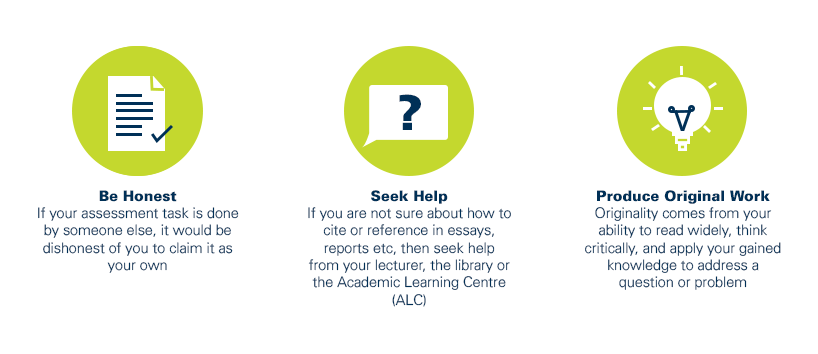
As a CQUniversity student you are expected to act honestly in all aspects of your academic work.
Any assessable work undertaken or submitted for review or assessment must be your own work. Assessable work is any type of work you do to meet the assessment requirements in the unit, including draft work submitted for review and feedback and final work to be assessed.
When you use the ideas, words or data of others in your assessment, you must thoroughly and clearly acknowledge the source of this information by using the correct referencing style for your unit. Using others’ work without proper acknowledgement may be considered a form of intellectual dishonesty.
Participating honestly, respectfully, responsibly, and fairly in your university study ensures the CQUniversity qualification you earn will be valued as a true indication of your individual academic achievement and will continue to receive the respect and recognition it deserves.
As a student, you are responsible for reading and following CQUniversity’s policies, including the Student Academic Integrity Policy and Procedure. This policy sets out CQUniversity’s expectations of you to act with integrity, examples of academic integrity breaches to avoid, the processes used to address alleged breaches of academic integrity, and potential penalties.
What is a breach of academic integrity?
A breach of academic integrity includes but is not limited to plagiarism, self-plagiarism, collusion, cheating, contract cheating, and academic misconduct. The Student Academic Integrity Policy and Procedure defines what these terms mean and gives examples.
Why is academic integrity important?
A breach of academic integrity may result in one or more penalties, including suspension or even expulsion from the University. It can also have negative implications for student visas and future enrolment at CQUniversity or elsewhere. Students who engage in contract cheating also risk being blackmailed by contract cheating services.
Where can I get assistance?
For academic advice and guidance, the Academic Learning Centre (ALC) can support you in becoming confident in completing assessments with integrity and of high standard.
What can you do to act with integrity?