Overview
How might we enable people to improve their health? Moving on from an individual focus towards a more systems-based approach requires innovation in health promotion. Human-centered design thinking (HCDT) is used in public health to embed innovation and shift inquiry towards an empowering process of solution-finding. The focus is on introducing you to the core functions of health promotion and innovation. In the first half of the term, you should be able to analyse how a HCDT lens impacts public health policy, supportive environments, and community action. In the second half of the term, you should be able to apply HCDT tools to identify problems and define solutions. You should emerge from this unit with the confidence to approach a diversity of public health challenges.
Details
Pre-requisites or Co-requisites
There are no requisites for this unit.
Important note: Students enrolled in a subsequent unit who failed their pre-requisite unit, should drop the subsequent unit before the census date or within 10 working days of Fail grade notification. Students who do not drop the unit in this timeframe cannot later drop the unit without academic and financial liability. See details in the Assessment Policy and Procedure (Higher Education Coursework).
Offerings For Term 2 - 2026
Attendance Requirements
All on-campus students are expected to attend scheduled classes - in some units, these classes are identified as a mandatory (pass/fail) component and attendance is compulsory. International students, on a student visa, must maintain a full time study load and meet both attendance and academic progress requirements in each study period (satisfactory attendance for International students is defined as maintaining at least an 80% attendance record).
Recommended Student Time Commitment
Each 6-credit Postgraduate unit at CQUniversity requires an overall time commitment of an average of 12.5 hours of study per week, making a total of 150 hours for the unit.
Class Timetable
Assessment Overview
Assessment Grading
This is a graded unit: your overall grade will be calculated from the marks or grades for each assessment task, based on the relative weightings shown in the table above. You must obtain an overall mark for the unit of at least 50%, or an overall grade of 'pass' in order to pass the unit. If any 'pass/fail' tasks are shown in the table above they must also be completed successfully ('pass' grade). You must also meet any minimum mark requirements specified for a particular assessment task, as detailed in the 'assessment task' section (note that in some instances, the minimum mark for a task may be greater than 50%). Consult the University's Grades and Results Policy for more details of interim results and final grades.
All University policies are available on the CQUniversity Policy site.
You may wish to view these policies:
- Grades and Results Policy
- Assessment Policy and Procedure (Higher Education Coursework)
- Review of Grade Procedure
- Student Academic Integrity Policy and Procedure
- Academic Progression Policy and Procedure
- Student Refund and Credit Balance Policy and Procedure
- Complaints Policy and Procedure
- Information and Communications Technology Acceptable Use Policy and Procedure
This list is not an exhaustive list of all University policies. The full list of University policies are available on the CQUniversity Policy site.
Feedback, Recommendations and Responses
Every unit is reviewed for enhancement each year. At the most recent review, the following staff and student feedback items were identified and recommendations were made.
Feedback from SUTE Unit Comments Report
Students appreciated the guest lecture at the end of the term, which included a guest speaker discussing what social innovation and health look like in practice and how to position oneself to apply for such roles after their studies.
Continue to invite guest speakers to showcase to students what the learning concepts look like when applied in the real world.
Feedback from SUTE Unit Comments Report
Students felt the lecturers were approachable, created a positive learning environment, explained everything well and clearly, and provided helpful feedback.
Continue to explain concepts clearly using explicit teaching practices and providing examples, whilst being approachable and responsive to student queries. Continue to foster a safe and welcoming learning environment, provide useful feedback, respond promptly to students' emails, and offer accessible meeting hours for student consultations.
Feedback from SUTE Teacher Evaluations Report
Students expressed that they would like to have more examples or elaboration of concepts provided.
Include additional real-world examples and expand upon learning concepts in greater detail in the content delivery and in the learning resources and materials.
Feedback from SUTE Teacher Evaluations Report
Students noted that they would like to be asked further questions to make them think more critically.
Provide further opportunities in tutorials for greater critical discussion, with collaborative question and answer dialogue to get students thinking more deeply about the unit content.
- Critique the challenges of addressing the action areas of the Ottawa Charter for Health Promotion
- Synthesise health promotion and innovation concepts to critically discuss contemporary public health problems
- Interpret and apply human-centred design thinking skills to creatively define problems and generate meaningful solutions appropriate to public health practice
- Reflect on your own strengths-based approach to public health innovation.
N/A
Alignment of Assessment Tasks to Learning Outcomes
| Assessment Tasks | Learning Outcomes | |||
|---|---|---|---|---|
| 1 | 2 | 3 | 4 | |
| 1 - Written Assessment - 40% | ||||
| 2 - Group Work - 60% | ||||
Alignment of Graduate Attributes to Learning Outcomes
| Graduate Attributes | Learning Outcomes | |||
|---|---|---|---|---|
| 1 | 2 | 3 | 4 | |
| 1 - Knowledge | ||||
| 2 - Communication | ||||
| 3 - Cognitive, technical and creative skills | ||||
| 4 - Research | ||||
| 5 - Self-management | ||||
| 6 - Ethical and Professional Responsibility | ||||
| 7 - Leadership | ||||
| 8 - First Nations Knowledges | ||||
| 9 - Aboriginal and Torres Strait Islander Cultures | ||||
Textbooks
There are no required textbooks.
IT Resources
- CQUniversity Student Email
- Internet
- Unit Website (Moodle)
- Microsoft Powerpoint
- Microsoft Word
- Miro
All submissions for this unit must use the referencing style: American Psychological Association 7th Edition (APA 7th edition)
For further information, see the Assessment Tasks.
e.rivera@cqu.edu.au
Week 1
Begin Date: 13 Jul 2026Module/Topic
Introduction to Health Promotion, Social Innovation and Human-Centred Design Thinking
Chapter
Readings available on the Moodle site via the e-Reading list
Events and Submissions/Topic
Week 2
Begin Date: 20 Jul 2026Module/Topic
Critiquing Health Promotion Challenges and Introducing Health Communication Campaigns
Chapter
Readings available on the Moodle site via the e-Reading list
Events and Submissions/Topic
Week 3
Begin Date: 27 Jul 2026Module/Topic
Part 1- Getting Started with Creating a Health Communication Campaign
Part 2- Situation Analysis
Part 3- Partners/Stakeholders/Gatekeepers
Chapter
Readings available on the Moodle site via the e-Reading list
Events and Submissions/Topic
Week 4
Begin Date: 03 Aug 2026Module/Topic
Audience Analysis: Determining the Campaign Audience
Chapter
Readings available on the Moodle site via the e-Reading list
Events and Submissions/Topic
Week 5
Begin Date: 10 Aug 2026Module/Topic
Selecting Campaign and Communication Goals and Objectives
Chapter
Readings available on the Moodle site via the e-Reading list
Events and Submissions/Topic
Week 6
Begin Date: 17 Aug 2026Module/Topic
Health Communication Strategies: Individual, Interpersonal and Group-Level
Chapter
Readings available on the Moodle site via the e-Reading list
Events and Submissions/Topic
Vacation Week
Begin Date: 24 Aug 2026Module/Topic
Chapter
Events and Submissions/Topic
Week 7
Begin Date: 31 Aug 2026Module/Topic
Health Communication Strategies: Social Media and Mass Media
Chapter
Readings available on the Moodle site via the e-Reading list
Events and Submissions/Topic
Week 8
Begin Date: 07 Sep 2026Module/Topic
Cross-level Health Communication Strategies and Selecting Activities and Channels
Chapter
Readings available on the Moodle site via the e-Reading list
Events and Submissions/Topic
Week 9
Begin Date: 14 Sep 2026Module/Topic
Communicating Public Health Data and Crafting Campaign Messages
Chapter
Readings available on the Moodle site via the e-Reading list
Events and Submissions/Topic
Week 10
Begin Date: 21 Sep 2026Module/Topic
Implementing a Health Communication Campaign
Chapter
Readings available on the Moodle site via the e-Reading list
Events and Submissions/Topic
Week 11
Begin Date: 28 Sep 2026Module/Topic
Evaluating a Health Communication Campaign
Chapter
Readings available on the Moodle site via the e-Reading list
Events and Submissions/Topic
Week 12
Begin Date: 05 Oct 2026Module/Topic
Social Innovation and Health Promotion Moving Forward – How Do You Put These into Practice?
Chapter
Readings available on the Moodle site via the e-Reading list
Events and Submissions/Topic
Exam Week
Begin Date: 12 Oct 2026Module/Topic
Chapter
Events and Submissions/Topic
Vacation/Exam Week
Begin Date: 19 Oct 2026Module/Topic
Chapter
Events and Submissions/Topic
1 Written Assessment
This task is a written assignment of about 1,750 words that you will complete INDIVIDUALLY. It should be written in a formal structure that follows postgraduate level academic writing conventions, including both in-text citations and a detailed reference list of high-quality peer-reviewed evidence.
For this assessment, you will need to critique and analyse one health communication campaign. From the list below, you must select ONE campaign to focus your assessment on. For each option, you will see that there are resources that provide context about what the campaign involves and is about. You can use these resources to support your critique. In addition, you should be using additional high-quality, relevant and peer-reviewed academic literature to support your analysis of the health communication campaign.
Campaign Options:
Option 1: Make Healthy Normal Campaign
See resources about this campaign on Moodle.
Option 2: Know Your Lemons Campaign
See resources about this campaign on Moodle.
Option 3: Shisha No Thanks Campaign
See resources about this campaign on Moodle.
Option 4: Find Thirty Every day
See resources about this campaign on Moodle.
Option 5: Every Mind Matters Campaign
See resources about this campaign on Moodle.
This assessment consists of 5 PARTS.
Part 1: Critique of health promotion action area challenges facing the campaign
The first part involves critiquing the challenges of addressing the action areas of the Ottawa Charter (e.g., strengthening community action, creating supportive environments, building healthy public policy, reorienting health services, developing personal skills) for the campaign that you selected. When critiquing the challenges, you are required to use content from the following article to support your critique: Fry D, Zask A. Applying the Ottawa Charter to inform health promotion programme design. Health Promot Int. 2017 Oct 1;32(5):901-912. doi: 10.1093/heapro/daw022. This article will assist you with the points of critique that you put forth. This article is available in the e-reading list for Week 2.
Additionally, you should utilise unit material and other relevant evidence from high-quality academic sources to critique the challenges with addressing the Ottawa Charter’s five action areas in the campaign that you selected for this assessment. To guide you with the critique, the questions you should answer (in paragraph form) are:
· What are the challenges the campaign faces with addressing the action area ‘strengthening community action’?
· What are the challenges the campaign faces with addressing the action area ‘creating supportive environments’?
· What are the challenges the campaign faces with addressing the action area ‘building healthy public policy’?
· What are the challenges the campaign faces with addressing the action area ‘reorienting health services’?
· What are the challenges the campaign faces with addressing the action area ‘developing personal skills’?
· What action areas of the Ottawa Charter are addressed or not addressed by the campaign?
· According to the Fry & Zask (2017) article, how well does the campaign address the five action areas of the Ottawa Charter and how could it be changed to better overcome the challenges of targeting the action areas?
· How could the campaign be improved to better address the five action areas of the Ottawa Charter?
Note: there are several questions here to guide your response to Part 1. You are expected to cohesively and concisely discuss such questions in paragraph form. These questions should not be headings. This part should be written in paragraph form (not bullet points with responses to each question).
Part 2: Synthesis of social innovation concepts
In the second part of this assignment, you should critically discuss the utility and application of social innovation concepts to your selected health communication campaign. Here, you should synthesise innovation concepts to discuss how they could help address the campaign’s challenges with addressing the action areas of the Ottawa Charter that you identified in part one. Additionally, you should discuss how well the campaign is or is not guided by social innovation concepts. If the campaign does not mention the use of social innovation, then assume that it was not applied.
This section should answer the following questions:
· What principles or concepts of social innovation could have been applied to this campaign to enhance it and what are examples of how these principles and concepts could have been used in the campaign?
· How would this campaign benefit from social innovation concepts to overcome challenges with targeting the action areas of the Ottawa Charter? Provide specific examples.
Unit material and other relevant evidence from high-quality academic sources should be used to write this part. An article that you must use to support your writing in this section is as follows (on e-reading list too): Tucker JD, Manderson L, Amazigo U, et alSocial innovation in health: concepts and practice. BMJ Innovations 2022;8:133-136. https://innovations.bmj.com/content/bmjinnov/8/3/133.full.pdf
Note: there are several questions here to guide your response to Part 2. You are expected to cohesively and concisely discuss such questions in paragraph form. These questions should not be headings. This part should be written in paragraph form (not bullet points with responses to each question).
Part 3: Synthesis of health promotion concepts
In the third part of this assignment, you should synthesise health promotion concepts to critically discuss the challenges facing the selected health communication campaign with respect to targeting action areas of the Ottawa Charter. In your critical discussion, you should also discuss how well the selected health communication campaign is guided by the use of key principles and concepts of health promotion. Here you should answer the following questions:
· How well did the campaign draw on health promotion principles and concepts?
· What could the campaign have done better and what additional principles or concepts should have been used for “best practice” health promotion?
· What are ways that the campaign could better utilise health promotion concepts to strengthen and maximise its potential impact?
· How well did the campaign address the social determinants of health and the levels of the socio-ecological model, and how could it have been done better?”
An article that you must use to support your writing in this section is as follows (on e-reading list too): Suzanne F. Jackson, Fran Perkins, Erika Khandor, Lauren Cordwell, Stephen Hamann, Supakorn Buasai, Integrated health promotion strategies: a contribution to tackling current and future health challenges, Health Promotion International, Volume 21, Issue suppl_1, December 2006, Pages 75–83, https://doi.org/10.1093/heapro/dal054
Unit material and other relevant evidence from high-quality academic sources should be used to write this part.
Note: there are several questions here to guide your response to Part 3. You are expected to cohesively and concisely discuss such questions in paragraph form. These questions should not be headings. This part should be written in paragraph form (not bullet points with responses to each question).
Part 4: Interpretation and application of human-centred design thinking concepts
In the fourth part of this assessment, interpret human-centred design thinking concepts to critically discuss how they could have been applied to help strengthen the health communication campaign. You should address the following questions in your answer:
· How would this campaign benefit from using human-centred design thinking?
· How could human-centred design thinking concepts have helped the campaign to better address the intended health problem? Provide specific examples.
· How could human-centred design thinking concepts have helped the campaign to ensure that they ‘empathised’ with their target audience to fully understand the ‘user’ for whom they were designing for? Provide specific examples.
· How could human-centred design thinking help the campaign to generate more meaningful and novel solution(s) that address the target audience (i.e. end-users)? Provide specific examples.
· In what aspects of the health communication campaign planning process (e.g., situation analysis, audience analysis, etc.) could the authors have utilised human-centred design thinking activities and concepts? Be specific.
Unit material and other relevant evidence from high-quality academic sources should be used to write this part.
Note: there are several questions here to guide your response to Part 4. You are expected to cohesively and concisely discuss such questions in paragraph form. These questions should not be headings. This part should be written in paragraph form (not bullet points with responses to each question).
Part 5: Handwritten concept map
In part five, you need to create a concept map to provide a visual depiction of your critique. In this concept map, you should be connecting the health promotion action area challenges facing the health communication campaign and the role of social innovation, health promotion, and human-centred design thinking for supporting and strengthening the campaign.
This concept map must be created by hand (i.e. hand drawn) and cannot be developed using digital software, website, or platforms.
For part five, you do not need to write anything for this section, nor do you need to include references. You only need to include a photo/screenshot or scanned PDF of your concept map. Please ensure that the image quality is clear enough that the content can be properly read.
Referencing
All sources must be cited and referenced appropriately throughout this task in the correct CQUniversity APA 7th style. If you need help with referencing or writing, please consult the Academic Learning Centre as soon as possible for guidance.
Word count
As per Moodle page and marking rubric +/-10%, excluding the cover page and the reference list. Calculate your word count minus exclusions before submission and include this on the cover page.
Grading rubric
Please refer to the Moodle site for additional assessment information, such as the assignment marking rubric and mandatory template.
Turnitin
All submissions are subject to Turnitin scans, and all Turnitin reports are scrutinised. All instances of plagiarism are reported to the Academic Misconduct Board for review.
Presentation requirements
You must use the Assessment Task One Template located in the Assessment Tile in Moodle. Submit your document in Microsoft Word (.doc or .docx).
Late submissions: Late submissions will be accepted, but penalties will accrue at 5% for every partial or full calendar day past the due date.
Use of Generative AI
Level of Gen AI Use allowed: AI Planning (Level 2): You may use AI for planning, idea development, and research. Your final submission should show how you have developed and refined these ideas.
In accordance with CQUniversity policy, please note that a declaration must be provided if Generative Artificial Intelligence is used on this assessment and Generative Artificial Intelligence must also be included in-text citations and the reference list.
Please note that if you used Generative Artificial Intelligence tools for the aforementioned permitted uses, then you MUST: 1) include a declaration in your assessment stating the use of Generative Artificial Intelligence and how it was used and 2) you need to cite it in-text and in the reference list. Please see resources on the Moodle site for guidance on appropriate declaring and referencing of Generative Artificial Intelligence. Examples of Generative Artificial Intelligence tools include but are not limited to: ChatGPT, Copilot, Claude, Gemini, Grammarly AI, DALL-E, and Bard.
Academic Integrity
In this unit, as well as in the rest of your course, you are expected to conform to the standards of academic integrity in all assessment. This means that you must: 1) correctly cite all sources of information used; 2) clearly indicate which ideas are your own and which come from another source; 3) write in your own words, whether you are expressing your own idea or the idea of another person; and 4) identify any phrases or sentences taken directly from a source as a direct quotation. Failure to do these things constitutes plagiarism, a serious form of misconduct, that will have serious consequences that include academic discipline measures.
Information on plagiarism is available on the University website and can be accessed at: https://www.cqu.edu.au/student-life/services-and-facilities/referencing/what-is-plagiarism
It is your responsibility as a student to ensure that you understand what constitutes plagiarism and to avoid it in all your work. All assignments in this unit will be checked with Turnitin, a text matching software that checks your work against a huge database of online documents that includes papers and assignments submitted to universities worldwide as well as journals articles, books, and webpages. An overview to checking your own drafts with Turnitin can be found at:
https://sportal.cqu.edu.au/__data/assets/pdf_file/0014/61610/Turnitin.pdf
Collusion, which means working together with another student on an assignment that is supposed to be completed as an individual, is also a form of academic misconduct. In this unit, Assessment 1 must be completed individually, and you are not allowed to work with other students on this task or to seek advice or help from any other person.
Information on all forms of academic misconduct, including plagiarism and collusion, can be found in The Great Guide to University Study available through the Student Portal at: https://sportal.cqu.edu.au/learning-support/student-guides/great-guide-to-university-study
Week 5 Friday (14 Aug 2026) 4:00 pm AEST
Vacation Week Friday (28 Aug 2026)
Broadly, you will be assessed on:
· Evidence-informed critique of health promotion action area challenges facing the selected health communication campaign
· Evidence-based synthesis of social innovation and health promotion concepts to critically discuss the public health problems presented in the selected health communication campaign
· Critical discussion of the application of human-centred design thinking principles to strengthen the health communication campaign to more creatively define the problem and generate innovative, meaningful solutions
· The development of an original, handwritten/hand-drawn concept map connecting the following: 1) challenges the health communication campaign faces with addressing the action areas of the Ottawa Charter, 2) social innovation concepts, 3) human-centred design thinking principles, and 4) health promotion concepts
· Writing a well-structured, well-written, and evidence-based analytical essay (i.e. follows academic conventions for post-graduate level including correct APA referencing) with a consistent voice, showcasing original thoughts, and drawing explicit links to the unit content
This assignment is worth 40% of the overall mark for the unit. You must achieve a score of at least 50% (20 out of 40) to pass this assessment.
The assessment criteria for this unit are in the form of a detailed marking rubric which is available from the Moodle site.
Check Moodle for an assessment template and rubric.
- Critique the challenges of addressing the action areas of the Ottawa Charter for Health Promotion
- Synthesise health promotion and innovation concepts to critically discuss contemporary public health problems
- Interpret and apply human-centred design thinking skills to creatively define problems and generate meaningful solutions appropriate to public health practice
2 Group Work
This assessment is a group project with an embedded individual assessment. Groups should have a maximum of 5 people.
This assessment will enable you to showcase your learning as you collaboratively define and articulate a public health problem and generate a novel solution to that problem as part of a health communication campaign plan. Working as a team, you will be exposed to the process of communicating constructively and encouragingly while maintaining time management. Your individual contribution will allow you to reflect on your active contributions as a team member as well as recognise your mastery and integration of the unit material.
For this assessment, you will innovate on what an evidence-based health communication campaign could look like for one of the four topics below:
- preventing vaping among young people in Australia (topic 1), OR
- preventing social isolation and loneliness among older adults in Australia (topic 2), OR
- preventing gambling among adults in Australia (topic 3)
- preventing substance abuse among First Nations people in Australia (topic 4)
You need to select ONE of these four options and your presentation should NOT focus on all topics (i.e., pick only one).
From Week 3 to Week 10, your group will be working on different components of innovating a health communication campaign while drawing on human-centred design thinking concepts and approaches: from definition of a problem to proposal of a novel solution (this is to be showcased in the group’s planned health communication campaign). Each week, there are human-centred design thinking and health communication activities that you will complete during tutorials to help you progress this assessment, and these activities will be summarised in your submitted final presentation. Therefore, it is critical that you attend tutorials each week as these activities occur during these live tutorial sessions.
There are two parts of this assessment (described below). Therefore, as part of this assessment, you will be preparing two types of documents for submission: 1) PowerPoint Presentation for Part A and 2) Individual Reflection for Part B.
Please note that the PowerPoint Presentation for Part A does not need to be presented during class or narrated.
Part A: Group work
The PowerPoint Presentation that you are required to submit for Assessment 2 is the part that includes group work. More specifically, the group component of this assessment requires you to engage in several health communication and human-centred design thinking activities as you go through a journey of problem-framing and generating a meaningful, user-centred, and novel solution that will be showcased within a broader health communication campaign plan.
These activities are collaborative, require all members to participate, and will mainly occur during tutorials – therefore, this necessitates attendance from everyone in your group. In Week 3, you will form groups.
With your team, you will need to plan a health communication campaign that integrates health promotion, health communication, social innovation, and human-centred design thinking concepts to creatively define a public health problem to address in the campaign and to generate novel or unique solution(s) to that problem.
The presentation components include:
- Introduction to campaign topic (topic 1, 2, 3 or 4) and overall group experience engaging in human-centred design thinking
- Engagement in activities in the 5 human-centred design thinking phases (embedded individual component where different group members will cover each of these sections within the presentation)
- 5 Why’s
- User Persona
- Sailboat (Facilitators and Barriers)
- Problem Statement
- How Might We
- Quick Ideas
- Brainstorming with Constraints
- Affinity Mapping
- Campaign plan concept pitch or storyboard
- Key details about the health communication campaign to include in the concept pitch are: target audience(s), problem being addressed, campaign and communication goals and objectives, key message(s), strategies, activities, stakeholders/partnerships/gatekeepers, and channels.
- Solution prototype (this is showcasing your novel solution idea as part of the campaign)
- Testing results
- Summary and application of feedback on concept pitch/poster or storyboard
- Final campaign solution and campaign plan based on the feedback received from classmates
- Evidence-based critique of challenges facing health promotion practitioners with addressing the action areas of the Ottawa Charter and how your campaign solution and plan may overcome them
The exact number of slides that each individual group member creates in the PowerPoint presentation should be equal across the whole group. The slides that each group member creates is assessed at a group level and individual level (see marking rubric).
In your PowerPoint presentation, you will need to put your name on the slides that you created and include your speaker notes in the ‘notes’ section of the PowerPoint.
Please refer to the PowerPoint presentation template on Moodle for guidance on what to include in each slide.
Part B: Individual Reflection
For the individual component of this assessment, you have two main tasks.
Task 1. Social innovation is a key graduate skill at CQUniversity and a learning outcome for this unit. You will need to complete the iChange online program, which consists of six short modules and quizzes exploring creative, practical solutions to entrenched social issues. When you finish the modules, you will receive a PDF completion certificate. You must upload this certificate to Moodle in your assessment submission or include a screenshot of the certificate as proof of completion. If you have completed iChange previously, then you may upload your old certificate instead of redoing the program.
Task 2. You will need to write a written reflection of your strengths-based approach to public health innovation. This reflection should be based on your learnings from the iChange module and/or your learnings in the unit’s learning activities throughout the term. You should consider reflecting on and discussing the following:
1. How did learning about and going through the phases of Human-Centred Design Thinking influence your own thinking and creativity?
2. How might the social innovation and human-centred design thinking skills and knowledge that you have gained in this unit affect your own practice as a public health professional in the future?
Another tool to help you with reflecting on your strengths-based approach to public health innovation is the following reflection framework:
- Experience: What happened? What were your thoughts and feelings at the time?
- Reflection: Reflect on the experience –What worked well and what didn’t work? Why did I respond the way I did? How does this link to my skills (e.g., creativity), thinking and knowledge?
- Conceptualisation: Learn from your experience – Why did the experience play out in this way? How could I improve? What could I have done differently?
- Experimentation: Put your learning into practice - How can I apply what I have learned to future situations? What are my new strategies and why is this relevant?
The written component should be between 750 (+/-10%) words.
Please include this Individual Reflection in the Microsoft Word template. This is the second document to submit for Assessment 2.
Submission
All group members must submit 2 documents: 1) PowerPoint presentation (Microsoft PowerPoint) and 2) Individual Reflection (Microsoft Word). Please note that the PowerPoint presentation that you submit should be the same for each member in your group.
Late submissions will be accepted, but penalties will accrue at 5% for every partial or full calendar day past the due date.
File format
Templates for the Presentation (Microsoft PowerPoint) and the Individual Reflection (Microsoft Word) are provided on Moodle, which you must use for this assessment.
Submit your documents in PowerPoint (.ppt) and Microsoft Word (.doc or .docx).
Grading rubric
Please refer to the Moodle site for additional assessment information, such as the assignment marking rubric and template.
Turnitin
All submissions are subject to Turnitin scans, and all Turnitin reports are scrutinised. All instances of plagiarism are reported to the Academic Misconduct Board for review.
Presentation requirements
You must use the Assessment Task Two Template and Assessment 2 Individual Reflection Template located in the Assessment Tile in Moodle.
You must submit the documents as Microsoft PowerPoint and Microsoft Word files.
Use of Generative AI
Level of Gen AI Use allowed: AI Planning (Level 2): You may use AI for planning, idea development, and research. Your final submission should show how you have developed and refined these ideas.
In accordance with CQUniversity policy, please note that a declaration must be provided if Generative Artificial Intelligence is used on this assessment and Generative Artificial Intelligence must also be included in-text citations and the reference list.
Please note that if you used Generative Artificial Intelligence tools for the aforementioned permitted uses, then you MUST: 1) include a declaration in your assessment stating the use of Generative Artificial Intelligence and how it was used and 2) you need to cite it in-text and in the reference list. Please see resources on the Moodle site for guidance on appropriate declaring and referencing of Generative Artificial Intelligence. Examples of Generative Artificial Intelligence tools include but are not limited to: ChatGPT, Copilot, Claude, Gemini, Grammarly AI, DALL-E, and Bard.
Academic Integrity
In this unit, as well as in the rest of your course, you are expected to conform to the standards of academic integrity in all assessment. This means that you must: 1) correctly cite all sources of information used; 2) clearly indicate which ideas are your own and which come from another source; 3) write in your own words, whether you are expressing your own idea or the idea of another person; and 4) identify any phrases or sentences taken directly from a source as a direct quotation. Failure to do these things constitutes plagiarism, a serious form of misconduct, that will have serious consequences that include academic discipline measures.
Information on plagiarism is available on the University website and can be accessed at: https://www.cqu.edu.au/student-life/services-and-facilities/referencing/what-is-plagiarism
It is your responsibility as a student to ensure that you understand what constitutes plagiarism and to avoid it in all your work. All assignments in this unit will be checked with Turnitin, a text matching software that checks your work against a huge database of online documents that includes papers and assignments submitted to universities worldwide as well as journals articles, books, and webpages. An overview to checking your own drafts with Turnitin can be found at:
https://sportal.cqu.edu.au/__data/assets/pdf_file/0014/61610/Turnitin.pdf
Collusion, which means working together with another student on an assignment that is supposed to be completed as an individual, is also a form of academic misconduct.
Information on all forms of academic misconduct, including plagiarism and collusion, can be found in The Great Guide to University Study available through the Student Portal at: https://sportal.cqu.edu.au/learning-support/student-guides/great-guide-to-university-study
Week 11 Friday (2 Oct 2026) 4:00 pm AEST
Exam Week Friday (16 Oct 2026)
This assignment is worth 60% of the overall mark for the unit. You must achieve a score of at least 50% (30 out of 60) on this assessment to pass the unit.
The assessment criteria for this unit are in the form of a detailed marking rubric which is available on the Moodle site.
Broadly, you will be assessed on:
- Critique of health promotion challenges and insightful, evidence-based discussion of health communication and innovation solutions to address these challenges
- Synthesis of health promotion concepts to discuss contemporary public health problems
- Synthesis of innovation concepts to discuss contemporary public health problems
- Interpretation and application of human-centred design thinking to demonstrate high ability to construct a clear, succinct, and insightful statement about a complex problem
- Interpretation and application of human-centred design thinking to propose novel, unique, and creative solution(s) that indicate a deep comprehension of the problem
- Development of an evidence-informed, innovative health communication campaign
- Evaluation of the impact of human-centred design thinking skills
- Completion of the iChange program, including proof of completion (PDF or screenshot of certificate)
- Reflection of your strengths-based approach to public health innovation using relevant evidence and the reflection framework
- Critique the challenges of addressing the action areas of the Ottawa Charter for Health Promotion
- Synthesise health promotion and innovation concepts to critically discuss contemporary public health problems
- Interpret and apply human-centred design thinking skills to creatively define problems and generate meaningful solutions appropriate to public health practice
- Reflect on your own strengths-based approach to public health innovation.
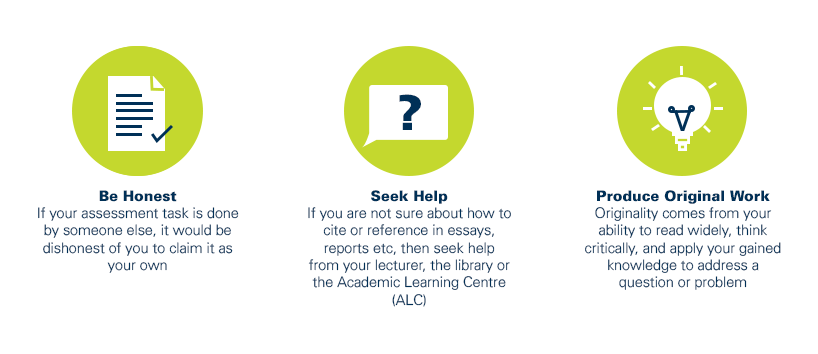
As a CQUniversity student you are expected to act honestly in all aspects of your academic work.
Any assessable work undertaken or submitted for review or assessment must be your own work. Assessable work is any type of work you do to meet the assessment requirements in the unit, including draft work submitted for review and feedback and final work to be assessed.
When you use the ideas, words or data of others in your assessment, you must thoroughly and clearly acknowledge the source of this information by using the correct referencing style for your unit. Using others’ work without proper acknowledgement may be considered a form of intellectual dishonesty.
Participating honestly, respectfully, responsibly, and fairly in your university study ensures the CQUniversity qualification you earn will be valued as a true indication of your individual academic achievement and will continue to receive the respect and recognition it deserves.
As a student, you are responsible for reading and following CQUniversity’s policies, including the Student Academic Integrity Policy and Procedure. This policy sets out CQUniversity’s expectations of you to act with integrity, examples of academic integrity breaches to avoid, the processes used to address alleged breaches of academic integrity, and potential penalties.
What is a breach of academic integrity?
A breach of academic integrity includes but is not limited to plagiarism, self-plagiarism, collusion, cheating, contract cheating, and academic misconduct. The Student Academic Integrity Policy and Procedure defines what these terms mean and gives examples.
Why is academic integrity important?
A breach of academic integrity may result in one or more penalties, including suspension or even expulsion from the University. It can also have negative implications for student visas and future enrolment at CQUniversity or elsewhere. Students who engage in contract cheating also risk being blackmailed by contract cheating services.
Where can I get assistance?
For academic advice and guidance, the Academic Learning Centre (ALC) can support you in becoming confident in completing assessments with integrity and of high standard.
What can you do to act with integrity?