Overview
This unit is the second and final stage of your final year research project which builds upon the successful completion of Research Project 1 (PPMP20019). In this unit, you will complete the investigative study you planned for in 'Research Project 1'. You will collect and analyse secondary or primary data and discuss the findings of your study. Then, you will draw conclusions and report the research findings via an industry-relevant academic report as well as an oral presentation. You will also be required to apply project management principles throughout the execution of your research project. The unit is designed to help you develop essential problem-solving and research skills for conducting independent research projects including the ethical issues involved.
Details
Pre-requisites or Co-requisites
Prerequisites: PPMP20019 Research Project 1 for CV84 and CL82 students, OR ENEG14005 Engineering Honours Project Implementation for CM15 students.
Important note: Students enrolled in a subsequent unit who failed their pre-requisite unit, should drop the subsequent unit before the census date or within 10 working days of Fail grade notification. Students who do not drop the unit in this timeframe cannot later drop the unit without academic and financial liability. See details in the Assessment Policy and Procedure (Higher Education Coursework).
Offerings For Term 1 - 2026
Attendance Requirements
All on-campus students are expected to attend scheduled classes - in some units, these classes are identified as a mandatory (pass/fail) component and attendance is compulsory. International students, on a student visa, must maintain a full time study load and meet both attendance and academic progress requirements in each study period (satisfactory attendance for International students is defined as maintaining at least an 80% attendance record).
Recommended Student Time Commitment
Each 12-credit Postgraduate unit at CQUniversity requires an overall time commitment of an average of 25 hours of study per week, making a total of 300 hours for the unit.
Class Timetable
Assessment Overview
Assessment Grading
This is a graded unit: your overall grade will be calculated from the marks or grades for each assessment task, based on the relative weightings shown in the table above. You must obtain an overall mark for the unit of at least 50%, or an overall grade of 'pass' in order to pass the unit. If any 'pass/fail' tasks are shown in the table above they must also be completed successfully ('pass' grade). You must also meet any minimum mark requirements specified for a particular assessment task, as detailed in the 'assessment task' section (note that in some instances, the minimum mark for a task may be greater than 50%). Consult the University's Grades and Results Policy for more details of interim results and final grades.
All University policies are available on the CQUniversity Policy site.
You may wish to view these policies:
- Grades and Results Policy
- Assessment Policy and Procedure (Higher Education Coursework)
- Review of Grade Procedure
- Student Academic Integrity Policy and Procedure
- Academic Progression Policy and Procedure
- Student Refund and Credit Balance Policy and Procedure
- Complaints Policy and Procedure
- Information and Communications Technology Acceptable Use Policy and Procedure
This list is not an exhaustive list of all University policies. The full list of University policies are available on the CQUniversity Policy site.
Feedback, Recommendations and Responses
Every unit is reviewed for enhancement each year. At the most recent review, the following staff and student feedback items were identified and recommendations were made.
Feedback from Student Unit Evaluation surveys, 2025
Students suggest updates to the Moodle learning material.
Refresh the unit's Moodle learning materials before the next offering, in particular exemplars and templates supporting the research report, while retaining the current supervision and feedback arrangements.
- Apply appropriate research tools and techniques in collecting and analysing research data
- Interpret and discuss results and draw conclusions that address the research question
- Employ ethical practices in collecting research data, analysing results and reporting research findings
- Apply project management principles in executing the research project plan
- Communicate and orally present a well-constructed scholarly paper.
Alignment of Assessment Tasks to Learning Outcomes
| Assessment Tasks | Learning Outcomes | ||||
|---|---|---|---|---|---|
| 1 | 2 | 3 | 4 | 5 | |
| 1 - Project (research) - 80% | |||||
| 2 - Presentation - 20% | |||||
Alignment of Graduate Attributes to Learning Outcomes
| Graduate Attributes | Learning Outcomes | ||||
|---|---|---|---|---|---|
| 1 | 2 | 3 | 4 | 5 | |
| 1 - Knowledge | |||||
| 2 - Communication | |||||
| 3 - Cognitive, technical and creative skills | |||||
| 4 - Research | |||||
| 5 - Self-management | |||||
| 6 - Ethical and Professional Responsibility | |||||
| 7 - Leadership | |||||
| 8 - First Nations Knowledges | |||||
| 9 - Aboriginal and Torres Strait Islander Cultures | |||||
Textbooks
There are no required textbooks.
IT Resources
- CQUniversity Student Email
- Internet
- Unit Website (Moodle)
- Endnote (available through Library - see Moodle link)
- SPSS 20.0 may be needed for data analysis
- computer lab
- Citation management software such as EndNote or Zotero
All submissions for this unit must use the referencing style: Harvard (author-date)
For further information, see the Assessment Tasks.
a.f.kineber@cqu.edu.au
Week 1: Kick-off the implementation phase of the research project
Begin Date: 09 Mar 2026Module/Topic
Revision and refinement of research plan
Chapter
Read the unit profile, assessment tasks and familiarise yourself with the Moodle site. Review the online resources within the relevant section of this week.
Events and Submissions/Topic
Refine and discuss your implementation plan with the Supervisor. Note that, the supervisor allocation is carried over from the predecessor courses.
Finalize the data collection instrument.
Revise Gantt chart
Meet with your project supervisor
and share your progress. Send meeting agenda in prior, take minutes of the meeting and ask your supervisor to update your attendance report.
Prepare and submit Ethics Approval Application if required.
Week 2: Update the data collection instrument
Begin Date: 16 Mar 2026Module/Topic
Finalize the sampling plan and prepare a list of all potential sources of data collection.
Chapter
Review the online resources within the relevant section of this week in Moodle site.
Events and Submissions/Topic
Finalize sampling plan and list of data sources finalized.
Meet with your project supervisor
and share your progress. Send meeting agenda in prior, take minutes of the meeting and ask your supervisor to update your attendance report.
Week 3: Collect data
Begin Date: 23 Mar 2026Module/Topic
- Proceed with pilot study (if applicable)
- Update/refine data collection instrument (if applicable).
- Proceed with mass data collection.
Chapter
Review the online resources within the relevant section of this week in Moodle site.
Events and Submissions/Topic
Meet with your project supervisor
and share your progress. Send meeting agenda in prior, take minutes of the meeting and ask your supervisor to update your attendance report.
Week 4: Collect data (Cont'd)
Begin Date: 30 Mar 2026Module/Topic
Continue with data collection.
Chapter
Review the online resources within the relevant section of this week in Moodle site.
Events and Submissions/Topic
Assessment: 1A Recorded Meeting
Meet with your project supervisor
and share your progress. Send meeting agenda in prior, take minutes of the meeting and ask your supervisor to update your attendance report.
Week 5: Manage and analyse data
Begin Date: 06 Apr 2026Module/Topic
- Organise, check, transcribe or code collected data.
- Discuss how to approach data analysis with your supervisor.
- Analyse data.
Chapter
Review the online resources within the relevant section of this week in Moodle site.
Events and Submissions/Topic
Meet with your project supervisor
and share your progress. Send meeting agenda in prior, take minutes of the meeting and ask your supervisor to update your attendance report.
Week 6: Analyse data (Cont'd)
Begin Date: 13 Apr 2026Module/Topic
- Analyse and interpret collected data.
- Write the interim research findings.
Chapter
Review the online resources within the relevant section of this week in Moodle site.
Events and Submissions/Topic
Meet with your project supervisor
and share your progress. Send meeting agenda in prior, take minutes of the meeting and ask your supervisor to update your attendance report.
Vacation Week: Your opportunity to recover any delays and come back on track.
Begin Date: 20 Apr 2026Module/Topic
Vacation Week: Your opportunity to recover any delays and come back on track.
Chapter
Events and Submissions/Topic
Week 7: Discuss your findings
Begin Date: 27 Apr 2026Module/Topic
Discuss findings and make links between objectives, findings, and literature.
Chapter
Review the online resources within the relevant section of this week in Moodle site.
Events and Submissions/Topic
Meet with your project supervisor
and share your progress. Send meeting agenda in prior, take minutes of the meeting and ask your supervisor to update your attendance report.
Week 8: Discuss your findings (Cont'd)
Begin Date: 04 May 2026Module/Topic
Finalise the discussion section.
Chapter
Review the online resources within the relevant section of this week in Moodle site.
Events and Submissions/Topic
Meet with your project supervisor
and share your progress. Send meeting agenda in prior, take minutes of the meeting and ask your supervisor to update your attendance report.
Week 9: Format the research paper
Begin Date: 11 May 2026Module/Topic
- Complete the conclusion section which summarises major findings in response to the research question or hypothesis, limitations, implications and directions for future research.
- Compile all completed sections to develop the research paper.
Chapter
Review the online resources within the relevant section of this week in Moodle site.
Events and Submissions/Topic
Meet with your project supervisor
and share your progress. Send meeting agenda in prior, take minutes of the meeting and ask your supervisor to update your attendance report.
Week 10: Finalize and proofread the research paper
Begin Date: 18 May 2026Module/Topic
- Proofread the final paper.
- Go through the given checklist and ensure you tick all boxes before submission.
Chapter
Review the online resources within the relevant section of this week in Moodle site.
Events and Submissions/Topic
Assessment: 1B Data Collection Report
Meet with your project supervisor
and share your progress. Send meeting agenda in prior, take minutes of the meeting and ask your supervisor to update your attendance report.
Week 11: Submit your paper
Begin Date: 25 May 2026Module/Topic
Submit your paper.
Chapter
Review the online resources within the relevant section of this week in Moodle site.
Events and Submissions/Topic
1C Research paper and comprehensive artefact submission.
Research Paper (80%) Due: Week 11 Friday (29 May 2026) 5:00 pm AEST
Week 12: Present your paper
Begin Date: 01 Jun 2026Module/Topic
- Present your paper
- Final remarks
Chapter
Review the online resources within the relevant section of this week in Moodle site.
Events and Submissions/Topic
Assessment 2: Presentation
Presentation Due: Week 12 Friday (5 June 2026) 5:00 pm AEST
Exam Week
Begin Date: 08 Jun 2026Module/Topic
Chapter
Events and Submissions/Topic
Vacation/Exam Week
Begin Date: 15 Jun 2026Module/Topic
Chapter
Events and Submissions/Topic
1 Project (research)
Overview:
This assessment requires you to work independently or in pairs and complete the second and final phase of your research project that you have already planned in PPMP20019. You will continue working with an assigned supervisor during the implementation phase. The assessment has two main components:
- 1A Recorded Meeting: (10%), marked by supervisor (Due in week 4)
- 1B Data Collection Report: (10%), marked by supervisor (Should be submitted once data collection is finished and no later than Week 10)
- 1C Research paper and comprehensive artefact submission: (60%), marked by 1 reviewer. (Due in week 11)
Assessment 1A: Recorded Meeting: (10%):
On week 4 you need to arrange a meeting with your supervisor to evaluate progress and plans against the initial plan prepared in PPMP20019. The meeting should review your research questions, data collection process, initial results and any impediments. The meeting should demonstrate your understanding of the project and your genuine engagement and commitment to the scheduled activities. The meeting with supervisor should be recorded and uploaded on Moodle for marking.
Artefact Submission:
You must provide a link to the OneDrive folder as part of this assessment that where you upload all research artefacts. The folder should include relevant materials such as draft results sections, research data, annotated cited articles, earlier word drafts, communications with stakeholders, status reports, meeting minutes, presentation materials, and any other resources you have used or created during the development of your interim submission.
Assessment 1B: Data Collection Report: (10%):
The data collection process should be planned and initiated at early weeks of the term. The students should update supervisor about the data collection progress and report it in weekly progress reports. Once data collection process is finalized, students should submit a detailed report about the collected data for Assessment 1B. Data collection should be finalized by the end of Week 10. Cases where delay incurs will be investigated and assessed by supervisor and UC.
The report should demonstrate validity, integrity and completeness of the collected data. It should track down the process from initiation to the analysis and presentation. This should involve but not limited to:
- Relevant communications with participants and stakeholders.
- The timeline of data collection and the
- Raw data (MoM, sheets, responses, etc)
- Assessment of the data completeness and validity.
Report should not exceed 2-pages, however, it should clearly refer to the relevant artifacts.
Assessment 1C: Research Paper and Comprehensive Artefact Submission (60%):
The task requires you to develop a report. A report template with clear guidelines on how to write key sections is available in Moodle for your use. The submission must include a reflective statement from each contributor summarising your experiences, feelings, and reactions during the implementation phase including practising project management in controlling and monitoring project activities and commenting on incurred risks & delays.
Students also must provide an updated link to the same OneDrive folder used for the interim submission, where all their research artefacts are stored. The folder must include all relevant materials, such as research data, coding & analysis files, annotated cited articles, earlier drafts, communications with stakeholders, status reports, minutes of meetings, presentation materials, and any other relevant materials or resources created or used in the development of the research paper.
For guidance, there should be a minimum of 8,000 in length excluding references, appendices, contribution and reflective statements. More details of the research report formatting and submission checklist are provided on the Moodle site.
Important Guidelines:
- Please mind that it is your responsibility to prepare and submit your ethics approval application. Approval times varies from one case to another. Therefore, make sure to start preparing your application from Week 1 and submit it as soon as you get the approval from your supervisor.
- Assessment re-take is not allowed once the submission is conducted. Make sure to work closely with your supervisor to fulfil all the requirements. If you notice any issues that can affect your final submissions raise them as soon as possible to your supervisor and unit coordinator.
- Students should stick to the responsible use of Gen-AI. Final report should contain a declaration statement for the use of Gen-AI clarifying how, and what, it was used for.
Important Notes:
Working in pairs: If you are directed to work in pairs, your submission must include a detailed contribution statement that clearly describes the roles and responsibilities assigned to each student within the pair and the specific areas of the project each student was primarily responsible for. The associated Artefact submission must include subfolders labelled with student names and includes all artefacts developed and contributed by each student. You will also be required to complete a compulsory group evaluation survey.
Compulsory progress presentations: Students are required to prepare slides and present their progress during the scheduled progress meetings as directed by the unit coordinator. Failing to show reasonable progress or present will attract a deduction of 5 marks as a penalty for each incident.
Faculty-student Interviews: Some students may be selected for further evaluation through an interview with the faculty. The selection of students for interviews will be based on the quality of their artefact submission, and other relevant factors determined by the faculty. The purpose of the interview is to delve deeper into the student's research process, clarify their understanding of the process and product, and assess the genuine contribution made by the student in their submissions.
Working with your supervisor: You will work closely with the allocated supervisor for the entire duration of the research project. The onus is upon you to make contact with the supervisor and to arrange and adhere to a programme of regular meetings thereafter. The supervisor is not obliged to chase you in order to check on your work progress. The supervisor will advise on the structure and suitability of the work, guide you through the entire process and warn you if the work is not thought to be of a satisfactory standard. You should maintain contact with your supervisor throughout the preparation of your work.
AI ASSESSMENT SCALE
You may use Al for planning, idea development, and research. Your final submission should show how you have developed and refined these ideas.
Final submissions must be written by the student, and no direct AI-generated content should appear in the submission. Students are encouraged to briefly describe how they used AI during the planning phase.
Week 11 Friday (29 May 2026) 5:00 pm AEST
Due dates: 1A: Week 4; 1B: Once data collection is finished and no later than Week 10; 1C: Week 11 (Monday)
Feedback return period as per CQU policy
- Updates in response to reviewers comments on PPMP20019 (2 marks)
- Clarity of Project Plan (4 marks)
- Data Collection Plan and Initial Findings (2 marks)
- Updated OneDrive Folder Content (2 marks)
1B – Data Collection Report (10%):
Compliance with the scientific research standards (2 marks)
Validity of the collection process (4 marks)
Quality and integrity of the collected data (2 marks)
Data analysis methods and generated information (2 marks)
-
Criteria HD D C P F Comprehension and Context (15%) Very high ability to comprehend the subject matter within the wider context; demonstrates considerable originality. Thorough understanding of the subject and issues; demonstrates a high degree of critical appraisal analysis; clear ability to formulate/construct research questions or hypotheses; excellent understanding and application of research methods. Good understanding of the subject and issues; clear ability to ask the right questions and/or formulate/construct research questions or hypotheses. Reasonable understanding of the subject and issues; asks questions and addresses potential answers with reasonable analysis and critique. Limited knowledge, effort, and understanding; minimal analysis and review. Research Findings (20%) Exceptionally comprehensive and well-presented research findings, including detailed and accurate results and analysis. Thorough and well-presented research findings, including detailed and accurate results and analysis. Adequate presentation of research findings, including relevant results and analysis. Basic presentation of research findings, with some relevant results and analysis. Inadequate or missing presentation of research findings; lack of relevant results and analysis. Discussion (15%) Exceptionally insightful and comprehensive discussion of research findings, drawing connections to existing literature and addressing implications; demonstrates critical analysis and original thought. Thorough and detailed discussion of research findings, making connections to existing literature and addressing implications; demonstrates critical analysis. Adequate discussion of research findings, including some connections to existing literature and addressing implications; demonstrates analysis. Basic discussion of research findings, with limited connections to existing literature and addressing implications; demonstrates basic analysis. Inadequate or missing discussion of research findings; lack of connections to existing literature and addressing implications; demonstrates insufficient analysis. Conclusions and Recommendations (10%) Well-supported conclusions; comprehensive and insightful recommendations. Well-supported conclusions; comprehensive and insightful recommendations. Conclusions and recommendations are supported. Well-supported conclusions; reasonable recommendations. Inadequate discussion with poorly or unsupported conclusions. Reflective statement (5%) Provides a comprehensive and thoughtful reflection on the experiences, challenges, and learning gained from the research project. Provides a reflective assessment on the experiences, challenges, and learning gained from the research project. Provides a basic reflection on the experiences, challenges, and learning gained from the research project. Provides a limited reflection on the experiences, challenges, and learning gained from the research project. Provides an inadequate or missing reflection on the experiences, challenges, and learning gained from the research project. Paper Structure and Presentation (10%) Excellent organisation and logical structure of the paper; effective use of headings and subheadings; clear and coherent writing style; professional presentation with proper citations and references. Well-structured and organised paper; effective use of headings and subheadings; clear and coherent writing style; professional presentation with proper citations and references. Fairly structured and presented paper (over and above basic standard); clear and coherent writing style; proper citations and references. Basic structure and presentation of the paper; clear and coherent writing style; proper citations and references. Poorly structured and presented paper; lacks clarity and coherence; inadequate citations and references. Research project management (15%) Demonstrates exceptional project management skills throughout the research project as evidenced by the reflective statement & appendices including comprehensive status reports, exceptional time management, clear communication records, and well-documented meeting minutes. Demonstrates strong project management skills throughout the research project as evidenced by the reflective statement & appendices including comprehensive status reports, effective time management, clear communication records, and well-documented meeting minutes. Demonstrates effective project management skills throughout the research project as evidenced by the reflective statement & appendices including status reports including regular status reports, good time management, clear communication records, and documented meeting minutes. Demonstrates basic project management skills throughout the research project as evidenced by the reflective statement & appendices, including some status reports, adequate time management, basic communication records, and recorded meeting minutes. Demonstrates inadequate or missing project management skills throughout the research project as evidenced by the reflective statement, 7 appendices including, lack of status reports, poor time management, insufficient communication records, and absence of meeting minutes. OneDrive Artefact (10%) Inclusion of all relevant research artefacts in the OneDrive folder; comprehensive collection of accurate and organised materials & earlier Word drafts; demonstrates genuine engagement with the research process; exceptional evidence of collaboration Inclusion of all relevant research artefacts in the OneDrive folder; comprehensive collection of accurate and organised materials & earlier Word drafts; demonstrates genuine engagement with the research process; solid evidence of collaboration Inclusion of relevant research artefacts in the OneDrive folder; collection of accurate and organised materials & earlier Word drafts; demonstrates engagement with the research process; fair evidence of collaboration Inclusion of research artefacts in the OneDrive folder; collection of materials & earlier Word drafts with some accuracy and organisation; demonstrates limited engagement with the research process; limited evidence of collaboration Inadequate inclusion or absence of research artefacts in the OneDrive folder; incomplete or disorganised collection of materials; missing earlier Word drafts; lacks genuine engagement with the research process; lacks evidence of collaboration. Note:
- If marks from both reviewers for 1B are close (Variance <10%), agreement is reached through UC moderation.
- If marks for 1B are substantially digressing (Variance >10%) and no agreement is reached, a panel is formed consisting of UC, supervisor, reviewers and HoC. Reviewers' comments are deliberated, and a decision is made.
- Apply appropriate research tools and techniques in collecting and analysing research data
- Interpret and discuss results and draw conclusions that address the research question
- Employ ethical practices in collecting research data, analysing results and reporting research findings
- Apply project management principles in executing the research project plan
- Communicate and orally present a well-constructed scholarly paper.
2 Presentation
Task
This assessment requires you to give an oral presentation and defend your research findings at a research seminar attended by the respective faculty and students. The seminar will be conducted in week 11 & 12 via ZOOM as scheduled by the unit coordinator following the submission of your final paper. You must cover the key sections of the paper in your presentation slides. All students enrolled in this unit must attend the oral presentations on the day to maximise their learning and knowledge in different research topics as presented by other students.
Important Notes:
- Make sure to attend at the presentation time. If you expect any obstacles to prevent you from attending the presentation inform the supervisor and UC as soon as you can in order to differ the presentation date.
- Assessment re-take is not allowed once the submission is conducted. Make sure to work closely with your supervisor to fulfil all the requirements. If you notice any issues that can affect your final submissions raise them as soon as possible to your supervisor and unit coordinator.
- Students are not allowed to contact the examiners for any issues relevant to exam outside the presentation time.
- All presentations will be organized online. Both examiners will attend. The presentation should be recorded and uploaded to the dedicated slot on Moodle.
Specifications
Each presentation will have 30 minutes time allocation. 15 minutes will be the student presentation, 10 minutes Q&A and 5 minutes swapping time. Exceeding the time limits for presentation will encounter mark deductions, therefore, you are encouraged to have adequate rehearsal in advance. The proposed flow of the slides is suggested to be as follows:
- Introduction/background
- The need and significance of the study
- Research question(s) & objectives
- Research methods
- The process of data analysis
- Research findings
- Discussion
- Conclusion, limitations and further research direction
- Project Management during the implementation phase
- Personal Reflection
AI ASSESSMENT SCALE
You must not use Al at any point during the assessment. You must demonstrate your core skills and knowledge.
Assessment Submission Policy Exception
This assessment is exempted from the 72-hour submission grace period and must be completed by the stated submission date/time.
Week 12 Friday (5 June 2026) 5:00 pm AEST
Week 11 & 12 via Zoom
Feedback return period as per CQU policy
Technical Content (40%): Thorough coverage of main components, sound knowledge and understanding of the implementation process of research plan, clear and relevant research findings, and excellent project management skills.
Delivery of Presentation (40%): Well-organised material, logical content ordering, appropriate communication style, effective argument construction, evidence integration, time management, and use of visual aids.
Handling of Questions and Discussion (20%): Ability to provide insightful answers, demonstrate original and sharp thinking, and stimulate discussion.
- Apply appropriate research tools and techniques in collecting and analysing research data
- Interpret and discuss results and draw conclusions that address the research question
- Employ ethical practices in collecting research data, analysing results and reporting research findings
- Apply project management principles in executing the research project plan
- Communicate and orally present a well-constructed scholarly paper.
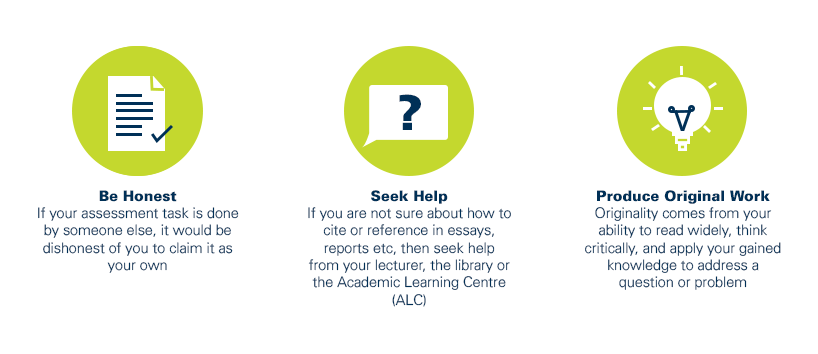
As a CQUniversity student you are expected to act honestly in all aspects of your academic work.
Any assessable work undertaken or submitted for review or assessment must be your own work. Assessable work is any type of work you do to meet the assessment requirements in the unit, including draft work submitted for review and feedback and final work to be assessed.
When you use the ideas, words or data of others in your assessment, you must thoroughly and clearly acknowledge the source of this information by using the correct referencing style for your unit. Using others’ work without proper acknowledgement may be considered a form of intellectual dishonesty.
Participating honestly, respectfully, responsibly, and fairly in your university study ensures the CQUniversity qualification you earn will be valued as a true indication of your individual academic achievement and will continue to receive the respect and recognition it deserves.
As a student, you are responsible for reading and following CQUniversity’s policies, including the Student Academic Integrity Policy and Procedure. This policy sets out CQUniversity’s expectations of you to act with integrity, examples of academic integrity breaches to avoid, the processes used to address alleged breaches of academic integrity, and potential penalties.
What is a breach of academic integrity?
A breach of academic integrity includes but is not limited to plagiarism, self-plagiarism, collusion, cheating, contract cheating, and academic misconduct. The Student Academic Integrity Policy and Procedure defines what these terms mean and gives examples.
Why is academic integrity important?
A breach of academic integrity may result in one or more penalties, including suspension or even expulsion from the University. It can also have negative implications for student visas and future enrolment at CQUniversity or elsewhere. Students who engage in contract cheating also risk being blackmailed by contract cheating services.
Where can I get assistance?
For academic advice and guidance, the Academic Learning Centre (ALC) can support you in becoming confident in completing assessments with integrity and of high standard.
What can you do to act with integrity?