Overview
This unit provides you with the opportunity to consolidate and apply all of the knowledge, skills and attitudes developed during your learning journey in the course, particularly with regard to human factors, occupational health and hygiene, safety science, and risk management. The unit also develops theoretical and methodological knowledge to allow you to evaluate the evidence that will inform your professional practice. There is a specific emphasis on developing higher order skills and understanding which are representative of the holistic application of core skills that occurs when a professional understands the interaction between disciplinary domains in solving complex problems.
Details
Pre-requisites or Co-requisites
Prerequisites: SAFE28001 Safety Regulation and Management and SAFE28003 Safety in Complexity. Corequisite: SAFE20011 Exposures and Health Risk, SAFE20017 Human Factors in Complex Systems and SAFE29001 Hazard Management and Risk Control.
Important note: Students enrolled in a subsequent unit who failed their pre-requisite unit, should drop the subsequent unit before the census date or within 10 working days of Fail grade notification. Students who do not drop the unit in this timeframe cannot later drop the unit without academic and financial liability. See details in the Assessment Policy and Procedure (Higher Education Coursework).
Offerings For Term 2 - 2026
Attendance Requirements
All on-campus students are expected to attend scheduled classes - in some units, these classes are identified as a mandatory (pass/fail) component and attendance is compulsory. International students, on a student visa, must maintain a full time study load and meet both attendance and academic progress requirements in each study period (satisfactory attendance for International students is defined as maintaining at least an 80% attendance record).
Recommended Student Time Commitment
Each 6-credit Postgraduate unit at CQUniversity requires an overall time commitment of an average of 12.5 hours of study per week, making a total of 150 hours for the unit.
Class Timetable
Assessment Overview
Assessment Grading
This is a graded unit: your overall grade will be calculated from the marks or grades for each assessment task, based on the relative weightings shown in the table above. You must obtain an overall mark for the unit of at least 50%, or an overall grade of 'pass' in order to pass the unit. If any 'pass/fail' tasks are shown in the table above they must also be completed successfully ('pass' grade). You must also meet any minimum mark requirements specified for a particular assessment task, as detailed in the 'assessment task' section (note that in some instances, the minimum mark for a task may be greater than 50%). Consult the University's Grades and Results Policy for more details of interim results and final grades.
All University policies are available on the CQUniversity Policy site.
You may wish to view these policies:
- Grades and Results Policy
- Assessment Policy and Procedure (Higher Education Coursework)
- Review of Grade Procedure
- Student Academic Integrity Policy and Procedure
- Academic Progression Policy and Procedure
- Student Refund and Credit Balance Policy and Procedure
- Complaints Policy and Procedure
- Information and Communications Technology Acceptable Use Policy and Procedure
This list is not an exhaustive list of all University policies. The full list of University policies are available on the CQUniversity Policy site.
Feedback, Recommendations and Responses
Every unit is reviewed for enhancement each year. At the most recent review, the following staff and student feedback items were identified and recommendations were made.
Feedback from Student email No Student Unit Evaluation Dashboard received.
Feedback reflecting how the assessment tasks synthesised key concepts and provided career direction, particularly with the final assessment task 'Reflection on professional practice'.
Continue to review and ensure contemporary and relevant material and assessment tasks are provided.
- Select and apply tools and techniques to analyse risk management issues and strategies in occupational settings.
- Select and apply tools and techniques to analyse human factors issues and strategies in occupational settings
- Select and apply tools and techniques to analyse occupational health and hygiene issues and strategies in occupational settings.
- Analyse, critique and present contemporary OHS practice issues and research in safety science.
Alignment of Assessment Tasks to Learning Outcomes
| Assessment Tasks | Learning Outcomes | |||
|---|---|---|---|---|
| 1 | 2 | 3 | 4 | |
| 1 - Portfolio - 25% | ||||
| 2 - Portfolio - 25% | ||||
| 3 - Portfolio - 25% | ||||
| 4 - Written Assessment - 25% | ||||
Alignment of Graduate Attributes to Learning Outcomes
| Graduate Attributes | Learning Outcomes | |||
|---|---|---|---|---|
| 1 | 2 | 3 | 4 | |
| 1 - Knowledge | ||||
| 2 - Communication | ||||
| 3 - Cognitive, technical and creative skills | ||||
| 4 - Research | ||||
| 5 - Self-management | ||||
| 6 - Ethical and Professional Responsibility | ||||
| 7 - Leadership | ||||
| 8 - First Nations Knowledges | ||||
| 9 - Aboriginal and Torres Strait Islander Cultures | ||||
Textbooks
There are no required textbooks.
IT Resources
- CQUniversity Student Email
- Internet
- Unit Website (Moodle)
All submissions for this unit must use the referencing style: Harvard (author-date)
For further information, see the Assessment Tasks.
f.bogna@cqu.edu.au
Week 1
Begin Date: 13 Jul 2026Module/Topic
• Introduction & unit outline
• Preparing for practical assessment in your/another workplace
• OHS Self-reflective mapping against INSHPO framework.
Chapter
International Network of Safety and Health Practitioner Organisations (INSHPO) 2017, The Occupational Health and Safety Professional Capability Framework: A global
framework for practice, International Network of Safety and Health Practitioner Organisations (INSHPO), Park Ridge, Il, USA.
Pryor, P, Provan, D, Casey, T & Hu, X 2021, 'The Generalist OHS Professional: International and Australian Perspectives' (2nd edn), in Australian Institute of Health & Safety (AIHS), The Core Body of Knowledge
for Generalist OHS Professionals, Tullamarine, VIC.
Events and Submissions/Topic
Week 2
Begin Date: 20 Jul 2026Module/Topic
Preparing for practical assessment in your/another workplace - Risk Refresher
Chapter
OHS Body of Knowledge
Ch 15 - Hazard as a concept
Ch 31 - Risk
Essential reading
Standards Australia 2018, Risk management – Guidelines (AS ISO 31000: 2018), Standards Australia,
Sydney.
Standards Australia, Standards New Zealand & International Electrotechnical Commission (AS/NZS
IEC) 2020, Risk Management – Risk Assessment Techniques (AS/NZS IEC 31010:2020), Standards Australia, Sydney.
Safe Work Australia 2018, How to manage work health and safety risks Code of Practice, Safe Work Australia.
Recommended reading
OHS Body of Knowledge
Ch 31.2 - OHS risk and decision making
Ch 34.1 - Control: Prevention and intervention
Other resources provided in Moodle.
Events and Submissions/Topic
Week 3
Begin Date: 27 Jul 2026Module/Topic
Preparing for practical assessment in your/another workplace - Human Factors refresher
Chapter
OHS Body of Knowledge
7.1 The Human: As a Biological System
10.1 The Organisation
12.1 Systems
16 Work-related Musculoskeletal Disorders
18 Biological Hazards
19 Psychosocial hazards
20 Fatigue
21 Bullying and violence
34.2 User-Centered Safe Design approach to control
34.3 Health and safety in design
34.4 Design of work
38.3 Ethics and Professional Practice
Other resources in Moodle
Events and Submissions/Topic
Week 4
Begin Date: 03 Aug 2026Module/Topic
Preparing for practical assessment in your/another workplace - Hygiene refresher
Chapter
OHS Body of Knowledge
7.1 The Human: As a biological system
12 Human biological systems
17.1 Chemical hazards
18 Biological hazards
33 Models of causation: Health determinants
35 Mitigation of health impacts
Supplementary Textbook
Reed, S, Pisaniello, D & Benke G 2020, Principles of Occupational Health and Hygiene: An Introduction, 3rd ed., Allen & Unwin, Sydney (available from CQUniversity library).
Other resources provided in Moodle.
Events and Submissions/Topic
Week 5
Begin Date: 10 Aug 2026Module/Topic
Review session: Preparing for practical assessment in your/another workplace
Chapter
A workbook for this week is provided in Moodle.
Events and Submissions/Topic
Week 6
Begin Date: 17 Aug 2026Module/Topic
Risk debrief and reporting (from practical assessment in your/another workplace)
Chapter
Resources in Moodle
Events and Submissions/Topic
Vacation Week
Begin Date: 24 Aug 2026Module/Topic
Independent Study
Chapter
Events and Submissions/Topic
Week 7
Begin Date: 31 Aug 2026Module/Topic
OHS Practice: Role of the OHS Professional
Chapter
OHS Body of Knowledge
37 Introduction to practice as a concept
37.2 A problem solving model of OHS practice
37.4 Workers Working from Home
Events and Submissions/Topic
Week 8
Begin Date: 07 Sep 2026Module/Topic
Human Factors debrief and reporting (from practical assessment in your/another workplace)
Chapter
Resources in Moodle
Events and Submissions/Topic
Week 9
Begin Date: 14 Sep 2026Module/Topic
Ethics and Professional Practice
Chapter
OHS Body of Knowledge
38.3 Ethics and Professional Practice
Code of Ethics (Australian Institute of Health and Safety)
https://www.aihs.org.au/
Events and Submissions/Topic
Week 10
Begin Date: 21 Sep 2026Module/Topic
Occupational Hygiene debrief and reporting (from practical assessment in your/another workplace)
Chapter
Resources in Moodle
Events and Submissions/Topic
Week 11
Begin Date: 28 Sep 2026Module/Topic
OHS Research: OHS Self- reflective mapping against INSHPO framework
Chapter
Body of Knowledge
39.1 The OHS professional as a critical consumer of research
Fan, D, Zhu, C.J., Timming, A.R., Su, Y, Huang, X & Lu, Y 2019, ‘Using the past to map out the future of occupational health and safety research: where do
we go from here?’, The International Journal of Human Resource Management, vol.31, no.1, pp. 90-127.
Events and Submissions/Topic
Week 12
Begin Date: 05 Oct 2026Module/Topic
Independent study
Chapter
International Network of Safety and Health Practitioner Organisations (INSHPO) 2017, The Occupational Health and Safety Professional Capability Framework: A global
framework for practice, International Network of Safety and Health Practitioner Organisations (INSHPO), Park Ridge, Il, USA.
Events and Submissions/Topic
Exam Week
Begin Date: 12 Oct 2026Module/Topic
Chapter
Events and Submissions/Topic
Vacation/Exam Week
Begin Date: 19 Oct 2026Module/Topic
Chapter
Events and Submissions/Topic
This unit requires students to undertake a number of practical (practicum) activities at their own workplace or another workplace for 3 separate, specific activities spanning risk management, human factors and occupational hygiene. Students should schedule these tasks to be undertaken in week 5 of term.
1 Portfolio
You will need to select an activity, process or situation at your workplace or another workplace. Each student must submit a Risk Management report, a completed Risk Assessment Template template and other relevant information supporting the report (as Appendices to the report)
Note: Use the Risk Assessment Template provided in Moodle for this task to work through the risk assessment activity. The template is then provided in the Appendix, with the Risk Management Report.
Word Count: Due consideration is given to the entries provided both in the completion of the template and report. Within 1800-2200 words is a preferred word count for both items (combined total).
Risk Assessment (completion of template) – 70% of total marks
1. Prepare a comprehensive risk assessment for the activity, process or situation at your workplace or another workplace. Section 6 of AS/NZS IEC 31010:2020 gives guidance on planning a detailed risk assessment. Use one of the techniques/tools set out in AS/NZS IEC 31010:2020, some of which are listed in ‘Section 4: Risk Management Tool used (and justification)’ on page 4 of the Risk Assessment Template. The topic must have sufficient depth to be suited to one of these tools. A range of tools will be suggested for you at the beginning of the term.
2. Do not undertake a task based risked assessment (Job Safety Analysis).
3. Ensure all parts of the risk management process as detailed in AS ISO 31000: 2018 Risk management – Guidelines are addressed within the risk assessment. Complete all sections of the template provided.
4. On the basis of the risk assessment, prepare a process flow (page 2 of the template) to reflect all of the actions required to coordinate the risk assessment from start to finish.
5. Outline any shortcomings/limitations of the risk assessment approach you have adopted.
6. Nominate staff training strategies and material to be communicated in a training event that outlines the new controls.
Risk Assessment Report – 30% of total marks
7. Prepare a report to present to management on the risk assessment conducted and the recommended controls. The risk assessment template will comprise one appendix of the report.
Table of Contents
-Executive Summary
-Table of Contents
-Introduction
-Purpose and Scope
-Methodology
-Findings
-Discussion
-Recommendations
-Proposed action plan
-References
-Appendix A
-Appendix B etc
Video capture
Provide a video capture (approximately 2 minutes) demonstrating part of the activity you conducted, preferably including some interaction with others. This requirement is also itemised in the rubric for this assessment task, requiring the ‘application of technical knowledge to selected activity, process or situation’.
Level of GenAI use allowed:
Level 2: AI Planning
Al may be used for pre-task activities such as brainstorming, outlining and initial research. This level focuses on the effective use of Al for planning, synthesis, and ideation, but assessments should emphasise the ability to develop and refine these ideas independently.
You may use Al for planning, idea development, and research. Your final submission should show how you have developed and refined these ideas.
The full AI Assessment Scale table is available in the Assessment block on the Moodle site.
Vacation Week Monday (24 Aug 2026) 11:59 pm AEST
Week 7 Friday (4 Sept 2026)
The detailed assessment matrices for each report will be provided on the Moodle site and explained during the term. In summary, students will be assessed on their demonstration and application of risk management strategies and associated knowledge, skills and tools using the following criteria:
1. Problem definition (including introduction, rationale and scope (15%)
2. Explanation of methodology and process flow (15%)
3. Application of technical knowledge to real-life situations, including video capture (10%)
4. Critical thinking through discussion and findings (10%)
5. Conclusion and practicality of recommendations (10%)
6. Accuracy and completeness of tools, forms and worksheets (15%)
7. Professional report formatting suitable for submission to a client (15%)
8. Written expression appropriate to a professional report (5%)
9. Well supported with relevant authoritative sources that are appropriately referenced.(5%)
- Select and apply tools and techniques to analyse risk management issues and strategies in occupational settings.
2 Portfolio
You will need to select a task (high-risk, or safety-critical) at your workplace or another workplace.
Note: Depending on your task, you will need to select appropriate analytical tools that
1) Identify the problem,
2) Understand the context in which the task is taking place,
3) Comprehend the task overview (big picture), and
4) Assess the chosen task with appropriate analytical tools (physical or cognitive).
Word Count: Due consideration is given to the entries provided both in the completion of the report and attached appendices. Within 1800-2200 words is a preferred word count for both items (report & appendices).
Each student must submit:
Human factors report (25%)
Details
Select a task/worker to do the following:
1. Select appropriate human factors analytical tools to assess the risks associated with this task (either cognitive or physical) in a holistic manner.
2. Conduct preliminary assessment
-Select and use tools to learn what task needs assessing (e.g. discomfort survey, interviews...)
-Select and use tools to learn about the task (e.g. Hierarchical Task Analysis - recommended)
-Select and use tools to learn about the worker's needs (e.g. Empathy Map...)
-Based on preliminary analysis, identify where to focus secondary analysis
3. Conduct secondary assessment
-Select and use tools to assess the task in a more focused manner (e.g. Cognitive Task Analysis, Rapid Entire Body Assessment...)
4. Based on the results;
-Explain the significance of risk factors found,
5. Devise recommendations to redesign the task/ equipment/ or other to address risk factors of the human-system interaction during the task found.
Structure of the report
Human Factors Report - 25% of total grade
- Title Page
- Table of Contents
- Introduction (include information about the organisation and the problematic task. Provide background information on the industry and HF issues and their impacts. Support claims with references)
- Methods (list the methods and materials used)
- Results & Redesign recommendations (Report the main findings and offer recommendations for each finding noted).
- References (relevant authoritative sources that are appropriately referenced)
- Appendices
- Professional report formatting suitable for submission to a client
Video Capture
Provide a video capture (approximately 2 minutes) demonstrating part of the activity you conducted, preferably including some interaction with others. This requirement is also itemised in the rubric for this assessment task, requiring the ‘application of technical knowledge to selected activity, process or situation’.
Provide this capture as a file in Moodle.
Level of GenAI use allowed:
Level 2: AI Planning
Al may be used for pre-task activities such as brainstorming, outlining and initial research. This level focuses on the effective use of Al for planning, synthesis, and ideation, but assessments should emphasise the ability to develop and refine these ideas independently.
You may use Al for planning, idea development, and research. Your final submission should show how you have developed and refined these ideas.
The full AI Assessment Scale table is available in the Assessment block on the Moodle site.
Week 8 Monday (7 Sept 2026) 11:59 pm AEST
Week 9 Friday (18 Sept 2026)
Detailed assessment matrices for each report will be provided on the Moodle site and explained during the term. In summary, students will be assessed on their demonstration and application of human factors knowledge, skills and tools using the following criteria:
1. Context, purpose and scope (including problem definition) (10%)
2. Explanation of methodology, including video capture (10%)
4. Critical thinking through application of technical knowledge, analysis, completed worksheets (15%)
5. Results accurately presented analysis with significant risk factors highlighted (15%)
6. Discussion, findings and conclusion (15%)
7. Relevant, reasonable and practicable recommendations (15%)
8. Written expression appropriate to a professional report (10%)
9. Well supported with relevant authoritative sources that are appropriately referenced (10%)
- Select and apply tools and techniques to analyse human factors issues and strategies in occupational settings
3 Portfolio
As an OHS professional, you need to have a practical understanding of what is required to collect occupational hygiene monitoring data. You also need to understand how to evaluate data collected by occupational hygiene consultants.
Often, the OHS professional is asked to do Chemical Risk Assessments as well.
Each student must submit:
- Occupational hygiene report (25%)
Word Count: Due consideration is given to the entries provided both in the completion of the report and attached appendices. Within 1800-2200 words is a preferred word count for both items (report & appendices).
Details
During the Occupational Hygiene activities at your workplace or another workplace, you will need to undertake some simple occupational hygiene monitoring activities, and demonstrate an understanding of site monitoring hazards and the appropriate monitoring equipment used to monitor those hazards, evaluate monitoring data and risk assess a chemical that is used in a workshop/field environment.
You will be required to work on the following hygiene activities:
- Monitoring an area/work task as nominated
- Chemical Risk Assessment
Preparing for the Site Visit
Watch the relevant lectures and tutorials, do the activities and complete the readings. Read through the information placed on the Residential School/hygiene page on the Moodle site:
Read through the Assessment Details and activity details below.
Activity 1 - Monitoring
During the hygiene lecture you will be given monitoring information for different hazards at industrial sites. You will then need to undertake some noise monitoring in a site familiar to you. Report on the completed monitoring, evaluate the monitoring data, draw conclusions and make appropriate recommendations in response to that evaluation. You will need to download a noise monitoring application to your phone. There are many available and each app will work in a similar way. It will give you a read for the level of noise that the app is exposed to.
You are to choose any site that has a noise source. This can be at your workplace or another workplace. It could be inside or outside. You are to monitor this environment to ensure compliance with WHS/OHS regulations.
Activity 2 - Hazardous Chemical Risk Assessment
You are required to complete a hazardous chemical risk assessment of a hazardous chemical that is present on a work site.
Complete the Hazardous Chemical Risk Assessment form provided in Moodle and identify recommendations for safe use of the product.
The Hazardous Chemical Risk Assessment should be completed using the Chemical Risk Assessment form.
Hygiene Report Structure
The report must be in the format recommended by the Australian Institute of Occupational Hygiene reporting. As such, it must include the items listed below.
You may add these two parts to one file or submit as three separate files.
A) Monitoring report
Cover Letter
Title page
Executive Summary
Table of Contents
Introduction- including information about the premises;
1. Overview of all Occupational Hygiene hazards, when and who did the sampling; background information on the contaminants sampled for, including the possible health impacts
(supported by references)
2. Monitoring
2.1 Monitoring Method (explaining precisely what you did and what sampling standards you used)
2.2 Monitoring Results
2.3 Monitoring Discussion (what the results mean in terms of recommended standards and the associated risks to human health)
2.4 Monitoring Recommendations
3. References
B) Chemical risk assessment worksheet
- Appendix A Safety Data Sheet
Video Capture
Provide a video capture (approximately 2 minutes) demonstrating part of the activity you conducted, preferably including some interaction with others. This requirement is also itemised in the rubric for this assessment task, requiring the ‘application of technical knowledge to selected activity, process or situation’.
Provide this capture as a file in Moodle.
Level of GenAI use allowed:
Level 2: AI Planning
Al may be used for pre-task activities such as brainstorming, outlining and initial research. This level focuses on the effective use of Al for planning, synthesis, and ideation, but assessments should emphasise the ability to develop and refine these ideas independently.
You may use Al for planning, idea development, and research. Your final submission should show how you have developed and refined these ideas.
The full AI Assessment Scale table is available in the Assessment block on the Moodle site.
Week 10 Monday (21 Sept 2026) 11:59 pm AEST
Week 11 Friday (2 Oct 2026)
Detailed assessment matrices for each report will be provided on the Moodle site and explained during the term. In summary, students will be assessed on their demonstration and application of human factors knowledge, skills and tools using the following criteria:
1. Report introduction includes context, purpose and scope (10%)
2. Explanation of methodology, for how the monitoring was performed including video capture (10%)
3. Monitoring results demonstrate critical thought and understanding of results (5%)
4. Discussion, findings and conclusion relevant to monitoring data (20%)
5. Critical thinking and practical application of health and hygiene risk concepts to solutions (5%)
6. Chemical risk assessment completed to a high level of detail (25%)
7. Professional report formatting and structure (5%)
8. Written expression appropriate to a professional report (5%)
9. Well supported with relevant authoritative sources that are appropriately referenced (15%)
- Select and apply tools and techniques to analyse occupational health and hygiene issues and strategies in occupational settings.
4 Written Assessment
The International Network of Safety and Health Practitioner Organisations (INSHPO) has established a Global OHS Capability Framework to provide greater clarity for OHS professionals by defining levels of practice, roles and what capabilities, knowledge and skills they would require to be effective. The Capability Framework defines and details the
activities, knowledge and skills the OHS professional may be expected to have in order to advise and manage OHS in the organisation.
Your task is to undertake a reflection and gap analysis of your role or future role as an OHS professional across the fields of ‘Activities’, ‘Knowledge’ and ‘Skills’ as presented in the Global OHS Capability Framework to determine your current position within each band of criteria as prescribed in the Framework.
Use the template provided in Moodle for this and based on the analysis, identify the gaps or areas for improvement that you may have within each of these fields, based on your current and potential future roles as an OHS Professional.
1. Complete the table in the template for each item of criteria listed, across all three fields of ‘Activities’, ‘Knowledge’ and ‘Skills’.
2. Reflect on these results and provide a discussion on where your strengths lie and identified opportunities for improvement in your professional practice (800-1000 words).
3. Outline an Action Plan that will help you develop as an OHS Professional for the future (table format, no word limit).
The capability framework can be found here:
https://www.inshpo.org/work
Level of GenAI use allowed:
Level 2: AI Planning
Al may be used for pre-task activities such as brainstorming, outlining and initial research. This level focuses on the effective use of Al for planning, synthesis, and ideation, but assessments should emphasise the ability to develop and refine these ideas independently.
You may use Al for planning, idea development, and research. Your final submission should show how you have developed and refined these ideas.
The full AI Assessment Scale table is available in the Assessment block on the Moodle site.
Week 12 Monday (5 Oct 2026) 11:59 pm AEST
Exam Week Friday (16 Oct 2026)
A detailed assessment matrix for the completion of the table representing the fields of ‘Activities’, ‘Knowledge’ and ‘Skills’ as prescribed in the Global OHS Capability Framework will be provided on the Moodle site and explained during the term and during the residential school. In summary, students will be assessed on their completion of the table across all fields of ‘Activities’, ‘Knowledge’ and ‘Skills’, and the provision of a cogent reflection based on these entries that translate into an Action Plan that can be used for future professional practice.
This will incorporate the following criteria:
1. Methodology of capability framework understood and applied (5 marks)
2. Identification of strengths and gaps in own professional practice annotated and connections between tacit assumptions and the capability framework expressed through reflexive dialogue. (20 marks)
3. Professional practice is supported by evidence (10 marks)
4. Design strategies and targets to bridge gaps in professional practice with items recorded for further attention in the action plan. (10 marks)
5 Written expression appropriate to the reflection (grammar, punctuation, references if relevant). (5 marks)
- Analyse, critique and present contemporary OHS practice issues and research in safety science.
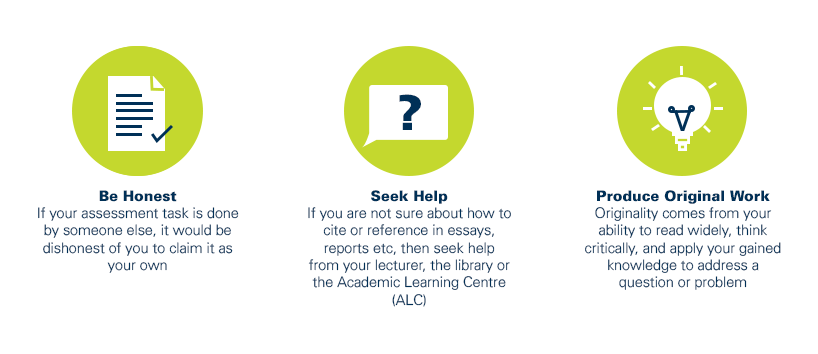
As a CQUniversity student you are expected to act honestly in all aspects of your academic work.
Any assessable work undertaken or submitted for review or assessment must be your own work. Assessable work is any type of work you do to meet the assessment requirements in the unit, including draft work submitted for review and feedback and final work to be assessed.
When you use the ideas, words or data of others in your assessment, you must thoroughly and clearly acknowledge the source of this information by using the correct referencing style for your unit. Using others’ work without proper acknowledgement may be considered a form of intellectual dishonesty.
Participating honestly, respectfully, responsibly, and fairly in your university study ensures the CQUniversity qualification you earn will be valued as a true indication of your individual academic achievement and will continue to receive the respect and recognition it deserves.
As a student, you are responsible for reading and following CQUniversity’s policies, including the Student Academic Integrity Policy and Procedure. This policy sets out CQUniversity’s expectations of you to act with integrity, examples of academic integrity breaches to avoid, the processes used to address alleged breaches of academic integrity, and potential penalties.
What is a breach of academic integrity?
A breach of academic integrity includes but is not limited to plagiarism, self-plagiarism, collusion, cheating, contract cheating, and academic misconduct. The Student Academic Integrity Policy and Procedure defines what these terms mean and gives examples.
Why is academic integrity important?
A breach of academic integrity may result in one or more penalties, including suspension or even expulsion from the University. It can also have negative implications for student visas and future enrolment at CQUniversity or elsewhere. Students who engage in contract cheating also risk being blackmailed by contract cheating services.
Where can I get assistance?
For academic advice and guidance, the Academic Learning Centre (ALC) can support you in becoming confident in completing assessments with integrity and of high standard.
What can you do to act with integrity?