Overview
On completion of this unit, you will be able to evaluate the relationships between catchment health, water quality and ecosystem health in receiving waters, by using a whole of catchment approach. You will be able to analyse the major threats to water quality and the ways to manage those threats through the monitoring of physical, chemical and biological parameters. You will be able to formulate management strategies for source pollutants, and apply relevant standards and guidelines to aquatic systems.
Details
Pre-requisites or Co-requisites
Undergraduate Courses: Completion of 72 credit points. Postgraduate Courses: nil prerequisites.
Important note: Students enrolled in a subsequent unit who failed their pre-requisite unit, should drop the subsequent unit before the census date or within 10 working days of Fail grade notification. Students who do not drop the unit in this timeframe cannot later drop the unit without academic and financial liability. See details in the Assessment Policy and Procedure (Higher Education Coursework).
Offerings For Term 1 - 2026
Attendance Requirements
All on-campus students are expected to attend scheduled classes - in some units, these classes are identified as a mandatory (pass/fail) component and attendance is compulsory. International students, on a student visa, must maintain a full time study load and meet both attendance and academic progress requirements in each study period (satisfactory attendance for International students is defined as maintaining at least an 80% attendance record).
Recommended Student Time Commitment
Each 6-credit Postgraduate unit at CQUniversity requires an overall time commitment of an average of 12.5 hours of study per week, making a total of 150 hours for the unit.
Class Timetable
Assessment Overview
Assessment Grading
This is a graded unit: your overall grade will be calculated from the marks or grades for each assessment task, based on the relative weightings shown in the table above. You must obtain an overall mark for the unit of at least 50%, or an overall grade of 'pass' in order to pass the unit. If any 'pass/fail' tasks are shown in the table above they must also be completed successfully ('pass' grade). You must also meet any minimum mark requirements specified for a particular assessment task, as detailed in the 'assessment task' section (note that in some instances, the minimum mark for a task may be greater than 50%). Consult the University's Grades and Results Policy for more details of interim results and final grades.
All University policies are available on the CQUniversity Policy site.
You may wish to view these policies:
- Grades and Results Policy
- Assessment Policy and Procedure (Higher Education Coursework)
- Review of Grade Procedure
- Student Academic Integrity Policy and Procedure
- Academic Progression Policy and Procedure
- Student Refund and Credit Balance Policy and Procedure
- Complaints Policy and Procedure
- Information and Communications Technology Acceptable Use Policy and Procedure
This list is not an exhaustive list of all University policies. The full list of University policies are available on the CQUniversity Policy site.
- Evaluate relationships between catchment health and water quality using a whole of catchment approach
- Analyse the major threats to instream and coastal water quality and the effects of anthropogenic pollutants on ecosystem health
- Critique essential physico-chemical and biological indicators of water quality, and their applications
- Formulate management strategies to reduce diffuse and point source pollutants
- Work with others to apply relevant standards and guidelines to the assessment of water quality and ecosystem health data and results from aquatic systems.
Alignment of Assessment Tasks to Learning Outcomes
| Assessment Tasks | Learning Outcomes | ||||
|---|---|---|---|---|---|
| 1 | 2 | 3 | 4 | 5 | |
| 1 - Written Assessment - 50% | |||||
| 2 - Online Test - 50% | |||||
Alignment of Graduate Attributes to Learning Outcomes
| Graduate Attributes | Learning Outcomes | ||||
|---|---|---|---|---|---|
| 1 | 2 | 3 | 4 | 5 | |
| 1 - Knowledge | |||||
| 2 - Communication | |||||
| 3 - Cognitive, technical and creative skills | |||||
| 4 - Research | |||||
| 5 - Self-management | |||||
| 6 - Ethical and Professional Responsibility | |||||
| 7 - Leadership | |||||
| 8 - First Nations Knowledges | |||||
| 9 - Aboriginal and Torres Strait Islander Cultures | |||||
Textbooks
There are no required textbooks.
IT Resources
- CQUniversity Student Email
- Internet
- Unit Website (Moodle)
All submissions for this unit must use the referencing styles below:
For further information, see the Assessment Tasks.
s.hawkins@cqu.edu.au
Week 1
Begin Date: 09 Mar 2026Module/Topic
Introduction to Catchments and Water as a Resource
Chapter
See Moodle for prescribed tasks.
Events and Submissions/Topic
Week 2
Begin Date: 16 Mar 2026Module/Topic
Water Governance and Policy
Chapter
See Moodle for prescribed tasks.
Events and Submissions/Topic
Week 3
Begin Date: 23 Mar 2026Module/Topic
Threats to Catchment and Flow Management
Chapter
See Moodle for prescribed tasks.
Events and Submissions/Topic
Week 4
Begin Date: 30 Mar 2026Module/Topic
Catchment Planning and Stakeholder Engagement
Chapter
See Moodle for prescribed tasks.
Events and Submissions/Topic
Week 5
Begin Date: 06 Apr 2026Module/Topic
Water as Habitat: Ecological Function and Rights of Nature
Chapter
See Moodle for prescribed tasks.
Events and Submissions/Topic
Week 6
Begin Date: 13 Apr 2026Module/Topic
Water Quality Standards and Monitoring Overview
Chapter
See Moodle for prescribed tasks.
Events and Submissions/Topic
Assessment 1A due (Friday, 17 April, 11pm).
Vacation Week
Begin Date: 20 Apr 2026Module/Topic
Chapter
Events and Submissions/Topic
Week 7
Begin Date: 27 Apr 2026Module/Topic
Microbiological Indicators
Chapter
See Moodle for prescribed tasks.
Events and Submissions/Topic
Week 8
Begin Date: 04 May 2026Module/Topic
Chemical Indicators and Nutrient Management
Chapter
See Moodle for prescribed tasks.
Events and Submissions/Topic
Week 9
Begin Date: 11 May 2026Module/Topic
Biological Indicators and Integrated Assessment
Chapter
See Moodle for prescribed tasks.
Events and Submissions/Topic
Week 10
Begin Date: 18 May 2026Module/Topic
Management Strategies and Adaptive Planning
Chapter
See Moodle for prescribed tasks.
Events and Submissions/Topic
Assessment 1B due (Friday, 22 May, 11pm).
Week 11
Begin Date: 25 May 2026Module/Topic
Engineering Solutions
Chapter
See Moodle for prescribed tasks.
Events and Submissions/Topic
Week 12
Begin Date: 01 Jun 2026Module/Topic
Integration, Reflection and Future Directions
Chapter
See Moodle for prescribed tasks.
Events and Submissions/Topic
Exam Week
Begin Date: 08 Jun 2026Module/Topic
Chapter
Events and Submissions/Topic
End of term online test scheduled for Wednesday, 10 June, 10:00 am AEST for 3 hours (plus 15 min. perusal time).
Vacation/Exam Week
Begin Date: 15 Jun 2026Module/Topic
Chapter
Events and Submissions/Topic
1 Written Assessment
Assessment 1 (50%) is a two‑part professional report applying the ANZG 10‑Step Water Quality Management Framework to a case study waterway. Detailed instructions will be provided on the unit Moodle.
Part A: Context and Community Values (submitted in week 6; 20%)
You will analyse the current environmental and governance context of the waterway using ANZG Steps 1–2.
The report will include:
- Definition of the selected reach and its key pressures
- A conceptual model showing pressures → stressors → receptors → outcomes
- A governance and stakeholder map
- Identification of community values and related management goals
- A brief social research plan outlining how stakeholder values will be collected
Part B: Indicators, Guideline Values, Objectives & Monitoring (submitted in week 10; 30%)
You will translate community values into measurable indicators and monitoring tools using ANZG Steps 3–6.
This part of the report will include:
- Selection and justification of relevant water‑quality indicators
- Application of ANZG guideline values
- Drafting of reach‑specific water‑quality objectives
- A monitoring program with sites, frequency, methods, QA/QC and adaptive triggers
- A short reflection on the strengths and limitations of the ANZG framework
Level of GenAI use allowed:
Level 4: You may use Al extensively throughout your work either as you wish, or as specifically directed in your assessment. Focus on directing Al to achieve your goals while demonstrating your critical thinking.
AI Declaration
You must include a brief AI use declaration at the end of your report. This should state whether and how you used generative AI tools to complete the task.
For example:
“I used ChatGPT to help summarise background literature and refine language in my report. All analysis, interpretation, and recommendations are my own.”
“I did not use generative AI in the preparation of this assessment.”
Part 1A is due in week 6 (Friday, 17 April, 11pm). Part 1B is due in week 10 (Friday, 22 May, 11pm).
Marked assessments will be returned within 14 days of the due date.
Part A:
- The selected waterway and its context are clearly described, including key pressures and a coherent conceptual model (30%)
- The governance framework and stakeholder roles are accurately mapped and clearly explained (20%)
- Community values and management goals are well‑defined and logically connected to the context (30%)
- The social research plan is feasible, ethical, and clearly aligned with eliciting stakeholder values (15%)
- The submission is well‑structured, clearly written, and correctly referenced (5%)
Part B:
- Indicators are appropriately selected and clearly justified in relation to values and pressures (25%)
- Guideline values are accurate, well‑sourced, and appropriately contextualised (20%)
- Draft water‑quality objectives are specific, defensible, and clearly linked to values and risks (25%)
- The monitoring plan is coherent, practical, and demonstrates sound understanding of methods, QA/QC, and adaptive triggers (25%)
- The submission is well‑presented, uses clear diagrams/tables, and includes correct referencing (5%)
- Evaluate relationships between catchment health and water quality using a whole of catchment approach
- Analyse the major threats to instream and coastal water quality and the effects of anthropogenic pollutants on ecosystem health
- Critique essential physico-chemical and biological indicators of water quality, and their applications
- Formulate management strategies to reduce diffuse and point source pollutants
- Work with others to apply relevant standards and guidelines to the assessment of water quality and ecosystem health data and results from aquatic systems.
2 Online Test
The online quiz assesses your understanding of content covered in Weeks 1 to 12. The quiz will contain 20 questions and will include a mixture of short‑answer and long‑answer questions, designed to evaluate both your conceptual knowledge and your ability to apply key ideas from the unit.
You will have one attempt only for this assessment.
Note that the automatic 72-hour extension DOES NOT APPLY for this assessment.
Level of GenAI use allowed:
Level 1: You must not use AI at any point during the assessment. You must demonstrate your core skills and knowledge.
The online test opens on Wednesday, 10 June, 10:00 am AEST for 3 hours (plus 15 min. perusal time).
Results will be returned within 14 days.
The end of term online assessment will be assessed with respect to the completeness and correctness of the answers.
- Evaluate relationships between catchment health and water quality using a whole of catchment approach
- Analyse the major threats to instream and coastal water quality and the effects of anthropogenic pollutants on ecosystem health
- Critique essential physico-chemical and biological indicators of water quality, and their applications
- Formulate management strategies to reduce diffuse and point source pollutants
- Work with others to apply relevant standards and guidelines to the assessment of water quality and ecosystem health data and results from aquatic systems.
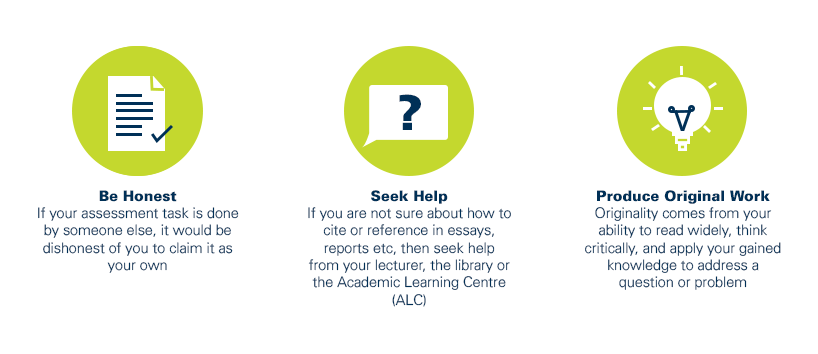
As a CQUniversity student you are expected to act honestly in all aspects of your academic work.
Any assessable work undertaken or submitted for review or assessment must be your own work. Assessable work is any type of work you do to meet the assessment requirements in the unit, including draft work submitted for review and feedback and final work to be assessed.
When you use the ideas, words or data of others in your assessment, you must thoroughly and clearly acknowledge the source of this information by using the correct referencing style for your unit. Using others’ work without proper acknowledgement may be considered a form of intellectual dishonesty.
Participating honestly, respectfully, responsibly, and fairly in your university study ensures the CQUniversity qualification you earn will be valued as a true indication of your individual academic achievement and will continue to receive the respect and recognition it deserves.
As a student, you are responsible for reading and following CQUniversity’s policies, including the Student Academic Integrity Policy and Procedure. This policy sets out CQUniversity’s expectations of you to act with integrity, examples of academic integrity breaches to avoid, the processes used to address alleged breaches of academic integrity, and potential penalties.
What is a breach of academic integrity?
A breach of academic integrity includes but is not limited to plagiarism, self-plagiarism, collusion, cheating, contract cheating, and academic misconduct. The Student Academic Integrity Policy and Procedure defines what these terms mean and gives examples.
Why is academic integrity important?
A breach of academic integrity may result in one or more penalties, including suspension or even expulsion from the University. It can also have negative implications for student visas and future enrolment at CQUniversity or elsewhere. Students who engage in contract cheating also risk being blackmailed by contract cheating services.
Where can I get assistance?
For academic advice and guidance, the Academic Learning Centre (ALC) can support you in becoming confident in completing assessments with integrity and of high standard.
What can you do to act with integrity?