Overview
This unit provides you with an understanding of Australian society in an increasingly diverse and globalising world and how it has developed over time. It will examine how Australian history has helped to define Australian national identities. You will explore issues of power and social change and consider a range of social issues using sociological concepts. This will give you an understanding of the politico economic distribution of resources that shape social inequalities around culture, ethnicity, "race", gender and sexuality. You will develop an understanding of Australian Indigenous issues, processes of settlement and colonisation and multiculturalism and the implications of the globalisation of society. In this way the unit will be the basis for a professional career in human service and other workplaces.
Details
Pre-requisites or Co-requisites
There are no requisites for this unit.
Important note: Students enrolled in a subsequent unit who failed their pre-requisite unit, should drop the subsequent unit before the census date or within 10 working days of Fail grade notification. Students who do not drop the unit in this timeframe cannot later drop the unit without academic and financial liability. See details in the Assessment Policy and Procedure (Higher Education Coursework).
Offerings For Term 1 - 2023
Attendance Requirements
All on-campus students are expected to attend scheduled classes - in some units, these classes are identified as a mandatory (pass/fail) component and attendance is compulsory. International students, on a student visa, must maintain a full time study load and meet both attendance and academic progress requirements in each study period (satisfactory attendance for International students is defined as maintaining at least an 80% attendance record).
Recommended Student Time Commitment
Each 6-credit Undergraduate unit at CQUniversity requires an overall time commitment of an average of 12.5 hours of study per week, making a total of 150 hours for the unit.
Class Timetable
Assessment Overview
Assessment Grading
This is a graded unit: your overall grade will be calculated from the marks or grades for each assessment task, based on the relative weightings shown in the table above. You must obtain an overall mark for the unit of at least 50%, or an overall grade of 'pass' in order to pass the unit. If any 'pass/fail' tasks are shown in the table above they must also be completed successfully ('pass' grade). You must also meet any minimum mark requirements specified for a particular assessment task, as detailed in the 'assessment task' section (note that in some instances, the minimum mark for a task may be greater than 50%). Consult the University's Grades and Results Policy for more details of interim results and final grades.
All University policies are available on the CQUniversity Policy site.
You may wish to view these policies:
- Grades and Results Policy
- Assessment Policy and Procedure (Higher Education Coursework)
- Review of Grade Procedure
- Student Academic Integrity Policy and Procedure
- Monitoring Academic Progress (MAP) Policy and Procedure - Domestic Students
- Monitoring Academic Progress (MAP) Policy and Procedure - International Students
- Student Refund and Credit Balance Policy and Procedure
- Student Feedback - Compliments and Complaints Policy and Procedure
- Information and Communications Technology Acceptable Use Policy and Procedure
This list is not an exhaustive list of all University policies. The full list of University policies are available on the CQUniversity Policy site.
Feedback, Recommendations and Responses
Every unit is reviewed for enhancement each year. At the most recent review, the following staff and student feedback items were identified and recommendations were made.
Feedback from Student feedback SUTE
The Zoom tutorial sessions were interactive and helped in understanding the content.
The unit coordinator will endeavour to continue to deliver the tutorials and unit material in an engaging and informative way to support students' learning.
Feedback from Student feedback SUTE
The assessment help sessions on Zoom were invaluable and provided useful additional knowledge.
The unit coordinator will continue to provide additional assessment help sessions to advise students on their assignment preparation.
Feedback from Student feedback SUTE
The assignment feedback needs to be clear and usable.
The unit coordinator will work closely with markers and provide further direction providing students with clearer and more constructive feedback. While only a small number of students identified this as an issue, further instruction and clearer feedback content will be provided to markers.
Feedback from Student feedback SUTE
Use more examples or elaboration and link content to real-world applications.
The unit coordinator will update the learning materials, including readings, with more examples and explanations to support students' understanding of the topics, key concepts, theories and processes. More real-world examples and evidence of application will be provided around social work topics and societal issues for social work students.
- Understand contemporary Australian society in a global context
- Identify the relevance of sociological concepts in everyday life
- Outline the role of cultural diversity in Australian history and identity
- Examine the role of colonialism and resistance in the lives of Aboriginal and Torres Strait Islander People - both past and present.
Nil
Alignment of Assessment Tasks to Learning Outcomes
| Assessment Tasks | Learning Outcomes | |||
|---|---|---|---|---|
| 1 | 2 | 3 | 4 | |
| 1 - Online Quiz(zes) - 20% | ||||
| 2 - Written Assessment - 40% | ||||
| 3 - Portfolio - 40% | ||||
Alignment of Graduate Attributes to Learning Outcomes
| Graduate Attributes | Learning Outcomes | |||
|---|---|---|---|---|
| 1 | 2 | 3 | 4 | |
| 1 - Communication | ||||
| 2 - Problem Solving | ||||
| 3 - Critical Thinking | ||||
| 4 - Information Literacy | ||||
| 5 - Team Work | ||||
| 6 - Information Technology Competence | ||||
| 7 - Cross Cultural Competence | ||||
| 8 - Ethical practice | ||||
| 9 - Social Innovation | ||||
| 10 - First Nations Knowledges | ||||
| 11 - Aboriginal and Torres Strait Islander Cultures | ||||
Textbooks
The Sociological Quest : An Introduction to the Study of Life
- Edition: 6th edn (2023)
- Authors: Willis , Evan & Aarons , Hayden
- Routledge
- Melbourne Melbourne , Vic , Australia
- ISBN: 9781032327099
- Binding: Paperback
Additional Textbook Information
Both paper and eBook versions can be purchased at the CQUni Bookshop here: http://bookshop.cqu.edu.au (search on the Unit code)
IT Resources
- CQUniversity Student Email
- Internet
- Unit Website (Moodle)
All submissions for this unit must use the referencing style: American Psychological Association 7th Edition (APA 7th edition)
For further information, see the Assessment Tasks.
s.rockloff@cqu.edu.au
Week 1
Begin Date: 06 Mar 2023Module/Topic
Sociology, the sociological imagination and our social selves
Chapter
* Check the e-Reading list on the Moodle site for further required weekly readings & videos.
Textbook: Aarons & Willis (2022) Ch. 1 & 2
Sociological imagination - Aarons & Willis (2022) Ch. 4 & 5
Events and Submissions/Topic
Complete ichange module
Week 2
Begin Date: 13 Mar 2023Module/Topic
Sociological investigations
Chapter
Textbook: Aarons & Willis (2022) Ch. 3 & 8
Events and Submissions/Topic
Week 3
Begin Date: 20 Mar 2023Module/Topic
Social (individual) selves & sociological theories
Chapter
Textbook: Aarons & Willis (2022) Ch. 6 & 7
Events and Submissions/Topic
Complete Practice Quiz
Week 4
Begin Date: 27 Mar 2023Module/Topic
Class and inequality in Australian society
Chapter
Events and Submissions/Topic
Week 5
Begin Date: 03 Apr 2023Module/Topic
Identities - Indigenous, national, ethnic and racial
Chapter
Events and Submissions/Topic
Vacation Week
Begin Date: 10 Apr 2023Module/Topic
Chapter
Events and Submissions/Topic
Week 6
Begin Date: 17 Apr 2023Module/Topic
Identities - Gender and sexuality
Chapter
Events and Submissions/Topic
Week 7
Begin Date: 24 Apr 2023Module/Topic
Intersectionality
Chapter
Events and Submissions/Topic
Week 8
Begin Date: 01 May 2023Module/Topic
Globalisation of society
Chapter
Events and Submissions/Topic
Week 9
Begin Date: 08 May 2023Module/Topic
Australian families and diversity
Chapter
Events and Submissions/Topic
Week 10
Begin Date: 15 May 2023Module/Topic
Health and inequalities
Chapter
Events and Submissions/Topic
Week 11
Begin Date: 22 May 2023Module/Topic
Power and the state
Chapter
Events and Submissions/Topic
Week 12
Begin Date: 29 May 2023Module/Topic
Crime and deviance in Australian society
Chapter
Events and Submissions/Topic
Review/Exam Week
Begin Date: 05 Jun 2023Module/Topic
Chapter
Events and Submissions/Topic
Exam Week
Begin Date: 12 Jun 2023Module/Topic
Chapter
Events and Submissions/Topic
1 Online Quiz(zes)
Aim
This assessment aims to assess your understanding of fundamental concepts, methods, theoretical perspectives, and facts covered by the set textbook, required readings, lectures, and tutorials covered in weeks 1 to 4 of the term.
Instructions
You are undertaking an online quiz that must be completed before the closing date. The quiz will assess your knowledge and understanding of materials covered in weeks 1 to 4 of the term. There will be a total of 40 multiple-choice questions, and you must answer the questions in 50 minutes. Each correct answer is worth half a mark.
Access the quiz via the Assessment 1 portal on the Moodle site. The quiz will be available for two days and will become available on Thursday, 30 March (week 4) at 8 am. The quiz closes at 11 pm (AEST) on Friday, 31 March (week 4).
There is only one correct or best answer to each question, and you need to select the option corresponding to this answer. There are four answer options. There are no penalties for incorrect answers. While you can refer to the textbook or other resources while taking the quiz, you cannot afford to do this for every question because of the time limit. You need to have a good understanding of the unit content before taking the quiz. Each student will receive a customised quiz, chosen randomly from the test bank, so collusion will not be possible.
If you have an Accessibility Plan that requires adjustment to your assessment, please contact the Unit Coordinator at the start of the term. Adjustments can not be made after the quiz opens.
Here is an example of a quiz question -
Q. Which theorist developed ‘power elite’ theory?
a. Robert Merton
b. Emile Durkheim
c. Erving Goffman
d. C. Wright Mills *
The correct answer is (d) C. Wright Mills—this is the one you need to select.
Some practice quizzes are available to familiarise yourself with the format, content type, and process.
Please follow the steps below to complete your assessment task:
1. The quiz will be delivered through the ‘Assessment’ section of the Moodle site and will only become visible and available at 8 am (AEST) on Thursday, 30 March 2023.
2. You will need to have access to a stable Internet connection to complete the quiz. It is your responsibility to be available to sit the quiz before the due date and time (11 pm (AEST) on Friday, 31 March 2023).
3. Before you take the quiz, make sure that you are ready (i.e., a proper revision has been done) and choose a time and computer/place with minimum distraction to sit for the quiz (i.e., do not have external disturbances from people, pets, etc).
4. Be conscious of the time limit while taking the quiz—make sure you have a clock in front of you and note down your starting time. Do not wait until the last minute to complete the quiz as it will time out once the time limit is reached (i.e., at 11 pm the quiz will close regardless of your start time). To have the full time allocation you need to start the quiz no later than 10.10 pm on Friday, 31 March 2023.
5. The presentation of questions is one page at a time with 5 questions per page. You must complete each page before you go on to the next one.
6. If you have any technical issues let the unit coordinators know immediately. Take a screenshot or photo of the issue and email it to the unit coordinators. We will assist you with resolving it or refer you to TaSAC for further assistance (toll-free phone number 1300 666 620). It is recommended that you complete the quiz during their office hours 7.30 am to 6 pm (AEST).
7. Please contact the Unit Coordinator immediately if you are unable to complete the quiz.
Requirements
· Computer access with a reliable internet connection.
· Relevant learning materials are available to access during the quiz.
Resources
• You can use your set textbook, unit provided materials and other credible sources during the quiz.
• We recommend that you prepare before the quiz day and take the practice quizzes.
Submission
· You will complete this assessment online. Click submit at the end of the quiz and your answers will be automatically submitted.
1
Week 4 Friday (31 Mar 2023) 11:00 pm AEST
Week 5 Monday (3 Apr 2023)
The quiz questions are randomly drawn from a test bank of multiple choice questions. Your answer will be assessed against the correct answer in the test bank.
- Identify the relevance of sociological concepts in everyday life
2 Written Assessment
Aim
We live in a globalised changing world, and our Australian society has diverse views which have been influenced by current issues, events, and historical patterns. As individuals, we live with multiple identities related to gender, ethnicity, socio-economic status, and sexual orientation. By reflecting on our own multiple identities, we better understand how we see ourselves, others, Australian society, and social issues. Understanding historical, social, and cultural factors influencing your life is the first step in gaining self-awareness and then also of the people and clients you will engage within your personal and professional capacity and the different factors in their background.
This assessment aims to demonstrate your understanding of the sociological imagination by analysing a current social issue (e.g., poverty, homelessness, racism, inequality, crime, climate change) in Australian society. At the end of your analysis, you will briefly use critical reflection to view this social issue against your biography and social identity. This reflection will require you to examine your biography against the social issue you have discussed. In this paragraph, you will demonstrate what you have grasped about sociology as a ‘way of seeing’ yourself in broader Australian society.
Instructions
To analyse a social issue using the sociological imagination, follow these steps:
1. Identify and define the social issue in Australian society you wish to analyse. This may involve researching and gathering information about the issue, including statistics on the prevalence, and other relevant facts.
2. Use historical, cultural, and structural analysis to understand the social issue. This involves looking at the historic context and origins of the issue, analysing the cultural and societal factors that contribute to it, and examining the structural systems and social institutions that maintain it.
3. Reflect on how the social issue affects individuals and groups within Australian Society. Consider the personal experiences and perspectives of those affected by the issue, and how it shapes their identities, beliefs, and behaviours.
4. Consider how the social issue connects to broader social, economic, and political issues, and how it is affected by and affects other social phenomena. Think about larger societal patterns and trends.
5. Make connections between the social issue and your life and experiences. Reflect on how the social issue relates to your own social identities. For this part of your essay only, you write in the first-person perspective (I, my).
On completion of this assessment, you should have gained an understanding of the complexities of your own life and the Australian society around you using the sociological imagination. Examining your biography will give you a deeper understanding of how larger societal forces (e.g., economic conditions, cultural norms and values, technological advances, government policies, and law), trends, and patterns have shaped your life.
Use the set textbook, assigned weekly readings, and lectures to help complete this task, along with material from the university library and databases.
The format of the essay will be:
1. COVER PAGE- include your name, student number, course code and assessment details, and word count (mandatory)
1. INTRODUCTION
Briefly explain what will be covered in the assignment in the sequence it will be presented and describe the sociological imagination.
2. DISCUSSION
This section covers the discussion for steps 2 to 5. The discussion needs to be supported by readings, examples, and evidence of originality.
Remember: For step 5, this is not an exercise in writing your personal history. Reflect on your own identity (social class, gender, ethnicity, race, sexuality), life (e.g., education, religion, cultural practices) and life chances.
3. CONCLUSION
Summarise the main points and arguments that have been made in the essay. It should provide closure and a final perspective on the topic. Restate the focus/aim of the essay in a new and more general way. No new ideas or information should be presented which means no references should appear in this part.
4. REFERENCES
Literature and references
In this assessment use a minimum of 5 contemporary references (<10 years) to support your discussion. The set textbook (Aarons & Willis, 2022) is one suitable reference. You may also use seminal scholarly literature where relevant. Suitable references include peer-reviewed journal articles as well as textbooks and credible websites. When sourcing information, consider the 5 elements of a quality reference: currency, authority, relevance, objectivity, and coverage. Grey literature sourced from the internet must be from reputable websites such as from government, university, or peak national bodies: for example, the Australian College of Nursing or the Australian Association of Social Workers.
Requirements
- Use a conventional and legible size 12 font, such as Times New Roman or Arial, with 2.0 line spacing and 2.54cm page margins (standard pre-set margin in Microsoft Word).
- Include page numbers on the top right side of each page in a header.
- Include the correct word count for your assignment on the Cover Page.
- Write in the third-person perspective, except for when you are reflecting on your life and experiences where you are required to use the first-person perspective.
- Use formal academic language.
- Use the seventh edition American Psychological Association (APA) referencing style. The CQUniversity Academic Learning Centre has an online APA Referencing Style Guide.
- The word count is considered from the introduction's first word to the conclusion's last word. The word count excludes the reference list but includes in-text references and direct quotations.
- No table of contents, abstract, or appendices are required for this assignment.
Resources
- You can use unit provided materials, the set textbook, and other credible sources (e.g., journal articles, books, grey literature) to reference your argument. The quality and credibility of your sources are important.
- We recommend that you access your discipline specific library guide: the Social Work and Community Services Guide.
- We recommend you use EndNote to manage your citations and reference list. More information on how to use EndNote is available at the CQUniversity Library website.
- For information on academic communication please go to the Academic Learning Centre Moodle site. The Academic Communication section has many helpful resources including information for students with English as a second language.
- Submit a draft before the due date to review your Turnitin Similarity Score before making a final submission. Instructions are available here.
Week 7 Friday (28 Apr 2023) 11:00 pm AEST
Week 10 Monday (15 May 2023)
Marking criteria
Refer to the marking rubric on the Moodle site for more detail on how marks will be assigned.
Assessment 2 Marking Rubric T1 2023
| HD (84.5-100%) | D (74.5-84.4%) | C (64.5-74.4%) | P (49.5-64.4%) | F (0-49.4%) |
| Writing quality & structure (10%) | ||||
| 4.3-5 Consistently accurate with spelling, grammar and paragraph structure. Adheres to the word count. (5%) | 3.8-4.2 Minimal (2-3) critical spelling, grammar or paragraph structure errors. Adheres to the word count. | 3.2-3.7 Few (3 - 4) critical spelling, grammar or paragraph structure errors. Adheres to the word count. | 2.5-3.1 Several (4-5) critical spelling, grammar or paragraph structure errors. Adheres to the word count. | 0-2.4 Many (>6) errors with spelling, grammar or paragraph structure. Fails to adhere to the word count. |
| 4.3-5 Clear and succinct introduction that introduces the topic and outlines the direction of the paper. A clear and succinct conclusion that provides closure to the topic. (5%) | 3.8-4.2 Clear and appropriate introduction that introduces the topic and outlines the direction of the paper. The conclusion provides a clear and appropriate closure to the topic. | 3.2-3.7 Appropriate introduction that introduces the topic and outlines the direction of the paper Appropriate conclusion to the topic that somewhat outlines closure to the topic. | 2.5-3.1 The introduction is apparent although consists only of a list of the contents of the paper. The topic is not clearly introduced. The conclusion is apparent although consists of only a brief closure of the topic. The topic is not clearly concluded. | 0-2.4 No recognisable introduction— the topic is not introduced and/or there is no direction offered in respect of the paper. No recognisable conclusion or the conclusion content is not reflective of the discussion. |
| Sociological Imagination & Application (75%) | ||||
| 8.5 - 10 Define the sociological imagination and outline the chosen social issue within Australian society. (10%) Content provides a clear and succinct description of the sociological imagination & the social issue. | 7.5-8.4 Content provides a clear description of the sociological imagination & the social issue. | 6.5-7.4 Content provides an appropriate description of the sociological imagination & the social issue. | 4.5-6.4 Content provides an adequate description of the sociological imagination template & the social issue. | 0-4.9 Content provides inadequate or no description or use of the sociological imagination & the social issue |
| 12.7-15 History – Discusses how the social issue has changed over time & what patterns, events & causes contributed to it (15%) The content provides a comprehensive and critical discussion of the historical context. | 11.1-12.6 The content provides a strong discussion of the historical context. | 9.7-11.1 The content provides an appropriate discussion of the historical context. | 7.5-9.6 The content provides an adequate discussion of the historical context. | 0-7.4 The content provides an inadequate discussion of the historical context & there are little or no readings, supporting examples or very limited evidence of originality. |
| 21.2-25 Structure – Discusses the structural patterns & groups within society (social institutions, social groups) relevant to the social issue (25%) Content provides a comprehensive and critical sociological discussion of social institutions & social groups. | 18.7-21.1 Content provides a strong sociological discussion of social institutions & social groups. | 16.2-18.6 Content provides an appropriate sociological discussion of social institutions & social groups. | 12.5-16.1 Content provides an adequate sociological discussion of social institutions & social groups | 0-12.4 Content provides an inadequate sociological discussion of social institutions & social groups. There are little or no readings, supporting examples or very limited evidence of originality. |
| 12.7-15 Cultural – Discusses the cultural patterns, norms, values, and beliefs relevant to the social issue (15%) Content provides a comprehensive and critical discussion of cultural influences. | 11.2-12.6 Content provides a strong discussion of cultural influences. | 9.7-11.1 Content provides an appropriate discussion of cultural influences. | 7.5-9.6 Content provides an adequate discussion of the cultural influences. | 0-7.4 Content provides an inadequate discussion of the cultural influences. There are little or no readings, supporting examples or limited evidence of originality. |
| 8.5-10 Critique - Reflection on how the social issue relates to your own social group identities (10%) Content provides an excellent reflection on the social issue & your social group identities. | 7.5-8.4 Content provides a strong reflection on the social issue & your social group identities. | 6.6-7.4 Content provides an appropriate reflection on the social issue & your social group identities. | 5-6.4 Content provides an adequate reflection on the social issue & your social group identities. | 0-4.9 Content provides an inadequate reflection on the social issue & your social group identities. |
| Referencing (15%) | ||||
| 4.3-5 Integrates references & adopts correct in-text referencing (5%) Consistently integrates references to support and reflect all ideas, information, and quotations. Consistently accurate with in-text referencing. | 3.8-4.2 Generally, integrates references to support and reflect ideas, information, and quotations with 1 or 2 exceptions. 1-2 consistent in-text referencing errors identified. | 3.2-3.7 Frequently integrates references to support and reflect ideas, information, and quotations, with 3 or 4 exceptions. 3-4 consistent in-text referencing errors are identified. | 2.5-3.1 Occasionally integrates references to support and reflect ideas, information, and quotations, with 5 or 6 exceptions. 5-6 inconsistent in-text referencing errors were identified. | 0-2.4 Fails to or infrequent attempts (6 or more errors) to integrate references to support & reflect ideas, information & quotations. Referencing is inconsistent with APA style. >6 inaccuracies with in-text referencing. |
| 4.3-5 Use of contemporary (<10 years) references (5%) A minimum of 8 contemporary references were used. | 3.8--4.2 A minimum of 7 contemporary references were used. | 3.2-3.7 A minimum of 6 contemporary references were used. | 2.5-3.1 A minimum of 5 contemporary references were used. | 0-2.4 The required minimum number of 5 contemporary references have not been used, and/or none are contemporary (<10 years). |
| 4.3-5 Reference list meets APA (7th edition) referencing style guidelines (5%) List appears in alphabetical order and fully adheres to APA 7th Edition reference list presentation guidelines. | 3.8-4.2 The reference list appears alphabetically and consistently adheres to reference list presentation guidelines. | 3.2-3.7 The reference list appears alphabetically and frequently adheres to reference list presentation guidelines. | 2.5-3.1 The reference list appears alphabetically and occasionally adheres to reference list presentation guidelines. | 0-2.4 The reference list does not appear in alphabetical order and does not adhere to reference list presentation guidelines. |
- Understand contemporary Australian society in a global context
- Identify the relevance of sociological concepts in everyday life
3 Portfolio
Aim
This assessment aims to document your reflection on the unit materials and show your sociological understanding by selecting and answering four portfolio questions. In your answers, you will demonstrate an understanding of the key issues and social divisions from a sociological perspective and use sociological concepts. The portfolio questions listed focus on understanding why Australian society has vulnerable and disadvantaged peoples, communities, and cultural groups whose livelihoods are impacted by historical and current power, oppression, and exploitation from local and global forces.
Instructions
You are required to submit a portfolio containing four,375-word answers. Please see the Assessment 3 marking rubric for the marking breakdown.
Select four of the numbered activities/questions from the list below and provide an answer to each.
1. Watch the YouTube video by the ABC Australian Story (2017) – Two gay dads redefining the meaning of family through foster care. https://www.youtube.com/watch?v=2qNtXC6i13U. Using this story, present a postmodern theory perspective to explain the change to diverse family forms in Australia.
2. Using examples from the media (e.g., newspaper articles, television), discuss how the media have influenced public perceptions and attitudes towards cultural diversity in Australia.
3. How has the cultural diversity of Australia’s immigration population influenced the country’s national identity?
4. Discuss the legacy of Western colonialism for Aboriginal and Torres Strait Islander people in Australia. Specifically, how colonialism continues to shape relationships between this group and non-Indigenous Australians today?
5. How does poverty impact health outcomes in Australia? In your answer consider the social determinants of health. To start your literature search read the newspaper article ‘Breaking the cycle’ by Hampson (2022) available in the eReading list on the Moodle site.
6. From a sociological perspective, explain intersectionality in Australian society and, using examples, discuss what privileges and oppressions exist. (Include in your response consideration of The Conversation online article titled ‘‘It’s not all about gender or ethnicity: a blind spot in diversity programs is holding equality back” by Rhodes et al. (2023) available in the eReading list on the Moodle site).
7. What are the effects of globalisation today on income inequality among low socio-economic groups in Australia? Use examples in your answer related to Australia.
Please do not use dot points or numbered lists in your answer. You are encouraged to discuss your ideas and resources with the unit coordinator and others in the Moodle Discussion Forum and Zoom tutorial sessions.
A brief, concisely written answer to the question is more effective than a long, winded general comment. Where appropriate, refer to the literature to support your discussion and provide an in-text citation for the sources you use. If you use a direct quote, it should only be included if you comment on what the author has said. If you use a direct quote as part of your discussion, it must be indicated as such, and you will need to provide full reference details using APA (7th Edition) referencing style.
Please follow the steps below to complete your assessment task:
1. Read the relevant required set textbook chapters and view the weekly topic resources and tutorial material on the Moodle site and in the e-Reading list.
2. Familiarise yourself with the key concepts, perspectives, and sociological imagination covered in the unit.
3. Search the CQU library and databases for useful references for each of the chosen questions and undertake further reading.
4. Draft an outline for each of the four answers before writing your response. Use examples to illustrate your applied understanding.
5. Provide in-text citations to support your discussion and add a single reference list at the end of your portfolio.
Literature and references
In this assessment, use a minimum of 5 contemporary references (<10 years) to support your discussion. The required set textbook (Aarons & Willis, 2022) is one suitable reference. You may also use seminal scholarly literature where relevant. Suitable references include peer-reviewed journal articles as well as textbooks, and credible websites. When sourcing information, consider the 5 elements of a quality reference: currency, authority, relevance, objectivity, and coverage. Grey literature from the internet must be from reputable websites such as government, university, or peak national bodies.
Requirements
• Use a conventional and legible size 12 font, such as Times New Roman or Arial, with 2.0 line spacing and 2.54cm page margins (standard pre-set margin in Microsoft Word).
• Include page numbers on the top right side of each page in a header.
• Write in the third-person perspective.
• Use formal academic language.
• Use the seventh edition American Psychological Association (APA) referencing style. The CQUniversity Academic Learning Centre has an online APA Referencing Style Guide.
The word count is considered from the introduction's first word to the conclusion's last word. The word count excludes the reference list but includes in-text references and direct quotations. No table of contents, abstract, introduction, conclusion, or appendices are required for this assignment. The answers do not need images, tables, and graphs inserted in the portfolio or attached as appendices.
Resources
You can use unit provided materials, the set textbook, and other credible sources (e.g., journal articles, books, grey literature) to reference your argument. The quality and credibility of your sources are important.
We recommend that you access your discipline specific library guide: the Social Work and Community Services Guide.
We recommend you use EndNote to manage your citations and reference list. More information on how to use EndNote is available at the CQUniversity Library website.
For information on academic communication please go to the Academic Learning Centre Moodle site. The Academic Communication section has many helpful resources including information for students with English as a second language.
Submit a draft before the due date to review your Turnitin Similarity Score before making a final submission. Instructions are available here.
Re-attempt
In this unit, you may be offered to re-attempt a failed assessment task to demonstrate your achievement of one or more of the unit’s learning outcomes. A re-attempt will only be considered if you have demonstrated a reasonable attempt to complete every part of the assessment task.
If the Unit Coordinator allows you to re-attempt an assessment task, you must resubmit your revised work within seven (7) consecutive days of being notified about the re-attempt opportunity. A re-attempted assessment will receive a mark no greater than the minimum pass mark allowable for the original assessment task.
Week 11 Friday (26 May 2023) 11:00 pm AEST
19/06/2022
Marking Criteria
Refer to the marking rubric on the Moodle site for more detail on how marks will be assigned.
Assessment 3 Marking Rubric T1 2023
| HD (84.5-100%) | D (74.5-84.4%) | C (64.5-74.4%) | P (49.5-64.4%) | F (0-49.4%) | |
| Word count (5%) | |||||
| Demonstrates adherence to the word count | 4.3-5 All responses adhere to the word count. | 3.8-4.2 Adheres to the word count for three of the four responses. | 3.2-3.7 Adheres to the word count for two of the four responses. | 2.5-3.1 Adheres to the word count for one of the four responses. | 0-2.4 Fails to adhere to the word count for all four responses. |
| Approach and Argument (80%) *each of your answers are worth 20% (to total 80% of the overall mark). Each response will be marked against the relevant criteria | |||||
| Q1. Discusses the Australian Story family from a postmodern perspective to explain changes to family structure in Australian society | 17-20 Answer 1. Content provides comprehensive and critical discussion and includes: Independent reading and research, relevant arguments, supporting examples, relevant concepts & evidence of originality. | 14.9-16.9 Content provides strong and appropriate discussion and includes: Independent reading and research, relevant arguments, supporting examples, relevant concepts & evidence of originality. | 12.9-14.8 Content provides adequate discussion and includes: Independent reading and research, relevant arguments, supporting examples, relevant concepts & evidence of originality. | 9.9-12.8 Content provides mostly relevant discussion and includes: Independent reading and research, relevant arguments, supporting examples, relevant concepts & evidence of originality. | 0-9.8 Content provides no or inadequate discussion and lacks many: Independent reading and research, relevant arguments, supporting examples, relevant concepts & evidence of originality. |
| Q2. Discusses the influence of the media on public perceptions & attitudes toward cultural diversity in Australia. | 17-20 Answer 2. Content provides comprehensive and critical discussion and includes: Independent reading and research, relevant arguments, supporting examples, relevant concepts & evidence of originality. | 14.9-16.9 Content provides strong and appropriate discussion and includes: Independent reading and research, relevant arguments, supporting examples, relevant concepts & evidence of originality. | 12.9-14.8 Content provides adequate discussion and includes: Independent reading and research, relevant arguments, supporting examples, relevant concepts & evidence of originality. | 9.9-12.8 Content provides mostly relevant discussion and includes: Independent reading and research, relevant arguments, supporting examples, relevant concepts & evidence of originality. | 0-9.8 Content provides no or inadequate discussion and lacks many: Independent reading and research, relevant arguments, supporting examples, relevant concepts & evidence of originality. |
| Q3. Discusses the way Australia’s national identity is influenced by the culturally diverse population of migrants. | 17-20 Answer 3. Content provides comprehensive & critical discussion and includes: Independent reading & research, relevant arguments, supporting examples, relevant concepts & evidence of originality. | 14.9-16.9 Content provides a strong and appropriate discussion and includes: Independent reading and research, relevant arguments, supporting examples, relevant concepts & evidence of originality. | 12.9-14.8 Content provides adequate discussion and includes: Independent reading and research, relevant arguments, supporting examples, relevant concepts & evidence of originality. | 9.9-12.8 Content provides mostly relevant discussion and includes: Independent reading and research, relevant arguments, supporting examples, relevant concepts & evidence of originality. | 0-9.8 Content provides no or inadequate discussion and lacks many: Independent reading and research, relevant arguments, supporting examples, relevant concepts & evidence of originality. |
| Q4. Discusses the legacy of Western colonialism & ongoing colonialism of Aboriginal & Torres Strait Islander people shapes their relations with non-Indigenous Australians. | 17-20 Answer 4. Content provides comprehensive and critical discussion and includes: Independent reading and research, relevant arguments, supporting examples, relevant concepts & evidence of originality. | 14.9-16.9 Content provides a strong and appropriate discussion and includes: Independent reading and research, relevant arguments, supporting examples, relevant concepts & evidence of originality. | 12.9-14.8 Content provides adequate discussion and includes: Independent reading and research, relevant arguments, supporting examples, relevant concepts & evidence of originality. | 9.9-12.8 Content provides mostly relevant discussion and includes: Independent reading and research, relevant arguments, supporting examples, relevant concepts & evidence of originality. | 0-9.8 Content provides no or inadequate discussion and lacks many: Independent reading and research, relevant arguments, supporting examples, relevant concepts & evidence of originality. |
| Q5. Discusses how poverty impacts health outcomes in Australian society using the provided Hampson (2022) article & the social determinants of health. | 17-20 Answer 5. Content provides comprehensive and critical discussion and includes: Independent reading and research, relevant arguments, supporting examples, relevant concepts & evidence of originality. | 14.9-16.9 Content provides a strong and appropriate discussion and includes: Independent reading and research, relevant arguments, supporting examples, relevant concepts & evidence of originality. | 12.9-14.8 Content provides adequate discussion and includes: Independent reading and research, relevant arguments, supporting examples, relevant concepts & evidence of originality. | 9.9-12.8 Content provides mostly relevant discussion and includes: Independent reading and research, relevant arguments, supporting examples, relevant concepts & evidence of originality. | 0-9.8 Content provides no or inadequate discussion and lacks many: Independent reading and research, relevant arguments, supporting examples, relevant concepts & evidence of originality. |
| Q6. Discusses intersectionality by focusing on privileges & oppressions in Australian society from a sociological viewpoint based on the Rohdes et al. (2023) article. | 17-20 Answer 5. Content provides comprehensive and critical discussion and includes: Independent reading and research, relevant arguments, supporting examples, relevant concepts & evidence of originality. | 14.9-16.9 Content provides a strong and appropriate discussion and includes: Independent reading and research, relevant arguments, supporting examples, relevant concepts & evidence of originality. | 12.9-14.8 Content provides adequate discussion and includes: Independent reading and research, relevant arguments, supporting examples, relevant concepts & evidence of originality. | 9.9-12.8 Content provides mostly relevant discussion and includes: Independent reading and research, relevant arguments, supporting examples, relevant concepts & evidence of originality. | 0-9.8 Content provides no or inadequate discussion and lacks many: Independent reading and research, relevant arguments, supporting examples, relevant concepts & evidence of originality. |
| Q7. Discusses with the aid of examples the globalising effects on income inequality among low socio-economic groups in Australia. | 17-20 Answer 5. Content provides comprehensive and critical discussion and includes: Independent reading and research, relevant arguments, supporting examples, relevant concepts & evidence of originality. | 14.9-16.9 Content provides a strong and appropriate discussion and includes: Independent reading and research, relevant arguments, supporting examples, relevant concepts & evidence of originality. | 12.9-14.8 Content provides adequate discussion and includes: Independent reading and research, relevant arguments, supporting examples, relevant concepts & evidence of originality. | 9.9-12.8 Content provides mostly relevant discussion and includes: Independent reading and research, relevant arguments, supporting examples, relevant concepts & evidence of originality. | 0-9.8 Content provides no or inadequate discussion and lacks many: Independent reading and research, relevant arguments, supporting examples, relevant concepts & evidence of originality. |
| Writing quality (5%) | |||||
| Shows appropriate grammar, spelling & paragraph structure. | 4.3-5 Consistently accurate with spelling, grammar, and paragraph structure. | 3.8-4.2 Minimal (2-3) critical spelling, grammar, or paragraph structure errors. | 3.2-3.7 Few (3 - 4) critical spelling, grammar, or paragraph structure errors. | 2.5-3.1 Several (4-5) critical spelling, grammar, or paragraph structure errors | 0-2.4 Many (>6) spelling, grammar, or paragraph structure errors. |
| Referencing (10%) | |||||
| Demonstrates ability to source relevant contemporary references & to apply APA style to intext referencing. | 4.3-5 A minimum of 8 contemporary references were used. Consistently integrates references to support and reflect ideas, factual information, and quotations with consistently accurate in-text referencing. | 3.8-4.2 A minimum of 7 contemporary references were used. Generally, integrates references to support and reflect ideas, factual information, and quotations with 1 or 2 exceptions. 1-2 consistent in-text referencing errors identified. | 3.2-3.7 A minimum of 6 contemporary references were used. Frequently integrates references to support and reflect ideas, factual information, and quotations, with 3 or 4 exceptions. 3-4 consistent in-text referencing errors are identified. | 2.5-3.1 A minimum of 5 contemporary references were used. Occasionally integrates references to support and reflect ideas, factual information, and quotations, with 5 or 6 exceptions. 5-6 inconsistent in-text referencing errors were identified. | 0-2.4 The required number of 5 references is not used, or none are contemporary. Fails to or infrequent attempts (>6 errors) to integrate references to support & reflect ideas, factual information & quotations. Inconsistent with APA 7th Edition style. >6 inaccuracies with in-text referencing. |
| Demonstrates ability to apply APA 7th Edition referencing list style & prepare a reference list. | 4.3-5 The list appears in alphabetical order and fully adheres to APA 7th Edition reference list presentation guidelines. | 3.8-4.2 The reference list appears alphabetically and consistently adheres to reference list presentation guidelines. | 3.2-3.7 The reference list appears alphabetically and frequently adheres to reference list presentation guidelines. | 2.5-3.1 The reference list appears alphabetically and occasionally adheres to reference list presentation guidelines. | 0-2.4 The reference list does not appear in alphabetical order and does not adhere to reference list presentation guidelines. |
- Understand contemporary Australian society in a global context
- Identify the relevance of sociological concepts in everyday life
- Outline the role of cultural diversity in Australian history and identity
- Examine the role of colonialism and resistance in the lives of Aboriginal and Torres Strait Islander People - both past and present.
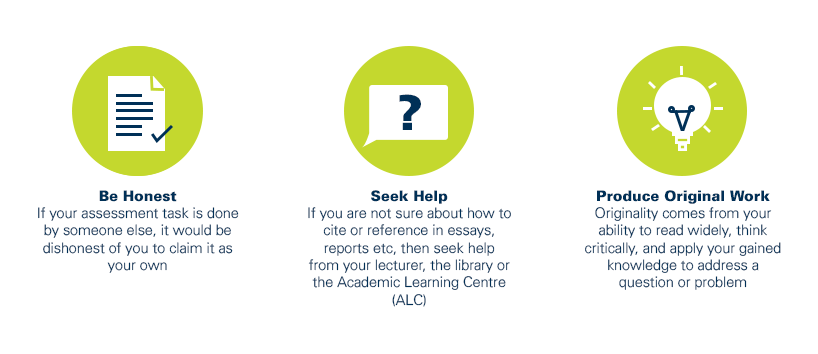
As a CQUniversity student you are expected to act honestly in all aspects of your academic work.
Any assessable work undertaken or submitted for review or assessment must be your own work. Assessable work is any type of work you do to meet the assessment requirements in the unit, including draft work submitted for review and feedback and final work to be assessed.
When you use the ideas, words or data of others in your assessment, you must thoroughly and clearly acknowledge the source of this information by using the correct referencing style for your unit. Using others’ work without proper acknowledgement may be considered a form of intellectual dishonesty.
Participating honestly, respectfully, responsibly, and fairly in your university study ensures the CQUniversity qualification you earn will be valued as a true indication of your individual academic achievement and will continue to receive the respect and recognition it deserves.
As a student, you are responsible for reading and following CQUniversity’s policies, including the Student Academic Integrity Policy and Procedure. This policy sets out CQUniversity’s expectations of you to act with integrity, examples of academic integrity breaches to avoid, the processes used to address alleged breaches of academic integrity, and potential penalties.
What is a breach of academic integrity?
A breach of academic integrity includes but is not limited to plagiarism, self-plagiarism, collusion, cheating, contract cheating, and academic misconduct. The Student Academic Integrity Policy and Procedure defines what these terms mean and gives examples.
Why is academic integrity important?
A breach of academic integrity may result in one or more penalties, including suspension or even expulsion from the University. It can also have negative implications for student visas and future enrolment at CQUniversity or elsewhere. Students who engage in contract cheating also risk being blackmailed by contract cheating services.
Where can I get assistance?
For academic advice and guidance, the Academic Learning Centre (ALC) can support you in becoming confident in completing assessments with integrity and of high standard.
What can you do to act with integrity?