Overview
The landscape of business, industry, and professional sectors is rapidly evolving, with emerging trends highlighting the essential capabilities required for graduate-level roles. To meet these changing expectations, this unit will prepare you for professional practice by developing the skills, knowledge, and attributes valued by both employers and clients. You will engage in self-awareness activities to better understand your strengths and career aspirations, and explore the expectations placed on professionals in your chosen field. You will learn how to craft targeted applications, refine your presentation techniques, and build a personal portfolio to support your career goals. You will also learn to use web-based technologies strategically to research opportunities and secure professional engagements. In addition, the unit will guide you through the ethical responsibilities, workplace norms, and mutual expectations that shape professional environments. This comprehensive preparation will support your confident transition into your chosen profession.
Details
Pre-requisites or Co-requisites
Students must successfully complete their first workplace learning / internship, BUSN12001 Business Internship, prior to commencing this unit.
Important note: Students enrolled in a subsequent unit who failed their pre-requisite unit, should drop the subsequent unit before the census date or within 10 working days of Fail grade notification. Students who do not drop the unit in this timeframe cannot later drop the unit without academic and financial liability. See details in the Assessment Policy and Procedure (Higher Education Coursework).
Offerings For Term 2 - 2026
Attendance Requirements
All on-campus students are expected to attend scheduled classes - in some units, these classes are identified as a mandatory (pass/fail) component and attendance is compulsory. International students, on a student visa, must maintain a full time study load and meet both attendance and academic progress requirements in each study period (satisfactory attendance for International students is defined as maintaining at least an 80% attendance record).
Recommended Student Time Commitment
Each 6-credit Undergraduate unit at CQUniversity requires an overall time commitment of an average of 12.5 hours of study per week, making a total of 150 hours for the unit.
Class Timetable
Assessment Overview
Assessment Grading
This is a graded unit: your overall grade will be calculated from the marks or grades for each assessment task, based on the relative weightings shown in the table above. You must obtain an overall mark for the unit of at least 50%, or an overall grade of 'pass' in order to pass the unit. If any 'pass/fail' tasks are shown in the table above they must also be completed successfully ('pass' grade). You must also meet any minimum mark requirements specified for a particular assessment task, as detailed in the 'assessment task' section (note that in some instances, the minimum mark for a task may be greater than 50%). Consult the University's Grades and Results Policy for more details of interim results and final grades.
All University policies are available on the CQUniversity Policy site.
You may wish to view these policies:
- Grades and Results Policy
- Assessment Policy and Procedure (Higher Education Coursework)
- Review of Grade Procedure
- Student Academic Integrity Policy and Procedure
- Academic Progression Policy and Procedure
- Student Refund and Credit Balance Policy and Procedure
- Complaints Policy and Procedure
- Information and Communications Technology Acceptable Use Policy and Procedure
This list is not an exhaustive list of all University policies. The full list of University policies are available on the CQUniversity Policy site.
Feedback, Recommendations and Responses
Every unit is reviewed for enhancement each year. At the most recent review, the following staff and student feedback items were identified and recommendations were made.
Feedback from Have Your Say and unit coordinator.
The current implementation of the selected learning and teaching philosophy works well.
It is recommended that the current unit learning and teaching philosophy and its current unit implementation is continued.
- Critically review and reflect on your skills, abilities, and achievements in relation to your chosen profession
- Appraise your chosen employer's expectations of graduates in your discipline and the career options and pathways available
- Construct skills in the ethical use of artificial intelligence and other new technologies that will assist you in your chosen career path
- Identify and comply with the appropriate ethical and professional standards expected of your chosen discipline.
Alignment of Assessment Tasks to Learning Outcomes
| Assessment Tasks | Learning Outcomes | |||
|---|---|---|---|---|
| 1 | 2 | 3 | 4 | |
| 1 - Written Assessment - 50% | ||||
| 2 - Portfolio - 50% | ||||
Alignment of Graduate Attributes to Learning Outcomes
| Graduate Attributes | Learning Outcomes | |||
|---|---|---|---|---|
| 1 | 2 | 3 | 4 | |
| 1 - Communication | ||||
| 2 - Problem Solving | ||||
| 3 - Critical Thinking | ||||
| 4 - Information Literacy | ||||
| 5 - Team Work | ||||
| 6 - Information Technology Competence | ||||
| 7 - Cross Cultural Competence | ||||
| 8 - Ethical practice | ||||
| 9 - Social Innovation | ||||
| 10 - First Nations Knowledges | ||||
| 11 - Aboriginal and Torres Strait Islander Cultures | ||||
Textbooks
There are no required textbooks.
IT Resources
- CQUniversity Student Email
- Internet
- Unit Website (Moodle)
All submissions for this unit must use the referencing style: American Psychological Association 7th Edition (APA 7th edition)
For further information, see the Assessment Tasks.
g.ilott@cqu.edu.au
Week 1
Begin Date: 13 Jul 2026Module/Topic
Self-Awareness & Career Identity
Chapter
All chapters listed are from:
Creutzmann, A. (2022). *Soft Skills for the Professional Services Industry: Principles, Tasks, and Tools for Success* (1st ed.). John Wiley & Sons, Incorporated.
This book is provided in your e-reading list.
Ch. 1 — Self‐Responsibility;
Ch. 4 — Leverage Strengths
Events and Submissions/Topic
- Reflect on your professional strengths, career aspirations, and the type of accounting work you currently perform.
- Connect your day-to-day experience to your long-term career goals.
- Workbook Week 1.
Week 2
Begin Date: 20 Jul 2026Module/Topic
Employer Expectations in Accounting
Chapter
Ch. 2 — Result Orientation;
Ch. 8 — Setting Goals
Events and Submissions/Topic
- Research what employers in your chosen accounting stream expect from graduate accountants.
- Use published position descriptions and professional body frameworks (CPA Australia, CA ANZ, IPA).
- Workbook Week 2; begin Assessment 1 draft (Part A).
Week 3
Begin Date: 27 Jul 2026Module/Topic
Professional Standards & Ethics
Chapter
Ch. 1 — Self‐Responsibility;
Ch. 6 — Action Orientation
Events and Submissions/Topic
- Explore the APES 110 Code of Ethics for Professional Accountants and the five fundamental principles.
- Understand the consequences of ethical breaches through published case studies.
- Workbook Week 3.
Week 4
Begin Date: 03 Aug 2026Module/Topic
Using AI & Technology Ethically
Chapter
Ch. 16 — Effective Communication Tools;
Introduction — Professionals in a Digital World
Events and Submissions/Topic
- Investigate how generative AI tools are used in accounting practice.
- Draft ethical AI prompts using hypothetical data.
- Evaluate the risks of over-reliance on AI output in a professional context.
- Workbook Week 4; continue Assessment 1 draft.
Week 5
Begin Date: 10 Aug 2026Module/Topic
Career Pathways & Professional Memberships
Chapter
Ch. 8 — Setting Goals;
Ch. 9 — Planning and Organizing
Events and Submissions/Topic
- Compare CPA Australia, CA ANZ, and IPA pathways.
- Understand entry requirements, CPD obligations, and career outcomes.
- Begin mapping your professional development plan.
- Workbook Week 5; finalise Assessment 1 draft.
Week 6
Begin Date: 17 Aug 2026Module/Topic
Crafting Your Professional Story
Chapter
Ch. 15 — Rhetoric;
Ch. 3 — Focus
Events and Submissions/Topic
- Articulate your skills, achievements, and AI capabilities in a structured written format.
- Finalise and submit Assessment 1.
Written Assessment: Critical skills reflection, employer expectations appraisal, and ethical AI prompt demonstration Due: Week 6 Friday (21 Aug 2026) 11:55 pm AEST
Vacation Week
Begin Date: 24 Aug 2026Module/Topic
Chapter
Events and Submissions/Topic
Week 7
Begin Date: 31 Aug 2026Module/Topic
Building Your Portfolio — Structure & Purpose
Chapter
Ch. 7 — Marketing;
Ch. 3 — Focus
Events and Submissions/Topic
- Plan a professional portfolio that showcases your skills without disclosing confidential information.
- Draft your professional statement and identify appropriate work samples to include.
- Workbook Week 7; begin Assessment 2 artefact collection.
Week 8
Begin Date: 07 Sep 2026Module/Topic
Workplace Norms, Professionalism & Conduct
Chapter
Ch. 11 — Developing and Promoting People;
Ch. 12 — Control
Events and Submissions/Topic
- Explore the formal and informal expectations of accounting workplaces.
- Address communication norms, conduct standards, and navigating professional culture.
- Workbook Week 8.
Week 9
Begin Date: 14 Sep 2026Module/Topic
AI Prompting Mastery for Accounting Professionals
Chapter
Ch. 16 — Effective Communication Tools;
Ch. 10 — Decision Making
Events and Submissions/Topic
- Develop advanced, ethical AI prompt-writing skills for accounting tasks.
- Critically evaluate AI outputs and apply professional judgement before use. All prompts use hypothetical data only.
- Workbook Week 9; continue Assessment 2 artefacts.
Week 10
Begin Date: 21 Sep 2026Module/Topic
Presenting Your Professional Self
Chapter
Ch. 7 — Marketing;
Ch. 15 — Rhetoric
Events and Submissions/Topic
- Build your professional presence through LinkedIn, personal branding, and networking skills.
- Develop an elevator pitch for professional contexts.
- Workbook Week 10.
Week 11
Begin Date: 28 Sep 2026Module/Topic
Integrating Learning — Portfolio Refinement
Chapter
Ch. 17 — Work‐Life‐Balanced‐Scorecard;
Ch. 13 — Self‐Management
Events and Submissions/Topic
- Draw together your 12-week learning journey.
- Review portfolio artefacts against all four learning outcomes.
- Seek and record mentor feedback. Confirm no confidential information is included.
- Workbook Week 11; Assessment 2 final preparation.
Week 12
Begin Date: 05 Oct 2026Module/Topic
Transition to Practice — Portfolio Submission
Chapter
Conclusion — Outlook into the Future;
Ch. 5 — Think Positively
Events and Submissions/Topic
- Reflect on your development as an emerging accounting professional.
- Set professional development goals for the next 12 months.
- Submit Assessment 2.
Portfolio: Work samples and structured reflections demonstrating professional development Due: Week 12 Friday (9 Oct 2026) 11:55 pm AEST
Exam Week
Begin Date: 12 Oct 2026Module/Topic
Chapter
Events and Submissions/Topic
Vacation/Exam Week
Begin Date: 19 Oct 2026Module/Topic
Chapter
Events and Submissions/Topic
1 Written Assessment
Assessment 1 asks you to bring together your learning results from Weeks 1 to 6 and produce a coherent written account of your professional development as an emerging accounting professional. It is not a summary of unit content. It is a critical, evidence-based reflection on who you are as a professional, what your profession expects of you, how you are developing the capabilities to meet those expectations, and how you can use AI tools ethically in your practice.
The assessment is designed to be completed by students who are currently working in an accounting role. All workplace references must be in general terms — describing the *type* of work you do without identifying clients, employer systems, or any confidential information.
Week 6 Friday (21 Aug 2026) 11:55 pm AEST
Week 8 Friday (11 Sept 2026)
This return date only applies to submission made by the due date and time.
The following table sets out the marking criteria for Assessment 1. Each criterion is weighted as a percentage of the total assessment mark. Your mark for each criterion will reflect the grade descriptor that best describes the quality of your work in that area.
| Criterion | Weight | HD (85–100%) | D (75–84%) | C (65–74%) | P (50–64%) | F (Below 50%) |
|---|---|---|---|---|---|---|
| A1. Depth and quality of critical reflection (LO1) | 20% | Demonstrates exceptional originality and insight; moves well beyond experience to analyse what it reveals about professional identity and trajectory; scholarly and surprising perspectives evident throughout | Identifies and debates deeper implications of professional experience; reflects on development over time with genuine critical awareness and analytical depth | Goes beyond describing tasks to analyse what experience has developed; demonstrates understanding of the distinction between task description and capability analysis | Reflects on professional capabilities with reference to workplace experience; identifies some strengths and gaps; satisfactory level of critical engagement | Primarily descriptive; lists tasks without analysing what they develop; minimal or no critical reflection |
| A2. Honesty and specificity of self-assessment (LO1) | 10% | Self-assessment is unusually candid and precise; strengths and development gaps identified with specific evidence and genuine insight; demonstrates evaluative maturity | Clear and specific self-assessment; both strengths and development gaps addressed with supporting evidence; honest about genuine limitations | Self-assessment is generally accurate and supported; some specificity in identifying strengths and gaps; goes beyond surface-level claims | Identifies strengths and development gaps at a satisfactory level; may be vague or uneven in places | Vague assertions without evidence; identifies only achievements or only weaknesses; lacks credibility |
| A3. Connection to employer expectations and professional body frameworks (LO1, LO2) | 10% | Scholarly and precise connection to employer expectations and professional body frameworks; demonstrates deep understanding of how self-assessment relates to professional standards; evidence used with originality and insight | Clear and specific connections drawn; self-assessment explicitly mapped to employer expectations and professional body requirements with analytical depth | Connects self-assessment to employer expectations and professional body frameworks with adequate analytical depth | Makes basic connections to employer expectations and membership requirements; satisfactory alignment | Little or no connection to employer expectations or professional body frameworks |
| B1. Quality of employer expectations appraisal (LO2) | 15% | Exceptional critical appraisal of employer expectations; draws on a range of high-quality sources; analyses tensions and nuances; demonstrates original synthesis across the research | Thorough and well-evidenced appraisal; sources are appropriate and well-used; identifies both explicit and implicit employer expectations | Appraises employer expectations with reference to published sources; demonstrates understanding beyond surface-level reading of position descriptions | Identifies key employer expectations from published sources; satisfactory appraisal with basic evidence | Asserts employer expectations without evidence; relies on opinion; superficial engagement with sources |
| B2. Gap analysis and career pathway appraisal (LO2) | 15% | Gap analysis is unusually precise, honest, and analytically sophisticated; pathway justification demonstrates deep understanding of membership requirements and career trajectory; original insight about professional direction | Clear and honest gap analysis with explicit mapping of capabilities to expectations; well-reasoned pathway justification with specific rationale and awareness of requirements | Gap analysis goes beyond general statements; some mapping of capabilities to requirements; pathway choice is justified with adequate specificity | Satisfactory gap analysis; pathway identified with a basic rationale; covers the required elements | Gap analysis absent or superficial; pathway choice unjustified or not connected to career goals and current experience |
| C1. Quality of AI prompt construction (LO3) | 10% | Prompts are exceptionally well-constructed; demonstrates sophisticated understanding of how context, constraint, and verification instructions shape output quality; original and insightful construction choices evident | Prompts are well-structured with clear rationale for all construction choices; jurisdiction, context, and verification addressed with depth; hypothetical data used throughout | Prompts include key structural elements; construction choices explained with adequate analytical depth; hypothetical data used throughout | Prompts are adequately constructed with basic context and hypothetical data; construction choices explained at a satisfactory level | Prompts are vague or poorly structured; construction choices not explained; real data used; or only one prompt provided |
| C2. Critical evaluation of AI output (LO3) | 10% | Evaluation is exceptionally rigorous and analytically precise; all five dimensions addressed with insight; demonstrates mature professional scepticism and sophisticated judgement | Thorough evaluation across all five dimensions; specific issues with accuracy, currency, or completeness identified; professional judgement clearly and convincingly articulated | Evaluation addresses most of the five dimensions with adequate analytical depth; professional judgement applied | Addresses the AI output with basic critical engagement across most dimensions; professional judgement applied at a satisfactory level | Evaluation absent or superficial; accepts AI output without critical assessment; professional judgement not applied |
| LO4. Integration of professional and ethical standards (LO4) | 10% | Professional and ethical standards are woven throughout with exceptional precision and insight; APES 110 principles applied with scholarly accuracy; the ethical framework is a living, integrated presence in the document | Ethical and professional standards are well integrated throughout; APES 110 principles applied accurately and with analytical depth; connections to real professional contexts are clear and well-reasoned | Professional standards are present in most sections with adequate accuracy; APES 110 referenced correctly; some analytical connection to professional situations evident | Professional and ethical standards referenced and applied at a satisfactory level; APES 110 acknowledged; basic connections to professional context | Professional standards largely absent; APES 110 not referenced or applied inaccurately; ethical framework not evident |
| TOTAL | 100% |
- Critically review and reflect on your skills, abilities, and achievements in relation to your chosen profession
- Appraise your chosen employer's expectations of graduates in your discipline and the career options and pathways available
- Construct skills in the ethical use of artificial intelligence and other new technologies that will assist you in your chosen career path
- Identify and comply with the appropriate ethical and professional standards expected of your chosen discipline.
2 Portfolio
Assessment 2 is a professional portfolio demonstrating your development as an emerging accounting professional across the full 12 weeks of this unit. It is a curated collection of evidence and reflection — not a summary of unit content — that shows what you can do, who you are becoming as a professional, and how your thinking about your career, your capabilities, and your ethical obligations has developed since Week 1.
The portfolio is built progressively from Week 7 through to Week 12. Your weekly workbook activities, Assessment 1, and the research and reflection tasks of the second half of the unit provide the raw material. Your task in Assessment 2 is to select, organise, and present that material as a coherent professional document.
All portfolio content must comply with the workplace confidentiality requirement throughout. No section may contain confidential client information, employer system names, internal financial data, or proprietary processes. Describe the *type* of work you do — not the specific work.
Week 12 Friday (9 Oct 2026) 11:55 pm AEST
Assessments will be returned on Certification Day.
The following table sets out the marking criteria for Assessment 2. Each criterion is weighted as a percentage of the total assessment mark. Your mark for each criterion will reflect the grade descriptor that best describes the quality of your work in that area.
| Criterion | Weight | HD (85–100%) | D (75–84%) | C (65–74%) | P (50–64%) | F (Below 50%) |
|---|---|---|---|---|---|---|
| 1. Professional statement — specificity and authenticity (LO1) | 10% | Exceptionally compelling and specific; demonstrates originality in articulating professional identity; entirely consistent with portfolio evidence; forward-looking and genuinely distinctive | Well-crafted and specific; clearly articulates professional values and direction; consistent with portfolio evidence; demonstrates awareness of personal distinctiveness | Specific and authentic; professional identity is clear; generally consistent with portfolio; goes beyond generic description | Identifies professional context and direction at a satisfactory level; may be somewhat generic but credible | Generic, vague, inconsistent with the rest of the portfolio, or essentially a list of qualifications and roles |
| 2. Skills showcase — quality of artefacts and analytical depth of commentaries (LO1) | 15% | Artefacts are exceptionally well-chosen and demonstrate a sophisticated range of capabilities; commentaries are analytically insightful, move well beyond description, and demonstrate scholarly self-awareness; every artefact is confidentiality-compliant | Artefacts are well-chosen and diverse; commentaries clearly identify capabilities and analyse what each demonstrates; awareness of professional development over time; confidentiality maintained | Three to five appropriate artefacts with commentaries that go beyond description to explain capability; analytical engagement evident; confidentiality maintained | At least three artefacts with satisfactory commentaries identifying a professional capability; basic analytical engagement; confidentiality maintained | Fewer than three artefacts; commentaries are purely descriptive; confidential material included; or artefacts do not demonstrate professional capability |
| 3. Closing reflection — integration and forward orientation (LO1) | 10% | Exceptionally insightful and integrative; draws on the full arc from Week 1 to Week 12 with originality; honest, specific, and forward-oriented in a way that demonstrates genuine professional maturity | Thoughtful and integrative; draws on the arc of the term with specificity and honesty; clearly forward-oriented; demonstrates genuine professional self-awareness | Reflects on the term's learning with adequate integration and specificity; goes beyond recent weeks; forward-oriented | Reflects on the term at a satisfactory level; some integration across the term; forward-oriented | Descriptive or shallow; focused only on recent weeks; not forward-oriented; or absent |
| 4. AI ethics — development and sophistication of prompting practice (LO3) | 10% | Progression from Week 4 is compelling and analytically precise; refined prompts demonstrate exceptional sophistication; the development in AI literacy is substantive, clearly evidenced, and original | Clear and meaningful progression from Week 4; refined prompts are well-constructed with insightful rationale; development is substantive and well-evidenced | Progression is evident; refined prompts demonstrate improved construction; rationale for changes is adequately explained | Some progression from Week 4 is identifiable; revised prompt is better than original with a satisfactory explanation | No meaningful progression shown; prompts not refined; development not demonstrated; or real data used in any prompt |
| 5. AI ethics — critical evaluation of output (LO3) | 10% | Five-point evaluation is exceptionally rigorous and analytically precise; specific issues identified with precision; professional judgement sophisticated and well-articulated; demonstrates scholarly scepticism | Thorough evaluation across all five dimensions; accurate and specific; professional judgement clearly and convincingly articulated | Evaluation addresses most dimensions with adequate depth; professional judgement applied | Basic critical evaluation across most dimensions; professional judgement applied at a satisfactory level | Evaluation absent, superficial, or accepts output uncritically; professional judgement not demonstrated |
| 6. Career pathway — justification and appraisal (LO2) | 10% | Exceptional and specific justification; demonstrates deep understanding of membership requirements and career trajectory; original insight about professional direction; draws on research with scholarly precision | Well-reasoned and specific pathway justification; understanding of requirements is clear and accurate; draws on research appropriately | Justified with some specificity; demonstrates adequate understanding of membership requirements and their fit with current experience | Pathway identified with a satisfactory rationale; basic but credible understanding of requirements | Pathway not justified or not connected to career goals and current experience; requirements not meaningfully addressed |
| 7. Career pathway — capability map and goal quality (LO2) | 10% | Capability map is unusually precise and honest; goals are specific, appropriately challenging, realistic, and connected to membership requirements with clear evidence markers; demonstrates planning maturity | Clear and honest capability map; goals are specific and well-structured with all four elements present — what, how, by when, and evidence | Capability map is generally accurate; goals are specific with most elements present; adequate planning depth | Satisfactory capability map; goals include most required elements; acceptable level of specificity | Capability map absent or vague; goals are aspirational rather than specific and actionable; required elements missing |
| 8. Ethical standards reflection — applied professional understanding (LO4) | 15% | Genuinely insightful and analytically sophisticated reflection; applies APES 110 principles with precision and originality to specific professional situations; demonstrates that ethics is a deeply integrated professional orientation, not compliance knowledge | Thoughtful and specific reflection; connects APES 110 accurately and in depth to professional situations; demonstrates genuine development in ethical understanding from Week 3 | Reflective and goes beyond summary of Week 3 content; connects to APES 110 with accuracy and some applied professional understanding | Reflects on ethical standards at a satisfactory level; references APES 110 correctly; basic applied understanding | Summarises ethical principles without applying them; makes inaccurate claims about APES 110; generic or indistinguishable |
| 9. Mentor commentary — substantiveness and professional credibility (LO1, LO2, LO4) | 5% | Substantive, specific, and independently written commentary providing genuine professional insight into the student's development; signed, dated, and entirely free of confidential workplace material | Well-developed commentary addressing professional conduct and development with specificity and professional credibility; signed and dated | Adequate commentary addressing professional engagement and development; signed and dated; written in the mentor's own voice | Satisfactory commentary confirming professional engagement and development; signed and dated | Absent; unsigned or undated; token acknowledgement only; or contains confidential workplace material |
| 10. Portfolio coherence — unified professional narrative (all LOs) | 5% | Exceptionally coherent professional narrative; sections reinforce and build on each other with originality; the whole is greater than the sum of its parts; a compelling and consistent portrait of one developing professional | Well-integrated portfolio; sections are consistent and connected; reads as a unified professional document with clear thematic continuity | Sections are generally consistent; connections evident; reads as an integrated document at an adequate level | Sections are present and satisfactory; basic coherence; no significant inconsistencies | Sections are disconnected or contradictory; portfolio reads as unrelated submissions assembled together |
| TOTAL | 100% |
- Critically review and reflect on your skills, abilities, and achievements in relation to your chosen profession
- Appraise your chosen employer's expectations of graduates in your discipline and the career options and pathways available
- Construct skills in the ethical use of artificial intelligence and other new technologies that will assist you in your chosen career path
- Identify and comply with the appropriate ethical and professional standards expected of your chosen discipline.
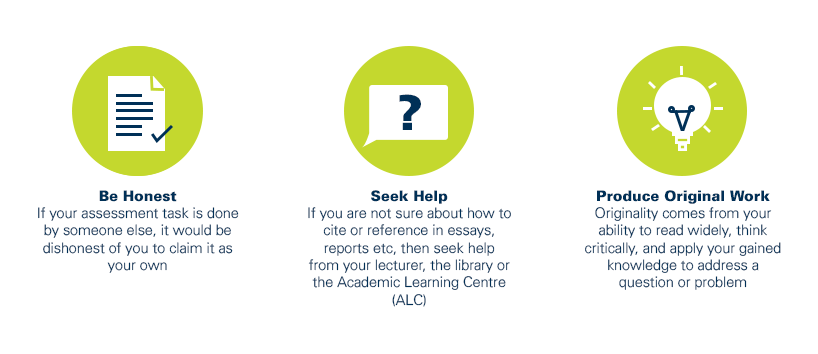
As a CQUniversity student you are expected to act honestly in all aspects of your academic work.
Any assessable work undertaken or submitted for review or assessment must be your own work. Assessable work is any type of work you do to meet the assessment requirements in the unit, including draft work submitted for review and feedback and final work to be assessed.
When you use the ideas, words or data of others in your assessment, you must thoroughly and clearly acknowledge the source of this information by using the correct referencing style for your unit. Using others’ work without proper acknowledgement may be considered a form of intellectual dishonesty.
Participating honestly, respectfully, responsibly, and fairly in your university study ensures the CQUniversity qualification you earn will be valued as a true indication of your individual academic achievement and will continue to receive the respect and recognition it deserves.
As a student, you are responsible for reading and following CQUniversity’s policies, including the Student Academic Integrity Policy and Procedure. This policy sets out CQUniversity’s expectations of you to act with integrity, examples of academic integrity breaches to avoid, the processes used to address alleged breaches of academic integrity, and potential penalties.
What is a breach of academic integrity?
A breach of academic integrity includes but is not limited to plagiarism, self-plagiarism, collusion, cheating, contract cheating, and academic misconduct. The Student Academic Integrity Policy and Procedure defines what these terms mean and gives examples.
Why is academic integrity important?
A breach of academic integrity may result in one or more penalties, including suspension or even expulsion from the University. It can also have negative implications for student visas and future enrolment at CQUniversity or elsewhere. Students who engage in contract cheating also risk being blackmailed by contract cheating services.
Where can I get assistance?
For academic advice and guidance, the Academic Learning Centre (ALC) can support you in becoming confident in completing assessments with integrity and of high standard.
What can you do to act with integrity?