Overview
In this unit, you will be introduced to curriculum frameworks and a range of pedagogical and assessment approaches for teaching and using Technologies and The Arts in primary school learning environments. Through investigation of the five areas of the Australian Curriculum: The Arts, namely, Dance, Drama, Media Arts, Music and Visual Arts, you will gain personal and practical experience in using the different symbol systems and ways of understanding and representing the world that The Arts provide and build your understanding of how arts practice relates to the formation and expression of social values, beliefs and identity. Through exploration of the two areas of Australian Curriculum: Technologies, you will be introduced to the nature of learning in Design and Technologies where you will use design thinking and technologies to generate and produce designed solutions for authentic needs and opportunities, as well as Digital Technologies where you will use computational thinking and information systems to define, design and implement digital solutions. The unit will equip you with dispositions for valuing the use of Technologies and The Arts for effective teaching and learning and with a working knowledge of some fundamental tools that can be applied across curriculum learning areas. You will also explore a range of tools that enhance and promote effective engagement through problem-solving, creative thinking and collaboration.
Details
Pre-requisites or Co-requisites
There are no requisites for this unit.
Important note: Students enrolled in a subsequent unit who failed their pre-requisite unit, should drop the subsequent unit before the census date or within 10 working days of Fail grade notification. Students who do not drop the unit in this timeframe cannot later drop the unit without academic and financial liability. See details in the Assessment Policy and Procedure (Higher Education Coursework).
Offerings For Term 1 - 2026
Attendance Requirements
All on-campus students are expected to attend scheduled classes - in some units, these classes are identified as a mandatory (pass/fail) component and attendance is compulsory. International students, on a student visa, must maintain a full time study load and meet both attendance and academic progress requirements in each study period (satisfactory attendance for International students is defined as maintaining at least an 80% attendance record).
Recommended Student Time Commitment
Each 6-credit Postgraduate unit at CQUniversity requires an overall time commitment of an average of 12.5 hours of study per week, making a total of 150 hours for the unit.
Class Timetable
Assessment Overview
Assessment Grading
This is a graded unit: your overall grade will be calculated from the marks or grades for each assessment task, based on the relative weightings shown in the table above. You must obtain an overall mark for the unit of at least 50%, or an overall grade of 'pass' in order to pass the unit. If any 'pass/fail' tasks are shown in the table above they must also be completed successfully ('pass' grade). You must also meet any minimum mark requirements specified for a particular assessment task, as detailed in the 'assessment task' section (note that in some instances, the minimum mark for a task may be greater than 50%). Consult the University's Grades and Results Policy for more details of interim results and final grades.
All University policies are available on the CQUniversity Policy site.
You may wish to view these policies:
- Grades and Results Policy
- Assessment Policy and Procedure (Higher Education Coursework)
- Review of Grade Procedure
- Student Academic Integrity Policy and Procedure
- Academic Progression Policy and Procedure
- Student Refund and Credit Balance Policy and Procedure
- Complaints Policy and Procedure
- Information and Communications Technology Acceptable Use Policy and Procedure
This list is not an exhaustive list of all University policies. The full list of University policies are available on the CQUniversity Policy site.
Feedback, Recommendations and Responses
Every unit is reviewed for enhancement each year. At the most recent review, the following staff and student feedback items were identified and recommendations were made.
Feedback from Student response
Forum engagement
Engage with student forum postings to offer support more frequently.
- Create plans and resources for learning in and through The Arts using the processes of making, presenting and responding to artworks
- Justify the selection of resources and strategies for making and responding to artworks through reference to the rationale and intent underpinning Arts education
- Critically reflect upon the positive contribution of The Arts in education and to participation in contemporary society
- Create plans and resources for learning in and through Design Technology through the creation and evaluation of designed solutions using the technology design process
- Justify the selection of authentic learning challenges to develop computational thinking, and to use and develop information systems confidently, ethically and safely
- Develop and present strategies and materials to develop systems thinking in Design and Digital Technology in order to predict and shape preferred futures.
Successful completion of this unit provides opportunities for students to demonstrate the Australian Professional Standards for Teachers focus areas of:
1.2 Understand how students learn
1.6 Strategies to support full participation of students with disability
2.1 Content and teaching strategies of the teaching area
2.6 Information and Communication Technology (ICT)
3.1 Establish challenging learning goals
3.2 Plan, structure and sequence learning programs
3.4 Select and use resources
3.6 Evaluate and improve teaching programs
4.1 Support student participation
5.1 Assess student learning
6.4 Apply professional learning and improve student learning
Alignment of Assessment Tasks to Learning Outcomes
| Assessment Tasks | Learning Outcomes | |||||
|---|---|---|---|---|---|---|
| 1 | 2 | 3 | 4 | 5 | 6 | |
| 1 - Group Work - 50% | ||||||
| 2 - Portfolio - 50% | ||||||
Alignment of Graduate Attributes to Learning Outcomes
| Graduate Attributes | Learning Outcomes | |||||
|---|---|---|---|---|---|---|
| 1 | 2 | 3 | 4 | 5 | 6 | |
| 1 - Knowledge | ||||||
| 2 - Communication | ||||||
| 3 - Cognitive, technical and creative skills | ||||||
| 4 - Research | ||||||
| 5 - Self-management | ||||||
| 6 - Ethical and Professional Responsibility | ||||||
| 7 - Leadership | ||||||
| 8 - First Nations Knowledges | ||||||
| 9 - Aboriginal and Torres Strait Islander Cultures | ||||||
Textbooks
There are no required textbooks.
IT Resources
- CQUniversity Student Email
- Internet
- Unit Website (Moodle)
All submissions for this unit must use the referencing style: American Psychological Association 7th Edition (APA 7th edition)
For further information, see the Assessment Tasks.
e.killion@cqu.edu.au
Week 1
Begin Date: 09 Mar 2026Module/Topic
Topic 1 - Course intro, creativity and innovation, Challenges and Task 1 intro
Chapter
ACARA. Australian Curriculum: The Arts.
A range of readings about The Arts, curriculum and research.
Deasy, Richard J. "Critical links: Learning in the arts and student achievement and social development." Washington, DC: AEP (2002).
Ewing, R. (2020). The Australian Curriculum: The Arts. A critical opportunity Curriculum Perspectives, 2020.
Ewing, R. (2011). The arts and Australian education: Realising potential. Melbourne: ACER.
Robinson, K., & Azzam, A. M. (2009). Why Creativity Now?. Educational Leadership, 67(1), 22-26
Events and Submissions/Topic
Week 2
Begin Date: 16 Mar 2026Module/Topic
Topic 2 - Visual Arts
Chapter
ACARA. Australian Curriculum: The Arts.
Visual Arts
Events and Submissions/Topic
Week 3
Begin Date: 23 Mar 2026Module/Topic
Topic 3 - Media Arts
Chapter
ACARA. Australian Curriculum: The Arts.
Events and Submissions/Topic
Week 4
Begin Date: 30 Mar 2026Module/Topic
Topic 4 - Drama
Chapter
ACARA. Australian Curriculum: The Arts. Drama
Events and Submissions/Topic
Week 5
Begin Date: 06 Apr 2026Module/Topic
Topic 5 & 6 - Dance and Music
Chapter
ACARA. Australian Curriculum: The Arts.
Dance and Music
Events and Submissions/Topic
Week 6
Begin Date: 13 Apr 2026Module/Topic
Topic 7 - Introduction to Technologies (Design Technologies & Task 2 overview)
Chapter
ACARA. Australian Curriculum: Technologies (Design Technologies)
A range of readings about Design & Digital Technologies:
Koh, J. H. L., Chai, C. S., Wong, B., & Hong, H. Y. (2015). Design Thinking and Education. In Design Thinking for Education (pp. 1-15). Springer Singapore.
Williams, P. J., & Stables, K. (Eds.). (2017). Critique in design and technology education. Springer Singapore.
The Conversation - various articles
Events and Submissions/Topic
Vacation Week
Begin Date: 20 Apr 2026Module/Topic
Chapter
Events and Submissions/Topic
Week 7
Begin Date: 27 Apr 2026Module/Topic
Topic 8 - Design technologies - sustainability, ethics and safety
Chapter
ACARA. Australian Curriculum: Technologies (Design Technologies)
Events and Submissions/Topic
Week 8
Begin Date: 04 May 2026Module/Topic
Topic 9 - Digital technologies & computational thinking
Chapter
ACARA. Australian Curriculum: Technologies (Digital Technologies)
Sterling, L (2015). An Education for the 21st Century means Teaching Coding in Schools. The Conversation.
Resnick, M., Maloney, J., Monroy-Hernández, A., Rusk, N., Eastmond, E., Brennan, K., ... & Kafai, Y. (2009). Scratch: programming for all. Communications of the ACM, 52(11), 60-67.
Events and Submissions/Topic
Week 9
Begin Date: 11 May 2026Module/Topic
Topic 10 - Digital technologies & coding
Chapter
ACARA. Australian Curriculum: Technologies (Digital Technologies)
Koh, J. H. L., Chai, C. S., Benjamin, W., & Hong, H. Y. (2015). Technological Pedagogical Content Knowledge (TPACK) and design thinking: A framework to support ICT lesson design for 21st century learning. The Asia-Pacific Education Researcher, 24(3), 535-543
Events and Submissions/Topic
1 Group Work
|
1. Complete two of the arts challenges (including at least one visual arts and one performing arts). The challenges are used to support your own practice-based learning in the arts and are based on activities you can then translate for the classroom. You set up and use your own blog to document your process and outcomes. 2.. Create a digital resource package to support arts learning for children in a specific band of schooling (as related to the Australian Curriculum: The Arts). Focus on the concept of either ‘Identity’ or ‘Place’ and build upon the work of one of your arts challenges. The package is to include materials to support learning for 3 lessons. The design and presentation of the package is also important and should show application of visual arts and design principles. The package should include: * A written justification of no more than 500 words that introduces your package and demonstrates your understanding of the purposes of the arts (reflecting key ideas in for example the Australian Curriculum: The Arts rationale), contributions the arts make to learning, including social values, beliefs and personal identity. You also need to identify the learning intentions for the package as related to The Arts curriculum at a chosen band/year level. This section should include references to relevant academic literature as well as curriculum documents. * Teacher resource – This should identify curriculum context and focus, lesson sequence/s and activities for the 3 lessons, and any resource materials required for a teacher to facilitate the processes of Making and Responding. * Include at least 2 examples of significant art works or stimulus for the arts area, and include statements/appraisals that introduce these to students. You might also include questions and prompts to engage students in Responding to art works and support the process of making art. In making your selections, consideration must also be given to encouraging learning about social, cultural and historical contexts (including Aboriginal and Torres Strait Islander perspectives and art). * Your package should also include resources that are age appropriate and designed for students. * The materials presented should also show consideration of assessment processes including ways to support ‘assessment as learning’ (formative assessment), and ‘assessment of learning’ (summative assessment). Include an example of what a final project/assessment product might look like (i.e. one that you have personally created – this should be something you created for one of your challenges). * You should also include within your lesson sequence advice about modifications or strategies that support participation and learning of students with disabilities and promote inclusive curriculum (consider Indigenous perspectives as well as gender and cultural diversity). Please upload a URL with your blog posts but also upload a word version of content that can be checked by Turnitin AI Assessment Scale: Level 2 Please note: The 72-Hour grace period applies to this task. |
Week 5 Friday (10 Apr 2026) 11:45 pm AEST
You must upload a document with the URL for your blog. We also require you to cut and paste the copy from your blog and upload it in a word document so that it can be scanned using Turnitin.
Feedback on this assessment response will be provided in sufficient time to allow for academic support and advice as necessary to inform students' responses to the next assessment task.
|
· Completion of arts challenges · Knowledge of Arts curriculum and the value of the arts in education · Skills in selecting and appraising arts learning materials · Application of knowledge and skills to teaching strategies, assessment and modifications · Communication Skills – visual and written communication skills |
- Create plans and resources for learning in and through The Arts using the processes of making, presenting and responding to artworks
- Justify the selection of resources and strategies for making and responding to artworks through reference to the rationale and intent underpinning Arts education
- Critically reflect upon the positive contribution of The Arts in education and to participation in contemporary society
2 Portfolio
|
Part A Design and Digital Technology Challenges and Learning (Approx 2000 words) Your task is to complete a series of design and digital technologies challenges that align to the two curriculum areas of Design Technologies (Challenges 7 & 8) and Digital Technologies (Challenges 9 & 10). (Please note you must complete all the Technology challenges). This work aims to develop practical technology skills, as well as your understanding of the curriculum foundations of Design Technologies and Digital Technologies so you can design, implement and assess quality curriculum for these areas. You also need to show application of design principles in the layout and presentation of your work. You are to maintain your reflective blog (created for Task 1) throughout and document your challenges and learning process including:
Part B Individual Reflection – a ‘Conversation’ style opinion piece Drawing from the unit materials, the Technologies curriculum, independent reading and research; your task is to write an opinion piece in the style of ‘The Conversation’ (http://theconversation.com/au). You need to develop a topic question that relates to technologies within education, this could include issues such as:
Your piece should be no more than 1000 words and be written in an appropriate academic style referring to research and academic reports but should also draw upon examples from your learning, the curriculum and classroom practice. This piece can be presented as a concluding statement on your blog. You must upload a document with the URL for your blog. You are also required to cut and paste the copy from your blog and upload it in a word document so that it can be scanned using Turnitin. AI Assessment Scale: Level 2 Please note: The 72-Hour grace period applies to this assessment task. |
Week 10 Friday (22 May 2026) 11:45 pm AEST
You must upload a document with the URL for your blog. We also require you to cut and paste the copy from your blog and upload it in a word document so that it can be scanned using Turnitin.
This assessment task will be returned to students once the moderation process is complete.
|
· Completion of Technology challenges · Knowledge of Technologies curriculum and issues · Skills in undertaking design and digital technology challenges · Application of knowledge and skills in design and digital technologies pedagogy · Communication Skills – visual literacies and clarity of written communications |
- Create plans and resources for learning in and through Design Technology through the creation and evaluation of designed solutions using the technology design process
- Justify the selection of authentic learning challenges to develop computational thinking, and to use and develop information systems confidently, ethically and safely
- Develop and present strategies and materials to develop systems thinking in Design and Digital Technology in order to predict and shape preferred futures.
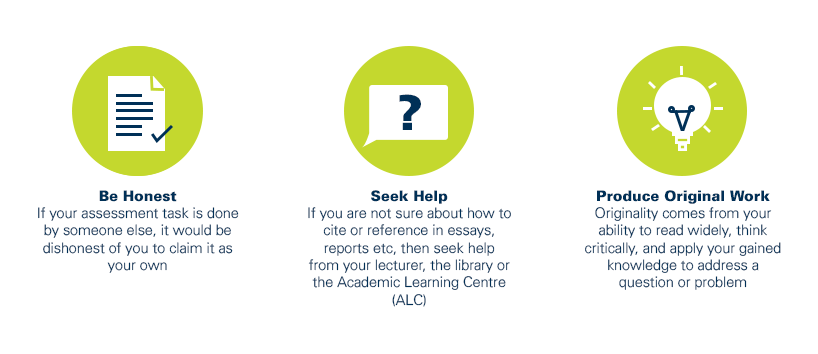
As a CQUniversity student you are expected to act honestly in all aspects of your academic work.
Any assessable work undertaken or submitted for review or assessment must be your own work. Assessable work is any type of work you do to meet the assessment requirements in the unit, including draft work submitted for review and feedback and final work to be assessed.
When you use the ideas, words or data of others in your assessment, you must thoroughly and clearly acknowledge the source of this information by using the correct referencing style for your unit. Using others’ work without proper acknowledgement may be considered a form of intellectual dishonesty.
Participating honestly, respectfully, responsibly, and fairly in your university study ensures the CQUniversity qualification you earn will be valued as a true indication of your individual academic achievement and will continue to receive the respect and recognition it deserves.
As a student, you are responsible for reading and following CQUniversity’s policies, including the Student Academic Integrity Policy and Procedure. This policy sets out CQUniversity’s expectations of you to act with integrity, examples of academic integrity breaches to avoid, the processes used to address alleged breaches of academic integrity, and potential penalties.
What is a breach of academic integrity?
A breach of academic integrity includes but is not limited to plagiarism, self-plagiarism, collusion, cheating, contract cheating, and academic misconduct. The Student Academic Integrity Policy and Procedure defines what these terms mean and gives examples.
Why is academic integrity important?
A breach of academic integrity may result in one or more penalties, including suspension or even expulsion from the University. It can also have negative implications for student visas and future enrolment at CQUniversity or elsewhere. Students who engage in contract cheating also risk being blackmailed by contract cheating services.
Where can I get assistance?
For academic advice and guidance, the Academic Learning Centre (ALC) can support you in becoming confident in completing assessments with integrity and of high standard.
What can you do to act with integrity?