Overview
In Environmental Monitoring you will learn the basics of ecosystem science as well as the research and industry skills necessary to carry out surveys and research in natural and impacted ecosystems. Your study will focus on two iconic Australian ecosystems, the Great Barrier Reef and the Brigalow Belt. The field skills you acquire in this unit will enable you to perform both academic research and industry surveys in ecosystems anywhere in the world. You will apply your knowledge of ecosystems, and animal and plant biology to sample collection, vegetation surveys, animal trapping and identification. You will also begin to learn some basic project management skills including how to legally document your work and to prepare and plan for safe field work. The residential school in this unit will involve animal trapping and will abide by the approved ethics proposal that includes the destructive sampling of some fish and, if caught, the euthanisation of pest species (e.g. cats) as required by law. Students are advised to contact the unit coordinator if they have any concerns with regard to this aspect of the unit. There is an additional cost for the off-campus component of the residential school in this unit.
Details
Pre-requisites or Co-requisites
There are no requisites for this unit.
Important note: Students enrolled in a subsequent unit who failed their pre-requisite unit, should drop the subsequent unit before the census date or within 10 working days of Fail grade notification. Students who do not drop the unit in this timeframe cannot later drop the unit without academic and financial liability. See details in the Assessment Policy and Procedure (Higher Education Coursework).
Offerings For Term 2 - 2026
Attendance Requirements
All on-campus students are expected to attend scheduled classes - in some units, these classes are identified as a mandatory (pass/fail) component and attendance is compulsory. International students, on a student visa, must maintain a full time study load and meet both attendance and academic progress requirements in each study period (satisfactory attendance for International students is defined as maintaining at least an 80% attendance record).
Recommended Student Time Commitment
Each 6-credit Undergraduate unit at CQUniversity requires an overall time commitment of an average of 12.5 hours of study per week, making a total of 150 hours for the unit.
Class Timetable
Assessment Overview
Assessment Grading
This is a graded unit: your overall grade will be calculated from the marks or grades for each assessment task, based on the relative weightings shown in the table above. You must obtain an overall mark for the unit of at least 50%, or an overall grade of 'pass' in order to pass the unit. If any 'pass/fail' tasks are shown in the table above they must also be completed successfully ('pass' grade). You must also meet any minimum mark requirements specified for a particular assessment task, as detailed in the 'assessment task' section (note that in some instances, the minimum mark for a task may be greater than 50%). Consult the University's Grades and Results Policy for more details of interim results and final grades.
All University policies are available on the CQUniversity Policy site.
You may wish to view these policies:
- Grades and Results Policy
- Assessment Policy and Procedure (Higher Education Coursework)
- Review of Grade Procedure
- Student Academic Integrity Policy and Procedure
- Academic Progression Policy and Procedure
- Student Refund and Credit Balance Policy and Procedure
- Complaints Policy and Procedure
- Information and Communications Technology Acceptable Use Policy and Procedure
This list is not an exhaustive list of all University policies. The full list of University policies are available on the CQUniversity Policy site.
Feedback, Recommendations and Responses
Every unit is reviewed for enhancement each year. At the most recent review, the following staff and student feedback items were identified and recommendations were made.
Feedback from Student
Video links need to be in one place.
The links to ECHO360 will be removed from Weekly tiles so that all links to weekly video material are in the Virtual Lectures tile.
Feedback from Student
Proof check due dates on Moodle.
Check and recheck dates against the Unit Profile. Reduce due dates to three places on each Moodle page (UP, Assessment Tile summary, and each assessment item).
Feedback from Student
Update video resources.
Lectures will be updated and refreshed, including the Great Barrier Reef, Brigalow Belt, Micrometeorology and Geochemical Cycles lectures.
Feedback from Unit Coordinator
Need to install permanent infrastructure (mainly survey posts) to allow students to make year to year comparisons in their residential school reports.
We will work with Woppaburra and GKI Hideaway to install permanent stakes/benchmarks for the beach profile exercise, the carbon monitoring project and the terrestrial vertebrate trapping module.
Feedback from Unit Coordinator
Invented citations in the Residential School Reports are a growing issue.
All scientific literature citations need to be accompanied by a clickable DOI link to ensure invented citations are minimized. Students will need to indicate the page and paragraph the cited item originates from.
Feedback from Unit Coordinator
Students still need help on report writing basics (making figures and tables, citation, basic report structure.
Bring back the School of Access Education tutorial sessions as in 2023.
- Describe the basic concepts of ecological populations and communities
- Identify the defining characteristics of biomes and ecosystems
- Measure biotic and abiotic characteristics of ecosystem communities using appropriate field methods
- Collate, summarise and present data collected in the field
- Adhere to Australian environmental and work, health and safety legislation.
Alignment of Assessment Tasks to Learning Outcomes
| Assessment Tasks | Learning Outcomes | ||||
|---|---|---|---|---|---|
| 1 | 2 | 3 | 4 | 5 | |
| 1 - Online Quiz(zes) - 30% | |||||
| 2 - Laboratory/Practical - 20% | |||||
| 3 - Report - 50% | |||||
Alignment of Graduate Attributes to Learning Outcomes
| Graduate Attributes | Learning Outcomes | ||||
|---|---|---|---|---|---|
| 1 | 2 | 3 | 4 | 5 | |
| 1 - Communication | |||||
| 2 - Problem Solving | |||||
| 3 - Critical Thinking | |||||
| 4 - Information Literacy | |||||
| 5 - Team Work | |||||
| 6 - Information Technology Competence | |||||
| 7 - Cross Cultural Competence | |||||
| 8 - Ethical practice | |||||
| 9 - Social Innovation | |||||
| 10 - First Nations Knowledges | |||||
| 11 - Aboriginal and Torres Strait Islander Cultures | |||||
Alignment of Assessment Tasks to Graduate Attributes
| Assessment Tasks | Graduate Attributes | ||||||||||
|---|---|---|---|---|---|---|---|---|---|---|---|
| 1 | 2 | 3 | 4 | 5 | 6 | 7 | 8 | 9 | 10 | 11 | |
| 1 - Online Quiz(zes) - 30% | |||||||||||
| 2 - Laboratory/Practical - 20% | |||||||||||
| 3 - Report - 50% | |||||||||||
Textbooks
Ecology: The Economy of Nature
- Edition: 10th edn or above (2025)
- Authors: Rick Relyea
- MacMillan Learning
- New York New York , NY , USA
- ISBN: 978-1319245542
8th or 9th edition are also acceptable, but page numbering and chapters may be different.
- Binding: Paperback
IT Resources
- CQUniversity Student Email
- Internet
- Unit Website (Moodle)
All submissions for this unit must use the referencing style: Harvard (author-date)
For further information, see the Assessment Tasks.
n.english@cqu.edu.au
Module/Topic
Chapter
Events and Submissions/Topic
Week 1
Begin Date: 13 Jul 2026Module/Topic
Ecology and the Scientific Method
Adaptations to Terrestrial and Aquatic Environments
Chapter
Chapter 1. Introduction: Ecology, Evolution, and the Scientific Method (p 1-29).
Chapter 2. Adaptations to Aquatic Environments (p 30-53).
Events and Submissions/Topic
Text Book (any edition from 6th up should be ok)
Ecology: The Economy of Nature
by Robert E. Ricklefs and Rick Relyea
W.H.Freeman & Co Ltd, United States
ISBN:9781319187729
CQU Library 577.39 1/2018
Week 2
Begin Date: 20 Jul 2026Module/Topic
Random and Non-Random Factors
Selection, Evolution and Limiting Factors.
Chapter
Chapter 7. Evolution and Adaptation (p 152 - 175).
Events and Submissions/Topic
Week 3
Begin Date: 27 Jul 2026Module/Topic
Life Histories and Reproductive Strategies.
Chapter
Chapter 8. Sex and Evolution.
Events and Submissions/Topic
Theory Quiz A will open Wednesday Week 3, 9:00AM AEST.
Week 4
Begin Date: 03 Aug 2026Module/Topic
Competition and Dispersal.
Populations and Population Growth.
Chapter
Chapter 11. Population Distributions (p 240 - 263).
Chapter 12. Population Growth and Regulation (p 264 - 287).
Chapter 16. Competition (p 360 - 405).
Readings on Moodle.
Events and Submissions/Topic
Theory Quiz A will close on Wednesday Week 4, 11:59PM AEST.
Residential School Payment due by Friday Week 4, 5:00PM AEST.
Week 5
Begin Date: 10 Aug 2026Module/Topic
Trophic Levels and Food Webs
Chapter
Chapter 18. Community Structure. (p406-433)
Events and Submissions/Topic
Week 5
Begin Date: 17 Aug 2026Module/Topic
Survey and Sample Design & Techniques
Micrometeorological Monitoring & the BOM
Preparation Residential School Activities: Terrestrial and Aquatic sampling
Chapter
Readings on Moodle.
Events and Submissions/Topic
Pre-Residential school online quiz Opens Tuesday, 11:59PM AEST. Closes Friday before Residential School A.
Vacation Week
Begin Date: 24 Aug 2026Module/Topic
Chapter
Events and Submissions/Topic
Pre-Residential school online quiz Due Friday, 11:59PM AEST.
Week 7 Residential School A
Begin Date: 31 Aug 2026Module/Topic
Residential School A
No Lectures this week.
Chapter
Events and Submissions/Topic
Residential School A begins Monday, Aug 31st at 8:30AM at the Keppel Bay Marina and continues on Woppa (Great Keppel Island Hideaway resort) for five days/four nights of field work. Students return by ferry to Keppel Bay Marina at 2:30PM on Sept 4th.
Students enrolled in CHEM11044 (Chemical Rxns) or other units with res schools and travelling from outside the Rockhampton region are encouraged to check timetabling and to enrol in the residential school that minimizes the travel you will need to undertake.
Week 8 Residential School B
Begin Date: 07 Sep 2026Module/Topic
Residential School B
No Lectures this week.
Chapter
Events and Submissions/Topic
Residential School B begins Monday, Sept 7th at 8:30AM at the Keppel Bay Marina and continues on Woppa (Great Keppel Island Hideaway resort) for five days/four nights of field work. Students return by ferry to Keppel Bay Marina at 2:30PM on Sept 11th.
Students enrolled in CHEM11044 (Chemical Rxns) or other units with res schools and travelling from outside the Rockhampton region are encouraged to check timetabling and to enrol in the residential school that minimizes the travel you will need to undertake.
Week 9
Begin Date: 14 Sep 2026Module/Topic
Biogeochemical Cycles
Chapter
Chapter 21. Movements of Elements in Ecosystems (p 481-505).
Events and Submissions/Topic
For students who attended Residential School A, Residential School Results and Discussion are due Monday Week 9, 11:59PM AEST.
Theory Quiz B will open Wednesday Week 9, 9:00AM AEST.
Week 10
Begin Date: 21 Sep 2026Module/Topic
Aquatic Ecosystems and Biomes: The Great Barrier Reef
Chapter
Chapter 6. Terrestrial and Aquatic Biomes (p 130 - 151).
Events and Submissions/Topic
For students who attended Residential School B, Residential School Results and Discussion are due Monday Week 10, 11:59PM AEST.
Theory Quiz B will close on Wednesday Week 10, 11:59PM AEST.
Week 11
Begin Date: 28 Sep 2026Module/Topic
Terrestrial Ecosystems and Biomes: Brigalow Belt.
Chapter
Chapter 6. Terrestrial and Aquatic Biomes (p 130 - 151).
Events and Submissions/Topic
Week 12
Begin Date: 05 Oct 2026Module/Topic
Environmental Monitoring: Innovation and Practice
Chapter
Readings on Moodle
Events and Submissions/Topic
Theory Quiz C will close Friday Week 12, 11:59PM AEST.
Exam Week
Begin Date: 12 Oct 2026Module/Topic
Chapter
Events and Submissions/Topic
Vacation/Exam Week
Begin Date: 19 Oct 2026Module/Topic
Chapter
Events and Submissions/Topic
1 Online Quiz(zes)
These periodic quizzes are based on lecture and study material from previous weeks (so please revise the lecture and reading material associated with the weeks covered by the quiz).
For ALL students, Theory Quizzes open the Wednesday after the weeks' covered in the quiz (e.g. Theory Quiz A covers Weeks 1-3, so opens on Wednesday in Week 3) and is open for 1 week. The 72 hour grace period does not apply to this assessment.
The Theory Quizzes are limited to 30 minutes for completion; make sure to submit within the 30 minutes.
You can attempt each quiz once.
Questions are true/false, multiple choice, mix-and-match and other formats. Because the questions are drawn at random from a question bank you will likely receive different questions from your peers. You must not share your quiz questions or answers with other students as this may disadvantage other students and is considered academic misconduct.
Level of GenAI use allowed:
Level 1: You must not use Al at any point during the assessment. You must demonstrate your core skills and knowledge.
Theory Quiz A will close on Wednesday Week 4, 11:59PM AEST. Theory Quiz B will close on Wednesday Week 10, 11:59PM AEST. Theory Quiz C will close on Friday, Week 12, 11:59PM AEST.
Theory quiz results will be made available to students upon completion of the quiz.
Correctness of answers.
- Describe the basic concepts of ecological populations and communities
- Identify the defining characteristics of biomes and ecosystems
- Communication
- Problem Solving
- Critical Thinking
- Critical Thinking
2 Laboratory/Practical
You will complete a pre-residential school online quiz (9% of total unit mark) by the Friday before Residential School A, and then a series of tasks in the field and associated activities during the residential school. The quiz will cover material and knowledge needed to carry out field work effectively, ethically, and in a culturally appropriate manner. Field work activities (11% of total unit mark) at the residential school will address animal monitoring skills (e.g. trapping and analysis), aquatic monitoring skills, (e.g. BRUVs), vegetation monitoring skills (e.g. vegetation transects and specimen collection and ID), and peripheral skills (e.g. GPS and Risk Assessment).
During or after each field activity, you will present your work to a supervisor for marking and feedback. It is important that you make sure that all required skills checks are completed and signed off on at the end of each activity or day. These sheets are due at the end of the residential school before students depart the island.
The 72 hour grace period does not apply to any portion of this assessment.
Level of GenAI use allowed:
Level 1: You must not use Al at any point during the assessment. You must demonstrate your core skills and knowledge.
Pre-residential school online quiz will open on Monday, Week 6 and close the Friday before Residential School A begins. Skills checks and workbooks will be checked/marked during or at the end of each activity during the residential school. It is the student's responsibility to make sure all checks/marking is completed at the time indicated in the field workbook.
Pre-residential school online quiz will be returned immediately. Students will be marked/checked off on skills and workbooks throughout the residential school.
Pre-residential school online quiz questions cover material provided on moodle and in lecture and must be answered correctly.
The assessment criteria for each field work activity will generally include around the following:
Safety;
Accuracy;
Completeness;
Compliance;
Active participation and teamwork within your assigned group.
After receiving feedback, and at the instructors discretion and within the limits of field work, students will be given an opportunity to demonstrate proficiency in skills they were not able to receive full marks on in the field or workbook.
- Measure biotic and abiotic characteristics of ecosystem communities using appropriate field methods
- Collate, summarise and present data collected in the field
- Adhere to Australian environmental and work, health and safety legislation.
- Problem Solving
- Team Work
- Ethical practice
3 Report
During your ENVR11014 residential you will undertake survey and monitoring field work activities that require the application of scientific and industry standard environmental monitoring methodologies and technologies. These activities will be across three areas: 1) terrestrial animal; 2) brackish-water aquatic; and 3) terrestrial vegetation. Following the residential school you will use the data collected to write up and present the results of each activity and then discuss those results with reference to accepted ecological theory(ies). Written activity reports must use both figures, tables and text and include a textual description of the main results linked to figures and relevant discussion around each of the field work activities linked to the main results (600 words ±10% per activity report, 1800 words ±10% total). To assist you with the task of writing up the results, general assistance with the interpretation and analysis of data will be provided at the end of field work activities. Each activity report will be only results and discussion (no abstract, introduction or conclusion sections).
Level of GenAI use allowed:
Level 2: You may use Al for planning, idea development, and research. Your final submission should show how you have developed and refined these ideas.
For students attending Residential School A, Residential School Results and Discussion are due Monday of Week 9, 11:59PM AEST. For students attending Residential School B, Residential School Results and Discussion are due Monday of Week 10, 11:59PM AEST.
Both Res School A and Res School B assessments will be returned to students during Exam Week.
The Residential School Results and Discussion will be marked on:
- Completeness (relevant observations and results presented from all three activities; 10%);
- Clarity, grammar, punctuation and organisation (10%);
- Presentation of figures and tables (figures and tables should be publication ready; 15%);
- Correct inline referencing of figures/tables(5%);
- Discussion of the results (are all the results included discussed?; 20%);
- Appropriate application of ecological theory to the results in the discussion (30%);
- At least three appropriate and correctly-cited references (look up "parenthetical referencing" i.e. Harvard Referencing) with appropriate author-date citation for each section (9 total for the assessment), citations in the reference list must include linked DOI (digital object identifiers) for scientific publications (10%).
- If AI was used in the planning, outline development and reserach stage, your inputs and the AI outputs must be included so that your input and understanding in the final report can be clearly seen. If no AI was used in the completion of your work, you must state this after the references section of your report.
- Describe the basic concepts of ecological populations and communities
- Identify the defining characteristics of biomes and ecosystems
- Measure biotic and abiotic characteristics of ecosystem communities using appropriate field methods
- Collate, summarise and present data collected in the field
- Communication
- Critical Thinking
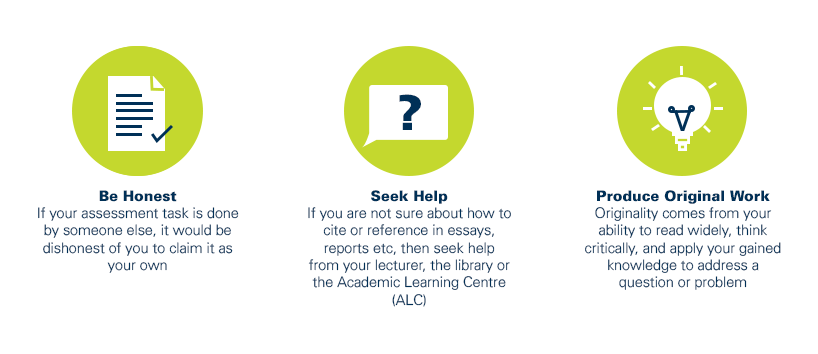
As a CQUniversity student you are expected to act honestly in all aspects of your academic work.
Any assessable work undertaken or submitted for review or assessment must be your own work. Assessable work is any type of work you do to meet the assessment requirements in the unit, including draft work submitted for review and feedback and final work to be assessed.
When you use the ideas, words or data of others in your assessment, you must thoroughly and clearly acknowledge the source of this information by using the correct referencing style for your unit. Using others’ work without proper acknowledgement may be considered a form of intellectual dishonesty.
Participating honestly, respectfully, responsibly, and fairly in your university study ensures the CQUniversity qualification you earn will be valued as a true indication of your individual academic achievement and will continue to receive the respect and recognition it deserves.
As a student, you are responsible for reading and following CQUniversity’s policies, including the Student Academic Integrity Policy and Procedure. This policy sets out CQUniversity’s expectations of you to act with integrity, examples of academic integrity breaches to avoid, the processes used to address alleged breaches of academic integrity, and potential penalties.
What is a breach of academic integrity?
A breach of academic integrity includes but is not limited to plagiarism, self-plagiarism, collusion, cheating, contract cheating, and academic misconduct. The Student Academic Integrity Policy and Procedure defines what these terms mean and gives examples.
Why is academic integrity important?
A breach of academic integrity may result in one or more penalties, including suspension or even expulsion from the University. It can also have negative implications for student visas and future enrolment at CQUniversity or elsewhere. Students who engage in contract cheating also risk being blackmailed by contract cheating services.
Where can I get assistance?
For academic advice and guidance, the Academic Learning Centre (ALC) can support you in becoming confident in completing assessments with integrity and of high standard.
What can you do to act with integrity?