Overview
In this unit, you will explore, synthesise and apply the fundamentals of the scientific method. You will develop skills in scientific communication beyond reading and writing - through a series of seminars, lectures and self-guided tasks students will learn appropriate manipulation of mathematical and statistical data as well as data presentation. You will enhance your knowledge and understanding of a range of fundamental scientific concepts and consider issues relating to ethics, experimentation and professional practice. Finally, through conducting your own research activity, you will learn how to develop a research framework and apply critical thinking to solve complex problems.
Details
Pre-requisites or Co-requisites
There are no requisites for this unit.
Important note: Students enrolled in a subsequent unit who failed their pre-requisite unit, should drop the subsequent unit before the census date or within 10 working days of Fail grade notification. Students who do not drop the unit in this timeframe cannot later drop the unit without academic and financial liability. See details in the Assessment Policy and Procedure (Higher Education Coursework).
Offerings For Term 1 - 2026
Attendance Requirements
All on-campus students are expected to attend scheduled classes - in some units, these classes are identified as a mandatory (pass/fail) component and attendance is compulsory. International students, on a student visa, must maintain a full time study load and meet both attendance and academic progress requirements in each study period (satisfactory attendance for International students is defined as maintaining at least an 80% attendance record).
Recommended Student Time Commitment
Each 6-credit Undergraduate unit at CQUniversity requires an overall time commitment of an average of 12.5 hours of study per week, making a total of 150 hours for the unit.
Class Timetable
Assessment Overview
Assessment Grading
This is a graded unit: your overall grade will be calculated from the marks or grades for each assessment task, based on the relative weightings shown in the table above. You must obtain an overall mark for the unit of at least 50%, or an overall grade of 'pass' in order to pass the unit. If any 'pass/fail' tasks are shown in the table above they must also be completed successfully ('pass' grade). You must also meet any minimum mark requirements specified for a particular assessment task, as detailed in the 'assessment task' section (note that in some instances, the minimum mark for a task may be greater than 50%). Consult the University's Grades and Results Policy for more details of interim results and final grades.
All University policies are available on the CQUniversity Policy site.
You may wish to view these policies:
- Grades and Results Policy
- Assessment Policy and Procedure (Higher Education Coursework)
- Review of Grade Procedure
- Student Academic Integrity Policy and Procedure
- Academic Progression Policy and Procedure
- Student Refund and Credit Balance Policy and Procedure
- Complaints Policy and Procedure
- Information and Communications Technology Acceptable Use Policy and Procedure
This list is not an exhaustive list of all University policies. The full list of University policies are available on the CQUniversity Policy site.
Feedback, Recommendations and Responses
Every unit is reviewed for enhancement each year. At the most recent review, the following staff and student feedback items were identified and recommendations were made.
Feedback from Email, in-person
Some students suggested they would have preferred out-of-hours live contact opportunities, as the ones offered were during their working hours.
It was noted several times through term that students could request out-of-hours live Zoom meetings (some did). For the next offering, the recommendation is to make this option clearer to students.
Feedback from SUTE feedback
One student noted that the unit did not challenge them and they lost interest in it.
While this is unfortunate and not communicated until SUTE feedback arrived, it is recommended to maintain the academic level of the unit given the relatively bell-shaped grade distribution suggests the expectations are about right.
Feedback from Email, in-person
Two students appeared somewhat 'put off' that teaching staff would not read and correct drafts of their assessments.
The recommendation is to maintain the approach of not reading and correcting drafts as it would need to be offered to all students and add to an already onerous marking load. Instead, the use of exemplars showing HD, passing, and fail-quality assessments will be continued.
Feedback from SUTE feedback
Several students noted the conceptually linked nature of the assessments helped them gain a thorough understanding of the subject matter.
Maintain the current linked assessment structure for the 2026 offering.
- Explain and apply information and numerical literacy skills to communicate scientific knowledge and ideas clearly and coherently to a variety of audiences
- Formulate a research hypothesis and research questions that include relevant ethical considerations
- Conduct and manage a small research project using quantitative, qualitative or mixed methods research methodologies
- Analyse, interpret and explain scientific data, resulting in the production of a research report appropriate for an e-portfolio.
Alignment of Assessment Tasks to Learning Outcomes
| Assessment Tasks | Learning Outcomes | |||
|---|---|---|---|---|
| 1 | 2 | 3 | 4 | |
| 1 - Written Assessment - 15% | ||||
| 2 - Presentation - 35% | ||||
| 3 - Portfolio - 50% | ||||
Alignment of Graduate Attributes to Learning Outcomes
| Graduate Attributes | Learning Outcomes | |||
|---|---|---|---|---|
| 1 | 2 | 3 | 4 | |
| 1 - Communication | ||||
| 2 - Problem Solving | ||||
| 3 - Critical Thinking | ||||
| 4 - Information Literacy | ||||
| 5 - Team Work | ||||
| 6 - Information Technology Competence | ||||
| 7 - Cross Cultural Competence | ||||
| 8 - Ethical practice | ||||
| 9 - Social Innovation | ||||
| 10 - First Nations Knowledges | ||||
| 11 - Aboriginal and Torres Strait Islander Cultures | ||||
Alignment of Assessment Tasks to Graduate Attributes
| Assessment Tasks | Graduate Attributes | ||||||||||
|---|---|---|---|---|---|---|---|---|---|---|---|
| 1 | 2 | 3 | 4 | 5 | 6 | 7 | 8 | 9 | 10 | 11 | |
| 1 - Written Assessment - 15% | |||||||||||
| 2 - Presentation - 35% | |||||||||||
| 3 - Portfolio - 50% | |||||||||||
Textbooks
There are no required textbooks.
IT Resources
- CQUniversity Student Email
- Internet
- Unit Website (Moodle)
- Microsoft word AND excel or equivalent Mac or Open Source packages
- Citation management software such as EndNote or Zotero
- Zoom videoconferencing software. A Zoom account is available with your student credentials
All submissions for this unit must use the referencing style: Harvard (author-date)
For further information, see the Assessment Tasks.
a.irving@cqu.edu.au
a.anastasi@cqu.edu.au
Week 1
Begin Date: 09 Mar 2026Module/Topic
- Unit introduction
- Planning for assessments
- The scientific method
Chapter
See Moodle for readings and activities
Events and Submissions/Topic
Week 2
Begin Date: 16 Mar 2026Module/Topic
- Testing hypotheses
- Research methods
Chapter
See Moodle for readings and activities
Events and Submissions/Topic
Week 3
Begin Date: 23 Mar 2026Module/Topic
- Fundamentals of experimental design
Chapter
See Moodle for readings and activities
Events and Submissions/Topic
Week 4
Begin Date: 30 Mar 2026Module/Topic
- Research planning
- Writing your research proposal
Chapter
See Moodle for readings and activities
Events and Submissions/Topic
Week 5
Begin Date: 06 Apr 2026Module/Topic
- Research integrity, ethics, and risk assessment
Chapter
See Moodle for readings and activities
Events and Submissions/Topic
Week 6
Begin Date: 13 Apr 2026Module/Topic
- Talking about your science: Strategies for preparing a 3-minute speech
Chapter
See Moodle for readings and activities
Events and Submissions/Topic
Vacation Week
Begin Date: 20 Apr 2026Module/Topic
Chapter
Events and Submissions/Topic
Week 7
Begin Date: 27 Apr 2026Module/Topic
- Getting comfortable with variation
- Constructing useful graphs
Chapter
See Moodle for readings and activities
Events and Submissions/Topic
Week 8
Begin Date: 04 May 2026Module/Topic
- Fundamental probability theory
- Basic statistical analysis
Chapter
See Moodle for readings and activities
Events and Submissions/Topic
Week 9
Begin Date: 11 May 2026Module/Topic
- Writing about your science: Tips for your research report
Chapter
See Moodle for readings and activities
Events and Submissions/Topic
Week 10
Begin Date: 18 May 2026Module/Topic
- Reading journal articles
- Evaluating information from the internet
Chapter
See Moodle for readings and activities
Events and Submissions/Topic
Week 11
Begin Date: 25 May 2026Module/Topic
- Referencing your research report
Chapter
See Moodle for readings and activities
Events and Submissions/Topic
Week 12
Begin Date: 01 Jun 2026Module/Topic
- Finalising your research report
Chapter
See Moodle for readings and activities
Events and Submissions/Topic
Exam Week
Begin Date: 08 Jun 2026Module/Topic
Chapter
Events and Submissions/Topic
Vacation/Exam Week
Begin Date: 15 Jun 2026Module/Topic
Chapter
Events and Submissions/Topic
In addition to the lectures and theory presented in this unit, you are required to conceptualize, plan, conduct, and
summarise your own scientific research project. The teaching staff are here to help guide you along your way, providing
professional advice and feedback for you to consider. The assessment items are also conceptually linked, such that the
feedback you receive from your first assessment should help to inform and improve your second assessment, and
likewise for the second to third assessment. Your research project will be done off campus (usually at your place of
residence) according to your own schedule, as there is no residential school for this unit. As such, effective time
management will be important to complete your project on schedule and submit related assessment pieces of an acceptable
quality. Communication with the teaching staff is a critical part of this process, especially earlier in term when
formulating your project design. The unit's Moodle page will be the central resource for advice, updates, and other
important information throughout term
1 Written Assessment
Complete a research proposal detailing the research project you will complete during this unit. The research proposal is a document that outlines the reason/justification for your project (often by way of a short background section), presents your aims/objectives, hypotheses, and describes how you're going to do the experiment and collect the data. Examples will be discussed in class, with additional information, resources, and assessment instructions provided on the unit's Moodle site during term. Feedback from this assessment will be helpful for ensuring your practical experimental work is of a high quality. AI may be used as part of your preliminary literature and information search strategy, but must not be used to construct your proposal (i.e. the written proposal must be your own work).
Level of GenAI use allowed: Level 2: You may use Al for planning, idea development, and research. Your final submission should show how you have developed and refined these ideas.
Week 5 Friday (10 Apr 2026) 11:45 pm AEST
Please submit your work as a Word document via Moodle.
Vacation Week Friday (24 Apr 2026)
Your marked work with feedback will be returned to you through Moodle.
The proposal you submit for assessment will require you to provide:
- An overview and justification supporting your proposed project
- Aims/objectives and hypotheses of your research
- A description of the planned methodology and experimental design
- Considers ethics and assesses risk
- Template(s) for data collection
- Proposal length: 1000 words (+/- 10 %)
- Minimum of four (4) references (no web pages unless of the data repository type).
Additional details, including the marking structure, will be available on the unit's Moodle site during term.
- Explain and apply information and numerical literacy skills to communicate scientific knowledge and ideas clearly and coherently to a variety of audiences
- Communication
- Problem Solving
- Critical Thinking
- Information Literacy
- Information Technology Competence
- Ethical practice
2 Presentation
Prepare a three minute video providing an update on the status of your research project. This video presentation should be considered an update that would be provided to key industry stakeholders or funding partners. Typically, such an update includes a brief description/recap of the reason for the project, the aims/objectives/hypothesis, a summary of the methodology, and the presentation of any results or observations to date. Additional information, resources, and assessment instructions will be provided on the unit's Moodle site during term. AI may be used to help search for an identify additional research relevant to your project, but must not be used to script or deliver your presentation.
Level of GenAI use allowed: Level 2: You may use Al for planning, idea development, and research. Your final submission should show how you have developed and refined these ideas.
Week 9 Friday (15 May 2026) 11:45 pm AEST
Please submit your video recording via the Moodle site.
Week 11 Friday (29 May 2026)
Marks and feedback for your update video will be provided via the Moodle site.
The three minute video you submit for assessment will require you to provide:
- An explanation to the background on your research.
- Aims/objectives and hypotheses of your research.
- A brief description of your methodology and experimental design.
- An update on the status of the research.
- A brief summary of any results/observations available.
- Minimum of four (4) references (no web pages unless of the data repository type).
- Presenting your update strictly within the time limit specified (3 mins +/- 20 seconds)
Further detail, including the marking structure, will be provided on the Moodle site during term.
- Explain and apply information and numerical literacy skills to communicate scientific knowledge and ideas clearly and coherently to a variety of audiences
- Formulate a research hypothesis and research questions that include relevant ethical considerations
- Conduct and manage a small research project using quantitative, qualitative or mixed methods research methodologies
- Communication
- Problem Solving
- Critical Thinking
- Information Literacy
- Information Technology Competence
- Ethical practice
3 Portfolio
This final assessment task requires you to complete a written report summarising your research project. Your research report format is to be based on a typical scientific paper or report (to be discussed in lecture), and must include an introduction/background section (including your hypothesis), a description of the methods used, a results section that
describes, presents, and analyses your data, and a summary discussion that describes what the results mean and what contribution to knowledge they make.
Additional information, resources, and assessment instructions will be provided on the unit's Moodle site during term. AI may be used as part of your literature and information search strategy, but must not be used to construct your research report (i.e. the written report must be your own work).
Level of GenAI use allowed: Level 2: You may use Al for planning, idea development, and research. Your final submission should show how you have developed and refined these ideas.
Week 12 Friday (5 June 2026) 11:45 pm AEST
Please submit your report as a Word document through the Moodle page.
Vacation/Exam Week Friday (19 June 2026)
Your marked report with feedback will be returned to you through the Moodle page.
The report you submit for assessment will require you to provide:
- A literature review and background description of the rationale for doing the research project, including the hypothesis(es).
- A description of the methodology used.
- An analysis, interpretation and explanation of results obtained.
- A summary discussion of the results obtained, placed in the context of current literature.
- Expectation of 2500 words (+/- 10 %).
- Minimum of eight (8) references (no web pages unless of the data repository type).
Further detail, including the marking structure, will be provided on the unit's Moodle site during term.
- Explain and apply information and numerical literacy skills to communicate scientific knowledge and ideas clearly and coherently to a variety of audiences
- Formulate a research hypothesis and research questions that include relevant ethical considerations
- Conduct and manage a small research project using quantitative, qualitative or mixed methods research methodologies
- Analyse, interpret and explain scientific data, resulting in the production of a research report appropriate for an e-portfolio.
- Communication
- Problem Solving
- Critical Thinking
- Information Literacy
- Information Technology Competence
- Ethical practice
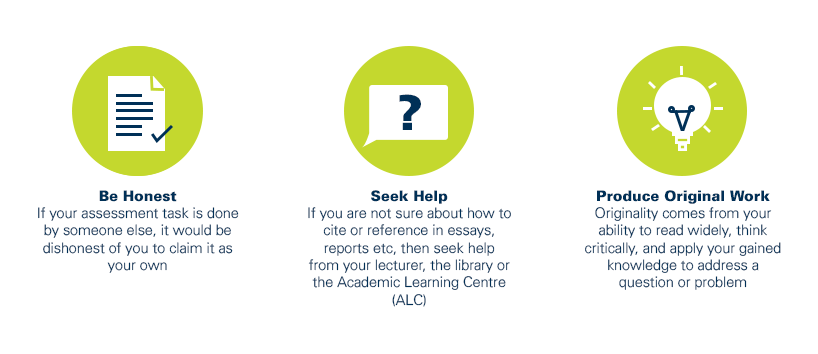
As a CQUniversity student you are expected to act honestly in all aspects of your academic work.
Any assessable work undertaken or submitted for review or assessment must be your own work. Assessable work is any type of work you do to meet the assessment requirements in the unit, including draft work submitted for review and feedback and final work to be assessed.
When you use the ideas, words or data of others in your assessment, you must thoroughly and clearly acknowledge the source of this information by using the correct referencing style for your unit. Using others’ work without proper acknowledgement may be considered a form of intellectual dishonesty.
Participating honestly, respectfully, responsibly, and fairly in your university study ensures the CQUniversity qualification you earn will be valued as a true indication of your individual academic achievement and will continue to receive the respect and recognition it deserves.
As a student, you are responsible for reading and following CQUniversity’s policies, including the Student Academic Integrity Policy and Procedure. This policy sets out CQUniversity’s expectations of you to act with integrity, examples of academic integrity breaches to avoid, the processes used to address alleged breaches of academic integrity, and potential penalties.
What is a breach of academic integrity?
A breach of academic integrity includes but is not limited to plagiarism, self-plagiarism, collusion, cheating, contract cheating, and academic misconduct. The Student Academic Integrity Policy and Procedure defines what these terms mean and gives examples.
Why is academic integrity important?
A breach of academic integrity may result in one or more penalties, including suspension or even expulsion from the University. It can also have negative implications for student visas and future enrolment at CQUniversity or elsewhere. Students who engage in contract cheating also risk being blackmailed by contract cheating services.
Where can I get assistance?
For academic advice and guidance, the Academic Learning Centre (ALC) can support you in becoming confident in completing assessments with integrity and of high standard.
What can you do to act with integrity?